
Sponsored

Lightning ER vs Hummer 2X, HorsePower and Torque stats

Lightning Rod

Well-known member
Joined
Nov 27, 2022
Threads
39
Messages
892
Reaction score
722
Location
North Coast
Vehicles
2023 Ford Lightning Lariat ER
Occupation
CNC PROGRAMMER/MACHINIST
A coworker if mine just bought a Hummer 2X. Looks really nice but I didn't have a chance to speak with him yet, so I did some research. My 2023 Lariat ER has 580 HP compared to his 570 HP, yet, take a look at these torque specs. Is this a typo? Google AI came up with this passage about the torque difference...

"When comparing torque between a 2023 Ford F-150 Lightning with the extended range battery and a GMC Hummer EV 2X, the Hummer has significantly more torque, with the Lightning producing 775 lb-ft of torque while the Hummer 2X delivers 7,400 lb-ft of torque; making the Hummer significantly more powerful in terms of torque despite having less horsepower overall."

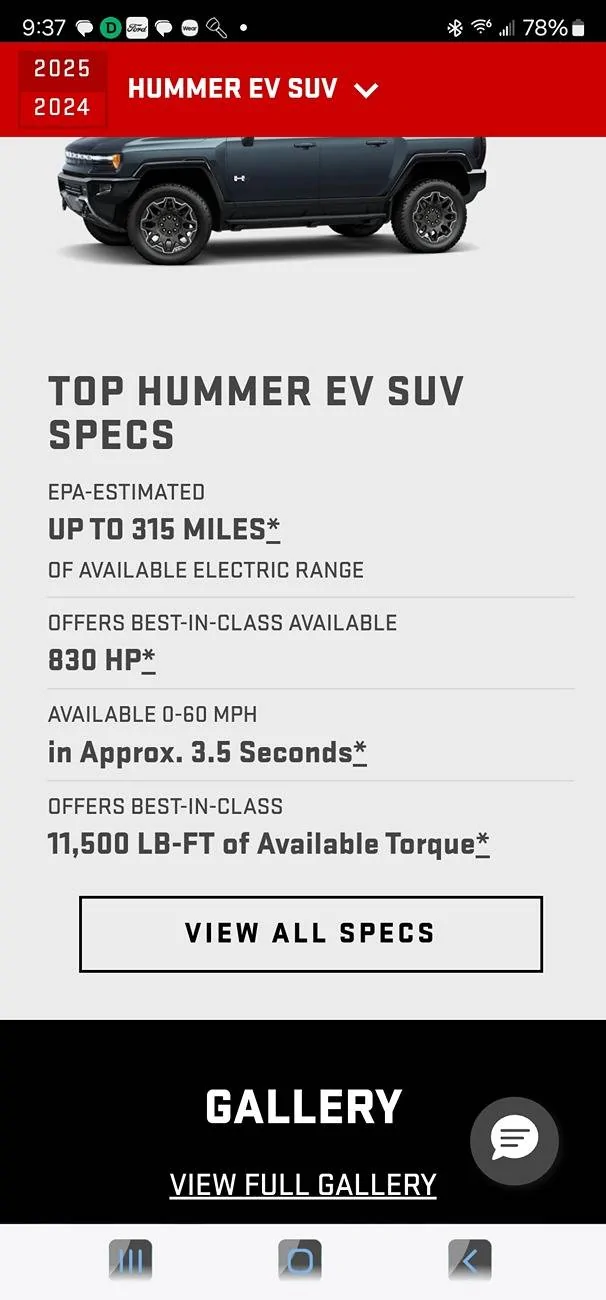
7,400 lb-ft of torque? That just doesn't sound right. This is the lower HP hummer. The 3 motor version produces 830 HP!! Can this be a real torque spec?
Sponsored
 

Heliian

Well-known member
Joined
Mar 9, 2023
Threads
4
Messages
1,779
Reaction score
2,028
Location
Canada
Vehicles
2023 LR Lariat, code name "Boogaloo"
Google AI came up with this passage about the torque difference...
The lightning has over 7500 ft lbs of torque.

These numbers are achieved by taking the motor torque and multiplying by the gear ratio of the drive.

Misleading, yes, big numbers gooder.
 

TaxmanHog

Moderator
Moderator
First Name
Noel
Joined
Jan 19, 2022
Threads
211
Messages
15,568
Reaction score
17,392
Location
SE. Mass.
Vehicles
2022 Lightning Lariat-ER & 2024 HD Road Glide CVO-ST
Occupation
Retired
Sounds like Ai is off by a factor or 10 for the Hummer Tq.
 
OP
OP
Lightning Rod

Lightning Rod

Well-known member
Joined
Nov 27, 2022
Threads
39
Messages
892
Reaction score
722
Location
North Coast
Vehicles
2023 Ford Lightning Lariat ER
Occupation
CNC PROGRAMMER/MACHINIST
Sounds like Ai is off by a factor or 10 for the Hummer Tq.

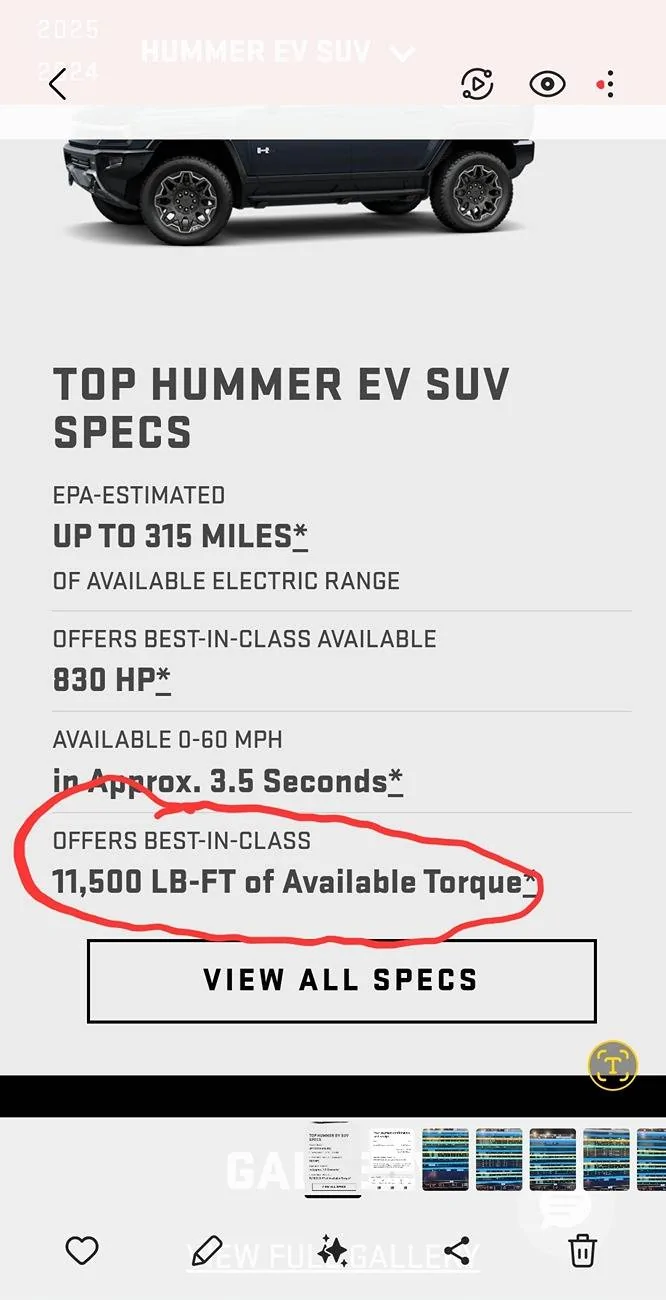
That's what I thought, but going to Hummer site, they tout the same torque spec figures. It just doesn't make sense.... that's why I started this thread, to see what you guys think about these claims.


Ford F-150 Lightning Lightning ER vs Hummer 2X, HorsePower and Torque stats Screenshot_20250103_094330_Gallery
Ford F-150 Lightning Lightning ER vs Hummer 2X, HorsePower and Torque stats Screenshot_20250103_093756_Dolphin
 

ZeusDriver

Active member
Joined
Dec 1, 2025
Threads
1
Messages
26
Reaction score
12
Location
East Coast, USA
Vehicles
2022 Lightning
These "at the drive wheels" torque claims began with the Tesla Cybertruck, I believe. Then Hummer did the same slight of hand (or fraud, depending upon your perspective) afterwards.

The torque quoted for an automotive prime mover has been at the flywheel for about a century. Tesla wanted a more impressive figure than the other trucks, (despite having less torque at the motor shafts than the Ford and Chevy). So they quoted drive wheel torque, without making it clear that that is what they were doing. Sleezy. Some of the auto mags just naively repeated the figures, making it seem, to some gullible readers, that the Tesla actually had stunningly high torque. Most diesel 4WD pickups have more drive wheel torque than the Tesla, (or the Hummer) by a pretty wide margin. Even a fairly small John Deere tractor has more drive wheel torque than the Tesla, because of the huge total gear reduction.

Some sycophantic automotive journalists wrote wobbly words about the Tesla claim without calling it out for the fraud that it was (is).

Granted, having a single speed and a large total reduction (about 9.7:1 for the Ford and 15: 1 for the Cybertruck) means that the torque curve at the drive wheels is different than it is for a typical ICE with a ten-speed gearbox. However, the natural great low speed torque and diminishing high speed torque of an electric motor ends up being similar to the diminishing drive wheel torque that occurs as a ICE truck shifts up through the gears (going, in very rough terms from about 16:1 in first to 3.5:1 in the highest gear). As it turns out, just knowing the HP figure and weight is sufficient for predicting performance, and a 500 HP ICE truck performs about as well as a 500 HP electric truck: they are both crazy fast.

Most customers and many hot-rodders don't understand the way in which torque and rpm interact to produce horsepower... so we still have arguments about what you "Need" for a good 1/4 mile time. "Ya need torque for acceleration, and HP for top speed." That's BS. Torque does not imply any acceleration at all: How fast does a bolt that has been torqued to 100 lb ft accelerate when you apply 90 lb ft via a torque wrench?
 

Sponsored

ZeusDriver

Active member
Joined
Dec 1, 2025
Threads
1
Messages
26
Reaction score
12
Location
East Coast, USA
Vehicles
2022 Lightning
HA HA! I may be putting nails in the coffin, but in many forums, these discussions are still active, because people don't understand how torque has been measured, historically, and those people can be confused -- as evidenced by Lightning Rod's confusion. Also, AI has developed to the point that it is correct about half the time, so people are tending to believe it. That sows more confusion.

It appeared that Lightning Rod still had some confusion, as of his last post... thus my post to clarify where these numbers came from -- it is not a problem with AI. It is a problem with manufacturers coming up with bogus figures.
 

Firn

Well-known member
Joined
Aug 26, 2024
Threads
28
Messages
1,396
Reaction score
1,494
Location
USA
Vehicles
23 Pro ER
These "at the drive wheels" torque claims began with the Tesla Cybertruck, I believe. Then Hummer did the same slight of hand (or fraud, depending upon your perspective) afterwards.

The torque quoted for an automotive prime mover has been at the flywheel for about a century. Tesla wanted a more impressive figure than the other trucks, (despite having less torque at the motor shafts than the Ford and Chevy). So they quoted drive wheel torque, without making it clear that that is what they were doing. Sleezy. Some of the auto mags just naively repeated the figures, making it seem, to some gullible readers, that the Tesla actually had stunningly high torque. Most diesel 4WD pickups have more drive wheel torque than the Tesla, (or the Hummer) by a pretty wide margin. Even a fairly small John Deere tractor has more drive wheel torque than the Tesla, because of the huge total gear reduction.

Some sycophantic automotive journalists wrote wobbly words about the Tesla claim without calling it out for the fraud that it was (is).

Granted, having a single speed and a large total reduction (about 9.7:1 for the Ford and 15: 1 for the Cybertruck) means that the torque curve at the drive wheels is different than it is for a typical ICE with a ten-speed gearbox. However, the natural great low speed torque and diminishing high speed torque of an electric motor ends up being similar to the diminishing drive wheel torque that occurs as a ICE truck shifts up through the gears (going, in very rough terms from about 16:1 in first to 3.5:1 in the highest gear). As it turns out, just knowing the HP figure and weight is sufficient for predicting performance, and a 500 HP ICE truck performs about as well as a 500 HP electric truck: they are both crazy fast.

Most customers and many hot-rodders don't understand the way in which torque and rpm interact to produce horsepower... so we still have arguments about what you "Need" for a good 1/4 mile time. "Ya need torque for acceleration, and HP for top speed." That's BS. Torque does not imply any acceleration at all: How fast does a bolt that has been torqued to 100 lb ft accelerate when you apply 90 lb ft via a torque wrench?
Except that torque at the wheels IS what matters. THAT is the number that determines how well the vehicle will move.

ICE manufactures use Torque at the flywheel because it gives a higher number than one after drivetrain losses (and they have multispeed gesrboxes so at the wheel is convoluted). They dont use it because it's somehow a superior method.

I also disagree that "500hp" is "500hp" because if you do know how HP is calculated then you know the HP is just the torque, and a big wide flat torque curve is MUCH more powerful than one with a sharp peak and some high number. This is why diesels with 300hp can pull 15,000lbs, but a gas truck with 500hp won't do so as well. Bottom line a big wide flat torque curve is going to KILL one with a sharp peak, even though the HP numbers are the same.
 

LightningDan

Member
First Name
Daniel
Joined
Aug 18, 2025
Threads
0
Messages
16
Reaction score
38
Vehicles
2023 F-150 Lighting Pro ER
Occupation
Solar Designer Engineer
Its 500hp, but if ran through locking diffs and axles, it mutliplies the torque by a huge amount. Pretty sure a TRD in low-end 4wd with all diffs locked is like 30k lbs./ft.
Same as a bigger truck or tank uses a 300hp cummins and managed to move hundreds of thousands of pounds. Its the gearing, axles, difs.
 

ZeusDriver

Active member
Joined
Dec 1, 2025
Threads
1
Messages
26
Reaction score
12
Location
East Coast, USA
Vehicles
2022 Lightning
Except that torque at the wheels IS what matters. THAT is the number that determines how well the vehicle will move.

It does not matter for usual performance measures, most notable 0-60 times. My Lightning is takes about 1/3 as long to get to 60 as did my 1990 4.9 F150 4WD, despite having much lower drive wheel torque.

ICE manufactures use Torque at the flywheel because it gives a higher number than one after drivetrain losses (and they have multispeed gearboxes so at the wheel is convoluted). They dont use it because it's somehow a superior method.

No that's not it at all. All US manufacturers use the guidance of SAE. To be fair from one manufacturer to another and to use the same standards that are used throughout industry for spec'ing prime movers, (ICE and electric and turboshaft, etc). Spec'cing after the gearing is meaningless, and would make engineering any engine or electric-powered device incredibly frustrating.

I also disagree that "500hp" is "500hp" because if you do know how HP is calculated then you know the HP is just the torque, and a big wide flat torque curve is MUCH more powerful than one with a sharp peak and some high number. This is why diesels with 300hp can pull 15,000lbs, but a gas truck with 500hp won't do so as well. Bottom line a big wide flat torque curve is going to KILL one with a sharp peak, even though the HP numbers are the same.

No, the HP is not "just the torque." HP is torque x Rpm /5252. always and forever. An electric motor producing its maximum stall torque, of say 500 lb ft is producing 0 HP and doing no useful work. If that motor can still produce 500 lb ft at 5252 rpm, then it is producing 500 hp, and can do useful work, at the rate of 500 x 33000 ft lb / minute. (I'm using the convention of lb ft to be torque, and ft lb to be work. )
You seem somewhat knowledgeable, but nothing you say makes sense in the context of my post, which has to do with people in general (including about 30% of SAE members) misinterpretting the effects of torque (which does not require motion) and HP, which does require motion. What I am saying in my post is that 1: torque specs for trucks have always been taken at the engine flywheel (or extrapolated to there if a chassis dyno is used) (They are also taken at the motor for Lightnings and EV Silverados. -- as they should be, if you are not trying to deceive the customer.) 2. That the most common measure of "performance or "power" in vehicles is 0-60 time -- its something that even the math-illiterate seem able to grasp, and even something that little old ladies who only drive on Sundays can grasp -- Wow! this car is really zippy! I can get to 60 in 4 seconds??!!! , etc. 3. That 0-60 times can be sufficiently accurately calculated from HP figures (and weight) to be able to say Wow, this car is quick... vs meh, vs yuck. 4. That it is borderline fraud to claim ("awesome" "incredible" ) torque values by comparing those drive wheel figures to the engine or motor figures that have been used historically for every vehicle ... other than the Tesla, and then the Hummer. Doing so preys on peoples' ignorance and inability to do math. (My 1990 F150 4.9 six with 4WD produced 10275 lb at the drive wheels -- a figure much higher than my Lightning produces. If I implied as Tesla has, that that figure is "awesome" etc, I would consider myself a fraud. Coincidently, the Tesla figure quoted was around 10,250lb ft. WOW!!! All the torque of a 35-year-old 6 cylinder Ford!)

(My 1990 F150 produced 15,000 Volts!! My lightning system is only 400 volts. Both those statements are true, but incredibly misleading. Elon musk has some education in Physics, as I recall, so his rigging the figures cannot be chalked up to simple ignorance. He knows he is intentionally being deceptive. Morons and 5th graders can be forgiven for misunderstanding, but Musk can do the math.... and did the math to make appear that the Cybertruck had unusually high "torque" which it does not. My plain jane Lighting has more, if measured fairy and honestly.)
My Lightning is incredibly fast as compared to my 1990 4.9. The 1990 was a slug -- 0-60 in 13 seconds. The Lighting is far quicker (Well into hot rod territory for 1990) but produces less torque at the drive wheels. This online calculator correctly predicts performance for both. https://www.omnicalculator.com/everyday-life/0-60
The separate figure for peak torque is not required, and it makes no sense to include it, given that torque is already a component of HP.

Nowadays, with ten speed automatics, all road going engines operate, in the vehicle, as (essentially) constant HP devices (when floored). The same is often loosely said regarding AC Induction motors, and is approximately true for some of the numerous other types of electric motors used in road cars. and trucks*. "Peakiness" (in the sense that a 250 cc motorcycle GP bike is "peaky"... the reason 50cc Kreidler GP bikes had 12 speed boxes.) no longer comes into play in cars and light trucks. So the various online HP-to weight-based calculators that predict a 0-60 time are surprisingly accurate, and none of those ask for a torque figure -- it is superfluous. (In the old days of "three on the tree" transmissions, where engines would fall well off the HP peak at shifts, the nature of the transmission mattered for calculating a 0-60 time. ) If you put in the figures for a 720 HP Raptor and then a Lightning, you will find that this online calculator gives you surprisingly close figures in both cases. As expected, the Raptor is quicker, given its higher HP, and despite its slightly lower torque.

*In other words, They create very large torque figures at very low speed, and very low torque figures at high speeds. The first Teslas had two speed transmissions, because this characterization is not completely accurate. My own Zing used a torque converter after the electric motor (PMDC) because the relationship is hardly true at all for PMDC motors.
 

Sponsored

ZeusDriver

Active member
Joined
Dec 1, 2025
Threads
1
Messages
26
Reaction score
12
Location
East Coast, USA
Vehicles
2022 Lightning
I googled, thinking that AI might have a more balanced take on this than I do. But no, AI thinks it is misleading too.

>>

Tesla was the first to start advertising the misleading (without context) drive wheel torque figure instead of the traditionally used engine (or motor) torque.
This practice gained attention when Elon Musk claimed the new Tesla Roadster would have "10,000 Nm of torque" (over 7,000 lb-ft). This number was specifically for wheel torque, a much higher figure achieved after gear multiplication, not the motor's direct output.
GMC then followed Tesla's lead with the electric Hummer EV, advertising an 11,500 lb-ft torque figure, which was also a wheel torque measurement, not motor torque.
Traditionally, car manufacturers quote engine or motor torque at the crankshaft/output shaft, before it is multiplied by the transmission and final drive gear ratios. This allows for a consistent, industry-standard comparison between different vehicles. <<
 

Firn

Well-known member
Joined
Aug 26, 2024
Threads
28
Messages
1,396
Reaction score
1,494
Location
USA
Vehicles
23 Pro ER
You seem somewhat knowledgeable, but nothing you say makes sense in the context of my post, which has to do with people in general (including about 30% of SAE members) misinterpretting the effects of torque (which does not require motion) and HP, which does require motion. What I am saying in my post is that 1: torque specs for trucks have always been taken at the engine flywheel (or extrapolated to there if a chassis dyno is used) (They are also taken at the motor for Lightnings and EV Silverados. -- as they should be, if you are not trying to deceive the customer.) 2. That the most common measure of "performance or "power" in vehicles is 0-60 time -- its something that even the math-illiterate seem able to grasp, and even something that little old ladies who only drive on Sundays can grasp -- Wow! this car is really zippy! I can get to 60 in 4 seconds??!!! , etc. 3. That 0-60 times can be sufficiently accurately calculated from HP figures (and weight) to be able to say Wow, this car is quick... vs meh, vs yuck. 4. That it is borderline fraud to claim ("awesome" "incredible" ) torque values by comparing those drive wheel figures to the engine or motor figures that have been used historically for every vehicle ... other than the Tesla, and then the Hummer. Doing so preys on peoples' ignorance and inability to do math. (My 1990 F150 4.9 six with 4WD produced 10275 lb at the drive wheels -- a figure much higher than my Lightning produces. If I implied as Tesla has, that that figure is "awesome" etc, I would consider myself a fraud. Coincidently, the Tesla figure quoted was around 10,250lb ft. WOW!!! All the torque of a 35-year-old 6 cylinder Ford!)

(My 1990 F150 produced 15,000 Volts!! My lightning system is only 400 volts. Both those statements are true, but incredibly misleading. Elon musk has some education in Physics, as I recall, so his rigging the figures cannot be chalked up to simple ignorance. He knows he is intentionally being deceptive. Morons and 5th graders can be forgiven for misunderstanding, but Musk can do the math.... and did the math to make appear that the Cybertruck had unusually high "torque" which it does not. My plain jane Lighting has more, if measured fairy and honestly.)
My Lightning is incredibly fast as compared to my 1990 4.9. The 1990 was a slug -- 0-60 in 13 seconds. The Lighting is far quicker (Well into hot rod territory for 1990) but produces less torque at the drive wheels. This online calculator correctly predicts performance for both. https://www.omnicalculator.com/everyday-life/0-60
The separate figure for peak torque is not required, and it makes no sense to include it, given that torque is already a component of HP.

Nowadays, with ten speed automatics, all road going engines operate, in the vehicle, as (essentially) constant HP devices (when floored). The same is often loosely said regarding AC Induction motors, and is approximately true for some of the numerous other types of electric motors used in road cars. and trucks*. "Peakiness" (in the sense that a 250 cc motorcycle GP bike is "peaky"... the reason 50cc Kreidler GP bikes had 12 speed boxes.) no longer comes into play in cars and light trucks. So the various online HP-to weight-based calculators that predict a 0-60 time are surprisingly accurate, and none of those ask for a torque figure -- it is superfluous. (In the old days of "three on the tree" transmissions, where engines would fall well off the HP peak at shifts, the nature of the transmission mattered for calculating a 0-60 time. ) If you put in the figures for a 720 HP Raptor and then a Lightning, you will find that this online calculator gives you surprisingly close figures in both cases. As expected, the Raptor is quicker, given its higher HP, and despite its slightly lower torque.

*In other words, They create very large torque figures at very low speed, and very low torque figures at high speeds. The first Teslas had two speed transmissions, because this characterization is not completely accurate. My own Zing used a torque converter after the electric motor (PMDC) because the relationship is hardly true at all for PMDC motors.
Because thats the way it has been done does not mean that is the best way to do it.

The reason torque applied to the wheel is actually a very good way to do it is because that IS what the vehicle is going to experience, not the torque at the flywheel. The torque value at the wheel directly indicates the acceleration the vehicle will experience. It takes all the other variables out. You can have high torque at the flywheel, and yet have low torque at the wheel and thus low acceleration, or for those that tow a limited ability to move weight. The torque at the flywheel does not represent what the user will experience.

Torque is not a component of HP, HP is a component of torque. You get HP from torque, not the other way around.

You say we dont need a separate peak torque figure however the torque value that is ever given IS the peak torque. And I can assure you with driving a variety of different engines how peaky the torque curve is makes a BIG difference in how a vehicle drives. My 4.3 v6 was a completely different vehicle to drive than my Tacoma. Wringing a 3.5l v6 to 7000rpm to get it to move quickly is a dramatically different experiance than the big block style power delivery of the old Chevy 4.3s.

0-60 times are only a limited aspect of how a vehicle is used, nor is an online calculator a good sense of the drivability. You mention the Raptor, but that same Raptor would be much different with some 2.50 gears in the rear end, even though it has the same torque and hp values at the flywheel. Thats the point.

AI responds to the way you ask the question. It will ruin most people through confirmation bias. Here is its response when I asked it the question.

Wheel torque is a better representation than flywheel torque because it reflects the actual twisting force that reaches the ground after gear ratios, drivetrain losses, and tire radius are applied. Flywheel torque is just the engine’s raw output, measured before all the reductions and inefficiencies. Wheel torque shows what the vehicle can really put down, making it a far more accurate indicator of real-world acceleration and performance.
 

RickLightning

Well-known member
Joined
Jan 17, 2022
Threads
100
Messages
6,401
Reaction score
8,647
Location
SE MI
Vehicles
'22 Lightning ER Lariat,'22 Mach-E Premium 4X
AI responds to the way you ask the question. It will ruin most people through confirmation bias.
90% of the population doesn't understand what confirmation bias is. I asked them and they confirmed it.

AI is dangerous. It will dumb down society even more. We have a friend who is an Engineering professor, teaches courses that are the cornerstone for a specific engineering profession. Students constantly hand in AI-generated assignments, with zero thought of their own. She fails them. Recently, she told of a student that kept arguing "AI said". She said "I have taught you 5 principles this semester, and the assignment is to show how those 5 principles get you to the answer, not just provide the answer". Student's response "but AI said". They were still failing last we heard.

Stupid, full of shit, f'in nuts?


ZeusDriver

Active member
Joined
Dec 1, 2025
Threads
1
Messages
26
Reaction score
12
Location
East Coast, USA
Vehicles
2022 Lightning
Wheel torque is a better representation than flywheel torque because it reflects the actual twisting force that reaches the ground after gear ratios, drivetrain losses, and tire radius are applied. Flywheel torque is just the engine’s raw output, measured before all the reductions and inefficiencies. Wheel torque shows what the vehicle can really put down, making it a far more accurate indicator of real-world acceleration and performance.
I gather you did not read anything I wrote, but here is a key point: My 1990 F150 4WD 4.9 (known for its "torquiness* produced 10275 lb ft at the drive wheels. That is substantially more than my Lightning's 7400 lb ft. The 1990 was an absolute slug by today's standards and pretty slow by 1990 standards too. So no. Maximum torque at the drive wheels is not a predictor of performance on the road. The Lightning is way faster: 4 seconds vs 13 seconds. 0-60. (Even a Prius Prime is quicker that a SS 396 Camaro from the old days.)

Try out the simple calculator I linked: using only HP, it gives very close figures for a 720 HP Raptor (peaky, in your view) the Lightning Pro (Max torque peak at 0 speed, and falling torque linearly with speed) a turbocharged 2000 S60 Volvo (perfectly flat torque curve through the usable rpm range, under electronic boost control), a normally aspirated 2000 BMW 330i (directly competitive with the Volvo, but with a traditional average torque curve.) Compare the numbers to real world, and you find they are remarkable close. (I mentioned the Volvo and BMW because I did new product launch training in which we would try to make one seem "better" than other... but they had two very different engines, both aimed at precisely the same market.)

Again, one hp is 33,000 ft lb per minute (meaning 550 ft per second). It is a measure of the rate of work done. If the prime mover rotates (not a requirement... horses do not have engines) then imagining a one foot radius pulley on the crankshaft (and knowing the rpm at the instant under consideration) allows you to determine the possible rate of work... the HP. Torque is only a force. It alone can tell you nothing about the rate of work (such as rate of acceleration of a weight, the top speed of a vehicle, the rate of ascending a hill when towing a trailer, etc.) My 1990 F 150, despite its "awesome" torque measured at the drive wheels, was an absolute dog by today's standards, bad for towing 10,000 lb, bad for accelerating even when empty. I loved it, and it towed my 6000 boat very well -- but not fast up hill. Great truck, but the opposite of fast. It was a 135 hp truck that performed like a 135 hp truck. It could not blow the doors off an SS 396 Camaro, as you would claim.

The people at SAE are not idiots. There is value in using standard measures for every aspect of vehicle performance, even if you cannot see that __ they have been at it a log time. You have not. By your new standard, my 1990 F150 should blow the doors off a Lightning, a SS 396 Camaro, a Tesla Roadster, a Tesla Cybertruck. It has more drive wheel torque than any of those, but is a stunning dog by comparison to any of them. Do you know how slow a 13 second 0-60 time is? A mid range John Deere is even torquier at the drive wheels than my "awesome" 1990 F150. My 1/4 HP lathe produces more torque at the chuck than many motorcycles do at their engines, but its 0-60 time is hours... just getting it into the back of my truck for its trip to 60 mph takes an hour.

When I was designing a PHEV microcar a couple decades ago, and wanting to know what HP was required for an acceptable 0-60 time (11 seconds was OK with me ) I set up a spread sheet, so that I could look at individual half-second increments of that time to 60. At each increment, the power available for acceleration was the excess over that required to overcome internal friction, tire rolling resistance, and aerodynamic resistance at that instant (This last one was the thing that determined top speed: when the aero drag sucked up all the excess power, the car can go no faster.) For adequate performance and with a reasonably priced DC motor, the only way to achieve adequate acceleration was by using a torque converter (or a three speed transmission would have worked... but more expensively and not as well.) At each instant, the torque at the motor, times the total gear reduction provided a rear wheel torque. Conveniently, the tire radius was 12 inches, so tractive force was the same number as the torque number (in my units). That figure was seemingly impressive at low speeds, but like any other vehicle, was much less impressive as the vehicle accelerated because the gear ratio became less advantageous-- just as it does in shifting up through any gearbox. HP was nearly constant through the entire run, for this reason.

Of course, as the vehicle accelerated, the fall off in torque from gearing was compounded by the fall off in torque at the motor: every electric motor has a torque curve, and some electric motors have torque curves that are not all that much different than ICE torque curves. The simplest solution (for having nearly constant HP) is a motor that can use single speed reductions- like all but a couple production cars use. (At the time of my microcar project, such motors were too heavy and far too expensive).

The people at MIT tend to be pretty good with engineering, and this article explains the nature of dc electric motor torque and power curves.
http://lancet.mit.edu/motors/motors3.html

But the simpler way to calculate a 0-60 time is via a calculator like the one I linked. For any production vehicle from the last 20 years, it comes up with a very close figure, because the determinant is, and always has been, HP-to-weight ratio. (Pick up a copy of the Bosch Automotive Handbook, if you doubt that. ) In this calculator, fudge factors are added for a likely CD and frontal area and the effectiveness of different transmissions to provide near-constant HP. Many decades ago, Chrysler 426 hemi powered cars were among the first to demonstrate that automatics could out accelerate manual transmission cars, because they were better at keeping the engine at its HP peak (not its torque peak, incidentally).

Since that time, as transmission have gone to ten speeds, the engine remains very close to its HP peak throughout virtually the entire run, usually only dropping down to near the torque peak briefly after each shift.

So do this: 1. Try out the calculator with cars mentioned above. You will find it quite accurate. 2. Then write up a spread sheet using only drive wheel torque (as quoted above for the Hummer and Tesla... and throw in the 7700 lb ft quoted for the Roadster, too. ) that shows how drive wheel torque alone can predict either 0-60 times or 1/4 mile times.... or top speed.

I await your calculations.

Also, find a friend with a truck with low range. Have a 0-60 run against then -- you in your Lightning, them in low range and first gear, in which they have far more drive wheel torque than you do. Report the results of the 0-60 run for both of you.

Try racing a Cat D9, which has far more drive "wheel" torque than even your friends pickup. See how it does on a 0-60 run. Per your measure, it should be far far faster than the Hummer's 3.25 seconds.
 

ZeusDriver

Active member
Joined
Dec 1, 2025
Threads
1
Messages
26
Reaction score
12
Location
East Coast, USA
Vehicles
2022 Lightning
90% of the population doesn't understand what confirmation bias is. I asked them and they confirmed it.

AI is dangerous. It will dumb down society even more. We have a friend who is an Engineering professor, teaches courses that are the cornerstone for a specific engineering profession. Students constantly hand in AI-generated assignments, with zero thought of their own. She fails them. Recently, she told of a student that kept arguing "AI said". She said "I have taught you 5 principles this semester, and the assignment is to show how those 5 principles get you to the answer, not just provide the answer". Student's response "but AI said". They were still failing last we heard.

Stupid, full of shit, f'in nuts?

Back in the mid 1980's I worked with AI. In one project, a group of 3 factory techs spent a full shift (24 man hours + many many $thousands in lost production. ) They had never fired up the expert system that I'd developed. The department manager came in , used the system and had the machine up and running in 15 minutes.

But I agree with everything you've said. I find it all pretty troubling, from many different perspectives. I don't like the idea of putting people out of work -- the techs who would not use the system probably did not want to be replaced by a machine. But I especially don't like the tendency of people to believe garbage, etc etc etc. I occasionally contribute to a boat design forum, and have been shocked at how often the forum is cited by AI as being a valid source, when it is not. It is just like any other forum -- most of what is written is bullshit.

But sometimes it gets something right, and especially somewhat esoteric stuff, such as calculating the required size of a foil for lifting a boat out of the water, with a certain amount of nuance presented. For fun, I have argued with Google AI about things like what constitutes a war crime, and the replies can be nearly those of a calm political scientist. So it seems about right just enough to make a person not realize how stupid it is. My Tesla showed be how stupid AI is almost every single day.
Sponsored


Top