

Sponsored

lazjen

Well-known member
First Name
Chris
Joined
May 8, 2024
Threads
6
Messages
48
Reaction score
162
Location
Sunshine Coast, QLD, Australia
Vehicles
F150 Lightning XLT ER 2023
Do you have solar still connected to your PW3? If so does it have a mode where it can charge only from solar and then only export the saved power. With that you could essentially turn it into a solar inverter from the Sigenergy point of view.
No. I did have solar connected to the PW3, but during this install, all strings got connected to the Sigenergy system. Another regulation we have to deal with here is to do with the size of our inverters. I think that had some influence on the change. Personally, I think I would have left the portion of the PW2 solar string alone and moved everything else, but I deferred to experts and I think these regulations (which might have been the key problem).
Sponsored


123XYZ

Well-known member
Joined
Sep 1, 2023
Threads
0
Messages
79
Reaction score
38
Location
SF Bay Area
Vehicles
2023 F-150 Lightning Pro
I remember watching the live reveal for the F150 lightning back in 2021 and thinking that is a cool truck. Maybe someday. Then the moment came where they showed the truck powering your house, and I was sold.
The Ford system that was released worked for me, but did not have the response or features that I really wanted...

Sigenergy has now come along, and their system with the V2X DC charger is the system that I had been hoping for. I have had their main components for almost a year now, but finally got the V2X module this past week. I will go through a detailed explanation of the system and its components below.

Load Hub:

Load Hub.webp

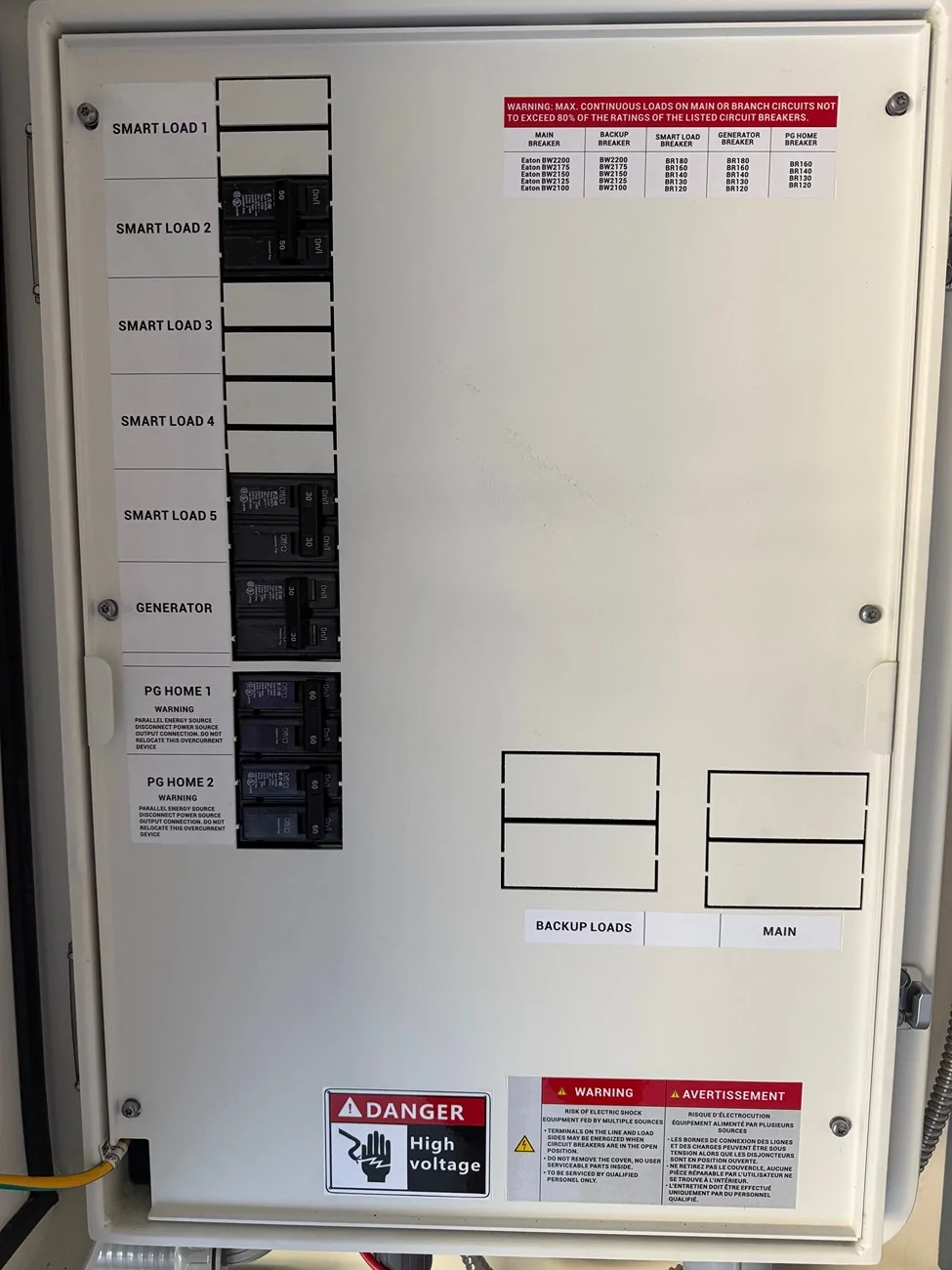
The load hub, while optional, is a key component to making the system great. It combines the functionality of the transfer switch and a smart panelboard (like SPAN) into a single item. At its core, it is a 200A service entrance rated automatic transfer switch. You can locate it between your utility meter and your main panelboard for whole home backup, or you can locate it between your main panel and a secondary/critical loads panel.
It also has 8 - 240V double pole smart breaker locations for various equipment. 2 of the positions are for the Sigenergy inverters only. 1 position is dedicated to a generator input (more details below). The other 5 positions can be used for smart managed loads or other inverters (sigenergy or 3rd party). You can use these if you want your dryer, oven,or any other load to be controlled manually or automatically in a grid outage or even on-grid low battery situation.
The most important feature of this, is their 0ms fail over. If you keep your equipment on performance mode, it is always ready to take over in a grid failure. If you have batteries or the truck plugged into V2X, there is not even hardly a flicker of the lights when you go off grid from a power failure. None of your devices like computers, or network equipment will shut down or even know the power is out. We have had utility power failures and only knew because the app sent a notifcation.

Energy Controller:

Inverter Stack.webp


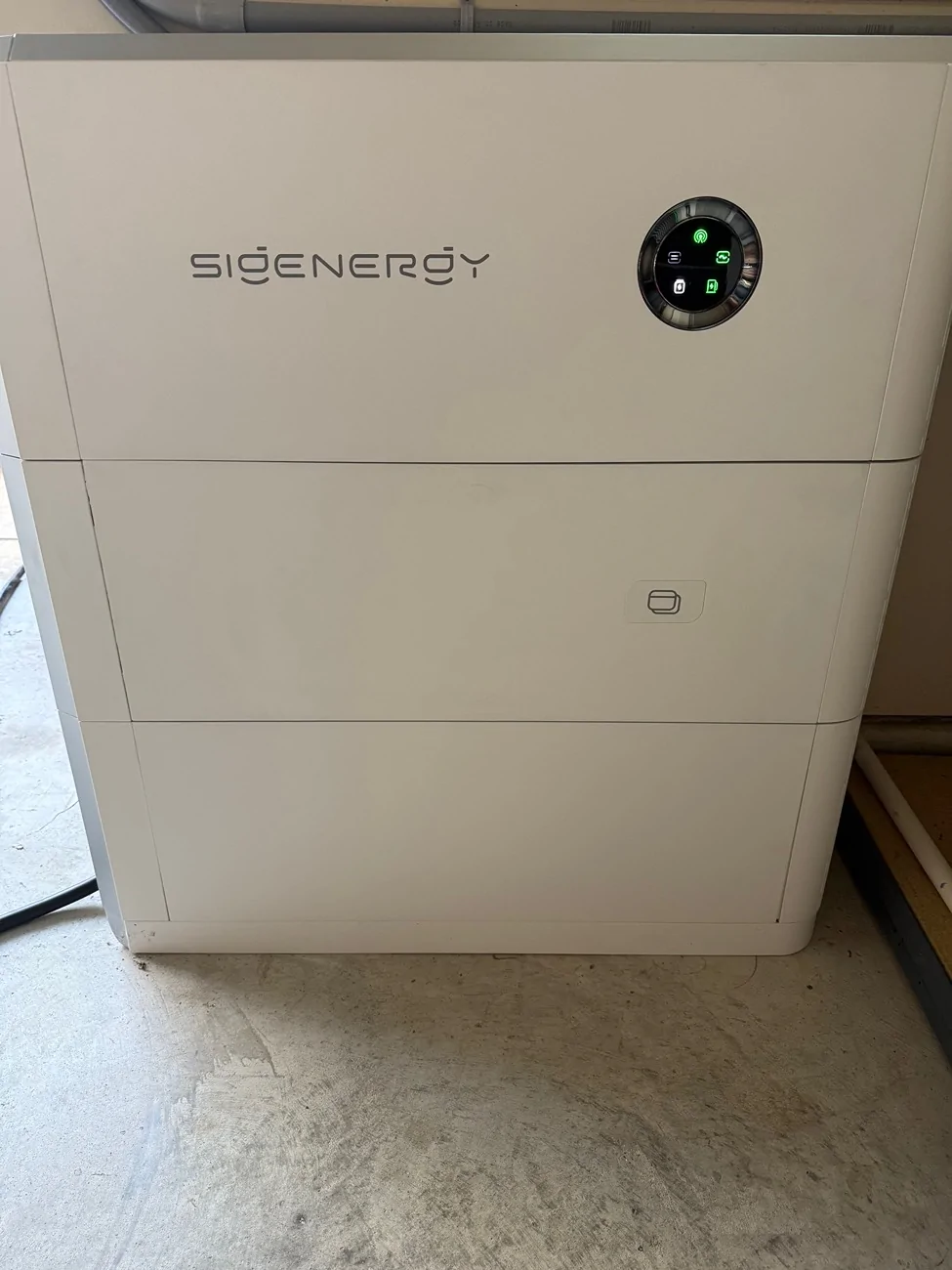
The energy controller is the hybrid inverter. It manages all the loads and physically sits on top of the stack of batteries. It has a continuous rating of 11.4 kW and has a short time surge limit higher than that. Now to get all 11.4kW you do need enough solar, batteries, V2X, or combination of those to achieve that power level. While this is good enough for most people, it is possible to parallel more inverters (up to 3 total) for up to a possible 34kW of power for large and high-load houses. The Energy Controller is also what interfaces with you app. You can have a system with just the Energy Controller for on-grid only applications (including V2X), but to have off grid, you need a load hub. One very nice feature is that all the communication of your Energy Controller and Load hub are all done over a network connection. It can be Wifi, cellular, or hard wired network into your home router. I have my whole system hard wired to a network switch so it is very fast and reliable connection. No more RS-485 communications. The only wiring that comes out of the whole stack is your 240V power that goes to the panelboard or Load Hub, and your network cable. All DC interconnection is built into the modules and you just line them up as you build your stack. There are no cables to mess with at all between the modules. This includes the V2X charger.

V2X Bi-directional DC EV charger:

V2X mode 1.webp
V2X mode 2.webp
V2X mode 3.webp
Bi-Directional Mode.webp


Ok this is what you are here for. For Sigenergy the V2X charger is a module that is the exact size of a battery module. It just sits in the stack immediately below the Energy controller and comes with a 25 ft. cable that comes out at the bottom of the stack. This does mean that you have to have the controller stack somewhat near your vehicle location. You can purchase it with either NACS or CCS adapters, but it is not designed to easily re-wire back and forth. You choose this option up front.

NACS Adapter.webp


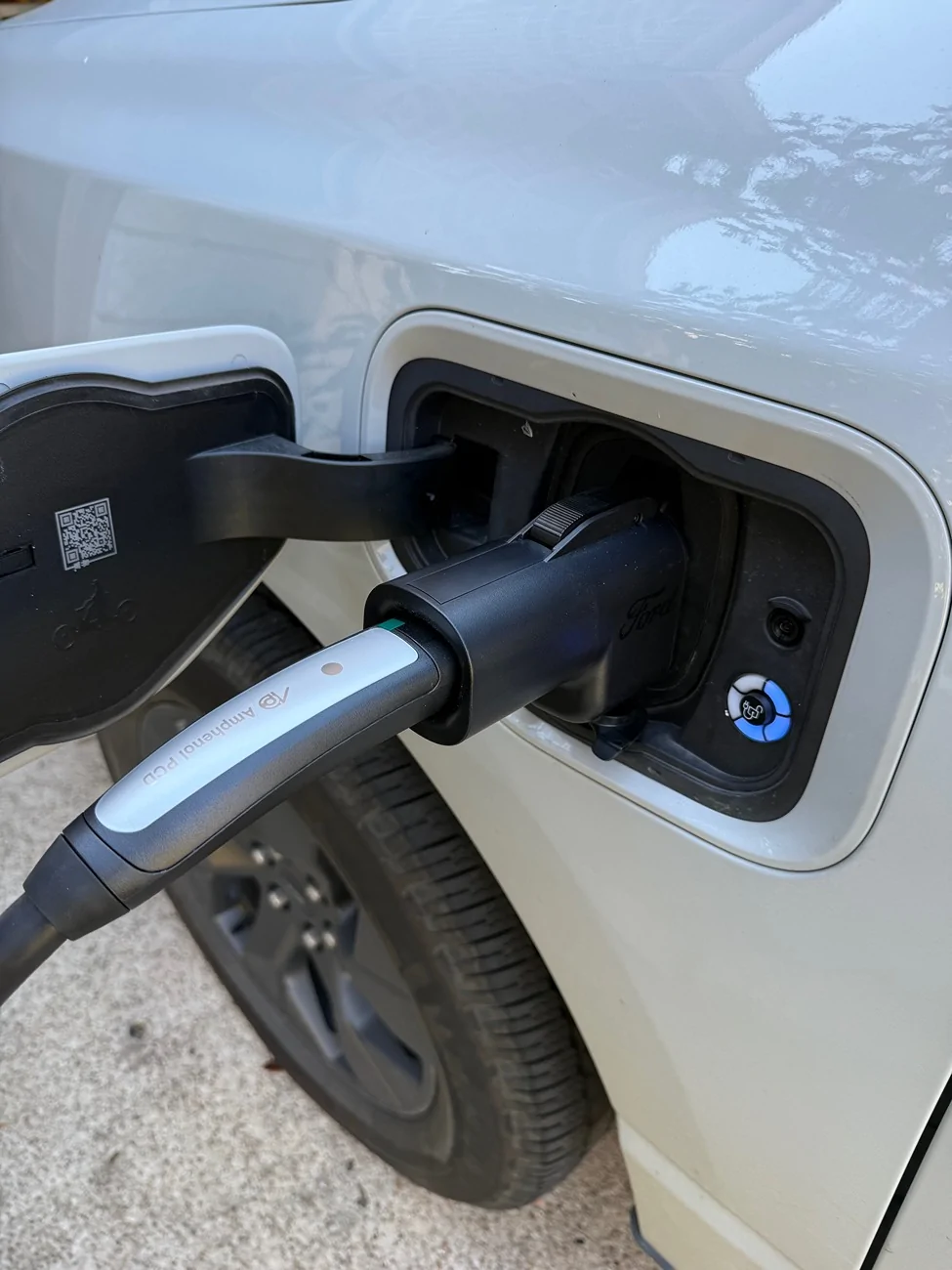
I decided to use the NACS cable and bought a second NACS to CCS DC fast charge adapter (some one as used for Tesla Superchargers) that I keep permanently connected. I can easily remove it if I want to have someone with a NACS connector try my system / their car out. Speaking of that, this system works with a whole host of different EV models and more are becoming compatible soon. The Lightning and Mach-E have some of the best perfomance of any of the vehicles out there, but even Rivian and most CCS compatible Tesla's work great. The Sigenergy website lists what they believe to be compatible vehicles.

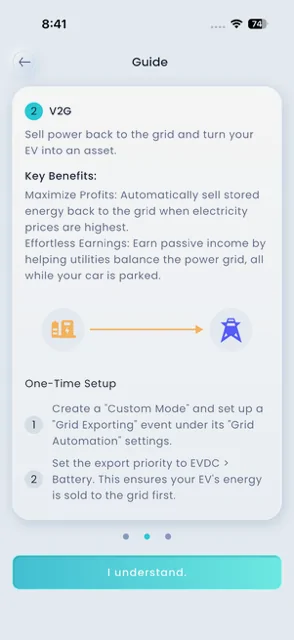
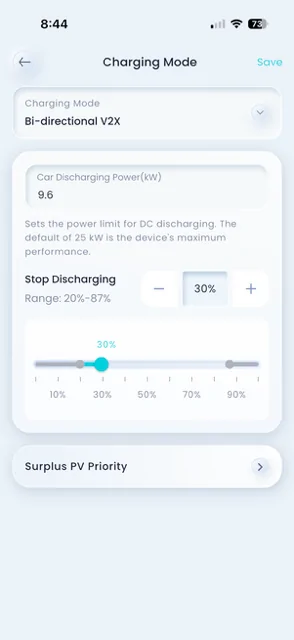
For performance this is a DC charger, so it bypasses the trucks AC charger. It also bypasses the limit of 48A that the AC charger has on 2024+ and old standard range Lightnings. Now technically off the grid it still has a 11.4kW limit for both charge and discharge to your panel. There is a boost ability however, that can bring your charge or discharge rate up to as much as 25kW. That is equal to about 100 amps on an AC charger. The caveat is that you have to use the solar or batteries that are directly connected to the same stack as the charger. In my case I don't have any solar and only one battery, so my limit would be 16kW. The 25kW can come from mix/match sources though. You could be getting 5kW from solar, 9 kW from battery, and 11kW from grid, if you wanted to get the full 25kW charge rate when it is needed.
This is a DC charger and thus works at the truck DC charger setting (not the same as the AC battery % max you might have set). It also has some caveat, like with the latest update it locks when the vehicle is locked and you don't have any key nearby.

Bi-directional.webp


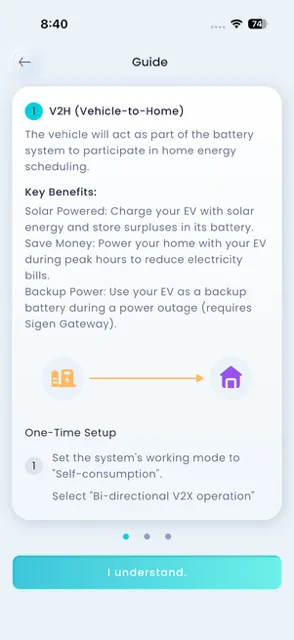
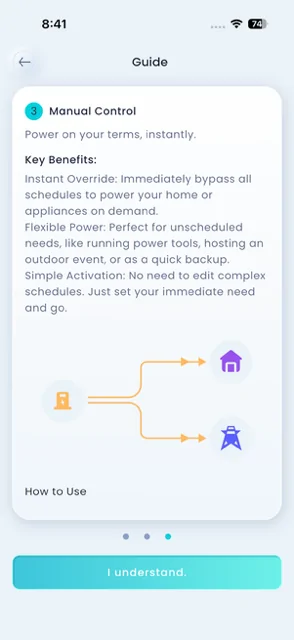
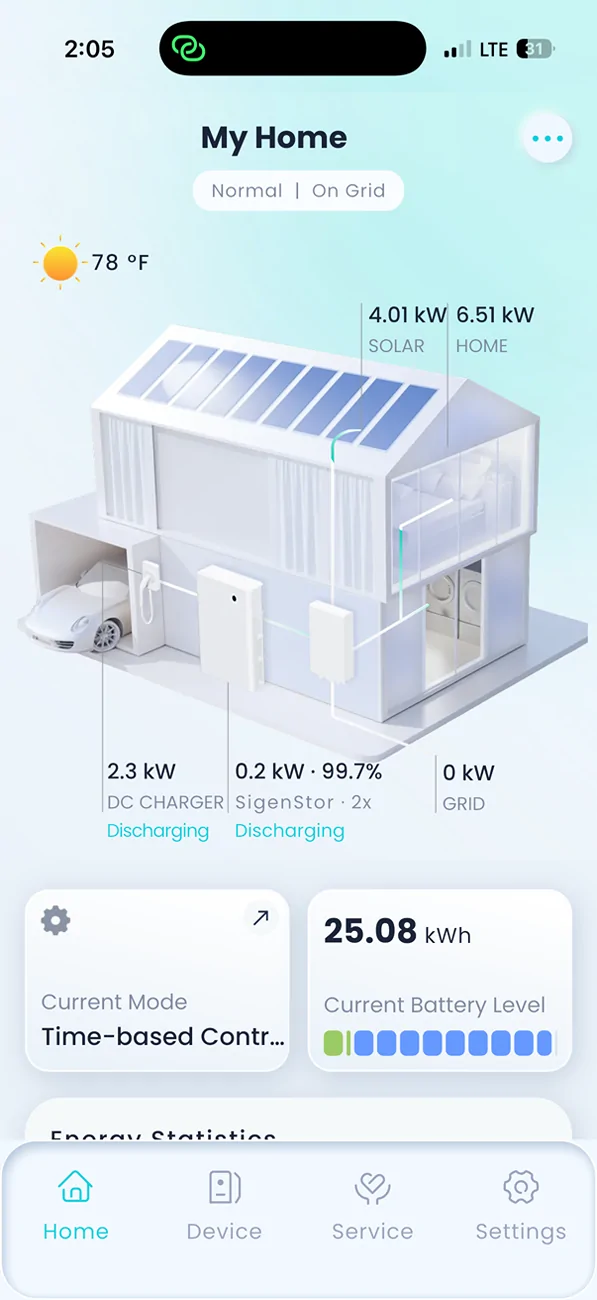
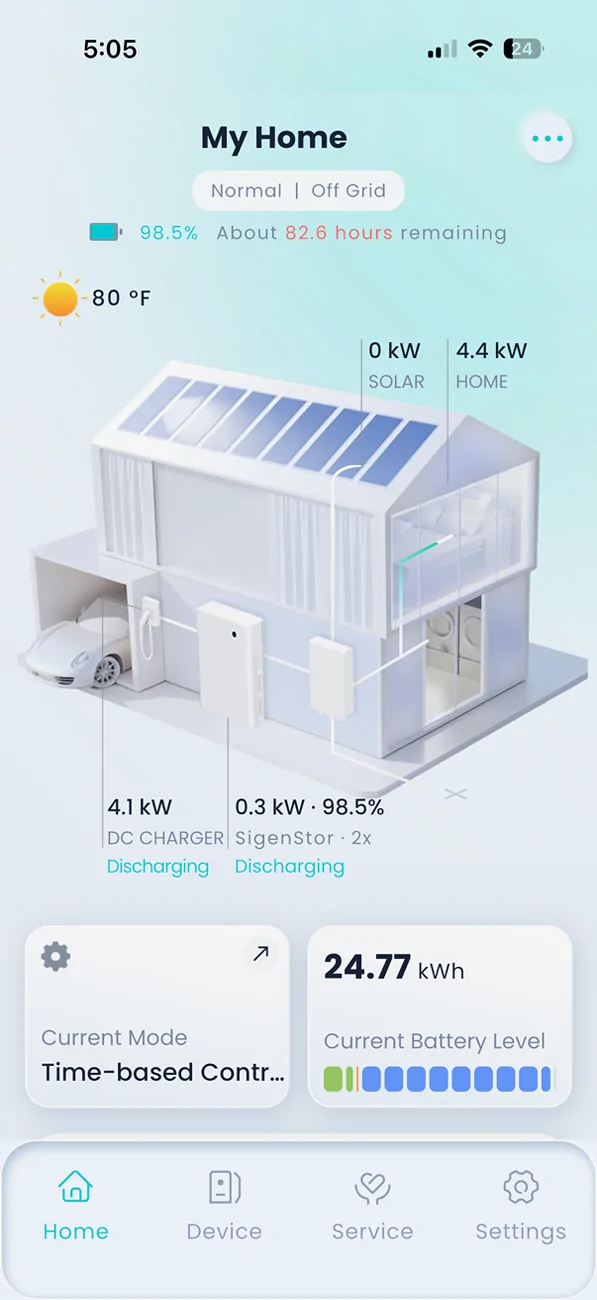
Once you are using the V2X, the truck becomes just part of the battery system and operates in synch with all the other components. There is a mode called self-consumption, where it is exactly like being off grid. It serves all your homes needs from all the sources available. If you have solar, and it exceeds the home load, it will begin to re-charge your batteries and vehicle automatically. It goes back and forth as needed automatically. The graphic above shows when my solar was meeting my AC needs, but the microwave got turned on, which took energy from the truck.

IMG_2797.webp


I can start my 5 ton AC unit while off-grid with this system (I do have an Easy Start on my unit)

Batteries:

Battery Priority.webp


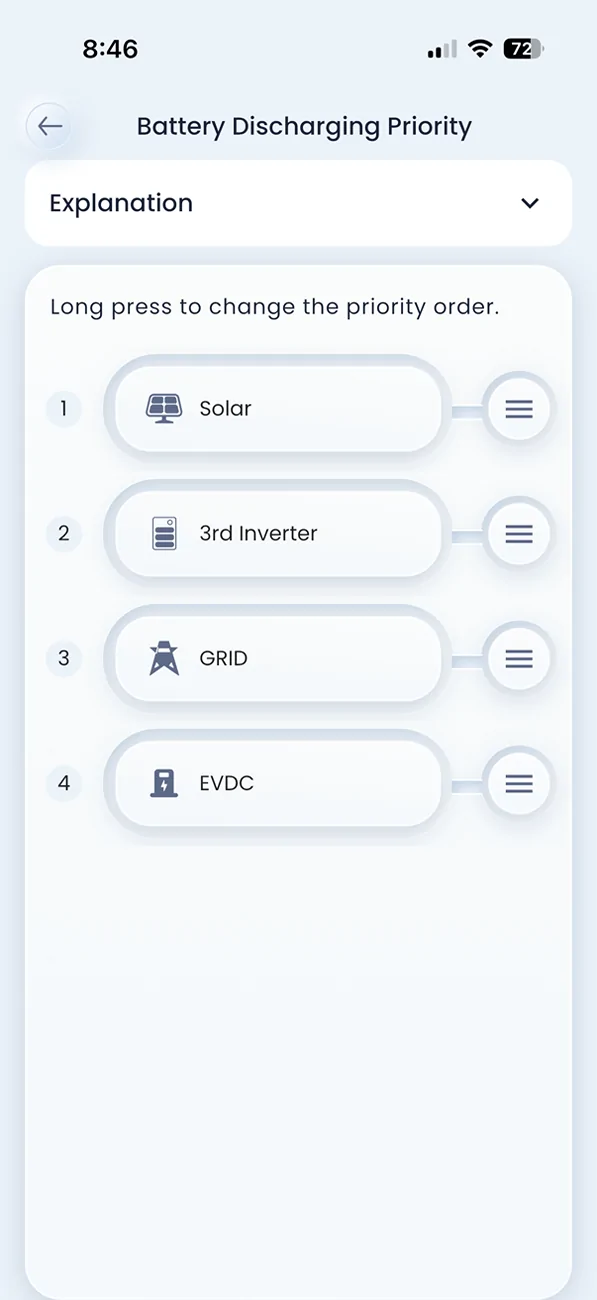
The batteries currently come in 6 kWh or 9 kWh increments. They are fully in parallel and can be mixed and matched. I believe currently each inverter supports up to 5 batteries, or 4 batteries + V2X module. That means you can have up to 45 kWh in a single inverter stacks. You can create an even larger system by adding more batteries with a 2nd or even 3rd inverter. If a battery were to fail, it does not affect anything else in the stack. It just takes itself out of service. You can not only mix different battery sizes, but also different technology in the future.

Solar:

Solar Priority.webp


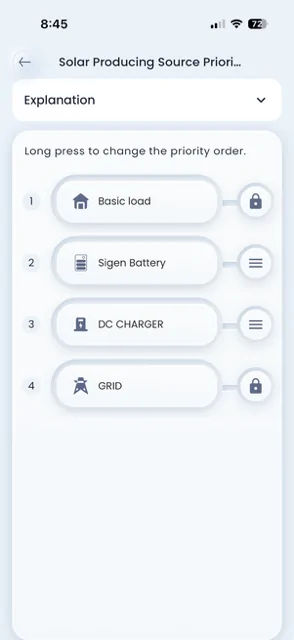
Solar is not required for the system, or for V2X, but it does integrate nicely. The inverter has 4 built in MPPT connections if you want to add it directly for a full DC coupled system. If you have the load hub or an external CT device sold by Sigenergy, you can also use AC coupled solar, even existing systems. I personally use my 5kW SolarEdge inverter I have had for 10 years now. It integrates exactly the same as if I had solar directly into the Sigenergy inverter (other than the power limit from the AC interface on the inverter).

Generator (with Load Hub):

IMG_2492.webp
IMG_2493.webp


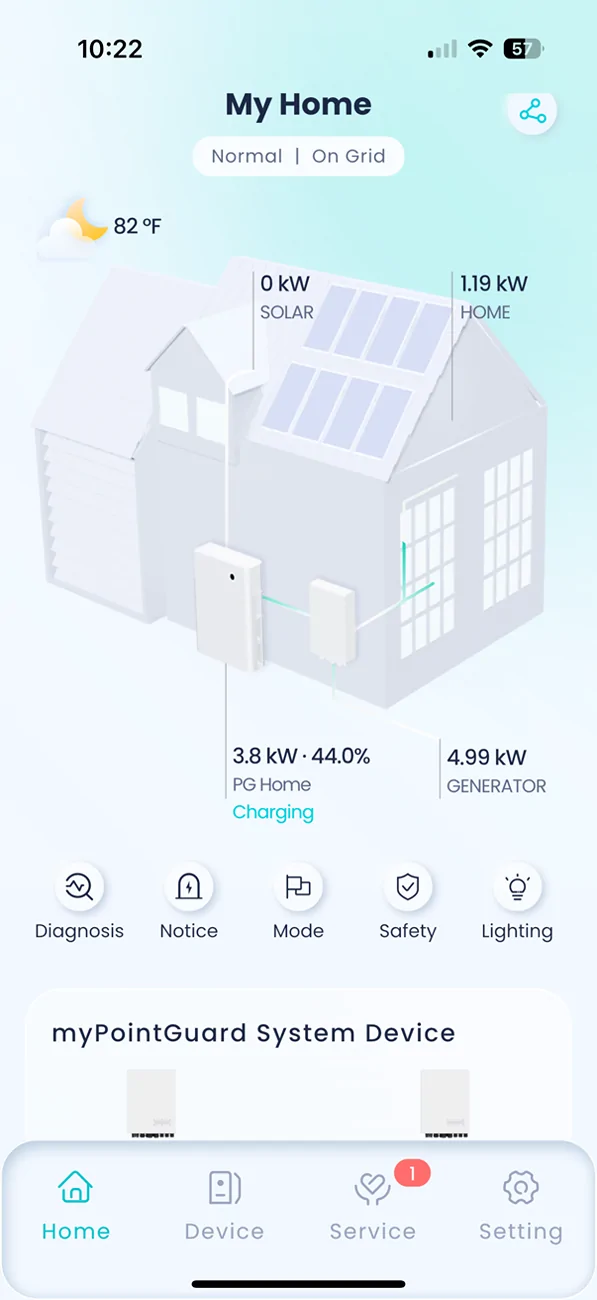
Lastly there is a generator input built in the load hub. You can have up to 80A generator that works with the system (off-grid only). It will work with nearly any type of portable or permanently installed generator. It can also automatically start-stop generators with remote start feature. You can set exactly how much load you want to pull from the generator. You can have the generator start up and not only service the house load, but also recharge the system battery (or EV with the V2X). One the charge level is reached, it will automatically turn off the generator input, so you can maximize the efficiency and minimize the runtime.
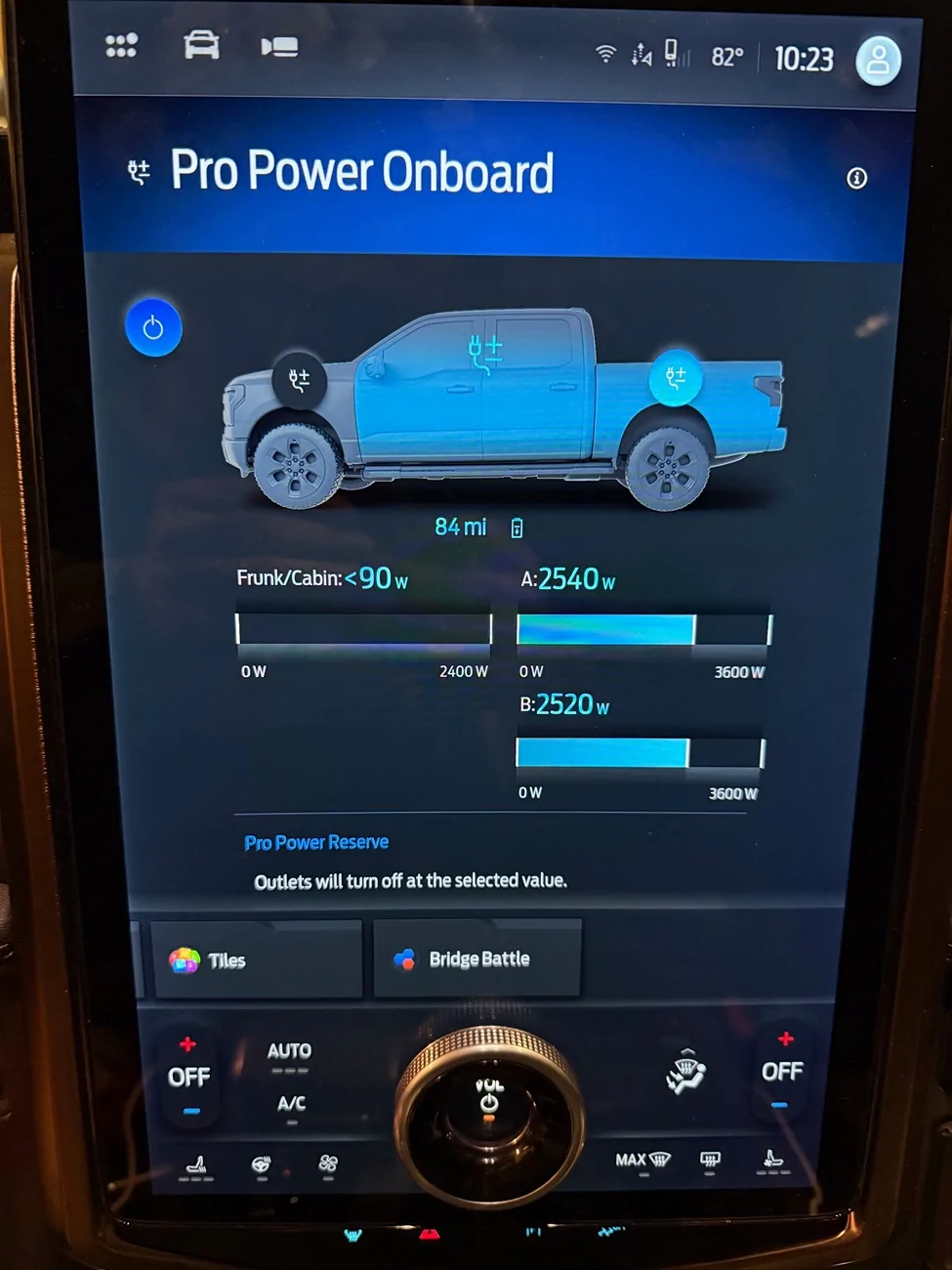
I have also successfully tested this with the Lightning Pro-power, but this only works if you disconnect the ground terminal between the two. This can cause a potentially dangerous issue and I don't recommend it. The V2X is really what you should use to connect the Lightning.


How to get it:
Sigenergy does require a certified installer to be able to commission the system. The best way to get these products is to reach out to a certified installer and get a quote.
It is possible to have any licensed electrician become a certified installer through a registration and small training program. Ask your favorite local electrician if you don't want to go through an unknown company.
The components are sold through distribution. I won't post the link here, but you can find retail pricing for the components online if you search.
I will say this is not the cheapest system. If you have ever researched systems on sites like Signature Solar, you will see lower cost systems. That being said, of the professional systems like Tesla, Franklin, etc. this is on the low cost side of that spectrum. It is likely lower cost for material and labor than Tesla. It is also the only system with both a bi-directional charger and generator input (both of which can be used at the same time).
If you're a buyer of this system, you should know how much it costs and be willing to tell us the price you paid for the equipment.

The company and it's distributors treat prices as some sort of secret though, so maybe they have offered you some compensation for posting this on the condition that you not still the beans on price?
 
OP
OP

tearitupsports

Well-known member
First Name
Russell
Joined
Jun 1, 2024
Threads
10
Messages
408
Reaction score
437
Location
Houston, TX
Vehicles
2023 F-150 Lightning Lariat ER
Occupation
Industrial Automation & Controls
If you're a buyer of this system, you should know how much it costs and be willing to tell us the price you paid for the equipment.

The company and it's distributors treat prices as some sort of secret though, so maybe they have offered you some compensation for posting this on the condition that you not still the beans on price?
I don't really like posting what I paid, because it really doesn't apply to anyone else. The main factor is that I have a good friend who is a master electrician, and my labor is free. It was the same for the Ford/Sunrun system I installed. My original Sigenergy install was last year when it was still branded Pointguard. I purchased the parts through a local distributor I found off the Sigenergy website, and my friend became certified then helped me install it for free. A lot of the system was already in place from the previous Ford HIS install.
There are a lot of things that have changed since then such as Tariffs, the 30% tax credit going away, and price changes. My belief though is that the pricing is still similar because Sigenergy lowered their prices to help compensate.
As previously posted in this thread I believe the component costs are around ($8k-$9k) for the absolute minimum amount of components required for a off-grid backup using V2X. The distributors are listed on the Sigenergy website, and you can call them to get a street price. Installers likely get a discount from that. One distributor posts their prices online (I believe self2solar) which you can double check my numbers.

Of the major installer based systems, this should be on the low end of cost. It would be comparable to Tesla, Franklin, Enphase, etc. This biggest difference is that those guys don't have V2X at all, and most don't even have a generator input.
 
Last edited:

FloridaMan85

New member
Joined
Sep 7, 2024
Threads
0
Messages
4
Reaction score
6
Location
Florida
Vehicles
2022 F-150 Lightning Lariat
I've been talking with a local installer about exactly this setup, so it's timely that you posted this week. Thanks for the detailed write-up sharing your experience.

On the truck side, are there any weird software quirks or setups to be aware of? For example, do departure schedules work like normal even when on a DC charger? Does is use "saved locations" for a DC charge to allow setting a charge limit at home?

I'm not sure I'd be wild about doing "settings gymnastics" frequently (per the comment by @lazjen ) and want to avoid little quality-of-life issues and make sure it's friendly for others in the family who might use it.
 
OP
OP

tearitupsports

Well-known member
First Name
Russell
Joined
Jun 1, 2024
Threads
10
Messages
408
Reaction score
437
Location
Houston, TX
Vehicles
2023 F-150 Lightning Lariat ER
Occupation
Industrial Automation & Controls
I've been talking with a local installer about exactly this setup, so it's timely that you posted this week. Thanks for the detailed write-up sharing your experience.

On the truck side, are there any weird software quirks or setups to be aware of? For example, do departure schedules work like normal even when on a DC charger? Does is use "saved locations" for a DC charge to allow setting a charge limit at home?

I'm not sure I'd be wild about doing "settings gymnastics" frequently (per the comment by @lazjen ) and want to avoid little quality-of-life issues and make sure it's friendly for others in the family who might use it.
There is nothing you really need to set up on the truck. I have never used departure schedule. While I think it would still work, I don't know because I don't have experience with how it works.

There are a few quirks with it DC charging. If you use the saved locations and a time schedule, then the charger will fault out when the truck does not let it charge. It doesn't just sit and wait. It doesn't know why the truck won't charge. It also does not use the charge limit either, because that is AC only. It defaults to the 90% fast charger cap. Ford Pass will also display it as Fast Charging.

That being said, with Sigenergy all those settings can be done in the app. I only charge my truck between 8pm and 6am. I can also control the charge rate and SOC max in the MySigen app.
I just turned off the location settings within the truck completely and let MySigen handle everything.
I set my SOC to just below the truck cap and it works fine.
You can change the settings at any time and it will instantly start using them.

Ford F-150 Lightning Sigenergy V2X for the Lightning (and most other EV's).  The way bi-directional charging should be! IMG_2812
 

Sponsored

TechnoSwiss

Well-known member
Joined
Jan 19, 2025
Threads
1
Messages
91
Reaction score
73
Location
PNW
Vehicles
2024 Ford F-150 Lightning Lariat Carbonized Gray Metalic
Occupation
Electrical Engineer
So it looks like you have 4 components total, LoadHub, Energy Controller, V2X and 1 battery? Are you able to do load transfer to take advantage of Time-of-Use and pull power from the battery and/or truck during peak times and then recharge both off-peak?

Quick edit, looks like checking out self2solar right now, the LoadHub, Energy Controller, V2X module, and 1 Pack5.0 battery is $10,068 without shipping or install.
 
Last edited:
OP
OP

tearitupsports

Well-known member
First Name
Russell
Joined
Jun 1, 2024
Threads
10
Messages
408
Reaction score
437
Location
Houston, TX
Vehicles
2023 F-150 Lightning Lariat ER
Occupation
Industrial Automation & Controls
So it looks like you have 4 components total, LoadHub, Energy Controller, V2X and 1 battery? Are you able to do load transfer to take advantage of Time-of-Use and pull power from the battery and/or truck during peak times and then recharge both off-peak?

Quick edit, looks like checking out self2solar right now, the LoadHub, Energy Controller, V2X module, and 1 Pack5.0 battery is $10,068 without shipping or install.
Those 4 components are the minimum needed for full V2X. I personally have 2 inverters, 3 batteries (25 kWh total), load hub, and V2X module.

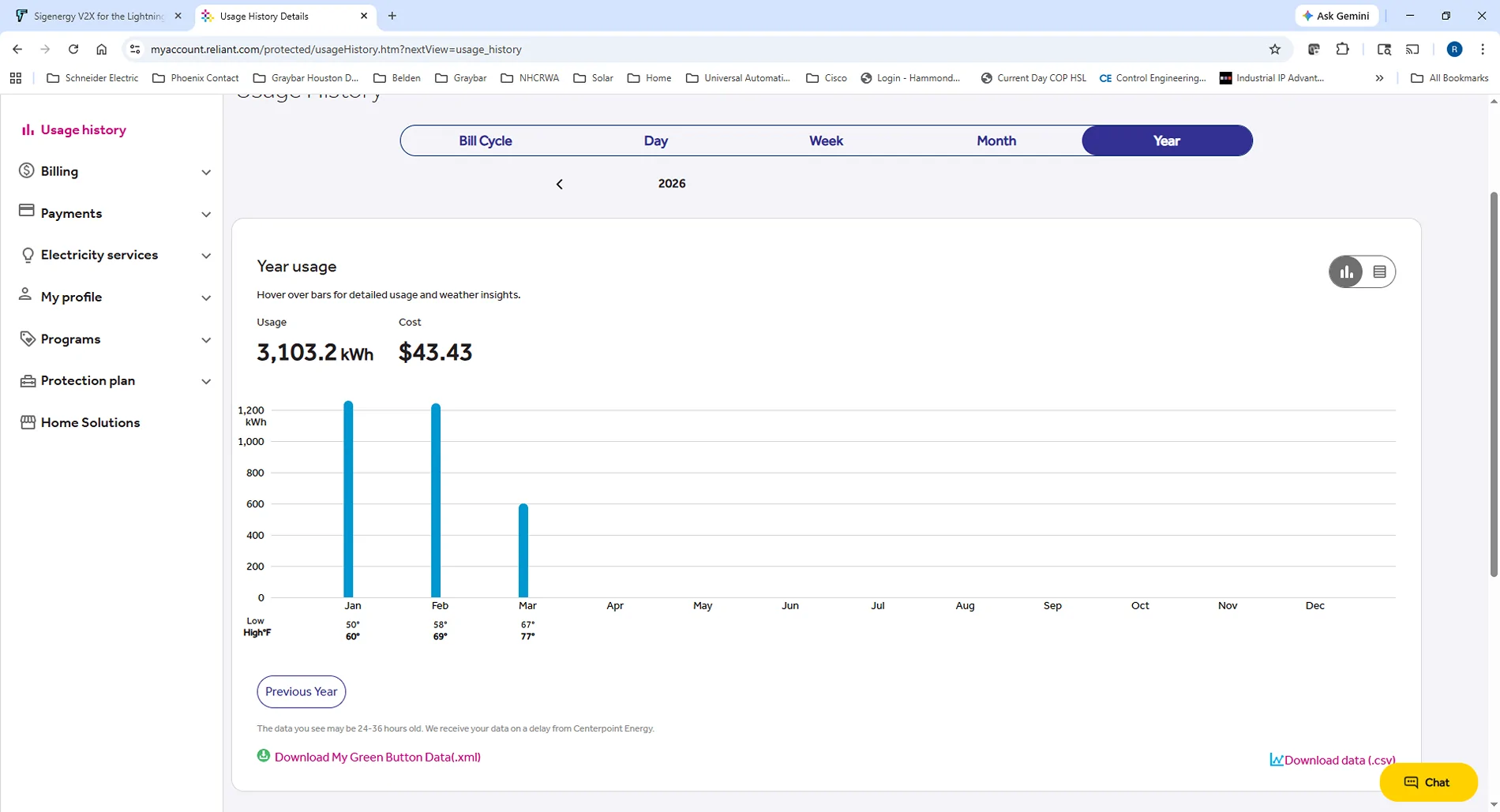
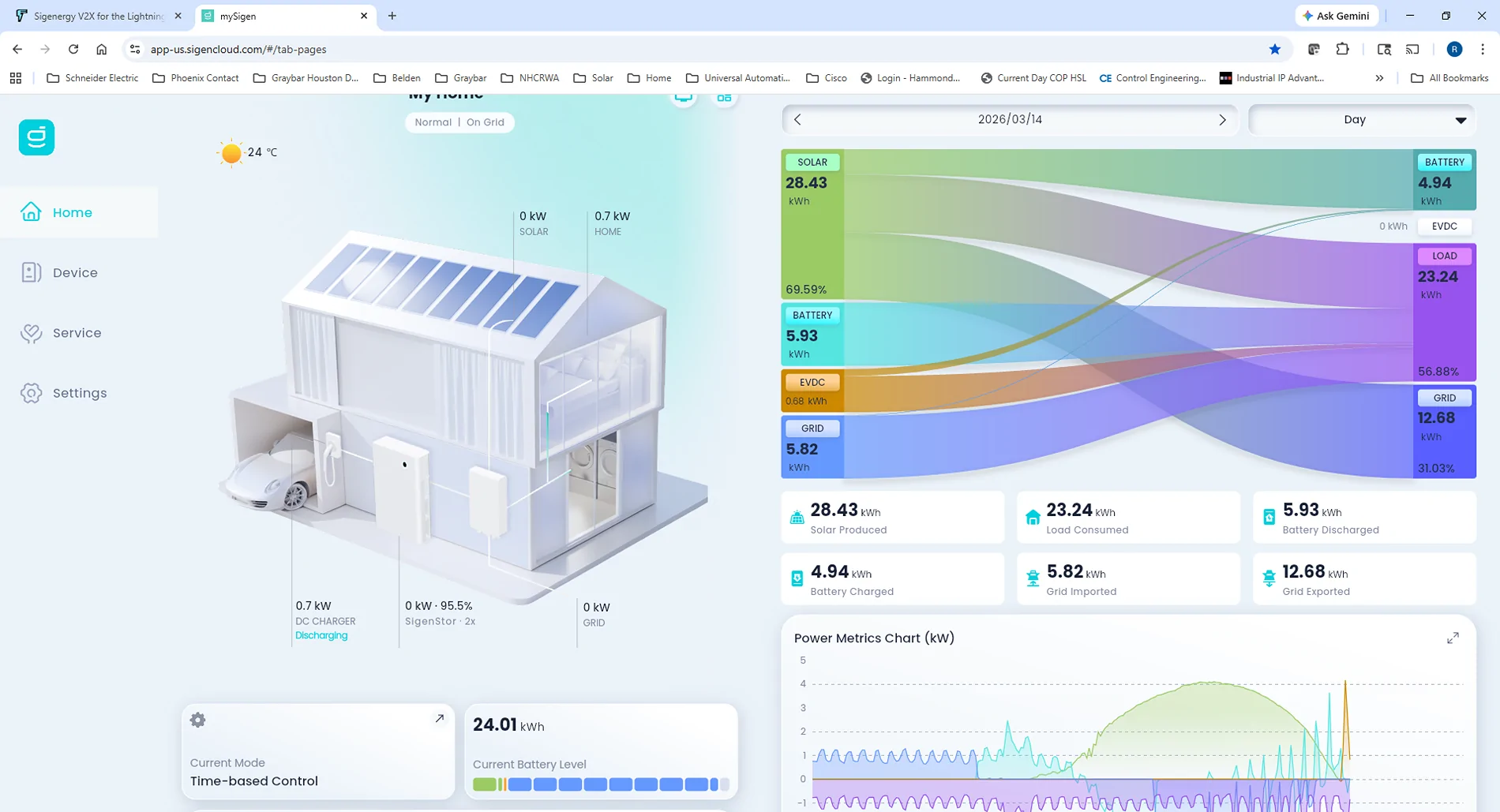
Yes the app has all sorts of time of use setting that can be used to maximize self consumption or rate plans. Here is TX we have an extremely awesome plan that is $0.30 during the day, but is totally free at night. $6 / month connection fee. As you can see below, I make huge amounts of money back per month, when combined with the 5kW solar I already had.

Ford F-150 Lightning Sigenergy V2X for the Lightning (and most other EV's).  The way bi-directional charging should be! 1773493228227-2k
 

bmwhitetx

Well-known member
First Name
Bruce
Joined
May 21, 2021
Threads
47
Messages
3,081
Reaction score
4,405
Location
DFW-Texas
Vehicles
2022 F150 Lightning Lariat ER
Occupation
Retired engineer
Here is TX we have an extremely awesome plan that is $0.30 during the day, but is totally free at night.
Great use of this plan. For those that may bristle and say it’s not totally free and there are always distribution charges, I can vouch for your statement.

I retired 10 years ago but when Texas deregulated electricity in 2002, my company came out with the first Free Nights program a few years later. It was a massive win. Originally it was only generation charges but we were quickly taken to task by the regulators and competition for our ads. So we made the daytime rate a little higher and added a bill credit to offset the distribution charges to make it “totally free” at night.
 
Last edited:

TechnoSwiss

Well-known member
Joined
Jan 19, 2025
Threads
1
Messages
91
Reaction score
73
Location
PNW
Vehicles
2024 Ford F-150 Lightning Lariat Carbonized Gray Metalic
Occupation
Electrical Engineer
Those 4 components are the minimum needed for full V2X. I personally have 2 inverters, 3 batteries (25 kWh total), load hub, and V2X module.
After I posted that I noticed in your other thread that you had more equipment, but thanks for confirming that minimum, and your write-up. I'd looked into the system about a year ago when it was still Pointguard, but was having a hard time confirming details, and none of the installers around me knew anything about it. Nice to get confirmation on what you need, and that it works (and cool to know it works through the NACS to CCS adapter as well, seems like going with NACS is the better option long-term now that more manufactures are adopting it).

We have 3 price tiers here, mid-peak at $0.17/kWh, peak (5-9PM) at $0.44/kWh, and off-peak (9pm-7AM) at $0.09/kWh. Even without changing our energy usage, enough of it was off-peak that we're saving about $40 a month with time-of-use (only charging overnight) but being able to sift some of that usage from peak to off-peak with a battery, in addition to having it available for power outages would be nice.
 
OP
OP

tearitupsports

Well-known member
First Name
Russell
Joined
Jun 1, 2024
Threads
10
Messages
408
Reaction score
437
Location
Houston, TX
Vehicles
2023 F-150 Lightning Lariat ER
Occupation
Industrial Automation & Controls
We have 3 price tiers here, mid-peak at $0.17/kWh, peak (5-9PM) at $0.44/kWh, and off-peak (9pm-7AM) at $0.09/kWh. Even without changing our energy usage, enough of it was off-peak that we're saving about $40 a month with time-of-use (only charging overnight) but being able to sift some of that usage from peak to off-peak with a battery, in addition to having it available for power outages would be nice.
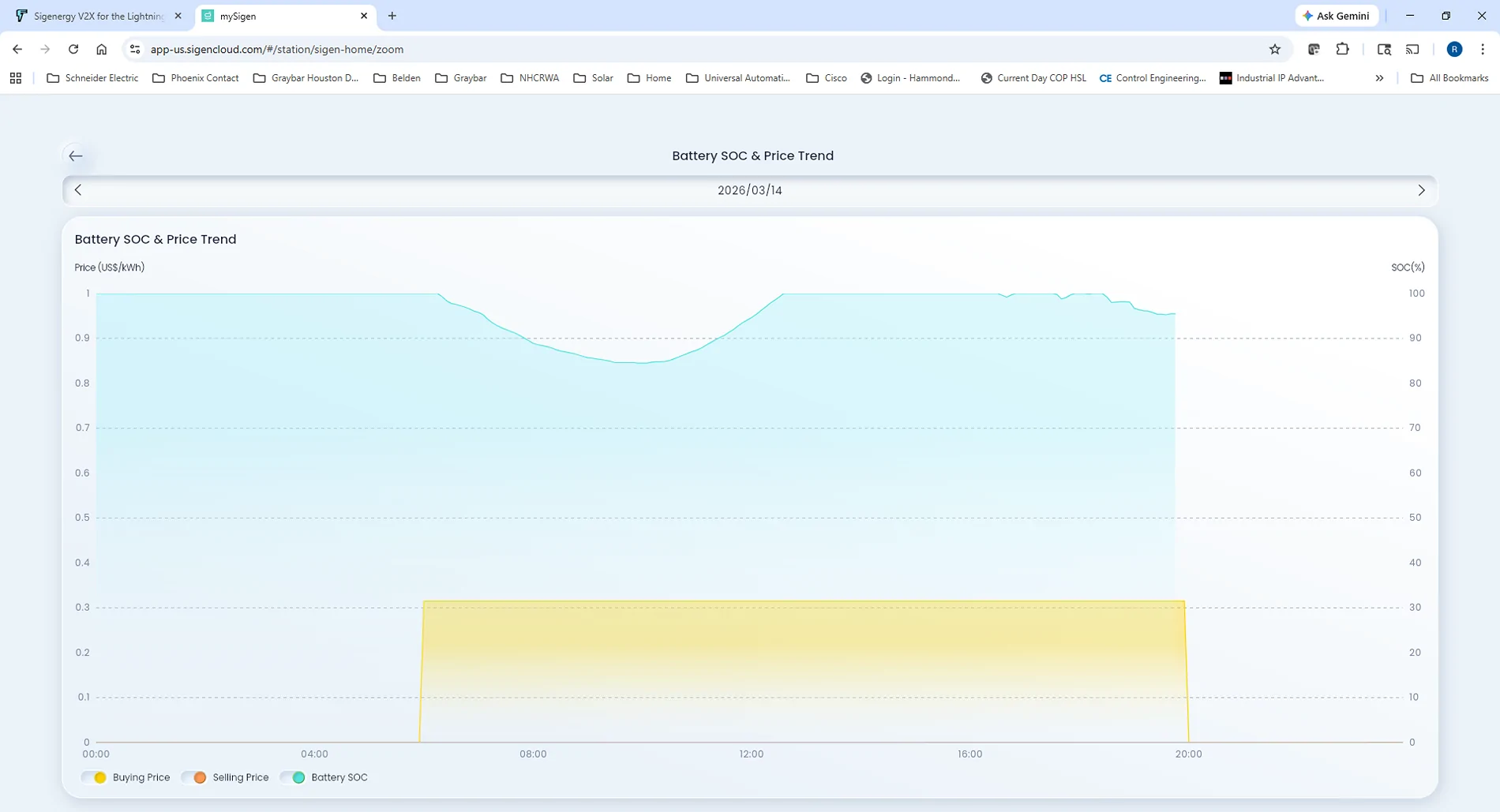
I shift all my usage to off-peak just like you are wanting to do. I run my system in self-consumption mode from 6am - 8pm every day. Then at 8pm I convert to charging mode, which charges the truck and batteries up to their set limit.
Self consumption mode is basically the same as being off grid. It will power your loads entirely by battery. In my case I also have a small solar system. If there is excess solar, then it starts charging the batteries back up. Once the batteries are full it will then export any excess after that.
With the truck plugged in, it just becomes a part of the battery system. In fact the system will switch to prefer using the truck battery before the stationary battery. Excess solar will of course charge the stationary battery, and then move to the truck if possible. This allows me to connect and disconnect the truck as needed and still have as full of home battery as possible.
In charge mode, it again charges the home battery first and then switches to the truck. The home battery is full in 3 hours or less for me, allowing the truck to charge the remainder.
What you would need to decide is how much money you would save with 100% of your electricity usage at your $0.09 off peak rate. Also you need to realistically determine how long your truck could be plugged in at home. For me I am not at home all day, so I needed a decent amount of stationary battery + a bit of solar to cover myself of full AC load days. I also have completely free night electricity, so my savings are a lot more than most people will have access to. For someone working from home, the minimal system might be all they need with the truck plugged in a lot.

I honestly am not worried about the economics so much. I feel like this is a great backup generator, and it is a huge added bonus I can save $2k / year on electricity cost. I like to mess with new technology, and am willing to spend some money on this sort of thing. I am sure I will not have the free nights forever (or much past my contract), so it will be ready to change as needed. In the future there are going to be things like virtual power plant programs and other incentives to use this sort of system. I can add up to 40 kW of solar with the equipment I already have if that becomes necessary.

Below is what my daily battery profile is like. It also shows the cost of electricity during the different times. Today was a cool and very sunny day, so the batteries stay almost full. Some days I drain down to 20% by 8pm.

Ford F-150 Lightning Sigenergy V2X for the Lightning (and most other EV's).  The way bi-directional charging should be! 1773535774475-qf


Ford F-150 Lightning Sigenergy V2X for the Lightning (and most other EV's).  The way bi-directional charging should be! 1773535824235-ws
 

Sponsored

chl

Well-known member
First Name
CHRIS
Joined
Dec 16, 2022
Threads
9
Messages
3,095
Reaction score
1,920
Location
alexandria virginia
Vehicles
2023 F-150 LIGHTNING, 2012 Nissan Leaf, 2015 Toyota Prius, 2000 HD 883 Sportster
Occupation
Patent Atty / Electrical Engineer
Others may have different situations and the SIENERGY system would make sense.

I think given the cost it would only make sense for me if I already had a solar system to integrate with it. I considered one, but the costs here are prohibitive and the ROI rather long.

But, in my state (Virginia) they recently passed a law allowing so-called 'balcony solar' aka 'plug-in solar" which is not for outages, does not use net-metering, but reduces the amount of utility energy used by inputting that generated by solar to the service panel, and it avoids all the permits and red tape involved with roof mounted net-metering type systems.

https://solarunitedneighbors.org/resources/what-to-know-about-plug-in-solar/

Right now not legal everywhere, just a few states.

The system does not need a transfer switch because it 'islands' the inverter, that is, if utility power goes out, the inverter stops providing energy to your house. It has been used in Germany for years with over a million installs but no injuries to line workers - zero injuries.

A lot of the cost with solar in VA is all the regulatory requirements and utility requirements, unless you are completely off-grid, so legalizing this is a big improvement is solar accessibility.

But back to the V2H, as far as getting juice from my Lightning all I needed was the Lightning PPOB (7.2kW = 240V x 30A) and:

- a $400 manual transfer switch (e.g., GENERAC 4853 kit),
- a longer 30A generator cable than what comes with the GENERAC kit (I needed one to reach my service panel from my driveway), and
- extra breakers to expand it to 10 (a combo of 15A and 20A) circuits from 8.

My total costs were under $700 (plus the $50k truck, lol).

Not worth thousands more dollars for an extra 2.4kW (240V x 10A) in my book with either the HIS or the SIGENERGY system, for my needs anyway.

The truck already has battery storage and inverters so why buy additional ones in an external system unless you need them for a solar system perhaps?

Others may have different situations and the SIENERGY system would make sense.
 
OP
OP

tearitupsports

Well-known member
First Name
Russell
Joined
Jun 1, 2024
Threads
10
Messages
408
Reaction score
437
Location
Houston, TX
Vehicles
2023 F-150 Lightning Lariat ER
Occupation
Industrial Automation & Controls
But back to the V2H, as far as getting juice from my Lightning all I needed was the Lightning PPOB (7.2kW = 240V x 30A) and:

- a $400 manual transfer switch (e.g., GENERAC 4853 kit),
- a longer 30A generator cable than what comes with the GENERAC kit (I needed one to reach my service panel from my driveway), and
- extra breakers to expand it to 10 (a combo of 15A and 20A) circuits from 8.

My total costs were under $700 (plus the $50k truck, lol).

Not worth thousands more dollars for an extra 2.4kW (240V x 10A) in my book with either the HIS or the SIGENERGY system, for my needs anyway.

The truck already has battery storage and inverters so why buy additional ones in an external system unless you need them for a solar system perhaps?

Others may have different situations and the SIENERGY system would make sense.
This post was not intended to compare options, as there are plenty of posts about that, but the 2 systems as you describe are not anywhere close to each other.

With just considering off-grid the Sigenergy is WAY more than an extra 2.4kW. You are referencing the HIS @ 9.6kW (or possibly my artificial limit I have during testing). The Sigenergy system can export 11.4kW all the way to the AC loads. On the DC side it can export up to 25 kW. This means it can power all your loads AND charge up the stationary batteries at the same time.

Pro Power even at 7.2kW is massively limited by the fact that it does not allow for any surge. I can't even use a lot of power tools without tripping the system. This means you cannot start large AC loads or some water pumps with the truck, and that is a massive difference for a lot of people. Sigenergy has up to 17 kW for 10 seconds and can power almost any load you have.

With the Generac you have up to 10 circuits, but with Sigenergy I can back a full 200A 42 circuit panelboard.

Another off-grid considerations are that I have to do nothing in a power outage. Nothing turns off or resets. I can also take the truck off site without any disruption of power. It is extremely inconvenient to be forced to have the truck connected during a long term outage.
Also having to go out to the garage and do the change over is not what a lot of people want to do.

Lastly I can use both at once. I don't lose pro-power by having the V2X. I can have up to 18kW continuous power.

Then there is the on-grid consideration, which doesn't apply to the Generac. For anyone with a time of use plan, this system actually can generate a ROI. I personally save over $200 / month on electricity, which offsets a large portion of investment pretty quickly. So far this year I am averaging just over $0.01 / kWh across all usage.

I acknowledge that you note the situation changes for different people, and you are happy with your solution. There are also people happy with their old Nokia flip phone, instead of having an iPhone 17, which is about the same comparison. :crackup:
Sponsored

 
Last edited:


Top