
Sponsored

VTHokies

Well-known member
First Name
Jason
Joined
Aug 17, 2023
Threads
1
Messages
237
Reaction score
328
Location
Dallas, TX
Vehicles
‘26 Chevy Silverado EV Max Range
Wow, you did it! Lol

Looking forward to your impressions after your trip.
Pushing 500 Mile range is nuts-
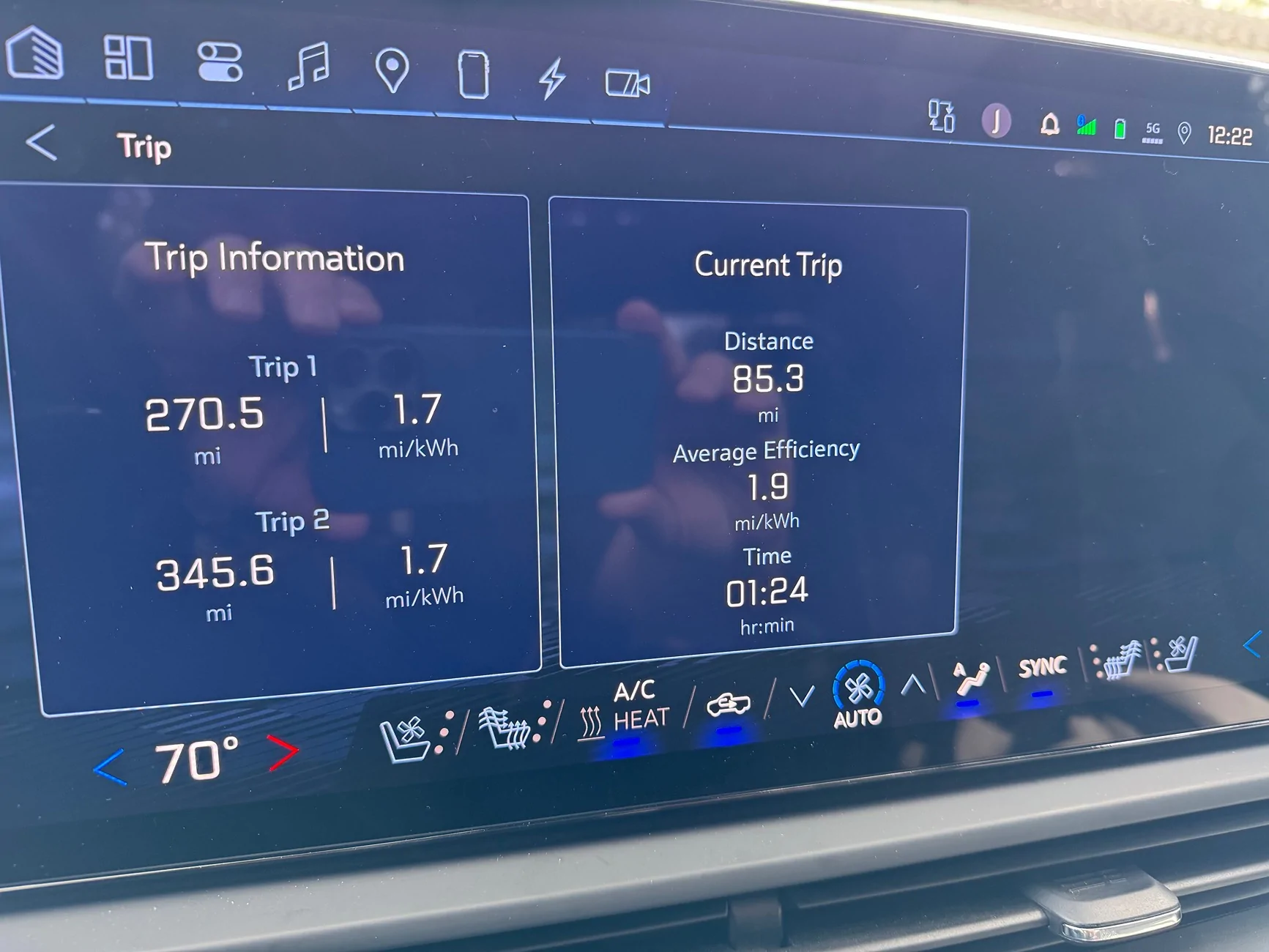
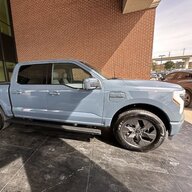
Went well, left Dallas at 95% and went 270.5 miles and ended with 25% in Houston. Mostly all SuperCruise doing 75mph, there was a headwind for most of the trip so truck was saying I got 1.7mi/kWh but it must have died down as the last 85 mile leg of it saying I got 1.9mi/kWh doing 75mph.

Doing it by hand, used 71% of 205kWh battery for 270.5 miles comes out to 1.85mi/kWh for the trip.

Only issue I had was about an hour in I got a message that the 120v plug was disabled and need to reset it (had an igloo cooler plugged in). At our first stop couldn’t get it to work so took it to the Chevy dealer near my in-laws this afternoon and they looked at it for about 45mins, checked all the fuse, which were good, so they think maybe a module went bad. Will have my dealership in Dallas look into it when I get back.

Tomorrow I get to see how it does at a 325kW Tesla supercharger, before 8am it’s $0.17/kwh (membership price) which will definitely help the wallet filing this thing up!

Overall I’m quite happy!

Ford F-150 Lightning Important Update: Ford EV Roadmap & Future of F-150 Lightning (EREV Next Gen Model) - ⛔️ ADMIN WARNING: NO POLITICS IMG_0062


Ford F-150 Lightning Important Update: Ford EV Roadmap & Future of F-150 Lightning (EREV Next Gen Model) - ⛔️ ADMIN WARNING: NO POLITICS IMG_0064
Sponsored


TruckOwner1

Member
Joined
Dec 16, 2025
Threads
0
Messages
15
Reaction score
35
Location
US
Vehicles
Lightning
This is the first step that could help Ford achieve electrification, or even just getting dealerships to modernize and cooperate! I bet everyone on this thread would take a flight/drive to Colorado, assuming other states don't go along, to purchase their next vehicle if the dealers aren't willing to act appropriately.

https://www.autoblog.com/news/dealers-take-another-hit-in-the-direct-to-consumer-sales-fight

The next step would be for Ford to set up corporate owned service centers across the nation that don't sell vehicles. Then Ford could offer consistent corporate backed experiences for both sales and service.
 

Rice_classic

Well-known member
First Name
Rice
Joined
Jun 20, 2025
Threads
1
Messages
87
Reaction score
143
Vehicles
2023 F150 lightning lariat ER
This is the first step that could help Ford achieve electrification, or even just getting dealerships to modernize and cooperate! I bet everyone on this thread would take a flight/drive to Colorado, assuming other states don't go along, to purchase their next vehicle if the dealers aren't willing to act appropriately.

https://www.autoblog.com/news/dealers-take-another-hit-in-the-direct-to-consumer-sales-fight

The next step would be for Ford to set up corporate owned service centers across the nation that don't sell vehicles. Then Ford could offer consistent corporate backed experiences for both sales and service.
I bought my Lightning mostly site unseen (saw photos) and without a test drive, but that's easy to do now based on being able to ride in many other Fords already (and owning them).

When it comes to car shopping I already expand my search to 1000 miles. My 2019 Ranger was bought in Texas and I had it shipped 1400 miles to me, because most of the dealerships where I live are that horrific.

I would happily travel to Colorado to buy a vehicle from a Not-a-dealership. In fact, I hope to be doing exactly this some day (not specific to CO, but to traveling for a purchase).
 

djwildstar

Well-known member
First Name
Guy
Joined
Mar 14, 2023
Threads
2
Messages
287
Reaction score
404
Location
Atlanta, GA
Vehicles
2023 Lightning Lariat ER, 2023 Mach-E GTPE
Occupation
Information Security
Heck Farley made a big deal saying people would be able to drive the erev solely on battery 90% of the time. They really think retooling for 10% is going to pick them up out of the toilet?
Here are the breakdowns for the EREV use case. As ballpark assumptions, we are comparing the EREV Lightning to the BEV Lightning, the EcoBoost F-150, and the PowerBoost F-150. We're using EPA combined efficiencies of 2.44 mi/kWh for the BEV, 20 MPG for the EcoBoost, 25 MPG for the PowerBoost, and estimate the EREV to get 2.2 mi/kWh on electricity and 20 MPG on gas. We'll also assume that electricity costs $0.20/kWh (and produces 0.85 lb/kWh of CO2) and gas is $3/gallon (and emits 20 lb/gallon of CO2). So the target costs are:
  • BEV Lightning: $0.082/mile and emits 0.35 lb/mi CO2
  • EcoBoost: $0.150/mile and emits 1.00 lb/mi CO2
  • PowerBoost: $0.120/mile and emits 0.80 lb/mi CO2
Since I've assumed slightly lower efficiency for the EREV Lightning even in electric mode, so there is no way to match the BEV Lightning. The closest you can get is to drive 100% in electric mode and achieve $0.091/mi cost and 0.39 lb/mi CO2.

If you drive the EREV on 100% gas (never plug it in), you basically match the EcoBoost truck for both cost of operation and CO2 emissions. There is (arguably) an advantage in power , torque, and acceleration -- from this point of view, the EREV Lightning is an unqualified success: a gas truck that drives like an electric. I'm sure many Ford dealers will be happy to sell it this way: "It drives like an electric, but you never have to plug it in and it runs great on regular gas".

The crossover between the EREV and the PowerBoost is at 50% gas for cost of operation. If you drive more than half of your miles on gas power (for example, towing or road trips), you're better off getting a PowerBoost hybrid than a EREV. THe crossover for CO2 is even higher, at 66% of gas miles.

So I guess the good news is that every EREV Lightning sold instead of an EcoBoost is a net win for both the buyers' wallet and the environment, as long as it is plugged in at least sometimes. Similarly, the it is a net win against the PowerBoost if at least half of all miles are driven on electric.

The tragedy here is that a the BEV Lightning would be an even bigger win, if only Ford could market it to people.
 

Sponsored

WXman

Well-known member
Joined
Aug 16, 2025
Threads
21
Messages
486
Reaction score
560
Location
Central Kentucky
Vehicles
2025 F-150 Lightning Flash
Occupation
Meteorology/Transportation
As another point: yesterday Tim Kuniskis (the head of Ram) was interviewed and asked two questions. One, why did you cancel the full BEV Ram? Two, is the EREV Ram still coming?

He said the EREV Ram is still coming for certain, but it is delayed because they are trying to push out stuff that sells better right now. He also said the EREV version will cost LESS despite the rumors that it will cost more versus a BEV version. He said the main cost of EV trucks is the battery. So, a smaller battery means significantly less cost. He expects that they can build EREV versions of the truck for roughly $10k less money than a BEV version would have cost.

And so, being late to market with their EV truck was a blessing in disguise, because it allowed Ford and GM to suffer the blow and gain the market reconnaissance. Now they know how to proceed, and full EV isn't it.

How does this relate to Ford? Well, Farley has made it well known that affordability is a main goal of the path forward. They have to get pricing down across the board. And an EREV F-150 seems to help to move toward that goal if it is in fact significantly less expensive to produce.
 

bc1

Well-known member
Joined
Oct 25, 2025
Threads
11
Messages
424
Reaction score
310
Location
McPherson, KS
Vehicles
2025 Ford f150 Lightning Flash
As another point: yesterday Tim Kuniskis (the head of Ram) was interviewed and asked two questions. One, why did you cancel the full BEV Ram? Two, is the EREV Ram still coming?

He said the EREV Ram is still coming for certain, but it is delayed because they are trying to push out stuff that sells better right now. He also said the EREV version will cost LESS despite the rumors that it will cost more versus a BEV version. He said the main cost of EV trucks is the battery. So, a smaller battery means significantly less cost. He expects that they can build EREV versions of the truck for roughly $10k less money than a BEV version would have cost.

And so, being late to market with their EV truck was a blessing in disguise, because it allowed Ford and GM to suffer the blow and gain the market reconnaissance. Now they know how to proceed, and full EV isn't it.

How does this relate to Ford? Well, Farley has made it well known that affordability is a main goal of the path forward. They have to get pricing down across the board. And an EREV F-150 seems to help to move toward that goal if it is in fact significantly less expensive to produce.
I don't get it. He can build a BEV for 10 grand more than a EREV in future costs but couldn't have done it a few years ago before we had all this inflation? Using his 10,000 incremental cost if he built a BEV a few years ago before inflation it would have been under the 7,500 tax credit buyers got from the gov and therefore profitable and comparable if we believe his figures now. (I am considering an EREV the same as a common hybrid vehicle in my example) I guess he didn't say how much less it will cost to build the EREV version over the ICE version. Then we can get the true apples to apricots to oranges comparison to really make it work.
 

sotek2345

Well-known member
First Name
Tom
Joined
Jun 7, 2021
Threads
34
Messages
3,907
Reaction score
4,720
Location
Upstate NY
Vehicles
2022 Lightning Lariat ER, 2021 Mach-e GT
Occupation
Engineering Manager
I don't get it. He can build a BEV for 10 grand more than a EREV in future costs but couldn't have done it a few years ago before we had all this inflation? Using his 10,000 incremental cost if he built a BEV a few years ago before inflation it would have been under the 7,500 tax credit buyers got from the gov and therefore profitable and comparable if we believe his figures now. (I am considering an EREV the same as a common hybrid vehicle in my example) I guess he didn't say how much less it will cost to build the EREV version over the ICE version. Then we can get the true apples to apricots to oranges comparison to really make it work.
How small the battery size needs to be really stands out here as well. The Lightning ER battery costs around $20k as best we can tell (if someone has a better number, Happy to update the math). If they can sell for $10k less, than the build price must be about that much cheaper, but you also have to put in the full ICE generator setup. Let's go on the cheaper side and say that costs $3k, that means the battery has to cost around $7k. If the battery scales linearly with capacity, that would be a ~45kwh battery, or just over 100 mi rated EV range.
 

WXman

Well-known member
Joined
Aug 16, 2025
Threads
21
Messages
486
Reaction score
560
Location
Central Kentucky
Vehicles
2025 F-150 Lightning Flash
Occupation
Meteorology/Transportation
I don't get it. He can build a BEV for 10 grand more than a EREV in future costs but couldn't have done it a few years ago before we had all this inflation? Using his 10,000 incremental cost if he built a BEV a few years ago before inflation it would have been under the 7,500 tax credit buyers got from the gov and therefore profitable and comparable if we believe his figures now. (I am considering an EREV the same as a common hybrid vehicle in my example) I guess he didn't say how much less it will cost to build the EREV version over the ICE version. Then we can get the true apples to apricots to oranges comparison to really make it work.
What do you mean "before we had all this inflation"? The inflation happened from 2021 through 2023. That's when prices on EVERYTHING doubled or tripled. The Lightning was first to market and it was a 2022 model. If Ram had gone through with their original EV truck plans it would have been 2023 or 2024 model. The inflation had already hit.

I think it's obvious that the EREV truck will cost more than the pure ICE truck. The buyer will have to decide if the benefit of being able to use electricity to propel the truck with the ICE only serving as a generator is worth it to them. For a guy like me it would be the perfect vehicle. I could use it exactly like I'm using my Lightning today, but the range anxiety and inconvenience during the 5% of the time I need to tow on long trips would be gone.
 

bc1

Well-known member
Joined
Oct 25, 2025
Threads
11
Messages
424
Reaction score
310
Location
McPherson, KS
Vehicles
2025 Ford f150 Lightning Flash
Got it guys I was a little off. Smaller battery and inflation timing. I would prefer the EREV as well. Never cared for the limitations of my 2013 Prius which wouldn't really let me just drive on the battery by itself except for a few blocks at 20 mph before the engine kicking on. Still haven't sold it yet but I don't know if there is a hack that the computer will allow it to drive on the battery so I can see about how many miles it would get. I've run it out of gas years ago to experiment with it but it didn't go very far.
 

Sponsored

djwildstar

Well-known member
First Name
Guy
Joined
Mar 14, 2023
Threads
2
Messages
287
Reaction score
404
Location
Atlanta, GA
Vehicles
2023 Lightning Lariat ER, 2023 Mach-E GTPE
Occupation
Information Security
There are a bunch of economic factors in play here
I don't get it. He can build a BEV for 10 grand more than a EREV in future costs but couldn't have done it a few years ago before we had all this inflation? Using his 10,000 incremental cost if he built a BEV a few years ago before inflation it would have been under the 7,500 tax credit buyers got from the gov and therefore profitable and comparable if we believe his figures now. (I am considering an EREV the same as a common hybrid vehicle in my example) I guess he didn't say how much less it will cost to build the EREV version over the ICE version. Then we can get the true apples to apricots to oranges comparison to really make it work.
I think there are a bunch of factors in play here. As I understood it, not only did carmakers get to apply the tax credit to BEV purchase prices, each BEV sold also improved the carmaker's CAFE score, lowering penalties they would otherwise have to pay. I also believe that at least some US BEV carmakers got direct subsidies for producing batteries in the US.

Back-of-the-envelope math suggests that together these were worth roughly $15,000 to $25,000 for a full-size BEV pickup truck. This roughly offsets the cost of the battery pack. However, with all of them now eliminated, it really changes the pricing and economics of large-battery BEV vehicles.

For the EREV, I assume the combustion engine and alternator are relatively low-cost items for Ford. I'm certain they will use an existing engine, presumably whatever produces the required power output at the lowest cost. For this reason, I think they will go with a normally-aspirated Cyclone V6, but I'm prepared to be surprised by a smaller EcoBoost V6.

This cost math does suggest that Ford may go with a significantly smaller battery pack (and therefore shorter electric-only range) than I'd initially guessed. I'd assumed that Ford would go with a ~26 gallon gas tank for ~550mi of gas range, and an ~70kWh usable battery for ~150mi electric range. ... but maybe they'll go with a bigger ~31 gallon tank for ~640mi of gas range, and a ~26kWh usable battery for ~60mi of electric range. One of the issues is that the smaller the battery gets, the lower the peak power and torque the truck can deliver.
 

bc1

Well-known member
Joined
Oct 25, 2025
Threads
11
Messages
424
Reaction score
310
Location
McPherson, KS
Vehicles
2025 Ford f150 Lightning Flash
Thanks for the corrections. All I know is they better keep the same torque and power with acceleration accomplished with the 20" tires. And I should be able to drive all the way like now on electric power let's say 200 to 500 miles plus keep the option open to stop for half hour at a supercharger instead of depending upon an the ICE to charge the battery.

That said, I would expect that with an EREV, that 2 people should be able to gas up at the East coast, drive west and make it to the West coast non-motel stop, just stopping for food, potty, driver changes, etc. and if need be a gas fill up to keep recharging the battery. Then Ford will have something to buy.

A 30 minute stop at a supercharger would be allowable in there while eating, I suppose.

Definitely don't want the standard powertrain with transmission and all the 4X4 gears that go with it. Then all they have is standard decades old Japanese hybrid technology with a bigger/better battery, nothing more, nothing less.
 

djwildstar

Well-known member
First Name
Guy
Joined
Mar 14, 2023
Threads
2
Messages
287
Reaction score
404
Location
Atlanta, GA
Vehicles
2023 Lightning Lariat ER, 2023 Mach-E GTPE
Occupation
Information Security
All I know is they better keep the same torque and power with acceleration accomplished with the 20" tires. And I should be able to drive all the way like now on electric power let's say 200 to 500 miles plus keep the option open to stop for half hour at a supercharger instead of depending upon an the ICE to charge the battery. [...] Definitely don't want the standard powertrain with transmission and all the 4X4 gears that go with it.
This is all hypothetical, but here's what I think:

First off, Ford has said that they understand that customers like the acceleration and torque of the BEV Lightning. So it makes sense that the EREV Lightning will be designed to deliver similar levels of performance. We also know that battery size and architecture constrains peak power, because the SR Lightning gets 450 HP versus 580 for ER, although both get 1050 lbft of torque. It seems likely that this can be addressed by battery architecture and motor, because the Jeep Grand Wagoneer EREV gets 647 horsepower and 620 lbft torque out of a 70kWh usable battery pack.

So YES -- I think Ford will offer roughly the same power and torque in the EREV Lightning as in the current BEV Lightning; maybe somewhere around 450-600 HP and about 1000 lbft torque.

Second, the point of an EREV is to be able to do most trips on battery power, but use the combustion engine and generator (rather than larger batteries) to provide the needed range for longer trips. Ford has stated that they're targeting a 700-mile range for their EREV, but haven't stated the breakdown between electric miles and gas miles.

Stellantis has stated that their RAM EREV is targeting a 690-mile range, getting 145 miles out of a 92kWh battery pack, and the remaining 545 miles on gas. Their Grand Cherokee EREV is targeting a 500-mile range. They don't (yet) state the electric range, but knowing that they're using a 70kWh battery, we can guess it is between 100 and 150 miles.

Given the similar range target to the Ram EREV, it seems likely that Ford will target an electric range of 100-150 miles, and the remaining 550-600 miles will be on gas power. I'm guessing that the maximum size of the battery (and therefore the number of electric miles) will be constrained by the cost of the battery pack, and the minimum size will be determined by how large the pack has to be to deliver the target power and torque. It is possible that Ford will go for a smaller pack (and sub-100-mile electric range) if they can get the power they need out of a small battery.

So NO -- I think that you will not be able to drive 200+ miles on electric-only power. Odds are that any trip over about 1/4th to 1/3rd of the electric range will start the gas generator to keep the battery topped off, unless you specifically toggle an "electric-only" mode for the trip.

However, YES -- you would be able to drive coast-to-coast nonstop by filling up on gas when needed. You will probably not be able to fast-charge the EREV, because it makes little sense from either a time or cost perspective (and because the EREV will probably try keep the battery between 50% and 75% unless specifically told otherwise).

Finally, YES -- the point of the EREV series-hybrid design is to avoid the mechanical complexsity of a transmission and gearboxes to couple the gasoline engine to the wheels. There is a slight efficiency penalty for this design, but it reduces complexity and should improve reliability.
 

StevenC56

Well-known member
First Name
Steven
Joined
Sep 13, 2024
Threads
6
Messages
390
Reaction score
350
Location
Fresno California
Vehicles
2024 Lightning Lariat Avalanche, 2017 Explorer Platinum
Occupation
Retired
Driving our Lightning or Mach E down the road and hearing only wind and road noise, we have never one thought "You know what I miss? The engine noise, vibration and resonance of an ICE engine, And the lovely smell starting the vehicles up in the garage too!"
 

Aminorjourney

Well-known member
First Name
Nikki
Joined
Jun 6, 2022
Threads
17
Messages
375
Reaction score
857
Location
Internet
Website
www.transportevolved.com
Vehicles
2023 F150 Lightning Lariat, 2017 Chevrolet Bolt EV, 2006 Vectrix VX-1
Driving our Lightning or Mach E down the road and hearing only wind and road noise, we have never one thought "You know what I miss? The engine noise, vibration and resonance of an ICE engine, And the lovely smell starting the vehicles up in the garage too!"
The reasons behind this announcement are plain to see - and, I hate to say it, a lot of it has been driven by bravado and... toxicity. The same toxicity that's, unfortunately, ruined a lot of things of late.

I LOVE driving electric. I've mainly driven electric since 2006. But I also love classic cars. I used to own more than 100 years of classic cars, and my best friend (who also emigrated to the U.S. shortly after me) brought her classic with her (she's converting it to electric).

My guilty pleasure is driving classic stick shift cars once in a while - but never as daily drivers. Those days are over. Gas is too smelly, noisy, and problematic for a chill time.

As for towing with an ICE Truck? Every time I've had to tow with a non-EV truck, I've HATED it. The feeling in the cab, the delay on acceleration, the noise... the smell.

Why would anyone pick that?
Sponsored


Top