
Sponsored

Battery SOH - bragging rights or bullshit?

mr.Magoo

Well-known member
Joined
May 27, 2022
Threads
26
Messages
1,116
Reaction score
1,413
Location
Michigan
Vehicles
2022 Lariat ER, AMB
Just looked at my 2023 Pro SR with CarScanner - 100% SOH and voltage variations was close to zero (0.001 or something).

Fingers crossed!

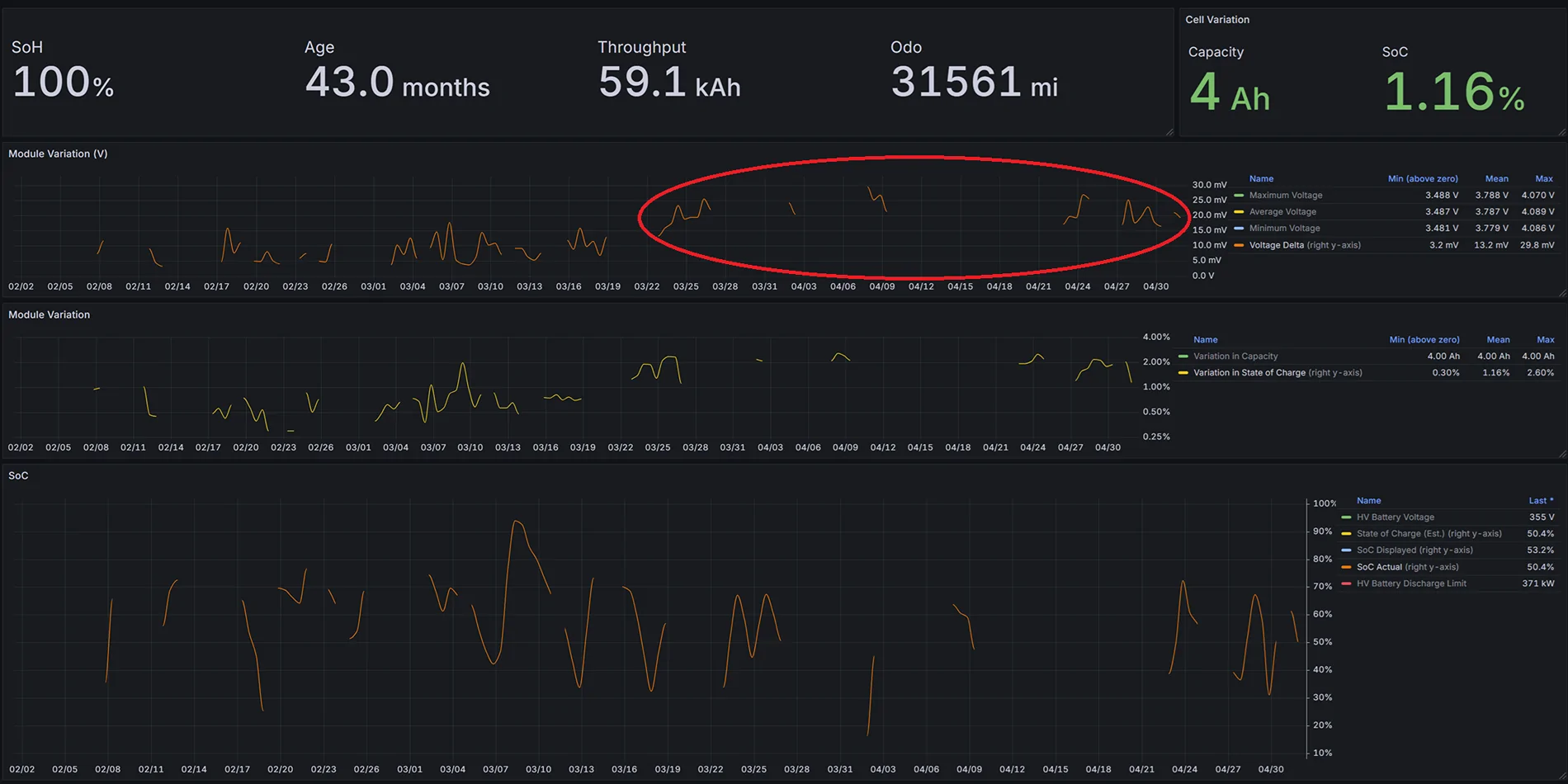
Hopefully this isn't a sign of what's to come, but my module variations made a significant shift for the worse a bit over a month ago...
Ford F-150 Lightning Battery SOH - bragging rights or bullshit? 1777734146711-n7
Sponsored


chl

Well-known member
First Name
CHRIS
Joined
Dec 16, 2022
Threads
9
Messages
3,429
Reaction score
2,091
Location
alexandria virginia
Vehicles
2023 F-150 LIGHTNING, 2012 Nissan Leaf, 2015 Toyota Prius, 2000 HD 883 Sportster
Occupation
Patent Atty / Electrical Engineer
Hopefully this isn't a sign of what's to come, but my module variations made a significant shift for the worse a bit over a month ago...

1777734146711-n7.webp
Sorry my eyes have trouble reading the small features and numbers on your graph, what is the module variation quantity in volts - it looks like the numbers on the right say there is a 3.2mV delta?

I believe that is a good number. :)

Not sure what the threshold is for 'trouble' - I read somewhere it'd be around 40mV to 50mV delta.

Some small cell voltage variations can just indicate the limitations of our passive balancing, which happens during charging and even some time after charging they say, and the delta may vary from charge to charge.

I think if your delta continued to get larger rapidly approaching the 40mV-50mV threshold, that would be an indication of a failing cell or cells.

With over 3 years and 31k miles 3.2mV is not bad I think...but maybe others with similar mileage can weigh in and give us some more data points?
 

chl

Well-known member
First Name
CHRIS
Joined
Dec 16, 2022
Threads
9
Messages
3,429
Reaction score
2,091
Location
alexandria virginia
Vehicles
2023 F-150 LIGHTNING, 2012 Nissan Leaf, 2015 Toyota Prius, 2000 HD 883 Sportster
Occupation
Patent Atty / Electrical Engineer
PS: To put my numbers into perspective...

My truck is a 2023 Pro with an SR battery, manufactured in Oct 2023, bought in Jan 2024.
It has under 3500 miles on it.
I never DC charged it.
A couple times it got charged to 100% by accident after an OTA changed things, but for the first 1-1/2 years I charged to 80% at 48A max.
Now I usually charge to 90% at 32A max so I have a bit more in case of a utility outage.
It lives outdoors but I keep it plugged in to my FCSP in cold weather (below 40F).
Mostly do local driving, rarely over 45mph.
---
Always on a 12v battery NOCO GENIUS1 maintainer now since the summer of 2024 when an OTA failed.

Had a small screw in one tire that I patched successfully - other than that, no issues except with the FCSP software setup that was finicky until an update in March 2025 fixed it.

I am set up for PPOB to GENERAC transfer switch for house backup in an outage since June 2025 - but so far haven't had one. It'll be worth the $600 it cost me if it ever happens.

Did some FORscan tweaks for the headlights, chimes, etc. which improved my sense of satisfaction with the Lightning.
 

mr.Magoo

Well-known member
Joined
May 27, 2022
Threads
26
Messages
1,116
Reaction score
1,413
Location
Michigan
Vehicles
2022 Lariat ER, AMB
Sorry my eyes have trouble reading the small features and numbers on your graph, what is the module variation quantity in volts - it looks like the numbers on the right say there is a 3.2mV delta?
It used to be between 3-15mV but as of a month ago it's between 15-30mV.

The FDRS battery report said:
Exceeds .030 volt threshold from average, Cell:
I ran that report in January so there was no deviation to speak of, but if I notice it going over 30mV I'll probably run another one just to see what it looks like.
 
  • Wow
Reactions: chl

chl

Well-known member
First Name
CHRIS
Joined
Dec 16, 2022
Threads
9
Messages
3,429
Reaction score
2,091
Location
alexandria virginia
Vehicles
2023 F-150 LIGHTNING, 2012 Nissan Leaf, 2015 Toyota Prius, 2000 HD 883 Sportster
Occupation
Patent Atty / Electrical Engineer
It used to be between 3-15mV but as of a month ago it's between 15-30mV.


I ran that report in January so there was no deviation to speak of, but if I notice it going over 30mV I'll probably run another one just to see what it looks like.
:sadface:

Yes, doubling to 30mV and approaching the threshold is concerning.

I wonder what the threshold is for Ford to do a module replacement, or do you just have to wait for the failure messages?
 

Sponsored

electricpig

Well-known member
First Name
Tim
Joined
Sep 10, 2024
Threads
1
Messages
245
Reaction score
289
Location
Northwest Arkansas
Vehicles
23 F150 Lightning XLT, Tesla Y
PS: To put my numbers into perspective...

My truck is a 2023 Pro with an SR battery, manufactured in Oct 2023, bought in Jan 2024.
It has under 3500 miles on it.
I never DC charged it.
A couple times it got charged to 100% by accident after an OTA changed things, but for the first 1-1/2 years I charged to 80% at 48A max.
Now I usually charge to 90% at 32A max so I have a bit more in case of a utility outage.
It lives outdoors but I keep it plugged in to my FCSP in cold weather (below 40F).
Mostly do local driving, rarely over 45mph.
---
Always on a 12v battery NOCO GENIUS1 maintainer now since the summer of 2024 when an OTA failed.

Had a small screw in one tire that I patched successfully - other than that, no issues except with the FCSP software setup that was finicky until an update in March 2025 fixed it.

I am set up for PPOB to GENERAC transfer switch for house backup in an outage since June 2025 - but so far haven't had one. It'll be worth the $600 it cost me if it ever happens.

Did some FORscan tweaks for the headlights, chimes, etc. which improved my sense of satisfaction with the Lightning.
IMHO, I just think you need to charge to 100% and let it sit plugged in fully charged for several hours (in moderate temps) to let the ceels balance. Then run it down to around 10% as quickly as reasonable, and repeat to 100% as above. That is the method to fully rebalance and recalibrate that I have read the electrical engineer that works with Martin Meeks. Martin rebuilds Lightnings.
 
Last edited:

chl

Well-known member
First Name
CHRIS
Joined
Dec 16, 2022
Threads
9
Messages
3,429
Reaction score
2,091
Location
alexandria virginia
Vehicles
2023 F-150 LIGHTNING, 2012 Nissan Leaf, 2015 Toyota Prius, 2000 HD 883 Sportster
Occupation
Patent Atty / Electrical Engineer
IMHO, I just think you need to charge to 100% and let it sit plugged in fully charged for several hours (in moderate temps) to let the ceels balance. Then run it down to around 10% as quickly as reasonable, and repeat to 100% as above. That is the method to fully rebalance and recalibrate that I have read the electrical engineer that works with Martin Meeks. Martin rebuilds Lightnings.
Yea, I've heard that before.
And I have seen a couple Martin Meeks rebuild videos, but I don't recall the name of an EE who works with him or reading anything about the balancing proceedure by someone associtiated with Meeks - got a link?

An AI search result may tell you to do that same thing, charge to 100% once a month, etc.
I don't think it is absolutely necessary but it is not going to hurt much.

Ford recommends charging to 90% for daily use, 100% only when long trips are planned.

Ford has not revealed all the details of their cell balancing program, but since they recommend 90% one would think/hope that would be adequate for balancing and battery health.

Ford warrants the battery for 8 years and 100k miles, so they have skin in the game of keeping the battery healthy.

If the charging to 100% etc process once a month was "necessary" for battery longevity, I'd expect Ford to say so and recommend it.

We all know frequent charging to 100% will cause degrading of the battery faster than not.
But once a month to 100% is probably not going to do any measurable harm to the battery, if you want to do it.

It may help re-calibrate the guess-o-meter, but that is not a concern of mine, I pretty much ignore the range estimate.

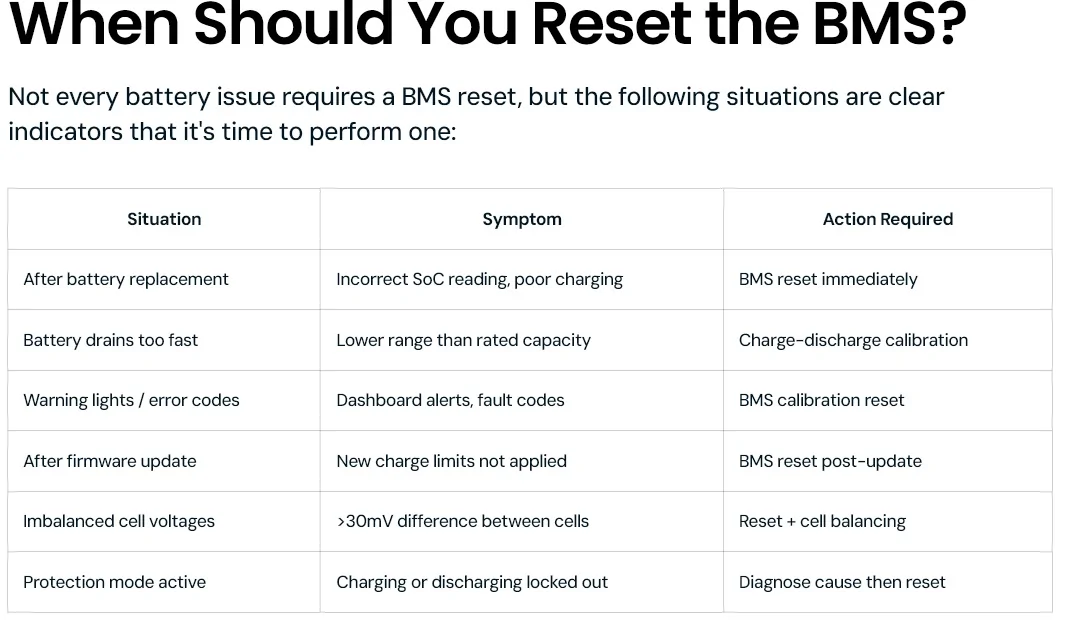
If the BMS really needs re-calibration/reset, because of drift or whatever, there should be tell-tales signs.

Ford F-150 Lightning Battery SOH - bragging rights or bullshit? when to reset bms


There are several methods I have read about for reset/recalibration/rebalancing.

----
NOTE: I have not verified these methods so attempt them at your own risk.

One methods says, first charge to 100% and let it sit there for some period of time still plugged in, a couple of hours at least. Then you discharge down to a safe low level like 20% and let it sit for several hours - that's a lot of driving, more than I usually do. Then you charge back up to 100%.

Another method is to take it down to 10% and let it sit there for some time with the truck ON in ACC mode, then charge to 100% and drive around a to let the BMS relearn the battery level.

The HVBMS might also be reset using an OBD tool and FORscan or FDRS according to internet sources.

There is also a battery pack re-balancing procedure accessible in FORscan or FDRS according to internet sources.

NOTE: I have not verified these methods so attempt them at your own risk.

----

But I think that since cell balancing occurs during charging, and takes time (because the discharge current of the stronger cells through resistance to match the weaker cells has to be limited), a slow charge to 80% or 90% ought to be good enough to achieve good balancing results in theory.

----

MY RESULTS:

So far, I see barely any delta in my battery from CarScanner readings.

For the first 1-1/2 years, I only charged my Pro SR at 48A max and only to 80%.
I have only charged to 100% by accident one or two times since I got the truck in Jan 2024.
So far, I never needed or did any DC fast charging.

While I do have low mileage (under 3500) and have just under 10 full charge cycles, if not going to 100% once a month was an big issue, I think I would see some cell imbalances by now.
But I don't.

I recently lowered my max amps to 32A which is adequate to charge to what I need within the 4 hour off peak rate time, 1AM to 5AM, so my charging is even 'slower' now.

Higher current means higher heat losses in wires, AC-DC conversion, etc. due to I^2xR (current squared times resistance) so to save a few pennies over the long haul, I reduce the max current.

---

Now, IF I saw a greater than 30mV delta, I'd probably try on of the methods above.

(I am also an electrical engineer with a masters degree and a JD, and I have worked in the patent field since 1985.)
 

mr.Magoo

Well-known member
Joined
May 27, 2022
Threads
26
Messages
1,116
Reaction score
1,413
Location
Michigan
Vehicles
2022 Lariat ER, AMB
Higher current means higher heat losses in wires, AC-DC conversion, etc. due to I^2xR (current squared times resistance) so to save a few pennies over the long haul, I reduce the max current.
Except that you're not saving anything, quite the opposite.
Didn't we just cover this ?

Besides, my great grandmother's second cousin was a pet sitter for Edisons cat "Watts" so I know a thing or two about electricity as well.
 

electricpig

Well-known member
First Name
Tim
Joined
Sep 10, 2024
Threads
1
Messages
245
Reaction score
289
Location
Northwest Arkansas
Vehicles
23 F150 Lightning XLT, Tesla Y
Yea, I've heard that before.
And I have seen a couple Martin Meeks rebuild videos, but I don't recall the name of an EE who works with him or reading anything about the balancing proceedure by someone associtiated with Meeks - got a link?

An AI search result may tell you to do that same thing, charge to 100% once a month, etc.
I don't think it is absolutely necessary but it is not going to hurt much.

Ford recommends charging to 90% for daily use, 100% only when long trips are planned.

Ford has not revealed all the details of their cell balancing program, but since they recommend 90% one would think/hope that would be adequate for balancing and battery health.

Ford warrants the battery for 8 years and 100k miles, so they have skin in the game of keeping the battery healthy.

If the charging to 100% etc process once a month was "necessary" for battery longevity, I'd expect Ford to say so and recommend it.

We all know frequent charging to 100% will cause degrading of the battery faster than not.
But once a month to 100% is probably not going to do any measurable harm to the battery, if you want to do it.

It may help re-calibrate the guess-o-meter, but that is not a concern of mine, I pretty much ignore the range estimate.

If the BMS really needs re-calibration/reset, because of drift or whatever, there should be tell-tales signs.

when to reset bms.webp


There are several methods I have read about for reset/recalibration/rebalancing.

----
NOTE: I have not verified these methods so attempt them at your own risk.

One methods says, first charge to 100% and let it sit there for some period of time still plugged in, a couple of hours at least. Then you discharge down to a safe low level like 20% and let it sit for several hours - that's a lot of driving, more than I usually do. Then you charge back up to 100%.

Another method is to take it down to 10% and let it sit there for some time with the truck ON in ACC mode, then charge to 100% and drive around a to let the BMS relearn the battery level.

The HVBMS might also be reset using an OBD tool and FORscan or FDRS according to internet sources.

There is also a battery pack re-balancing procedure accessible in FORscan or FDRS according to internet sources.

NOTE: I have not verified these methods so attempt them at your own risk.

----

But I think that since cell balancing occurs during charging, and takes time (because the discharge current of the stronger cells through resistance to match the weaker cells has to be limited), a slow charge to 80% or 90% ought to be good enough to achieve good balancing results in theory.

----

MY RESULTS:

So far, I see barely any delta in my battery from CarScanner readings.

For the first 1-1/2 years, I only charged my Pro SR at 48A max and only to 80%.
I have only charged to 100% by accident one or two times since I got the truck in Jan 2024.
So far, I never needed or did any DC fast charging.

While I do have low mileage (under 3500) and have just under 10 full charge cycles, if not going to 100% once a month was an big issue, I think I would see some cell imbalances by now.
But I don't.

I recently lowered my max amps to 32A which is adequate to charge to what I need within the 4 hour off peak rate time, 1AM to 5AM, so my charging is even 'slower' now.

Higher current means higher heat losses in wires, AC-DC conversion, etc. due to I^2xR (current squared times resistance) so to save a few pennies over the long haul, I reduce the max current.

---

Now, IF I saw a greater than 30mV delta, I'd probably try on of the methods above.

(I am also an electrical engineer with a masters degree and a JD, and I have worked in the patent field since 1985.)
It was just n a podcast they were doing that I happened to see. They said the wires to balance the cells were absolutely tiny and could carry very little energy, therefore it took several hours of "resting" after reading 100% to balance cells at a mint. So he was saying to let it sit at 100 for 4-6 hours at least before driving, but don't let it sit at 100 for days especially in the heat of summer. He also said he was charging his to 100 at least once a month, but he also drives allot, so that could be a factor in frequency. In another instance I though he said he has 145K on his SR Lightning, but I'm not certain I heard it correctly. Believe it or not, doesn't matter to me. Just spreading what I was lucky enough to tune into, and the reasoning behind it.
 
  • Like
Reactions: chl

chl

Well-known member
First Name
CHRIS
Joined
Dec 16, 2022
Threads
9
Messages
3,429
Reaction score
2,091
Location
alexandria virginia
Vehicles
2023 F-150 LIGHTNING, 2012 Nissan Leaf, 2015 Toyota Prius, 2000 HD 883 Sportster
Occupation
Patent Atty / Electrical Engineer
Except that you're not saving anything, quite the opposite.
Didn't we just cover this ?

Besides, my great grandmother's second cousin was a pet sitter for Edisons cat "Watts" so I know a thing or two about electricity as well.
The wasted/lost energy due to resistance is in the wiring and the AC-DC converter as well as internally to the battery.

The quantity of lost energy is dependent on current and goes up with the square of the current and the length of time.

It is why the utilities step up the voltage on transmission lines so they can deliver the same energy with less loss due to transmission wire resistance.

If we do the math, current x current x resistance = power; x time = energy lost so assuming 1 ohm resistance and 1 hour time, to make the math easier:

1 ohm x 80 amps x 80amps x 1 hour = 6.4kWh
1 ohm x 32 amps x 32 amps x 1 hour = 1.024kWh

That should make it clear that considerably more energy is lost to resistance at 80 amp compared with 32 amps.

Power can also be expressed as current x voltage, and using the EVSE L2 level of 240 volts:

240 volts x 32 amps = 7.68kW

The energy is the power x time, so in 1 hour that is 1h x 7.68kW = 7.68kWh

But we have to subtract the losses due to 1 ohm in one hour to get the energy transferred to your truck at 32 amps:

7.68kWh - 1.024kWh = 6.656kWh transferred to the truck in 1 hour at 32A.

At the higher current, 240 volts x 80 amps = 19.2kW is the power and in 1 hour 19.2kWh is the energy produced.

Subtracting the loss due to 1 ohm resistance, in one hour: 19.2kWh - 6.4kWh = 12.8kWh is transferred to the truck.

12.8kWh/6.656kWh = 1.92 which means the energy is transferred about twice as fast at 80A than at 32A, so it takes about twice as long to transfer the same amount of energy.

So, suppose we want to add about 12.8kWh to the truck.

It takes about 1 hour at 80 amps with 6.4kWh lost to heat using our values.

At 32 amps it takes about 2 hours with 2 x 1.024kW = 2.048kWh lost to heat.

So the energy lost due to resistance is about significantly larger at 80 amps than at 32 amps.

We could get exact and plug in the resistance per foot of the wire etc. if we wanted to - I may at some point.

I have about 75ft run from the service panel to the FCSP.
You may have a lot less so your wire resistance losses could be a lot less, I don't know.

For any given session it may only be a small amount of cost in wasted energy.

Currently, I pay about 15 cents per kwh, but over time it adds up - and rates will probably rise due to data centers' demand and fuel costs.

Bottom line if the additional time spent charging is important and worth the additional kWh cost, then use the higher current.
 

Sponsored

chl

Well-known member
First Name
CHRIS
Joined
Dec 16, 2022
Threads
9
Messages
3,429
Reaction score
2,091
Location
alexandria virginia
Vehicles
2023 F-150 LIGHTNING, 2012 Nissan Leaf, 2015 Toyota Prius, 2000 HD 883 Sportster
Occupation
Patent Atty / Electrical Engineer
It was just n a podcast they were doing that I happened to see. They said the wires to balance the cells were absolutely tiny and could carry very little energy, therefore it took several hours of "resting" after reading 100% to balance cells at a mint. So he was saying to let it sit at 100 for 4-6 hours at least before driving, but don't let it sit at 100 for days especially in the heat of summer. He also said he was charging his to 100 at least once a month, but he also drives allot, so that could be a factor in frequency. In another instance I though he said he has 145K on his SR Lightning, but I'm not certain I heard it correctly. Believe it or not, doesn't matter to me. Just spreading what I was lucky enough to tune into, and the reasoning behind it.
Thanks for the reply, interesting.

Yes, I'm not saying it doesn't work, just that I don't think it is absolutely necessary.

The difference between 80%, 90% and 100% charging for balancing effects may be minimal, who knows?

And besides, we have a buffer of battery anyway so we never REALLY charge to 100% because of it.

So, I'm not going to go out of my way to do the charge to 100% every month routine...unless I see some kind of delta. :)
 

potato

Well-known member
First Name
John
Joined
Feb 1, 2024
Threads
0
Messages
494
Reaction score
725
Location
BC, Canada
Vehicles
2023 F150 Lightning XLT ER
If we do the math, current x current x resistance = power; x time = energy lost so assuming 1 ohm resistance and 1 hour time, to make the math easier:

1 ohm x 80 amps x 80amps x 1 hour = 6.4kWh
1 ohm x 32 amps x 32 amps x 1 hour = 1.024kWh
I feel like if you are dissipating 1 kW (or 6 kW!!!) as heat in your wires, you have some bigger problems somewhere lol. (That 1 ohm number must be way too high.)

The principle is sound of course. Higher current = higher power loss. BUT there is also fixed overhead to run pumps, fans etc. in the truck during charging. So higher current shortens the overall time therefore the overall loss due to the fixed overhead. There's probably some optimum rate where the two lines would cross on a graph.
 

chl

Well-known member
First Name
CHRIS
Joined
Dec 16, 2022
Threads
9
Messages
3,429
Reaction score
2,091
Location
alexandria virginia
Vehicles
2023 F-150 LIGHTNING, 2012 Nissan Leaf, 2015 Toyota Prius, 2000 HD 883 Sportster
Occupation
Patent Atty / Electrical Engineer
I feel like if you are dissipating 1 kW (or 6 kW!!!) as heat in your wires, you have some bigger problems somewhere lol. (That 1 ohm number must be way too high.)

The principle is sound of course. Higher current = higher power loss. BUT there is also fixed overhead to run pumps, fans etc. in the truck during charging. So higher current shortens the overall time therefore the overall loss due to the fixed overhead. There's probably some optimum rate where the two lines would cross on a graph.
Yes, true, I just used 1 ohm for math convenience, the #6awg wire used for 80A install has a lot less resistance than 1 ohm.

I think 100 feet has a resistance of somewhere around 0.05 ohms, two hots means twice that around 1/10th of an ohm.

If you use smaller diameter wire for the install for 48A or 32A, you save money on the wire cost upfront, but the smaller wire has a higher resistance so at the lower current more would be wasted that with larger diameter wire.

Always trade offs.

In a residential single charger install they maybe small differences, in an industrial setting those things have to be taken into account.

And I agree if time is most important, use a faster rate/higher current.

I was just taking issue with the idea that higher current has no effect on the energy wasted.

There are other reasons to use a lower current besides the wasted energy.

The heat inside the FCSP at higher currents (80A) has been an issue for some - even if torqued correctly, the heating and cooling effects over time cause expanding and contracting can loosen connections, and the FCSP does not have a fan or other active cooling mechanism (it will slow down the charge speed if things get too hot though).

Less stress on the breaker, the charge port, the battery, etc., too.

The longer charge time at a lower current gives the truck more time to charge the 12v battery, and more time for the passive balancing the HVB (in theory).

Not sure what the fixed over head number is, but yes there is some for sure.

I do see a very small difference in energy used vs added to the battery between 48A and 32A when I have a longer charge time. Usually I do small percentage charges though rarely even 20% (70 to 90), and I have the SR 98kWh battery.

Anyway, little things add up over time.
 

mr.Magoo

Well-known member
Joined
May 27, 2022
Threads
26
Messages
1,116
Reaction score
1,413
Location
Michigan
Vehicles
2022 Lariat ER, AMB
I was just taking issue with the idea that higher current has no effect on the energy wasted.
No one said that, ever !

The only thing we've said is that the cost (in energy consumption) to keep the truck alive longer (by charging with a lower current) outweighs any gains from reduced losses in cabling, etc.

If you chose to charge with a lower current, that's your choice, and you have your reasons that are as good as any...

But people are not saving money by charging slower, so it would be incorrect to tell them so.
 

electricpig

Well-known member
First Name
Tim
Joined
Sep 10, 2024
Threads
1
Messages
245
Reaction score
289
Location
Northwest Arkansas
Vehicles
23 F150 Lightning XLT, Tesla Y
Thanks for the reply, interesting.

Yes, I'm not saying it doesn't work, just that I don't think it is absolutely necessary.

The difference between 80%, 90% and 100% charging for balancing effects may be minimal, who knows?

And besides, we have a buffer of battery anyway so we never REALLY charge to 100% because of it.
I personally don't charge to 100% monthly w
So, I'm not going to go out of my way to do the charge to 100% every month routine...unless I see some kind of delta. :)
Thanks for the reply, interesting.

Yes, I'm not saying it doesn't work, just that I don't think it is absolutely necessary.

The difference between 80%, 90% and 100% charging for balancing effects may be minimal, who knows?

And besides, we have a buffer of battery anyway so we never REALLY charge to 100% because of it.

So, I'm not going to go out of my way to do the charge to 100% every month routine...unless I see some kind of delta. :)
FWIW, I don't charge to 100% unless I'm going on a trip outside my usual sphere. Example, a.friend that lives about 80 to 90 miles away, family that is 100 plus miles, etc. I want to be sure to use the extra charge above the 80% I typically charge to. Really, I have probably fully followed their criteria only a few times.

However I was responding to the person that appears to be having balancing issues. Their responses.suggested to me that they had never changed to 100% for balancing. So for that person, it seems prudent to give it a go to see if it improves their situation, or flushes out another problem.
Sponsored

 
  • Like
Reactions: chl


Top