

Sponsored

Can't get full 80Amps out of Tesla Gen 2... How to monitor the J1772 negotiation??

mr.Magoo

Well-known member
Joined
May 27, 2022
Threads
26
Messages
1,088
Reaction score
1,384
Location
Michigan
Vehicles
2022 Lariat ER, AMB
My only point is simply that higher current is not more energy efficient.
But thats the whole point - you're making that conclusion based on the presumption that higher current equals higher energy loss (i.e. voltage drop) in the the cables feeding your EVSE and from the EVSE to the truck.

While this would be the correct conclusion IF, and only IF, all other parameters (including time) are constants.

The problem is - they're not.

Even if you look at it from a favorable (to your point of view) position, say we take a 80A 3AWG install and we run it at 40A instead, your voltage drop is now 1V vs. 2V so you "save" 120W. (in reality people would probably use 6AWG so your drop / losses are higher and your "savings" as a result are even lower).

But the truck is using about 200W to keep things alive during charging and now you're charging twice as long, so you're using 2.9kWh (12h x 200W + 40W) as "overhead" in the 40A scenario to charge your truck from 10% to 80%, but you'll use 2.2kWh (6h x 200W + 160W) in the 80A scenario.

So yes, your thermal losses are lower with lower charging current, but that doesn't make it more energy efficient since there's overhead to account for.
Sponsored

 

garsh

Well-known member
First Name
Brad
Joined
Dec 28, 2025
Threads
0
Messages
59
Reaction score
61
Location
Pittsburgh
Vehicles
2023 Ford F-150 Lightning Lariat
My only point is simply that higher current is not more energy efficient.
You keep assuming that the majority of the losses are ohmic (I²•R). They are not. The fixed losses by the on-board charger are much higher.
 

ZSC100

Well-known member
First Name
Zach
Joined
Mar 29, 2023
Threads
9
Messages
641
Reaction score
765
Location
Tulsa, OK
Vehicles
2022 F150 Lightning SR EG 311A
Occupation
Electrical Engineer
You keep assuming that the majority of the losses are ohmic (I²•R). They are not. The fixed losses by the on-board charger are much higher.
The fixed losses are indeed huge. Try doing a 5-hour update, You need a 100Amp battery charger min, No joke, this blew my mind, The truck was using 12V x 80A for 5 hours straight. Just to update a module via CAN. The fixed losses are huge.
 

Maquis

Well-known member
First Name
Dave
Joined
May 20, 2021
Threads
9
Messages
4,342
Reaction score
5,815
Location
Illinois
Vehicles
2021 Mach-E E4-X; 2023 Lightning Lariat ER
The fixed losses are indeed huge. Try doing a 5-hour update, You need a 100Amp battery charger min, No joke, this blew my mind, The truck was using 12V x 80A for 5 hours straight. Just to update a module via CAN. The fixed losses are huge.
The power required to apply updates vs the power used by the truck while charging isn’t a valid comparison. In the first case, every module affected by the update is running, but while charging, only the modules required to charge are powered.
 

ZSC100

Well-known member
First Name
Zach
Joined
Mar 29, 2023
Threads
9
Messages
641
Reaction score
765
Location
Tulsa, OK
Vehicles
2022 F150 Lightning SR EG 311A
Occupation
Electrical Engineer
Partially true, but the coolant pumps, DCDC are a lot.
 

mr.Magoo

Well-known member
Joined
May 27, 2022
Threads
26
Messages
1,088
Reaction score
1,384
Location
Michigan
Vehicles
2022 Lariat ER, AMB
So, I thought I'd make a little experiment....

tldr;
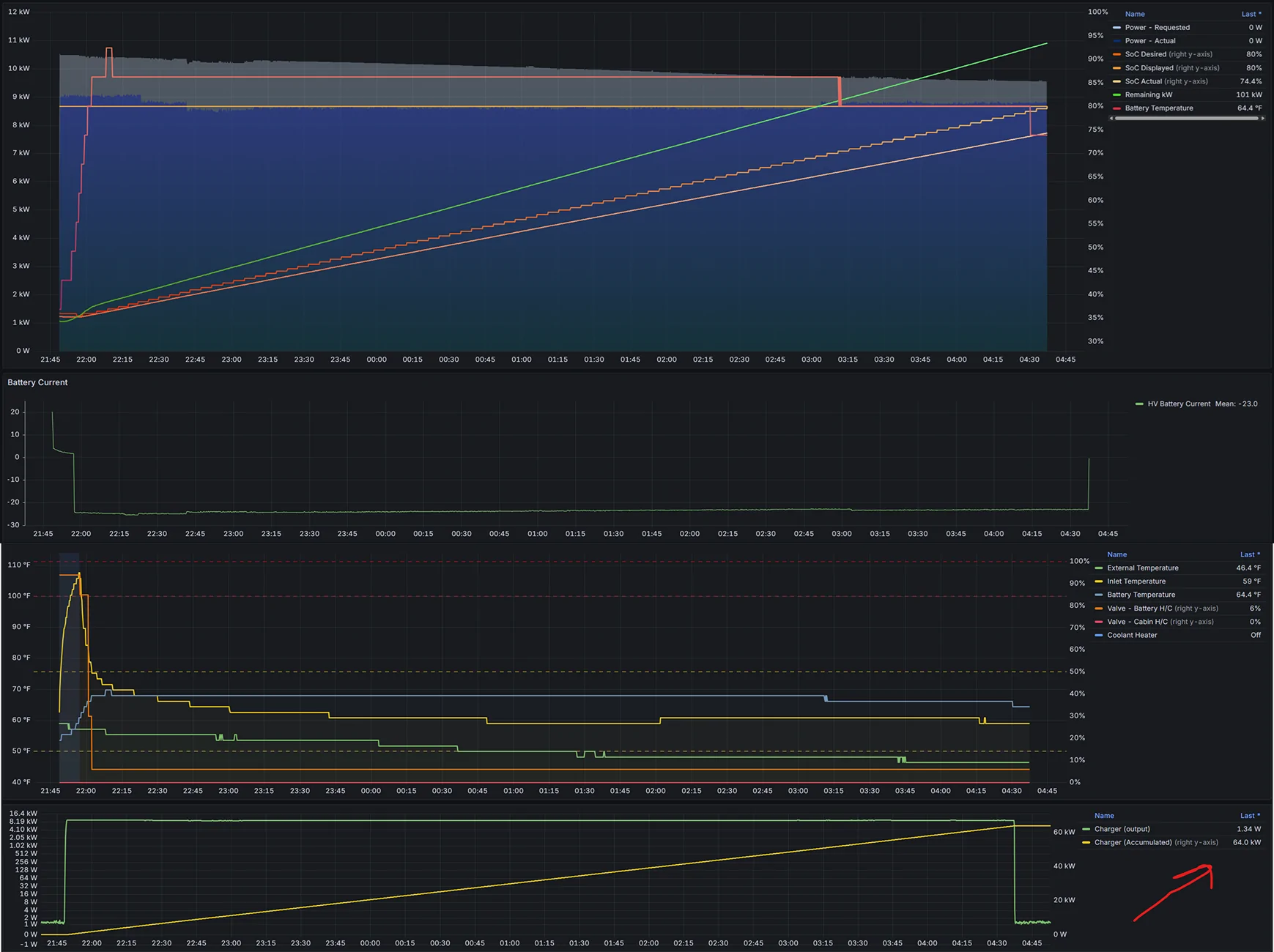
@9kWh charging rate you're using 62.7kWh (or 64 if you account for the heater) to gain 59kWh
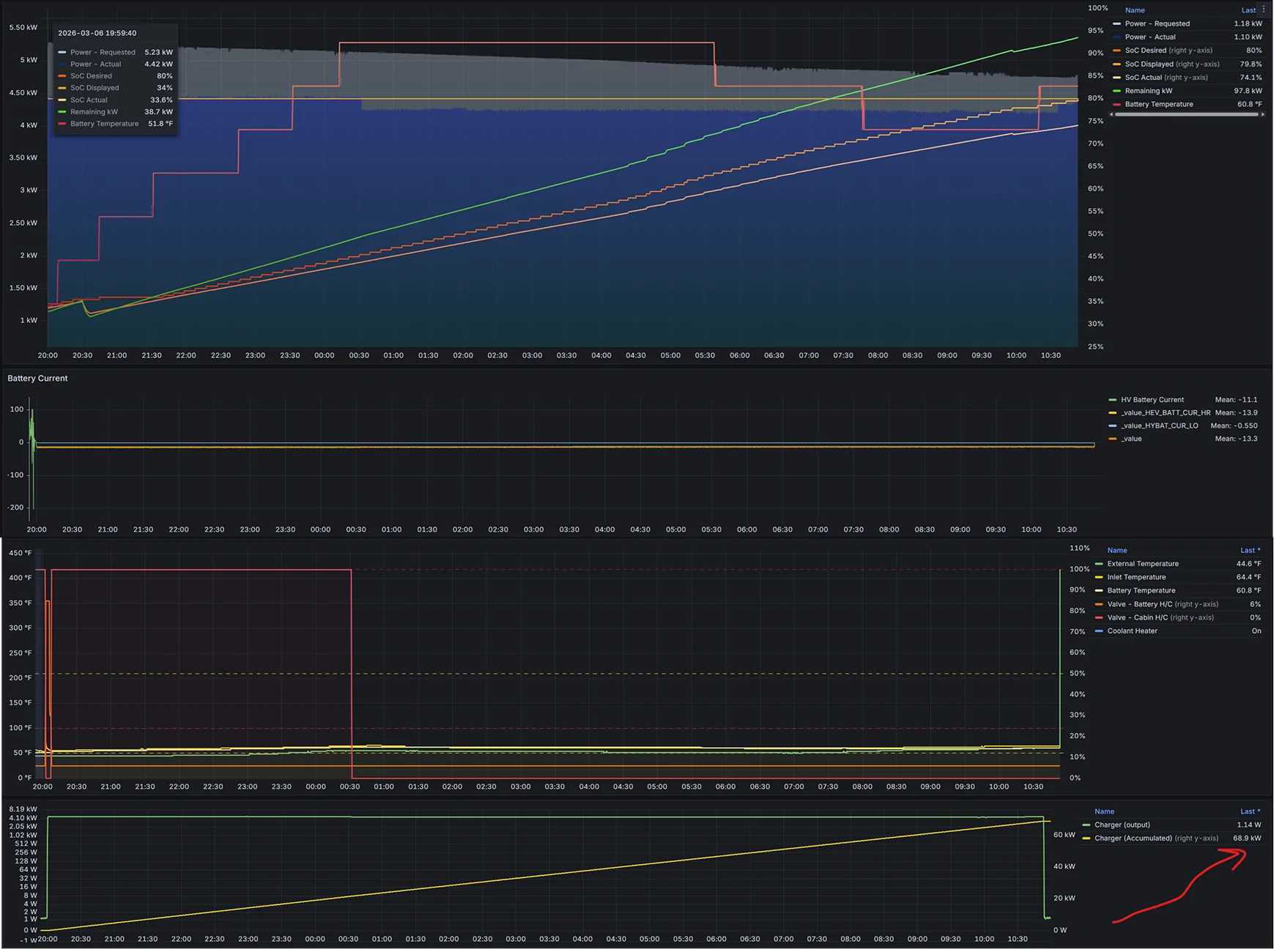
@4.5kWh charging rate you're using 68.9kWh to gain 59kWh

While charging at a higher rate will create more/higher thermal losses they will in no way outweigh the additional "cost" in energy of keeping the truck awake longer, proving that charging at a higher rate IS more efficient overall.


Both cases are essentially the same, a charge from 35 >> 80% under similar conditions, one last year @9kWh and one last night at 4.5kWh, with the main difference that last years charge was using the heater for the first 10min, so about 1.3-1.4kWh is "lost" to the heater.

But, as you can see, last year it charges at 9kW (charger set to 40A breaker) the whole time.
@9kWh charging from 35% (42kWh remaining) to 80% (101kWh remaining) used a total of 64kWh (yellow line in the last chart, which is a IotaWatt device on the charger supply in the panel itself).

2nd chart was last night night and it's charging with 4.5kWh (charger set to 20A breaker)
@4.5kWh charging from 34% (38.7kWh remaining) to 80% (98.7kWh remaining) used a total of 68.9kWh


Another interesting thing I noticed is that at 80% SoC it used to be 101kWh remaining, now it's 98kWh, that's a drop of 3kWh which just happens to match the 3kWh "dip" / flatline that I see after 30min. https://www.f150lightningforum.com/...-your-soc-about-30min-into-your-charge.35225/

And interestingly enough, that dip (seen in 2nd graph) is:
A) still present at a lower charge rate
and
B) still happens after exactly 30min.


Ford F-150 Lightning Can't get full 80Amps out of Tesla Gen 2... How to monitor the J1772 negotiation?? 1772902337237-1a


Ford F-150 Lightning Can't get full 80Amps out of Tesla Gen 2... How to monitor the J1772 negotiation?? 1772900593360-94
Sponsored


Top