

Sponsored

Bonus KWh when fully charged to 100%

MountainAlive

Well-known member
Joined
Apr 18, 2024
Threads
50
Messages
858
Reaction score
1,559
Location
Massachusetts, USA
Vehicles
2023 F-150 Lighting Lariat ER 512A Max Tow
I decided to use the Car Scanner app to see if I could gauge how much bonus juice you get when you charge to complete 100%. I’m sure everyone has had this experience of starting out at 100% and you’re driving for what feels like 20-30 minutes and it’s still at 100%.

Full charge SOC reading:
131.07 kWh
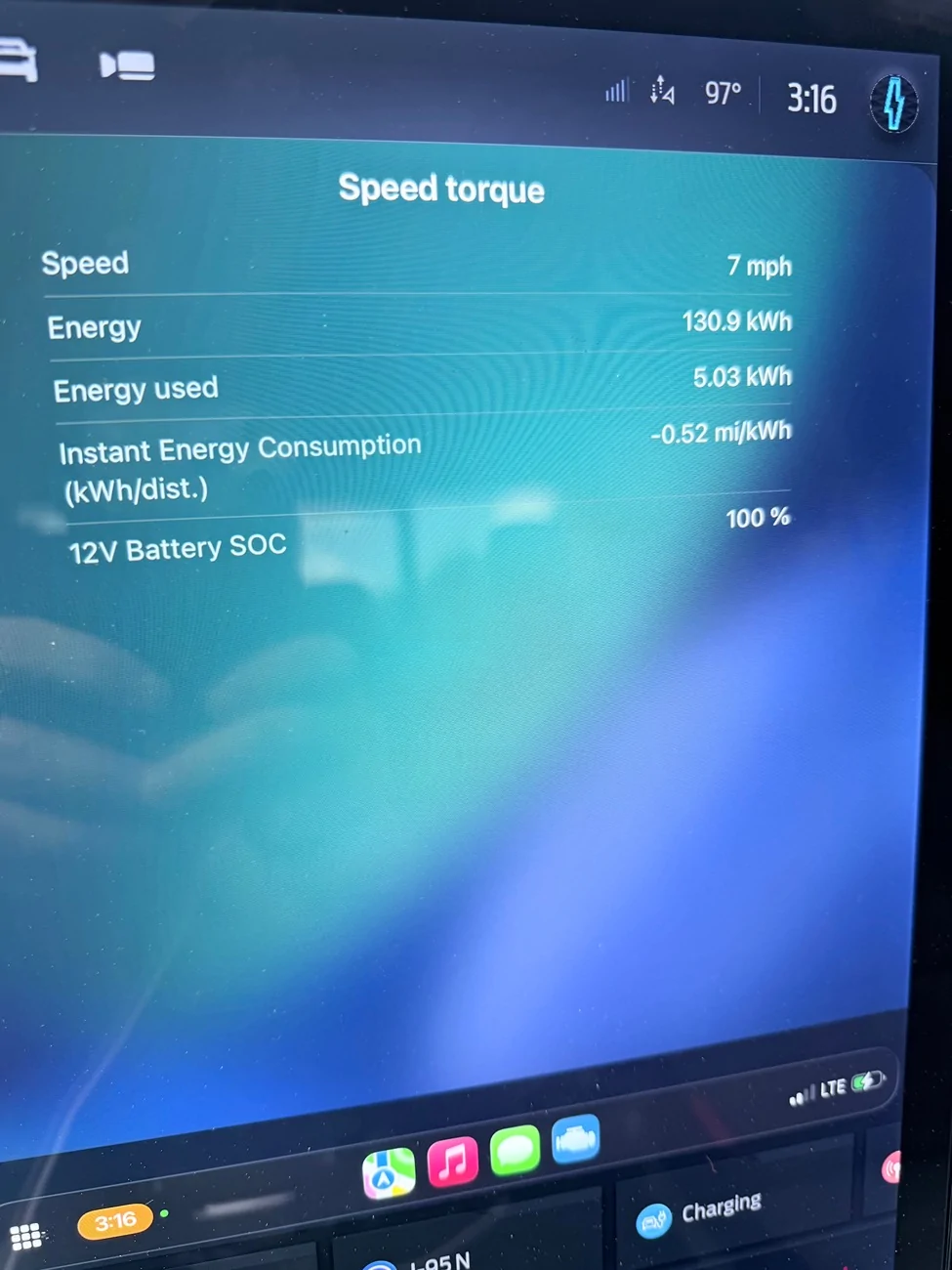
Energy used/driven until it finally started to dip below 131.07 / 100% SOC on the dash
~5 kWh

So in reality, it seems the extended range starting point is actually closer to 136kwh. Is this pretty much what others are seeing?

I took a pic of the energy used during the drive as it just started to dip below 131.07 (which it held for about 12 miles).

Ford F-150 Lightning Bonus KWh when fully charged to 100% IMG_6001
Sponsored


Aminorjourney

Well-known member
First Name
Nikki
Joined
Jun 6, 2022
Threads
21
Messages
437
Reaction score
1,106
Location
Internet
Website
www.transportevolved.com
Vehicles
2023 F150 Lightning Lariat, 2017 Chevrolet Bolt EV, 2006 Vectrix VX-1
So here's my theory, and fair warning, it complicates that clean 136 number a little.

The 131.07 the truck shows you is the usable nameplate figure, not a live readout of what's actually in the pack — gross capacity on the ER is somewhere around 144–145 kWh, with roughly 13–14 kWh of buffer split top and bottom. So that ~5 kWh you burned while it sat pinned at 100% is coming out of the top reserve that normally lives above the displayed ceiling. You're not starting at 136 in any way you can plan around; you're catching a peek at the buffer because the gauge holds at 100% coming off a full balance charge. (FWIW there's a thread on here where someone ran the same test and calculated ~134.5, so you're right in the expected band — nothing weird going on.)

The more interesting part: I think Ford progressively releases that hidden reserve as the pack ages, so the reported capacity and range stay high even as the cells quietly lose a bit underneath. That's a theory, not confirmed by Ford, but it lines up neatly with the 3-year range tests showing negligible loss.

There's also genuine SOC drift in play. Coulomb counting accumulates error over partial cycles, then the BMS recalibrates whenever you take it to a true 100%. So if you mostly charge to 80–90%, a little drift creeps in, and the next full charge snaps it back.

And underneath all of it is the Mr. Scott methodology: "A good engineer is always a wee bit conservative, at least on paper." The truck says 100% when the battery says it's still got room for more. 😉
 

Shmoe

Well-known member
First Name
Mike
Joined
Jun 30, 2025
Threads
3
Messages
310
Reaction score
478
Vehicles
2024 F-150 Lightning Lariat, 2025 Rivian R1S, Sold-2020 Tesla Model 3 SR+
The more interesting part: I think Ford progressively releases that hidden reserve as the pack ages, so the reported capacity and range stay high even as the cells quietly lose a bit underneath. That's a theory, not confirmed by Ford, but it lines up neatly with the 3-year range tests showing negligible loss.
As you said this one is definitely speculation -- I feel like the opposite has been proven by people working on the car but I'm not able to dig up whatever I saw otherwise.

Smells like the EV equivalent of Dieselgate too :)
 
OP
OP
MountainAlive

MountainAlive

Well-known member
Joined
Apr 18, 2024
Threads
50
Messages
858
Reaction score
1,559
Location
Massachusetts, USA
Vehicles
2023 F-150 Lighting Lariat ER 512A Max Tow
So that ~5 kWh you burned while it sat pinned at 100% is coming out of the top reserve that normally lives above the displayed ceiling.
This is good info thanks. At the end of the day I’m glad Ford built such a huge buffer on this battery pack and went with the Mr. Scott methodology. It does seem like this could be a way to hide age related degradation over time (on the battery, not myself unfortunately).
 

RickLightning

Well-known member
Joined
Jan 17, 2022
Threads
115
Messages
7,340
Reaction score
10,085
Location
SE MI
Vehicles
'22 Lightning ER Lariat,'22 Mach-E Premium 4X
So here's my theory, and fair warning, it complicates that clean 136 number a little.

The 131.07 the truck shows you is the usable nameplate figure, not a live readout of what's actually in the pack — gross capacity on the ER is somewhere around 144–145 kWh, with roughly 13–14 kWh of buffer split top and bottom. So that ~5 kWh you burned while it sat pinned at 100% is coming out of the top reserve that normally lives above the displayed ceiling. You're not starting at 136 in any way you can plan around; you're catching a peek at the buffer because the gauge holds at 100% coming off a full balance charge. (FWIW there's a thread on here where someone ran the same test and calculated ~134.5, so you're right in the expected band — nothing weird going on.)

The more interesting part: I think Ford progressively releases that hidden reserve as the pack ages, so the reported capacity and range stay high even as the cells quietly lose a bit underneath. That's a theory, not confirmed by Ford, but it lines up neatly with the 3-year range tests showing negligible loss.

There's also genuine SOC drift in play. Coulomb counting accumulates error over partial cycles, then the BMS recalibrates whenever you take it to a true 100%. So if you mostly charge to 80–90%, a little drift creeps in, and the next full charge snaps it back.

And underneath all of it is the Mr. Scott methodology: "A good engineer is always a wee bit conservative, at least on paper." The truck says 100% when the battery says it's still got room for more. 😉
So here's why I disagree that Ford is releasing capacity as time goes on.

Yes, my Lightning battery is close to 100% after 4 years and 23,000 miles. On 3/20 it was 100% at around 22,000 miles.

But, my 4 year old Mach-E was 96.5% last I checked, but has been down to 94.5%. If Ford was releasing capacity, why is it also not at 100%?

@Aminorjourney, Ford's former VP of EVs, Darren Palmer, said a lot of things that Ford never did, including releasing more capacity based on usage (take good care of battery, you get more, take bad care, you don't), and changing charging curve for some and not others.

I believe that Ford may release capacity as a battery nears the end of its 8 year / 100,000 mile warranty if it is below or near 70%, to avoid a warranty claim.

But, I believe the reason all Lightnings have higher SOH than all Mach-Es boils down to:

- different battery packs
- different sensors, HVBJB, etc.
- different battery calibration methodology

On the Mach-E forum, Mach-Lee says "The SoC meter has hysteresis at the top end of the charge range. Has to do with the top buffer and the way the BMS estimates state of charge."
 

Sponsored

21st Century Truck

Well-known member
First Name
Martin
Joined
Jul 11, 2024
Threads
20
Messages
1,182
Reaction score
1,518
Location
Virginia
Vehicles
Ford 150 Lightning 2023 XLT ER pkg. 312A
I appreciate the OP's post and others' posts above.

It's an interesting subject.

I'll add my uninformed opinion based on some older, wiser engineers' discussions with this political science graduate:

1. All these numbers are estimates.

2. They are estimates of "electricity's potential capacity to do work" (not my words, pls see my introductory statement above).

3. Such estimates are naturally ranges of a sort, rather than a direct physical measurement of, say, weight or volume or mass, such as weight of coal, volume of fluids (gasoline), pressure of a contained gas, etc. etc.

Therefore, I am personally glad to accept such estimates in the case of our trucks' traction battery, for the lack of any other repeatable measurement.

I hope my meandering words here are of use.
 

chl

Well-known member
First Name
CHRIS
Joined
Dec 16, 2022
Threads
9
Messages
3,884
Reaction score
2,402
Location
alexandria virginia
Vehicles
2023 LIGHTNING PRO, 2012 Nissan Leaf, 2015 Toyota Prius, 2000 HD 883 Sportster
Occupation
Patent Atty / Electrical Engineer
As the battery warms, it's internal resistance lowers and the capacity appears to change and the BMS displays that.

The SOC fluctuates with temperature. Colder a lower SOC reading, warming higher SOC reading.

A similar thing happens right after charging - as the battery cools, the SOC reading may drop a few percent.

The stated usable capacity, e.g., 131kWh, is measured/determined at a temperature of 77F (25C) degrees allowing for top and bottom buffers (included in the gross capacity).
 
OP
OP
MountainAlive

MountainAlive

Well-known member
Joined
Apr 18, 2024
Threads
50
Messages
858
Reaction score
1,559
Location
Massachusetts, USA
Vehicles
2023 F-150 Lighting Lariat ER 512A Max Tow
I appreciate the OP's post and others' posts above.

It's an interesting subject.

I'll add my uninformed opinion based on some older, wiser engineers' discussions with this political science graduate:

1. All these numbers are estimates.

2. They are estimates of "electricity's potential capacity to do work" (not my words, pls see my introductory statement above).

3. Such estimates are naturally ranges of a sort, rather than a direct physical measurement of, say, weight or volume or mass, such as weight of coal, volume of fluids (gasoline), pressure of a contained gas, etc. etc.

Therefore, I am personally glad to accept such estimates in the case of our trucks' traction battery, for the lack of any other repeatable measurement.

I hope my meandering words here are of use.
I got curious and had to look up all the ways we humans monitor and measure electricity and it’s kind of amazing to be reminded of them:
Pressure: Volt (V) – How hard the electricity is being pushed.
Volume/Flow: Ampere (A) – How many electrons are passing by per second.
Friction: Ohm (Ω) – How much the wire or device slows the current down.
Quantity: Coulomb (C) – A specific bucket size of electrons (6.24 x 10¹⁸ of them).
Speed of Work: Watt (W) – How fast energy is being used right now.
Total Work: Kilowatt-hour (kWh) – The total amount of energy used over time.
Storage Capacity: Farad (F) – How much charge a component can hold onto.
Magnetic Inertia: Henry (H) – How strongly a wire resists changes in current.
Wasted AC Power: VAR (Volt-Ampere Reactive) – Power that loops back and forth without doing work.
Ease of Flow: Siemens (S) or Mho – The literal opposite of an Ohm; how easily current moves.
Wiggle Speed: Hertz (Hz) – How many times a second the current changes its mind and reverses.
 

Shmoe

Well-known member
First Name
Mike
Joined
Jun 30, 2025
Threads
3
Messages
310
Reaction score
478
Vehicles
2024 F-150 Lightning Lariat, 2025 Rivian R1S, Sold-2020 Tesla Model 3 SR+
@Aminorjourney, Ford's former VP of EVs, Darren Palmer, said a lot of things that Ford never did, including releasing more capacity based on usage (take good care of battery, you get more, take bad care, you don't), and changing charging curve for some and not others.

I believe that Ford may release capacity as a battery nears the end of its 8 year / 100,000 mile warranty if it is below or near 70%, to avoid a warranty claim.
Again, the EV equivalent of dieselgate.. it would never fly if true/discovered/proven.

It also makes very little sense. If you release the buffer, you exacerbate degradation by not having a buffer.
 

Sponsored

Bushwood CC

Well-known member
First Name
Pete
Joined
Nov 17, 2024
Threads
17
Messages
76
Reaction score
123
Vehicles
Ford Lightning Flash
Occupation
teacher
GOM has been wildly optimistic lately but I’ve been getting longer ranges to go along with it. Last week I charged to 100% for the first time in a while and the range was 346 for my 2024 Flash. I’ve not seen anything over 320 before.
 

Shmoe

Well-known member
First Name
Mike
Joined
Jun 30, 2025
Threads
3
Messages
310
Reaction score
478
Vehicles
2024 F-150 Lightning Lariat, 2025 Rivian R1S, Sold-2020 Tesla Model 3 SR+
GOM has been wildly optimistic lately but I’ve been getting longer ranges to go along with it. Last week I charged to 100% for the first time in a while and the range was 346 for my 2024 Flash. I’ve not seen anything over 320 before.
if only there was a seasonal explanation for such :)
 

chl

Well-known member
First Name
CHRIS
Joined
Dec 16, 2022
Threads
9
Messages
3,884
Reaction score
2,402
Location
alexandria virginia
Vehicles
2023 LIGHTNING PRO, 2012 Nissan Leaf, 2015 Toyota Prius, 2000 HD 883 Sportster
Occupation
Patent Atty / Electrical Engineer
I got curious and had to look up all the ways we humans monitor and measure electricity and it’s kind of amazing to be reminded of them:
Pressure: Volt (V) – How hard the electricity is being pushed. EMF-Electromotive Force
Volume/Flow: Ampere (A) – How many electrons are passing by per second. Actually in coulombs per second but a coulomb is a whole bunch of e-s
Friction: Ohm (Ω) – How much the wire or device slows the current down. Impedances/resistances reduces/restricts the amount of current getting from one end to the other, but the speed of each e- also called the drift velocity depends on other things.
Quantity: Coulomb (C) – A specific bucket size of electrons (6.24 x 10¹⁸ of them).
Speed of Work: Watt (W) – How fast energy is being used or transferred right now.
Total Work: Kilowatt-hour (kWh) – The total amount of energy used over time.
Storage Capacity: Farad (F) – How much charge a capacitance component can hold onto. (A battery for example "holds" charge differently, in electro-chemical reactions.)
Magnetic Inertia: Henry (H) – How strongly a wire resists changes in current and its ability to store energy in a magnetic field.
Wasted AC Power: VAR (Volt-Ampere Reactive) – Power that loops back and forth without doing work. The oscillating power used to create magnetic or electric fields in devices like transformers and air conditioners - but No net energy is consumed so is it really "wasted?"
Ease of Flow: Siemens (S) or Mho – The literal opposite of an Ohm; how easily current moves through a given material, conductance..
Wiggle Speed: Hertz (Hz) – How many times a second the current changes its mind and reverses. LOL - does current have a 'mind?' It is how long it take to complete one cycle of mind changing' I suppose.
Pretty close...stuck in some nuance because...well, because I have an MS in Elecrtical Engineering and I just can't help myself :)
Sponsored


Top