
Sponsored

Elevated HVB Module Variation - What's yours? (Solved post 26)

ZSC100

Well-known member
First Name
Zach
Joined
Mar 29, 2023
Threads
9
Messages
629
Reaction score
741
Location
Tulsa, OK
Vehicles
2022 F150 Lightning SR EG 311A
Occupation
Electrical Engineer
And yet, here I am and many others with ZERO module failures, 10% is not likely real since we don't know for sure how many other success stories are out there.

The failure reports tend to find forums to gather more information regarding their negative experience and share with likewise affected owners.
Yeah it's just a guesstimate based on my personal experiences and what I've seen over the past 3 years. Also, personally I know three people who have had two modules fail. I guarantee you Ford is not counting double failures. We know there are just over 100,000 Lightnings in North America. For one Ford dealer in Oklahoma to have replaced over 100 modules seems crazy, but they have kind of touted themselves as being experts in EV service. And they have EV loaners, so it feels like they are going after the business.
Sponsored


Scorpio3d

Well-known member
First Name
Chris
Joined
Mar 18, 2024
Threads
33
Messages
1,319
Reaction score
1,732
Location
Texas
Vehicles
2023 Ford F150 Lightning Lariat ER
Occupation
SS/IBA car wash owner
Glad you were able to get it in and figure out what was wrong pretty quickly but it sucks that that was your second failure! I have had none and I’m approaching 32K miles🤞🏼
 

chl

Well-known member
First Name
CHRIS
Joined
Dec 16, 2022
Threads
9
Messages
2,968
Reaction score
1,857
Location
alexandria virginia
Vehicles
2023 F-150 LIGHTNING, 2012 Nissan Leaf, 2015 Toyota Prius, 2000 HD 883 Sportster
Occupation
Patent Atty / Electrical Engineer
Has anyone actually 'corrected' cell imbalances with the charging to 100% method in a Lightning?

I think large differences are indications of bad cells rather than any problem with the cell balancing process at lower SOC targets, like the 90% SOC Ford recommends.

Small variations are inevitable and not a big problem it seems.

This (going to 100%) has also been an issue people have discussed and debated on the Nissan Leaf forum - the Leaf also uses passive balancing during charging - some swear by it, others not so much.

No appreciable range increase on the guess-o-meter has been noted from the 100% charging to balance method, and some small cell voltage differences within an acceptable tolerance still exist afterwards.

Just wondering if anyone has seen a significant improvement in cell balance with the 100% method in the Lightning with Car Scanner?

Or is cell balancing with a target of 80% or 90% SOC adequate?
 

ZSC100

Well-known member
First Name
Zach
Joined
Mar 29, 2023
Threads
9
Messages
629
Reaction score
741
Location
Tulsa, OK
Vehicles
2022 F150 Lightning SR EG 311A
Occupation
Electrical Engineer
Has anyone actually 'corrected' cell imbalances with the charging to 100% method in a Lightning?

I think large differences are indications of bad cells rather than any problem with the cell balancing process at lower SOC targets, like the 90% SOC Ford recommends.

Small variations are inevitable and not a big problem it seems.

This (going to 100%) has also been an issue people have discussed and debated on the Nissan Leaf forum - the Leaf also uses passive balancing during charging - some swear by it, others not so much.

No appreciable range increase on the guess-o-meter has been noted from the 100% charging to balance method, and some small cell voltage differences within an acceptable tolerance still exist afterwards.

Just wondering if anyone has seen a significant improvement in cell balance with the 100% method in the Lightning with Car Scanner?

Or is cell balancing with a target of 80% or 90% SOC adequate?
Did you read my post on 3-2(first page of this thread)? I routinely see up to 4% variation, charging to 90% every night. Then as soon as I charge to 100%, variation goes to < 0.2%.
 

mr.Magoo

Well-known member
Joined
May 27, 2022
Threads
26
Messages
1,032
Reaction score
1,328
Location
Michigan
Vehicles
2022 Lariat ER, AMB
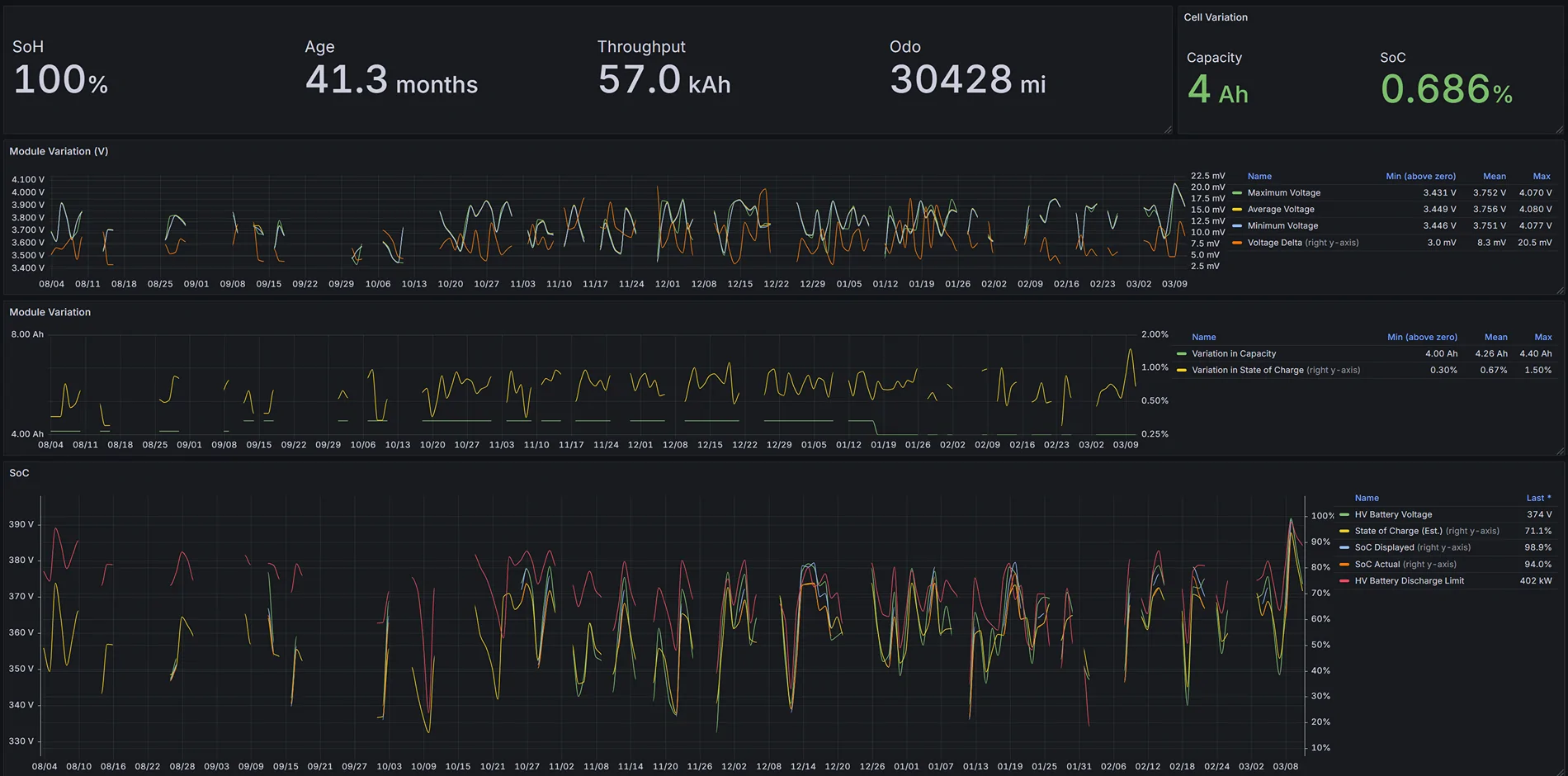
I routinely see up to 4% variation, charging to 90% every night. Then as soon as I charge to 100%, variation goes to < 0.2%.
And for me it's the complete opposite.

My variation (yellow line, middle chart) is consistently between 0.5% and 0.8% and in the rare occasion I do see a higher number it's after having charged to 100% which I do a few times per year.
I do not charge every day, more like every 3-4 days and usually charge to 80%.


Ford F-150 Lightning Elevated HVB Module Variation - What's yours? (Solved post 26) 1773228585356-n0
 

Sponsored
OP
OP
bmwhitetx

bmwhitetx

Well-known member
First Name
Bruce
Joined
May 21, 2021
Threads
47
Messages
3,070
Reaction score
4,387
Location
DFW-Texas
Vehicles
2022 F150 Lightning Lariat ER
Occupation
Retired engineer
Has anyone actually 'corrected' cell imbalances with the charging to 100% method in a Lightning?

Or is cell balancing with a target of 80% or 90% SOC adequate?
For me and many others, once a cell goes bad, the ability to balance by charging to 100% becomes moot.

On my first bad module, Ford software would stop charging at ~65% and throw the red ring of death. Could not get to 100.

This time around, charging slows at 80%, then charging current completely stops around 83%. Display shows 100% but falls to 83% on starting.

I do believe with healthy cells that it will charge to 99-100 and continue to pull charging current to balance. But it won’t do that when a cell goes bad.

My deviation has always been under 0.6% except when a module goes bad which happens suddenly, see chart in post 1.
 

chl

Well-known member
First Name
CHRIS
Joined
Dec 16, 2022
Threads
9
Messages
2,968
Reaction score
1,857
Location
alexandria virginia
Vehicles
2023 F-150 LIGHTNING, 2012 Nissan Leaf, 2015 Toyota Prius, 2000 HD 883 Sportster
Occupation
Patent Atty / Electrical Engineer
Did you read my post on 3-2(first page of this thread)? I routinely see up to 4% variation, charging to 90% every night. Then as soon as I charge to 100%, variation goes to < 0.2%.
Thanks, I did but I guess I am more used to voltage differences between cells or modules, and your paragraphs talked about percentage variation between modules, so I have to look that up.

"I charge every night to 90%, if I go over a month without charging to 100% I have seen over 6% module variation, soon as I charge to 100% it's back down to less than 0.2%. "

What is the threshold of percent variation between module that will cause the warnings and/or shutdowns?

6% seems like it would be over that threshold?
Is this not happening because FMC changed the threshold?

When I looked up percentage variation between modules the number that keeps coming up is 1% to 2% is OK but anything above, not so much.

Does any of that variation you have seen have to do with the module replacements you've had? They say is can take a long time for balancing after a module has been replaced.

It does make it hard to evaluate with FMC keeping the balancing algorithm details a secret as you mentioned.

What gives me pause about going to 100% frequently is that a high state of charge has always been associated with faster battery degradation.

I think I will download car scanner and take a look at my battery info.

I always go to 80% except when an update resets everything, which happened recently/

If charging to 80% has not resulted my battery having imbalances beyond an acceptable threshold then I'm good with that.
 

chl

Well-known member
First Name
CHRIS
Joined
Dec 16, 2022
Threads
9
Messages
2,968
Reaction score
1,857
Location
alexandria virginia
Vehicles
2023 F-150 LIGHTNING, 2012 Nissan Leaf, 2015 Toyota Prius, 2000 HD 883 Sportster
Occupation
Patent Atty / Electrical Engineer
For me and many others, once a cell goes bad, the ability to balance by charging to 100% becomes moot.

On my first bad module, Ford software would stop charging at ~65% and throw the red ring of death. Could not get to 100.

This time around, charging slows at 80%, then charging current completely stops around 83%. Display shows 100% but falls to 83% on starting.

I do believe with healthy cells that it will charge to 99-100 and continue to pull charging current to balance. But it won’t do that when a cell goes bad.

My deviation has always been under 0.6% except when a module goes bad which happens suddenly, see chart in post 1.
I get that.

I am wondering if the Lightning BMS does an adequate job balancing if I don't ever charge to 100%.

The question has been an issue of debate in the Nissan Leaf community for a long time.

Most seem to say going to 100% only marginally reduces the cell voltage differences that were already within an acceptable range, and if you have weak cells, it isn't going to help much.

Since I have been only charging to 80% (except when an update resets things) I think I will have to take a look at my battery and see how balanced or unbalanced it is to answer my own question.
 

ZSC100

Well-known member
First Name
Zach
Joined
Mar 29, 2023
Threads
9
Messages
629
Reaction score
741
Location
Tulsa, OK
Vehicles
2022 F150 Lightning SR EG 311A
Occupation
Electrical Engineer
I don't think we can relate our Lightnings to the Leaf or any other EV. We have no idea how Ford or it's vendor programmed the BMS or its true capability or algorithm of balancing. I've always taken the variation to be module variation b/c that's what the PID says, but we know that a single cell(p group) within a module is what goes bad to cause a "bad module" I'm continually disgusted that even technical people (service techs/engineers) don't know any details or thresholds that they can disclose to the community. And Ford doesn't provide cell OR module voltage PIDs to owners either which is absolutely ridiculous and should be illegal. We should have the ability to use ANY off the shelf scanner tool to gather metrics that help us understand the health and pair of our vehicles.
 

DavidS

Well-known member
First Name
DAVID
Joined
Dec 27, 2025
Threads
0
Messages
61
Reaction score
60
Location
Green Bay, WI
Vehicles
F150 Lightning Lariat
Let’s just remember that an old Leaf battery has some fundamental differences with a Lightning so none of it might be directly comparable. The Leaf uses different BMS software, different chemistry, and only a 2kwh buffer at “100%”.

The Lightning has a 13kwh buffer at 100% so full is never really full. I’m hoping that the engineers at Ford know what they are doing and have conditioning built into AC charging and you don’t need to force anything. Just do regular L1/L2 charging vs DC fast charging.

The LFP batteries are completely different in their BMS. The almost flat voltage levels during discharge of useable capacity means that voltage cannot be used as an accurate measurement of state of charge and the BMS needs to estimate actual power delivered. Running full to empty allows them to recalibrate the measurement system to actual battery health.

I’m guessing LFP batteries can’t balance until they know what state of charge they hold so they need to be at 100 before that can happen. NMC BMS systems don’t have these limitations.
 

Sponsored

Karlos

Well-known member
First Name
Karl
Joined
Dec 4, 2022
Threads
2
Messages
171
Reaction score
153
Location
DFW & Kerrville Tx
Vehicles
2022 Ice Blue & 2023 Silver ER Lariat Lightnings, 2024 Mach-e Premium ER
Occupation
Retired CPA, active pilot
I've seen my 2022 LER exhibit that same scenario. For most of it's life, it's been charged up L1 to 85%, and then a day or so before I'm going to drive it (it's a spare at a remote location from my house), I'll top it off to 100% on L1. It also has about 14k mile trips with DCFC over the last two years. It's now showing 98.5% SOH & 0.25% of SOC Module variation. I bot it used with 12k miles after 6 months prior ownership & unknown activity/treatment.
 

vvgogh

Well-known member
Joined
Feb 16, 2023
Threads
25
Messages
158
Reaction score
172
Location
Colorado
Vehicles
'23 F-150 Lightning ER
The Lightning BMS does passive balancing only, and will only balance at the top end of a charge once the first cell reaches maximum SoC. Basically resistors are switched on to waste the charge power as cells reach maximum SoC, in this way all cells can be raised to the same maximum level (balancing).
I've noticed the "wasted" energy in the 99-100% balancing. The wasted energy varies, but I think it's upwards of 10 kWh lost in those resistors in that last percent balancing. I limit how often I let the vehicle balance in the 99-100% range to minimize $/mi operating cost. I also limit how long I let the vehicle sit at 100% particularly when the weather is hot.

If I were to 100% charge once week, it's maybe its 500 kWh of balancing loss to those resistors in a year. That's about 1,100 miles of annual driving lost in those resistors. That's also about $100/y of balancing loss at my electricity rate if balancing weekly. Compare this to balancing every other week to save $50/y over weekly. Top up monthly instead to saving $75/y on balancing vs. weekly.

If you never balance, the cost is much greater with the increased risk of a cell voltage getting too far out of family. Even if it's covered under warranty, you'll lose many hours of your time. You may also have difficulty getting a loaner vehicle increasing the cost further.

Ford aims to keep replacement modules at regional centers so they can be shipped to your dealer within a day(?). There have been cases where the regional center is out of stock of the needed module, and there are additional delays. Dealers' service departments are largely at fault - they are generally really bad at getting the diagnostics done quickly: they'll typically let your vehicle sit for days before looking at it because they do not have enough staff. Let alone getting the order into Ford. Ford also wants certainty the warranty repair is necessary; inexperienced technicians may have additional back and forth with Ford before Ford is satisfied a warranty repair is necessary.
Sponsored


Top