

Sponsored

Adventureboy
Well-known member
It's pretty simple. Here is the perspective - The low-range warning and lights come on at 30 miles, and at that point, you are entering "reserve". Treat it as you would treat the little yellow light on ICE and head for a station if you aren't already on the way.It's a little disappointing there isn't reserve. The state of charge estimate shown on the screen can easily vary by plus or minus 2%.
Stay out of single digit SOC - stay out of trouble. Same as you don't burn through the last 1/8 of a tank of gas on an ICE.
Technical details, if such things don't bore you:
The BMS is not capable of managing every variable, all of the time, due to the inherent inequalities of each cell's environmental situation. Even if each cell is perfectly equal coming out of the factory, its placement in the module and in the pack introduces minor environmental discrepancies in how each cell discharges. Those changes are cumulative until you charge to 100% and let it complete the top balance process. Remember, there are 480 cells (ER) that all have slight variances in temperature, internal resistance and bus resistance - this is not a mobile phone with 1 cell. 2% is pretty accurate, especially for owners who DCFC lots and don't charge to 100% periodically. Over time, the cells simply become out of balance with each other, and the BMS can't fix or measure this without the top balance. When ONE of the 100s of cells drops to the knees, your whole pack shuts down, and your truck will stop to protect itself. Since the truck uses a top balance process (as do all EVs and the vast majority of BMS-controlled packs) it has to estimate where the bottom is - hence the variance +/-x%.
DCFC causes cells to go out of balance with others faster than L2 charging. Charging to 100% on L2 balances all of the cells across the pack. If you DCFC often, find the time to charge to 100% on L2 more regularly to improve accuracy. I'd suggest monthly for most of us who L2 most of the time and perhaps weekly if you DCFC every few days or more.

chl
Well-known member
- First Name
- CHRIS
- Joined
- Dec 16, 2022
- Threads
- 9
- Messages
- 3,456
- Reaction score
- 2,109
- Location
- alexandria virginia
- Vehicles
- 2023 F-150 LIGHTNING, 2012 Nissan Leaf, 2015 Toyota Prius, 2000 HD 883 Sportster
- Occupation
- Patent Atty / Electrical Engineer
First, I would be interested to know if anyone has found evidence that periodically charging to 100% is really needed to balance the cells in the Lightning HVB? Or evidence that the BMS handles that adequately as designed for 80% to 90% charging?
---
The SOC is never an exact number, it is a best estimate based on a sometimes complex formula.
Ford has not disclosed theirs as far as I know, but the general consensus it is is a combination of coulomb counting (as the charge goes into and out of the HVB) and voltage of the HVB is then used to adjust the SOC.
It may also adjust based on other factors, such as the temperature of the battery because:
When the battery is warm, the voltage will be higher - it's a chemical thing.
As the battery cools, the voltage will drop so the SOC may adjust downward.
When you are down at the low end of the capacity (discharge below 20% SOC) the voltage curve gets steep and the voltage drops faster:

It is dangerous down there because there is the risk of damage from a full discharge, and it can happen suddenly.
They put in a lower buffer to avoid that. There is also an upper buffer to avoid over charging.
It has been observed in multiple studies that deep charge/discharge cycling is a significant factor in shortening battery longevity. Avoiding more than 50% of capacity discharge can more than double the lifespan of the battery.
Ford already warns about the risks of charging to 100% all the time, and of going too low as well in their literature.
The BMS in the Ford Lightnings operates to balance the cells during charging (and perhaps during discharging?), i.e., active balancing, from what I have read, so no special charging procedure is recommended for cell balancing.
"...active balancing can be implemented during charging or discharging. The ability to actively balance during discharge provides more balancing time and allows charge to be transferred from the strong cells to the weak cells, thereby extending battery pack runtime ... In summary, active balancing is advantageous for applications that require faster balancing, limited thermal load, improved energy efficiency, and increased system runtime. ..."
https://www.monolithicpower.com/en/...ive-balancing-how-it-works-and-its-advantages
Some EVs makers may recommend periodic charging to 100 percent in order to balance the cells, perhaps because they use passive balancing and/or are LFP chemistry.
Ford says about their "Adaptive Charging Protocols"
---
The BMS continuously optimizes charging behavior:
Adjusts charging rates based on battery temperature, state of charge, and
cell health
Implements cell balancing during charging to ensure uniform wear
Varies maximum charge levels based on driving patterns and needs
Adapts fast-charging profiles to minimize degradation
For frequent short-trip users, the system may limit maximum charge to
80-90% to extend battery life, while automatically enabling 100% charges
before planned long journeys..."
https://amford.com/blog/2025-ford-f-150-lightning-battery-options-for-performance/
---
So I conclude that if Ford wanted us to do some sort of special charging procedure to balance cells, e.g., charging to "100%" periodically, I believe they would have put that in the owners manual.
----
However, as I said at the top, I would be interested to know if anyone has found that periodically charging to 100% is really needed to balance the Lightning HVB?
---
The SOC is never an exact number, it is a best estimate based on a sometimes complex formula.
Ford has not disclosed theirs as far as I know, but the general consensus it is is a combination of coulomb counting (as the charge goes into and out of the HVB) and voltage of the HVB is then used to adjust the SOC.
It may also adjust based on other factors, such as the temperature of the battery because:
When the battery is warm, the voltage will be higher - it's a chemical thing.
As the battery cools, the voltage will drop so the SOC may adjust downward.
When you are down at the low end of the capacity (discharge below 20% SOC) the voltage curve gets steep and the voltage drops faster:
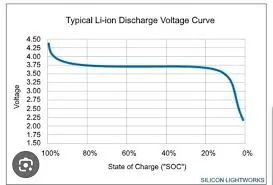
It is dangerous down there because there is the risk of damage from a full discharge, and it can happen suddenly.
They put in a lower buffer to avoid that. There is also an upper buffer to avoid over charging.
It has been observed in multiple studies that deep charge/discharge cycling is a significant factor in shortening battery longevity. Avoiding more than 50% of capacity discharge can more than double the lifespan of the battery.
Ford already warns about the risks of charging to 100% all the time, and of going too low as well in their literature.
The BMS in the Ford Lightnings operates to balance the cells during charging (and perhaps during discharging?), i.e., active balancing, from what I have read, so no special charging procedure is recommended for cell balancing.
"...active balancing can be implemented during charging or discharging. The ability to actively balance during discharge provides more balancing time and allows charge to be transferred from the strong cells to the weak cells, thereby extending battery pack runtime ... In summary, active balancing is advantageous for applications that require faster balancing, limited thermal load, improved energy efficiency, and increased system runtime. ..."
https://www.monolithicpower.com/en/...ive-balancing-how-it-works-and-its-advantages
Some EVs makers may recommend periodic charging to 100 percent in order to balance the cells, perhaps because they use passive balancing and/or are LFP chemistry.
Ford says about their "Adaptive Charging Protocols"
---
The BMS continuously optimizes charging behavior:
Adjusts charging rates based on battery temperature, state of charge, and
cell health
Implements cell balancing during charging to ensure uniform wear
Varies maximum charge levels based on driving patterns and needs
Adapts fast-charging profiles to minimize degradation
For frequent short-trip users, the system may limit maximum charge to
80-90% to extend battery life, while automatically enabling 100% charges
before planned long journeys..."
https://amford.com/blog/2025-ford-f-150-lightning-battery-options-for-performance/
---
So I conclude that if Ford wanted us to do some sort of special charging procedure to balance cells, e.g., charging to "100%" periodically, I believe they would have put that in the owners manual.
----
However, as I said at the top, I would be interested to know if anyone has found that periodically charging to 100% is really needed to balance the Lightning HVB?
chl
Well-known member
- First Name
- CHRIS
- Joined
- Dec 16, 2022
- Threads
- 9
- Messages
- 3,456
- Reaction score
- 2,109
- Location
- alexandria virginia
- Vehicles
- 2023 F-150 LIGHTNING, 2012 Nissan Leaf, 2015 Toyota Prius, 2000 HD 883 Sportster
- Occupation
- Patent Atty / Electrical Engineer
Ford also says (Lightnings have NCM battery chemistry):
- Lithium Iron Phosphate (LFP) batteries
- Set the maximum charge level to 100%.
- Charge to 100% at least once per month to maintain estimated in-vehicle range accuracy for state of charge and distance to empty.
Important: If not charged to 100% at least once per month, you may experience degraded vehicle performance and a decrease in the accuracy of the vehicle's estimated range.
- Nickel Cobalt Manganese (NCM) batteries
- Set the maximum charge level to 90% to reduce strain on the battery.
- Set the maximum charge level to 100% to provide a full range for long trips.
Sponsored

proprepper
Well-known member
- First Name
- Bruce
- Joined
- Feb 7, 2024
- Threads
- 1
- Messages
- 61
- Reaction score
- 68
- Location
- Grayslake, Il
- Vehicles
- 2022 Pro SR
- Occupation
- done with work!
My poky ass would have made it with more than 2% left. 100% of the time I arrive with more than forecast. 

Adventureboy
Well-known member
As we know, Ford doesn't disclose anything, so we are left to figure this out.First, I would be interested to know if anyone has found evidence that periodically charging to 100% is really needed to balance the cells in the Lightning HVB? Or evidence that the BMS handles that adequately as designed for 80% to 90% charging?
The strong evidence for cell balancing between 99-->100% is this:
- If you charge to 100% displayed SOC, it can take up to 3 hours to go from 99%-->100% while the current tapers off.
- If no balancing is taking place, the current would not taper off slowly since even at 94% true SOC, the battery pack can accept full power from most EVSEs (charge power is less than 8% of pack capacity for a 10kw charger on ER battery, or 0.08C).
Is charging to 100% needed? This is your call. For some, maybe not. For others, yes.
If you don't ever charge to 100%, your pack may go out of balance to some degree and show up in various ways, like lower SOH and less accurate SOC estimates. If you charge to 90% daily, there is likely active balancing taking place during 85%-90% while charging, but it is limited in capacity due to the very low voltage differential and the short time period where the imbalance can be perceived and managed by the BMS. For many in temperate climates, this may well be fine, but if you throw in more extreme temperatures, active balancing in that SOC range may not be enough (evidence: 3-hour balancing timeline between 99%-->100%).
Eg. if you are driving in 0°F, the cells on the outside of the pack may be several degrees cooler and therefore be slightly less efficient than the ones in the centre, causing SOC to drop slightly faster for the cooler cells. This causes an imbalance across perfectly healthy and matched cells that cannot be perceived by the BMS until you charge to 85-90% dislayed SOC or drop below 15% displayed SOC (as per the graph). If your charging plan doesn't provide adequate time or conditions for balancing, the effect is cumulative and shows up as lower SOH and less accurate SOC estimates.
ER has 480 cells, and the one that is out of balance the most is the limiting factor on your SOH and your overall pack capacity. Charging to 100% and allowing balancing to complete, and then driving to below 20% SOC will balance the pack and give the BMS accurate numbers to estimate true capacity since the knees in your graph are measurable in those ranges. This will reduce SOC estimation inaccuracies. Most of us do this through our natural driving habits by charging to 100% for a longer road trip once in a while, which is enough.
JvdMaat
Well-known member
There is most definitely a reserve in ICE vehicles. They (modern vehicles) use fuel pumps, so those running dry is bad. Generally when your car says 0 miles till empty, you have another 1-3 gallons (depending on the model and tank size). My Honda Insight has a listed tank size of 10.6 gallons. I think the most I've ever fueled up (and that's with the DTE stating 2 miles) was just shy of 9 gallons.There is not a reserve in most ICE vehicles... Yes most have a light to warn you but so does the truck... When you run out of gas the vehicle stops.
I could have easily driven another 30-50 miles on that.
chl
Well-known member
- First Name
- CHRIS
- Joined
- Dec 16, 2022
- Threads
- 9
- Messages
- 3,456
- Reaction score
- 2,109
- Location
- alexandria virginia
- Vehicles
- 2023 F-150 LIGHTNING, 2012 Nissan Leaf, 2015 Toyota Prius, 2000 HD 883 Sportster
- Occupation
- Patent Atty / Electrical Engineer
I
After 80% the BMS changes it's strategy from providing a constant current to constant voltage to protect the battery from heat stress and the risk of overcharging.
Yes it is related to potential imbalances in cells and allows weak cells to catch up to stronger ones which is critical as the battery gets closer to 100% charge.
There is less risk of overcharging any cells at or below 80% so a tapering below 80% is not critical.
But active cell balancing is going on whenever the battery is being charged no matter whether it is only up to 80% or to 100%, and maybe also when being discharged.
As you noted, we don't really know a lot since Ford doesn't tell us much.
We kind of have to read between the lines.
But my question is really whether there is any evidence that charging to the max of 80% to 90% for normal daily driving as Ford recommends, and not to 100%, is resulting in any harmful cell imbalance?
The only place I have seen that proposition is anecdotally in the forums, but without any data to back it up, prove it.
Since cell imbalances may shorten battery capacity lifespan depending on how severe they are, one would think if 100% charging periodically was necessary to eliminate that problem, Ford would recommend it since premature battery capacity loss is warrantied by them.
Many studies show normal daily use and a charging limit of 80% in the real world have resulted in longer than expected longevity than predicted in lab experiments where batteries are repeatedly run up to 100% and down to 10%. Depth of discharge has been shown to be a big factor in the loss of capacity over time both in the lab and in real world EVs.
What ill effects not charging over 80% has on longevity seem to be non-existent based on studies of real world EV use at least.
So it appears any theoretical cell imbalance harm that might result from never charging to 100% to balance the cells may be a phantom issue.
In LFPs it is a different story of course.
I'm not sure the current tapering off at the end of a 100% charge cycle is necessarily a sign that no cell balancing or inadequate cell balancing occurred before that.As we know, Ford doesn't disclose anything, so we are left to figure this out.
The strong evidence for cell balancing between 99-->100% is this:
There is no modern BMS that won't actively balance the cells in that SOC range, especially in a heavy application like an EV traction battery or the batteries simply wouldn't last. If the BMS were able to maintain balance in the lower SOC range, it wouldn't take 3 hours to tweak the balance between 99-100%. For any target SOC below 100%, there is no taper. Charging is terminated immediately when the target SOC is achieved.
- If you charge to 100% displayed SOC, it can take up to 3 hours to go from 99%-->100% while the current tapers off.
- If no balancing is taking place, the current would not taper off slowly since even at 94% true SOC, the battery pack can accept full power from most EVSEs (charge power is less than 8% of pack capacity for a 10kw charger on ER battery, or 0.08C).
Is charging to 100% needed? This is your call. For some, maybe not. For others, yes.
If you don't ever charge to 100%, your pack may go out of balance to some degree and show up in various ways, like lower SOH and less accurate SOC estimates. If you charge to 90% daily, there is likely active balancing taking place during 85%-90% while charging, but it is limited in capacity due to the very low voltage differential and the short time period where the imbalance can be perceived and managed by the BMS. For many in temperate climates, this may well be fine, but if you throw in more extreme temperatures, active balancing in that SOC range may not be enough (evidence: 3-hour balancing timeline between 99%-->100%).
Eg. if you are driving in 0°F, the cells on the outside of the pack may be several degrees cooler and therefore be slightly less efficient than the ones in the centre, causing SOC to drop slightly faster for the cooler cells. This causes an imbalance across perfectly healthy and matched cells that cannot be perceived by the BMS until you charge to 85-90% dislayed SOC or drop below 15% displayed SOC (as per the graph). If your charging plan doesn't provide adequate time or conditions for balancing, the effect is cumulative and shows up as lower SOH and less accurate SOC estimates.
ER has 480 cells, and the one that is out of balance the most is the limiting factor on your SOH and your overall pack capacity. Charging to 100% and allowing balancing to complete, and then driving to below 20% SOC will balance the pack and give the BMS accurate numbers to estimate true capacity since the knees in your graph are measurable in those ranges. This will reduce SOC estimation inaccuracies. Most of us do this through our natural driving habits by charging to 100% for a longer road trip once in a while, which is enough.
After 80% the BMS changes it's strategy from providing a constant current to constant voltage to protect the battery from heat stress and the risk of overcharging.
Yes it is related to potential imbalances in cells and allows weak cells to catch up to stronger ones which is critical as the battery gets closer to 100% charge.
There is less risk of overcharging any cells at or below 80% so a tapering below 80% is not critical.
But active cell balancing is going on whenever the battery is being charged no matter whether it is only up to 80% or to 100%, and maybe also when being discharged.
As you noted, we don't really know a lot since Ford doesn't tell us much.
We kind of have to read between the lines.
But my question is really whether there is any evidence that charging to the max of 80% to 90% for normal daily driving as Ford recommends, and not to 100%, is resulting in any harmful cell imbalance?
The only place I have seen that proposition is anecdotally in the forums, but without any data to back it up, prove it.
Since cell imbalances may shorten battery capacity lifespan depending on how severe they are, one would think if 100% charging periodically was necessary to eliminate that problem, Ford would recommend it since premature battery capacity loss is warrantied by them.
Many studies show normal daily use and a charging limit of 80% in the real world have resulted in longer than expected longevity than predicted in lab experiments where batteries are repeatedly run up to 100% and down to 10%. Depth of discharge has been shown to be a big factor in the loss of capacity over time both in the lab and in real world EVs.
What ill effects not charging over 80% has on longevity seem to be non-existent based on studies of real world EV use at least.
So it appears any theoretical cell imbalance harm that might result from never charging to 100% to balance the cells may be a phantom issue.
In LFPs it is a different story of course.
CD4TNF
Well-known member
Powering off and on didn't allow for the reserve to kick in? Motortrend found there was a little bit of reserve.
The difference might be sunny Detroit conditions during their test vs current winter.
What Happens When Your Ford F-150 Lightning EV Battery Runs Out of Range?
https://www.motortrend.com/reviews/2023-ford-f-150-lightning-xlt-yearlong-review-update-8We ran our F-150 Lightning electric pickup truck’s battery to zero so you don’t have to.
The difference might be sunny Detroit conditions during their test vs current winter.
Sponsored
PJnc284
Well-known member
- Joined
- Sep 30, 2024
- Threads
- 0
- Messages
- 1,198
- Reaction score
- 1,364
- Location
- Garner, NC
- Vehicles
- 2023 Ford F150 Lightning Lariat ER
I think that's more of a ymmv thing. I certainly wouldn't expect it to work. Branden tried it in the video I posted and it didn't work. Believe his showed 5-6kWh remaining and was a brick. Kyle also tried it with Out Of Spec with no luck when they were doing the range test but he actually ran it about 8 miles past 0 and was showing 2kWh remaining when it finally died.Powering off and on didn't allow for the reserve to kick in? Motortrend found there was a little bit of reserve.
https://www.motortrend.com/reviews/2023-ford-f-150-lightning-xlt-yearlong-review-update-8
The difference might be sunny Detroit conditions during their test vs current winter.
CD4TNF
Well-known member
I think that's more of a ymmv thing. I certainly wouldn't expect it to work. Branden tried it in the video I posted and it didn't work. Believe his showed 5-6kWh remaining and was a brick. Kyle also tried it with Out Of Spec with no luck when they were doing the range test but he actually ran it about 8 miles past 0 and was showing 2kWh remaining when it finally died.
Ah well. Thank for summarizing their videos. Haven't watched those yet.
Agreed I don't trust going down past 10% on road trips.
Adventureboy
Well-known member
Correct - It would have to be tracked at the cell level to see if and when balancing is occurring and if it is adequate.I'm not sure the current tapering off at the end of a 100% charge cycle is necessarily a sign that no cell balancing or inadequate cell balancing occurred before that.
Here is my tracking data.
- If I charge to 100% after 2-3 months of daily charging to 85% and an average of 2-3 DCFC sessions per month, it takes about 3 hours to go from 99-100%
- If I charge to 100% after a month of daily charging to 85% and 2-3 DCFC sessions per month, it takes less than an hour.
- If I charge to 100% two consecutive days in a row, it only takes 15-20 minutes.
This doesn't mean I need to charge to 100% more frequently; it simply means the imbalance will have a larger impact on BMS estimations, like SOC.
The imbalance won't hurt the cells. The BMS protects at the cell level. The only thing that will happen is the degradation of the indicated SOH (overall pack capacity) and the inaccuracy of SOC estimates (the OP's problem when he dropped to 2% and the truck stopped). These effects are temporary until you decide to charge to 100% and let it balance, then drive to around 15% so the BMS can accurately calculate the overall pack capacity and calibrate SOC. The issues only show up if you push the boundaries (like in the OPs case, trying to reach a station at 2%.)But my question is really whether there is any evidence that charging to the max of 80% to 90% for normal daily driving, as Ford recommends, and not to 100%, is resulting in any harmful cell imbalance?
There is a larger risk on the bottom end of the SOC range (below 10% indicated SOC) that the lower cells will be stressed more and cause exponentially faster aging if you run SOC down to single digits. This is exacerbated if your cells are not balanced. This is a well-documented fact that has been tracked for more than a decade. Ford is not exempt.
Net: If you charge to 90% daily and stay above 20%, you will not likely have any issues for years. Throw in an occasional 100% balance cycle, followed by a drive to 15% or so, and your SOH and SOC will stay accurate. If you push the boundaries, you'll get bitten.
Last edited:
chl
Well-known member
- First Name
- CHRIS
- Joined
- Dec 16, 2022
- Threads
- 9
- Messages
- 3,456
- Reaction score
- 2,109
- Location
- alexandria virginia
- Vehicles
- 2023 F-150 LIGHTNING, 2012 Nissan Leaf, 2015 Toyota Prius, 2000 HD 883 Sportster
- Occupation
- Patent Atty / Electrical Engineer
Well then it seems the balancing is only occurring during charging, and not during discharging.Correct - It would have to be tracked at the cell level to see if and when balancing is occurring and if it is adequate.
Here is my tracking data.
Conclusion: Balancing takes longer the less frequently I charge to 100%, so the imbalance is increasing as time passes between charges to 100%.
- If I charge to 100% after 2-3 months of daily charging to 85% and an average of 2-3 DCFC sessions per month, it takes about 3 hours to go from 99-100%
- If I charge to 100% after a month of daily charging to 85% and 2-3 DCFC sessions per month, it takes less than an hour.
- If I charge to 100% two consecutive days in a row, it only takes 15-20 minutes.
This doesn't mean I need to charge to 100% more frequently; it simply means the imbalance will have a larger impact on BMS estimations, like SOC.
The imbalance won't hurt the cells. The BMS protects at the cell level. The only thing that will happen is the degradation of the indicated SOH (overall pack capacity) and the inaccuracy of SOC estimates (the OP's problem when he dropped to 2% and the truck stopped). These effects are temporary until you decide to charge to 100% and let it balance, then drive to around 15% so the BMS can accurately calculate the overall pack capacity and calibrate SOC. The issues only show up if you push the boundaries (like in the OPs case, trying to reach a station at 2%.)
There is a larger risk on the bottom end of the SOC range (below 10% indicated SOC) that the lower cells will be stressed more and cause exponentially faster aging if you run SOC down to single digits. This is exacerbated if your cells are not balanced. This is a well-documented fact that has been tracked for more than a decade. Ford is not exempt.
Net: If you charge to 90% daily and stay above 20%, you will not likely have any issues for years. Throw in an occasional 100% balance cycle, followed by a drive to 15% or so, and your SOH and SOC will stay accurate. If you push the boundaries, you'll get bitten.
But I still wonder if 100% is truly needed to correct the estimates.
Seems like a slow charge over a longer time could have the effect of allowing a fuller cell balancing.
At some point the BMS has to correct cell imbalances before they get too large to avoid consequences: reduced usable capacity, faster battery degradation, or complete shut-down, not to mention the risk of thermal runaway, for example.
So over time, even without charging to 100%, the BMS should keep cells balanced.
If it wasn't doing this effectively I'd imagine a lot of battery shut-down type failures in our Lightnings.

hturnerfamily
Well-known member
- First Name
- William
- Joined
- Jan 8, 2022
- Threads
- 49
- Messages
- 2,430
- Reaction score
- 3,137
- Location
- rural Georgia
- Vehicles
- 22 LIGHTNING PRO IcedBlueSilver 8/23/2022
- Occupation
- Owner
I always find it amusing that some will constantly argue why we "don't have a battery reserve", or why we "don't have an extended range gas generator under the hood", or why we "can't just press a button when we are 'low' to suddenly find that 'extra' 100 miles we need"...
it's baffling...
If your truck shows that you have 5% battery level, then, well, you are already 'within your RESERVE'. Why does FORD, or any manufacturer, need to baby you thru the process?
For some, the 'Reserve' might be 10%... and, others, might need to consider their 'Reserve' as 25%... it's all sometimes about your 'comfort' level...
Some of us will press our 'luck' and continue, knowing we are close enough to our destination, while others need to stop and 'make sure' at their last DC Fast CHarger option...
'Reserve' is simply where YOU want that to be. It's not up to FORD.
it's baffling...
If your truck shows that you have 5% battery level, then, well, you are already 'within your RESERVE'. Why does FORD, or any manufacturer, need to baby you thru the process?
For some, the 'Reserve' might be 10%... and, others, might need to consider their 'Reserve' as 25%... it's all sometimes about your 'comfort' level...
Some of us will press our 'luck' and continue, knowing we are close enough to our destination, while others need to stop and 'make sure' at their last DC Fast CHarger option...
'Reserve' is simply where YOU want that to be. It's not up to FORD.
Sponsored


