
Sponsored

mr.Magoo

Well-known member
Joined
May 27, 2022
Threads
24
Messages
992
Reaction score
1,254
Location
Michigan
Vehicles
2022 Lariat ER, AMB
One of the dangers of using tools like Gemini to do this work is that it isn't as apparent exactly what is going on in the back end. It's possible it's using SOC and not SOC displayed but I don't believe it is.
So, you're not telling it to use specific parameters?
Sponsored

 
OP
OP
Firn

Firn

Well-known member
Joined
Aug 26, 2024
Threads
32
Messages
1,521
Reaction score
1,724
Location
USA
Vehicles
23 Pro ER
So, you're not telling it to use specific parameters?
Its not making the charts unprompted, so yes I am telling it the parameters we are working with for each chart. But with SOC, I recognize that on occasion I may have said SOC not SOC displayed which is how they are delineated in my logs. The ingest and cleanup process also transfers the PID names I use in torque into different names within the database so there can be some ambiguity there as well.

So yes, each plot is made with specific parameters in mind, but I'm cognizant it is not infallable.
 

mr.Magoo

Well-known member
Joined
May 27, 2022
Threads
24
Messages
992
Reaction score
1,254
Location
Michigan
Vehicles
2022 Lariat ER, AMB
Thank you for clarifying.

It probably is displayed in that case.
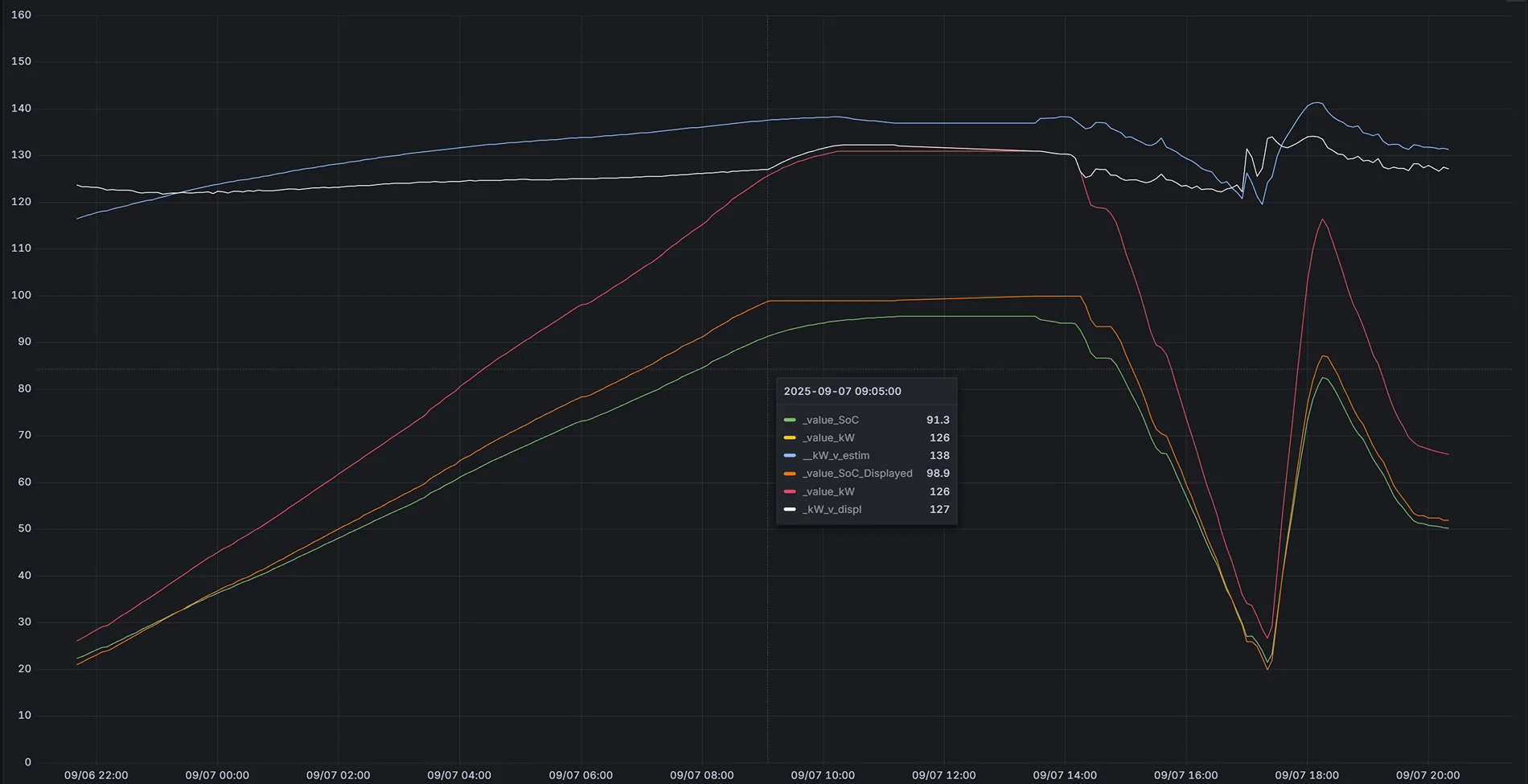
Here's the same graph as before, but I added in a displayed conversion (white line) for comparison.
As you can see, it remains retty flat, from 123kWh @ 22% SoC (est) to 127kWh @ 92% SoC / 99% Displayed.

So, in other words, if you're using SoC displayed, you'll never see 1.31kWh/1% SoC unless you charge to 100%, otherwise you'll stay around 1.2-1.27, which is also what your graph shows.


Ford F-150 Lightning Deep-Dive: Lightning Pro ER Performance & Efficiency via Custom PID Logging 1770468084110-9q
 

Cvh8601

Well-known member
Joined
Jun 22, 2024
Threads
5
Messages
93
Reaction score
120
Location
MD
Vehicles
2023 Lightning Lariat
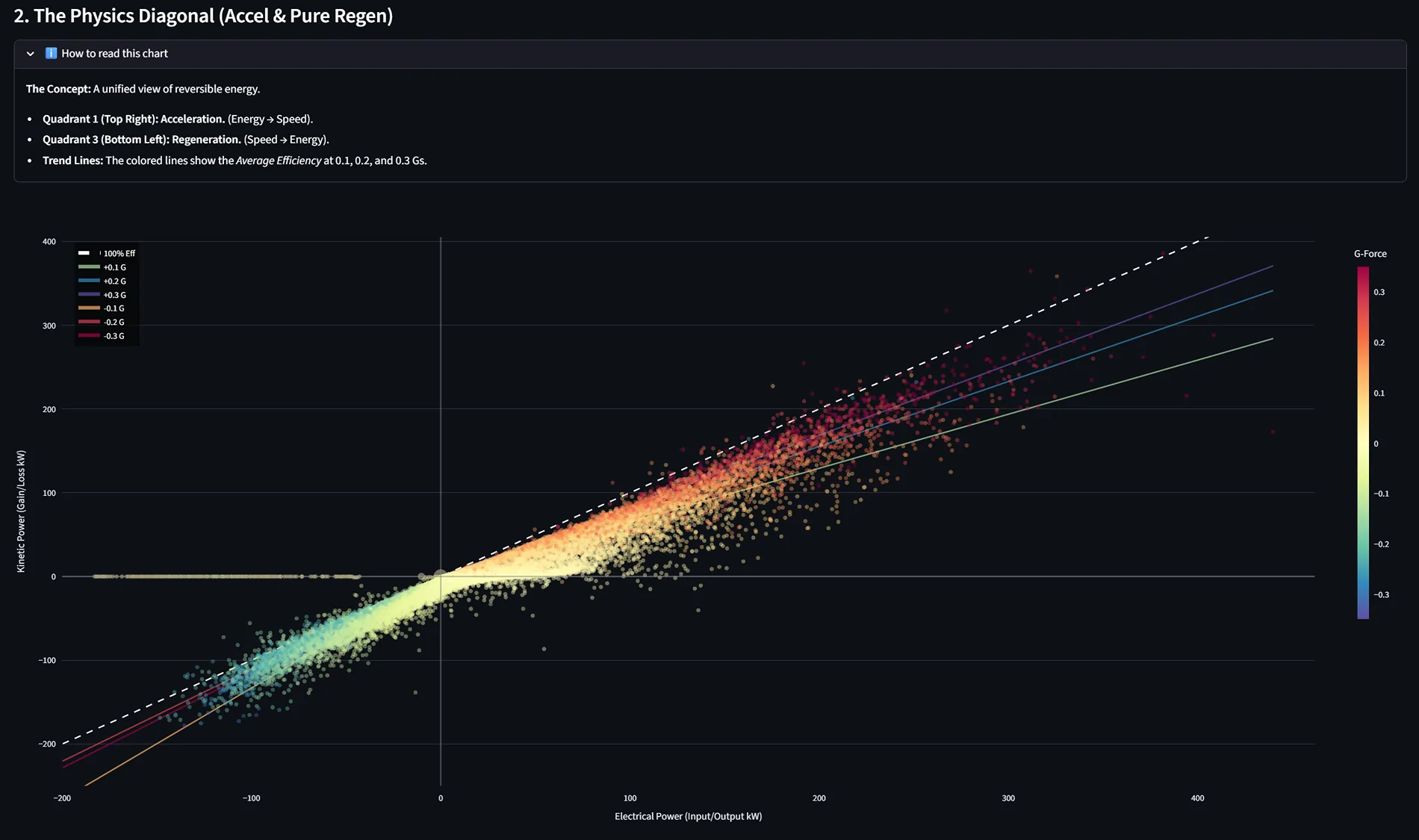
The solid colored lines are the trend lines for the acceleration rates.

I'll see if anyone else gets it, but I spent some time on this trying to figure out what is happening.

1770341519439-cx.webp
Super interesting plot. My read is that it’s telling us that the machine is most efficient when running at maximum power. That very much aligns with expectations, and other types of machines. ICE engines are most thermally efficient at wide open throttle at their design RPM for example, etc.

Now there is data to support telling the wife we have to punch it off the line at red lights because we’re maximizing efficiency!
 

bc1

Well-known member
Joined
Oct 25, 2025
Threads
9
Messages
294
Reaction score
222
Location
McPherson, KS
Vehicles
2025 Ford f150 Lightning Flash
You might try some of your calculations using Perplexity which is supposed to be more of a scientific oriented AI app. At least a few months ago it was top rated for those kind of questions.
 

Sponsored
OP
OP
Firn

Firn

Well-known member
Joined
Aug 26, 2024
Threads
32
Messages
1,521
Reaction score
1,724
Location
USA
Vehicles
23 Pro ER
Super interesting plot. My read is that it’s telling us that the machine is most efficient when running at maximum power. That very much aligns with expectations, and other types of machines. ICE engines are most thermally efficient at wide open throttle at their design RPM for example, etc.

Now there is data to support telling the wife we have to punch it off the line at red lights because we’re maximizing efficiency!

Yes, although its also a bit misleading.

The plot indicates that accelerating hard is more efficient than accelerating slow, which is opposite from gas motors.

By plotting Kinetic Power gained vs Electric Power consumed a perfect system is along the diagonal, and an imperfect system is below it. The closer it is to the diagonal the closer to perfect it is, or the more efficient it is.

I spent quite a bit of time with this and even dug into why it may indicate why it implies that it is MORE efficient to accelerate hard. The best premise I could come up with was the system overhead, you are always consuming energy for the computers, the inverters consume energy (and have their own efficiency curve), the HVAC, etc. So thus the shorter time it takes to gain energy the less energy that was wasted towards other things.

Where it is misleading is in using kinetic energy. We don't really care about kinetic energy. We are going to take on-ramp A and drive to off-ramp B, and we are going to do that at say 70mph regardless of how hard we accelerated up to 70mph. The energy overhead is the same regardless, because the overall trip didn't have a meaningful difference in time. I wanted to try this but the data is too noisy to really dig into trips where I accelerated hard vs where I didn't.

What we can say though is that the truck does not appear to have a major difference in efficiency when accelerating hard vs slow, if there was the hard acceleration would fall away from the diagonal.

I'm going to spend some time with this one since I wish we could see more granular details. There may be things where absolute maximum acceleration is slightly below say 80% throttle. I also don't have any filters where say more than 20mph needs to be gained, so right now all the small accelerations are in there too.
 

mr.Magoo

Well-known member
Joined
May 27, 2022
Threads
24
Messages
992
Reaction score
1,254
Location
Michigan
Vehicles
2022 Lariat ER, AMB
Yes, although its also a bit misleading.

By plotting Kinetic Power gained vs Electric Power consumed
Which weight of the vehicle are you using for Kinetic energy and when you're looking power consumed are you just looking at battery current & voltage, or are you converting torque from the motors back to kW?
 
OP
OP
Firn

Firn

Well-known member
Joined
Aug 26, 2024
Threads
32
Messages
1,521
Reaction score
1,724
Location
USA
Vehicles
23 Pro ER
Which weight of the vehicle are you using for Kinetic energy and when you're looking power consumed are you just looking at battery current & voltage, or are you converting torque from the motors back to kW?
6700 lbs

I'm using battery voltage and current.
Sponsored


Top