

Sponsored

Replaced Charging Station, tripped meter breaker again.

chl

Well-known member
First Name
CHRIS
Joined
Dec 16, 2022
Threads
9
Messages
3,549
Reaction score
2,179
Location
alexandria virginia
Vehicles
2023 LIGHTNING PRO, 2012 Nissan Leaf, 2015 Toyota Prius, 2000 HD 883 Sportster
Occupation
Patent Atty / Electrical Engineer
PPS: I do not think it is your FCSP at all. IF it were, the branch breaker would have tripped.
I suggest you find a master electrician who knows what they are doing.
Sponsored
 

ZeusDriver

Well-known member
Joined
Dec 1, 2025
Threads
9
Messages
239
Reaction score
206
Location
East Coast, USA
Vehicles
2022 Lightning
I'd recommend getting a good electrician.

It is worth noting this, from Mike Holt:
"According to UL standards, a residential circuit breaker must be able to safely interrupt its maximum rated fault current at least twice and still remain functional. While they can trip thousands of times on minor overloads, severe short-circuit faults (especially near their max rating) degrade internal components, making them unsafe for continued use. "

Chances are good that the breaker at the meter has failed.
 

ElectrifyingMe25

Well-known member
First Name
Trav
Joined
Jul 31, 2025
Threads
15
Messages
147
Reaction score
184
Vehicles
F150 Lightning, XLT, 2023
Occupation
Engineer
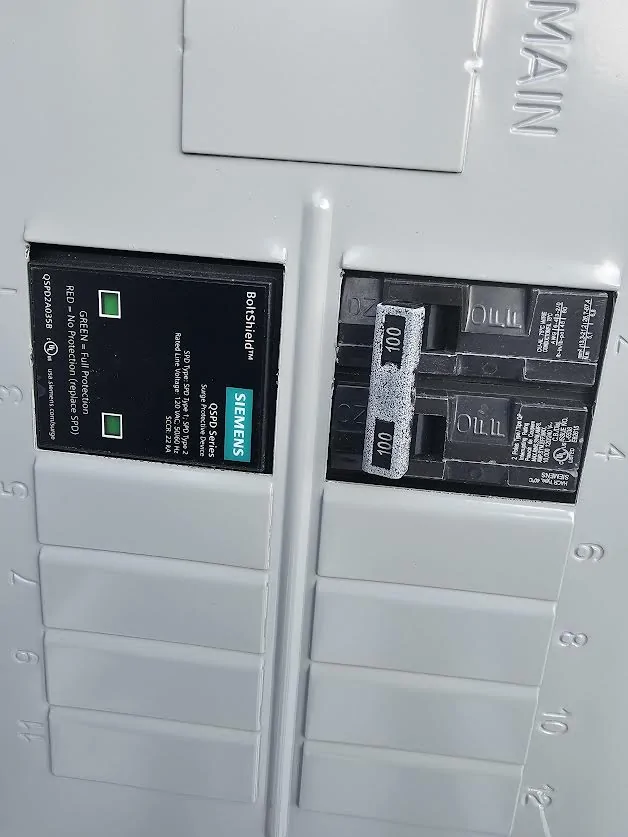
I posted a few weeks back how I'd had my truck in for a heater replacement, charged it at home and the breaker at the meter tripped. Here is the setup. Isolated meter from utility in back of house, used exclusively for truck. it has its own breaker > wiring from this to box in front of house > surge protector(imaged), in front box > 100amp meter(imaged) in front box > fcsp set to 64 amps.

This setup had worked fine through a previous winter, so this was a mystery, with some clues, oddities, and coincidences:

-The entire circuit had been on but unused for almost 3 weeks in temperatures below 0F, its an outdoor setup.
-When I plugged it in after getting truck back from the shop, it seemed to work fine, charging for a few hours before everything stopped at 71% (scheduled to 80%).
-The meter breaker tripped, while the fcsp's breaker (imaged) stayed in the on position. (could a 64a setting gone wrong fail to trip a 100a breaker??) Nobody seems to know exactly why the box breaker won't trip but the meter breaker will.
-the box breaker (imaged) has very weird white coloring on it that an electrician forum said indicated water ingress / condensation on the zinc plated bar
-the truck had just been in for high voltage work - hopefully everything was put back together right and the truck itself wasn't causing the issue.

electrician trip 1: they came out, replaced the breaker, turned the meter breaker back on, i plugged in and everything looked like it was working. sometime later the exact same thing happened. meter breaker tripped, box breaker did not, everything died.

electrician trip 2: i ordered and received a new fcsp. electricians came out, replaced fcsp, replaced breaker again (this time with an 80a instead of 100a because they said it would be better for me if i charged at 64amp which i do), turned everything on, tested it , it looked good, i was charging as they left... less than 30 mins later exact thing happened AGAIN! meter breaker tripped, box breaker stayed on, everything dead.

I suspect the biggest clue of all is the old breaker (imaged). that there may indeed be corrosion and faulty happenings with the zinc bus bar. though the electricians had their tools out and were testing everything. when they first turned on the new fscp, they watched the amperage climb up to just below 80 amps. when they turned it to 64 amps, they watched the amperage climb up to around 60 amps. they were satisfied, everything looked good. now they will have to come back, and more money will be spent. if anyone can provide me some very good chores, checklists, things to make sure they do before they leave this time, it would be much appreciated. if it is a corrosion issue due to moisture or temp differential (sweat) can my outdoor box be upgraded/insulated/heated so it can not do that again the next time we hit sub-zero weather?!

0.webp
The problem is downstream of the meter breaker but before the breaker that supplies your charger. So the items in play for causing the problem are: the surge protector, the wiring to the meter breaker, and issues with the meter breaker.

For starters, temporarily disconnect the surge protector and see if the problem goes away. If that doesn't solve the problem, with both breakers turned off, and with surge arrestor still disconnected, and with your charger disconnected electrically, use an insulation tester to test L1 and L2 to ground and test L1 and L2 to themselves while electrically isolated. Also test the neutral wire to ground. Set the insulation tester to 400V.

The insulation test will verify your wiring in the conduit is good. It's possible you have water in your conduit and bad insulation. The insulation test will see if water in your conduit is a factor. Make sure both breakers are "Off" and your wires are disconnected at both ends... even your neutral wires need to be disconnected at both ends (meter and charger)to prevent damage to your charger and meter from the insulation tester. A good electrician will have an insulation tester and know how to use it safely. You can let him read this message.

If everything checks out for the wiring, check for loose connections at the meter breaker that could be causing heat in the breaker. Because it's taking a while to trip the breaker, it very well could be a connection issue at the meter breaker causing heat build-up.

If someone didn't install your boxes correctly, water could be getting into your boxes and filling up your conduit and creating a source for moisture for both breakers. You can run a fish tape into your condiut and see if it come back wet.

Maybe before you call an electrician out to perform the test I suggested, you could send us more info and pictures of the breaker at the meter base. Is it GFI? GFI breakers outside don't handle the weather very well. It only takes a few milliamps of leakage current to trip GFCI breakers.

Also, surge arrestors connect between L1 and L2, and from each line to ground. Whe they activate, they trip breakers. Maybe your surge arrestor is partially bad.

Here is what Grok-3 said about surgery arrestors going partially bad...

However, the symptoms—like upstream breaker trips—can appear intermittent or repeated due to the failure dynamics, which might feel like the unit is "recovering" between events.

I hope this helps.
Sponsored

 
  • Like
Reactions: chl


Top