
Sponsored

EREV - A Horsepower Math Problem?

TheBigBezo

Well-known member
Joined
Jun 6, 2022
Threads
20
Messages
521
Reaction score
604
Location
Earth
Vehicles
F-150 Lightning Lariat ER
I am curious to see how intelligent they make the overall system. Lots of ways to find efficiency. For example, in the winter, running the generator because it generates waste heat that can warm the cabin and battery. Is that more efficient than using resistive heating? Possibly so. Very curious to see if the generator can maintain speed or if the truck will begin to derate at high speeds. Would kill adoption if folks suddenly can’t cruise at 75mph or faster on the interstate because they bled their battery down. Also interested if the system would be smart enough to leave room in the battery especially in different grades to allow the electric motors to brake the vehicle. I also would expect that the generator would have a direct motor connection in addition to the battery. I’m no EE but I feel like generator to battery to motor if the battery is empty will limit current pass through.
Sponsored

 
OP
OP
Lytning

Lytning

Well-known member
Joined
Jan 8, 2022
Threads
12
Messages
651
Reaction score
1,064
Location
Georgia
Vehicles
Prev: 2000 SVT Lightning; Now: 2022 BEV Lightning
Occupation
Engineer
Because you dont have to run the battery to minimum SOC. Thats just computer logic to balance generstor output and battery output. Ultimately though the battery HAS to be available, the demand placed on the system is highly variable and the battery provides that variation.

No reason that at 50% SOC the generstor kicks on full time, and at 25% SOC speed and acceleratiin are limited. Or 75% and 50%. After that its just giving the drivers some settings to bias the system one way or another.
I understand that the generator would start at a mid-level SOC to add kW to the HV battery and extend range. But, I can also envision in a heavy towing situation where the HV battery, even with generator input, could drop to its minimum allowable SOC. At that point, the vehicle will either stop, or continue under power provided only by the generator (either through the HV battery, or bypassing the HV battery).
 

Mal106

Well-known member
First Name
Mal
Joined
May 9, 2025
Threads
4
Messages
152
Reaction score
121
Location
SW VA
Vehicles
2025 Lightning Flash
Occupation
Retired Pilot
If i were Ford I'd just take the Ecoboost 3.5 truck and replace the 10 speed with whatever generator could use it's max power and let it power the current lightning drive train. Then stuff in as much battery as the chassis could carry and still have 1500 to 2000lb payload.
Tune the 3.5 for generator operation and let software give you what you need and when. Defeciencies in EPA range that happen due to battery size can be made up with fuel tank size.
 

grottomatic

Member
Joined
Dec 19, 2025
Threads
0
Messages
5
Reaction score
3
Location
US
Vehicles
2025 Lightning Flash
I don’t see why they don’t just make a big battery 2.7 ecoboost plugin hybrid. The 2.7 is a great engine, proven performer with high reliability that has been accepted by fleets-but needs more towing power, which they can get with electric on the driveline. I think they will ditch the current powerboost and work on a hybrid that can actually have the battery buffer to help with towing, and the battery only range to get you at least to work (30-40 kWh). The current powerboost has a tiny battery that is gone about half a second into towing a grade and then you get the poor economy of a 3.5 twin turbo on full blower.

I think the EREV is going to be too expensive and too heavy for the benefits without massive breakthroughs in battery weight and efficiency losses with genset operation. There will be massive warranty issues.

Without absolutely stunning performance out of the generator and DC bus (I don’t think you can get away without the ability for the generator to provide massive power directly to the motors in a towing situation) the solution doesn’t make a lot of sense for something early marketing tells us is going to “tow like a locomotive.”
 

ZeusDriver

Well-known member
Joined
Dec 1, 2025
Threads
7
Messages
154
Reaction score
131
Location
East Coast, USA
Vehicles
2022 Lightning
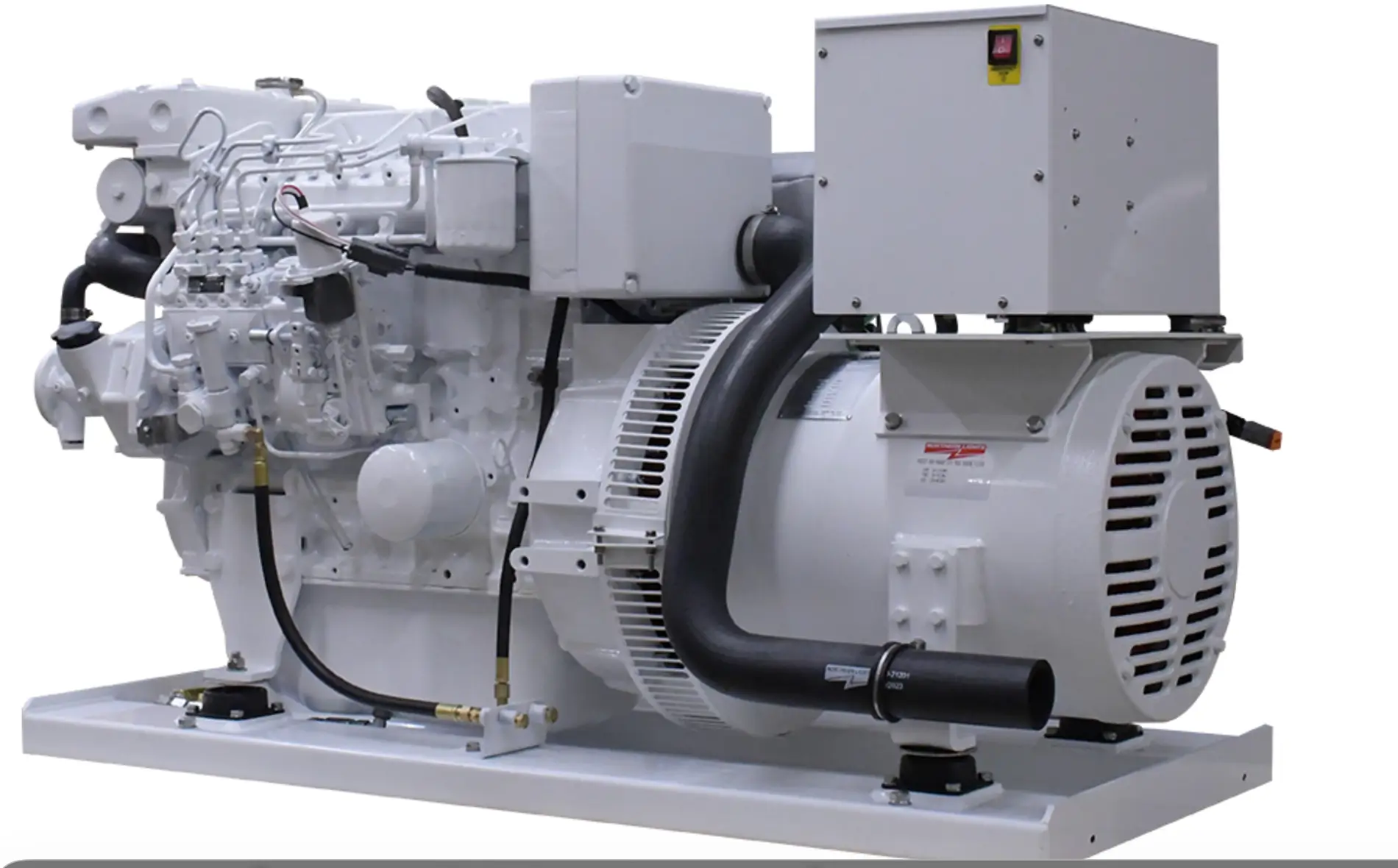
I'm trying to wrap my brain around some type of 400+volt generator... give me some examples of some, especially something that would fit in the frunk area.
Surely you jest. The drive motors of the current Lightning are 400 volt generators. The rotors are 8 or 9 inches across. Every electric motor is simultaneously a generator. (There can be vey slight tweaks to an electric machine to make a motor better at generating, but these are extremely subtle.) In my little PHEV (EREV in todays words) prototype, the drive motor and the generator were exactly the same, and the motor provided propulsion at 91% efficiency and generated at 91% efficiency. In this application, the total generating process was actually just slightly more efficient than the drive process, because there was nothing electronic controlling the generator. In other words, there was just a contactor (a heavy switch) and heavy wires between the generator and the batteries (Whereas the drive motor was controlled by a fancy version of pulse width modulation.)

Some concepts are more easily understood with a brushed permanent magnet motor. You can probably guess that such a motor has a particular maximum speed when fed by e.g. 12 VDC. Suppose you have no load on the motor. What keeps it from going faster and faster and then flying apart from centrifugal effects? The back emf generated by the motor as is runs increases with speed. At the point that the back emf and input voltage are the same, then there is no difference in voltage, thus no flow and thus no further acceleration.

If you read about the Ram EREV truck, you will see that there is no starter motor. There was also no starter motor in my little protype. The generator was the motor that started the engine.

This article explains back emf: https://en.wikipedia.org/wiki/Counter-electromotive_force
 

Sponsored

ZeusDriver

Well-known member
Joined
Dec 1, 2025
Threads
7
Messages
154
Reaction score
131
Location
East Coast, USA
Vehicles
2022 Lightning
If i were Ford I'd just take the Ecoboost 3.5 truck and replace the 10 speed with whatever generator could use it's max power and let it power the current lightning drive train. Then stuff in as much battery as the chassis could carry and still have 1500 to 2000lb payload.
Tune the 3.5 for generator operation and let software give you what you need and when. Defeciencies in EPA range that happen due to battery size can be made up with fuel tank size.
I imagine that's not too far from what they will do. I doubt that they will use the engine in ecoboost configuration, because they can probably get better thermal efficiency by making it Atkinson cycle, and the engine can be simpler and lighter and cheaper and longer-lasting without the turbo and its controls.

Using the Lightning truck layout would probably work better to retain the two motors, the independent rear suspension, and the space for batteries (that not having a drive shaft allows). There may be enough room to put the engine above front electric motor, if the oil reservoir were mounted remotely.

I think they will limit the battery pack size to control cost. 150 mile EPA range at 2.2 m/kWh would be about 70 kWh pack, with the reduction in size from an SR lightning pack being about enough to offset the engine weight. The remaining 550 miles could come from a 25 gallon tank at 22 mpg. Making the pack smaller than 70 kWh would make it difficult to get the desired HP output from the motors.
 

ZeusDriver

Well-known member
Joined
Dec 1, 2025
Threads
7
Messages
154
Reaction score
131
Location
East Coast, USA
Vehicles
2022 Lightning
I don’t see why they don’t just make a big battery 2.7 ecoboost plugin hybrid. The 2.7 is a great engine, proven performer with high reliability that has been accepted by fleets-but needs more towing power, which they can get with electric on the driveline. I think they will ditch the current powerboost and work on a hybrid that can actually have the battery buffer to help with towing, and the battery only range to get you at least to work (30-40 kWh). The current powerboost has a tiny battery that is gone about half a second into towing a grade and then you get the poor economy of a 3.5 twin turbo on full blower.

I think the EREV is going to be too expensive and too heavy for the benefits without massive breakthroughs in battery weight and efficiency losses with genset operation. There will be massive warranty issues.

Without absolutely stunning performance out of the generator and DC bus (I don’t think you can get away without the ability for the generator to provide massive power directly to the motors in a towing situation) the solution doesn’t make a lot of sense for something early marketing tells us is going to “tow like a locomotive.”
I think the hitch with 30-40 kWh is getting adequate HP from the batteries. The SR Lightnings have a lower HP rating than the ERs because the battery pack is smaller. A parallel hybrid of your description would work well, but that is no what Jim Farley described.

The Ranger PHEV (in non US markets) has both very limited range and very limited performance in the electric-only mode. I think with the Ram EREV having the lead, that Ford will have to bring out something similar.
 

ZeusDriver

Well-known member
Joined
Dec 1, 2025
Threads
7
Messages
154
Reaction score
131
Location
East Coast, USA
Vehicles
2022 Lightning
Lots of ways to find efficiency. For example, in the winter, running the generator because it generates waste heat that can warm the cabin and battery. Is that more efficient than using resistive heating?
The Chevy Volt did this. The efficiency (if measured in terms of equivalent kW input -- fuel value -- vs kW output of the heater) is much lower with the engine running. If the heating element is fully contained in the thing that you want to heat, then any electric heater is 100% efficient -- there is no "waste heat". An engine as a waste heat generator is not great, because a lot of heat goes out the exhaust, and a lot is radiated from the engine block, exhaust tubing and catalytic converter. Things improve if there is otherwise a need to run the generator, however.

In the volt, it appeared to me that comfort was the entire motive -- it was only in very cold weather that the engine would start up for that reason.
 

grottomatic

Member
Joined
Dec 19, 2025
Threads
0
Messages
5
Reaction score
3
Location
US
Vehicles
2025 Lightning Flash
I think the hitch with 30-40 kWh is getting adequate HP from the batteries. The SR Lightnings have a lower HP rating than the ERs because the battery pack is smaller. A parallel hybrid of your description would work well, but that is no what Jim Farley described.

The Ranger PHEV (in non US markets) has both very limited range and very limited performance in the electric-only mode. I think with the Ram EREV having the lead, that Ford will have to bring out something similar.
That’s interesting, didn’t know there was a Ranger PHEV. I was thinking they would transition to the 2.7 for the next gen powerboost model with a bigger battery and possibly better efficiency. With a larger electric motor (I think the current one is -45hp) there could be more torque fill to help with towing power and efficiency which is the weakness of the 2.7 (very little torque out of boost at lower rpm). With a bigger battery you could naturally get better range- at steady state unloaded.

At highway speeds a 100hp electric motor would be fine for ICE shutdown.

I’m assuming the EREV and any new power plant (hybrid/ice) will come with the updated truck in 2028 thus have a new frame and probably suspension.

I’m not as knowledgeable about this stuff as you though. Seems like the 3.5 may be overkill for a future power plant.
Sponsored


Top