

Sponsored

My interest in a DIY kit that adds a J1772 port to the bed and allows CWD?


  • Total voters
    161

hturnerfamily

Well-known member
First Name
William
Joined
Jan 8, 2022
Threads
49
Messages
2,333
Reaction score
2,981
Location
rural Georgia
Vehicles
22 LIGHTNING PRO IcedBlueSilver 8/23/2022
Occupation
Owner
I agree somewhat with both sentiments, as if the manufacturers wanted to give you an 'extended range' option vehicle, you would also decline because of the price...

and, while we all somewhat pawn over the 'what if we had....' scenarios, as though those themselves would be the ultimate answers to every situation, it begs to ask the question:

What NUMBER of miles is the 'ultimate' answer? 300? I guess not. 500? Many would still say "that's not enough". 1,000? No, it still wouldn't satisfy some.

There will ALWAYS be worries about '...if I just had xxxxx more miles it would be just perfect'... but, no matter, you'd still always be able to worry about a situation where it wouldn't be.

We started with 70 mile range Nissan LEAFS. Believe me, I don't have ANY issues with my 'bare bones' 240 mile range LIGHTNING PRO SR... it's a joy. We go EVERYWHERE and ANYWHERE we want to, ANYTIME we want to. We actually did the same in the LEAFS... and some would still complain that it 'can't be done'...


but yes, no matter my own experiences, there is always some who will suggest that we 'must' need some type of range extender, just in case. I 'm just not sure where the 'cases' ever happen.
Sponsored


 

PJnc284

Well-known member
Joined
Sep 30, 2024
Threads
0
Messages
963
Reaction score
1,031
Location
Garner, NC
Vehicles
2023 Ford F150 Lightning Lariat ER
Martin got his hands on a 28k generator and will be using it on a trip to Florida after Christmas. Will be interesting to see the fuel burn of that beast running pretty much full out and curious how it will ride with a 700lb+ (generator+custom carrier) lever just hanging off the back. Hitch receiver lists only a 500lb tongue weight for non-WD and usually they recommend significantly less than the sticker on the hitch for cargo carriers. Explorer is only 165lbs for instance but couldn't find a reference for the lightning or F150s.


NW Ontario Ford Lightning

Well-known member
First Name
Robert
Joined
Feb 14, 2025
Threads
1
Messages
553
Reaction score
704
Location
NW Ontario Canada
Vehicles
2024 F-150 SR Lightning XLT, 2023 Escape Hybrid
Occupation
Contractor
I like the idea of 'charge while driving' - however not really interested in using a generator.
I have a SR and a favourite lake that is right at my limit for the round trip from the nearest charging location. Rather than a generator, I am working on a battery pack that fits in the bed with the tonneau cover closed.
My set up uses 3x 15.5kWh battery packs (46.5kWh from my 147kWh solar ESS) and a 12kW inverter. I don't need the charging while driving really, I plan to just plug in the aux battery pack to charge the truck while I am camping/fishing/sleeping - but it allows me a way to gain say 39kWh (after losses) for the round trip into the remote lake site, and have significant power available for the day to day stuff while camping. The three packs together weigh just over 600 lbs.

The bed can hold three additional battery packs, for a total of 1200 lbs; and 93kWh.
The destination charger at 7.7kW is 12 hours of charging (overnight stay for sure), and all the bed space would be filled with battery packs, not ideal for camping.

The Ever-Drive plug in would allow me to use my 51.5kWh Aux battery while driving, adding 7.7kW per hour. This could be handy for the forest access roads where the low speed travel means the charger adds energy at close to the same rate it is being used. My last summer trip I was running 19kWh per 100km, averaging 50km per hour = 9.5 kW burn rate, so 7.7kw charging rate would be useful in this type of low speed back roads in summer weather.

I have done a few tests charging the truck from the aux packs while monitoring the temperatures - the low 0.15C-rate discharge only raised the cell temps a few degrees above the ambient air temp.
 

ZeusDriver

Well-known member
Joined
Dec 1, 2025
Threads
7
Messages
138
Reaction score
120
Location
East Coast, USA
Vehicles
2022 Lightning
I apologize for not reading through all the comments, but noticed several that had math questions, which may have already been answered.

An ER goes 314 miles on a perfect spring windless day. (2.4 miles / kWh *131) It is possible to get 2.4 m/kWh at 60 mph, on such a day. A 300 mile trip takes 5 hours. Ignoring losses, 5 hrs at 11kW is 55 kWh. So the generator has added 55*2.4=132 miles range. That means you could drive 2 more hours, and that you have (so far) 432 mile range. But in those two hours, you will have generated another 22 kWh, for another 53 miles. That is another hour, roughly. You get the drift, no doubt. (There is a simpler way to calculate this, but this might seem more intuitive. )

Allowing for some inefficiencies, you could go about 450 miles under these perfect conditions.

Issues?
- There is the fuel, but not all that much, say 10 gallons. (8hrs at 1.25 gph) 10 gallons for 150 mile range extension is discouraging, but there may be a compelling reason for not just stopping at a supercharger.
- There is the noise, which pretty completely defeats one of the great things about an EV.
- There is the gas on board, without any of the engineering for automotive systems that makes cars pretty safe from fire in most conditions.
- There is the collision hazard, so you'd want a very well engineered hold-down system, so you are not charged with contributory negligence should there be a collision
- There is the reduction in cargo space and capacity.
- There is the fact that these conditions are ideal. If towing something, then there is half as much time for charging, so the range extending effect is much less noticeable.
- There is the fact that you have a home built hybrid, which does not meet vehicle emission standards.
- There are the modifications required to make charging while moving possible, and possible warranty denial issues.
- There is all the screwing around with lifting a heavy generator into the truck bed, doing all the initial conversions and modifications, etc.

There are probably people who would want this contraption, and who would not be concerned about the issues above. .
 

Sponsored
OP
OP

ZSC100

Well-known member
First Name
Zach
Joined
Mar 29, 2023
Threads
9
Messages
557
Reaction score
594
Location
Tulsa, OK
Vehicles
2022 F150 Lightning SR EG 311A
Occupation
Electrical Engineer
I just wanted to share this generator I just purchased that says it is built for EV charging from Home Depot. I don't have it yet, but should be interesting.

https://www.homedepot.com/p/WEN-680...da372a714359abbf51ad03909ce58de179aba23c8aa78
Nice, I like the form factor and 63db is pretty good. I think you'll want 2 of them paralleled to get 10kW, I love that they post the full load fuel usage,, basically you can get 10kW for 0.83gal/hr*2=1.66gal/hr for 10kW,, if you consider that a gallon of gas has 33kWhr of energy, this is 55kWhr of energy, so it's roughly 1/5 efficient. Seems to be normal for small ICE generators.

Hopefully the emerging EREV industry can get closer to 50% with bigger more advanced engines.
 

dm5point0

Member
First Name
David
Joined
Mar 8, 2022
Threads
1
Messages
17
Reaction score
6
Location
Atlanta, GA
Vehicles
2021 F-150 Lariat FX4
Occupation
UPS
Yeah...I just got this for when I am at my hunting camp and don't want to "steal" any power from our main camp generator.
 

ZeusDriver

Well-known member
Joined
Dec 1, 2025
Threads
7
Messages
138
Reaction score
120
Location
East Coast, USA
Vehicles
2022 Lightning
Hopefully the emerging EREV industry can get closer to 50% with bigger more advanced engines.
That could be a very long way out into the future. The Prius engine is among the best of the Atkinson cycle car engines, and is 38.5% efficient at its peak. In car sizes, diesels have been, in practice worse, with the Jetta Diesel getting significantly lower mpg figures than the Prius. Of course, the Jetta did not have regen (...but in the EPA tests, (and in the real world) the contribution to overall efficiency from regen is quite modest.) I don't have a Jetta engine chart in front of me, but I doubt that it would show combustion efficiency any higher than the Prius engine.

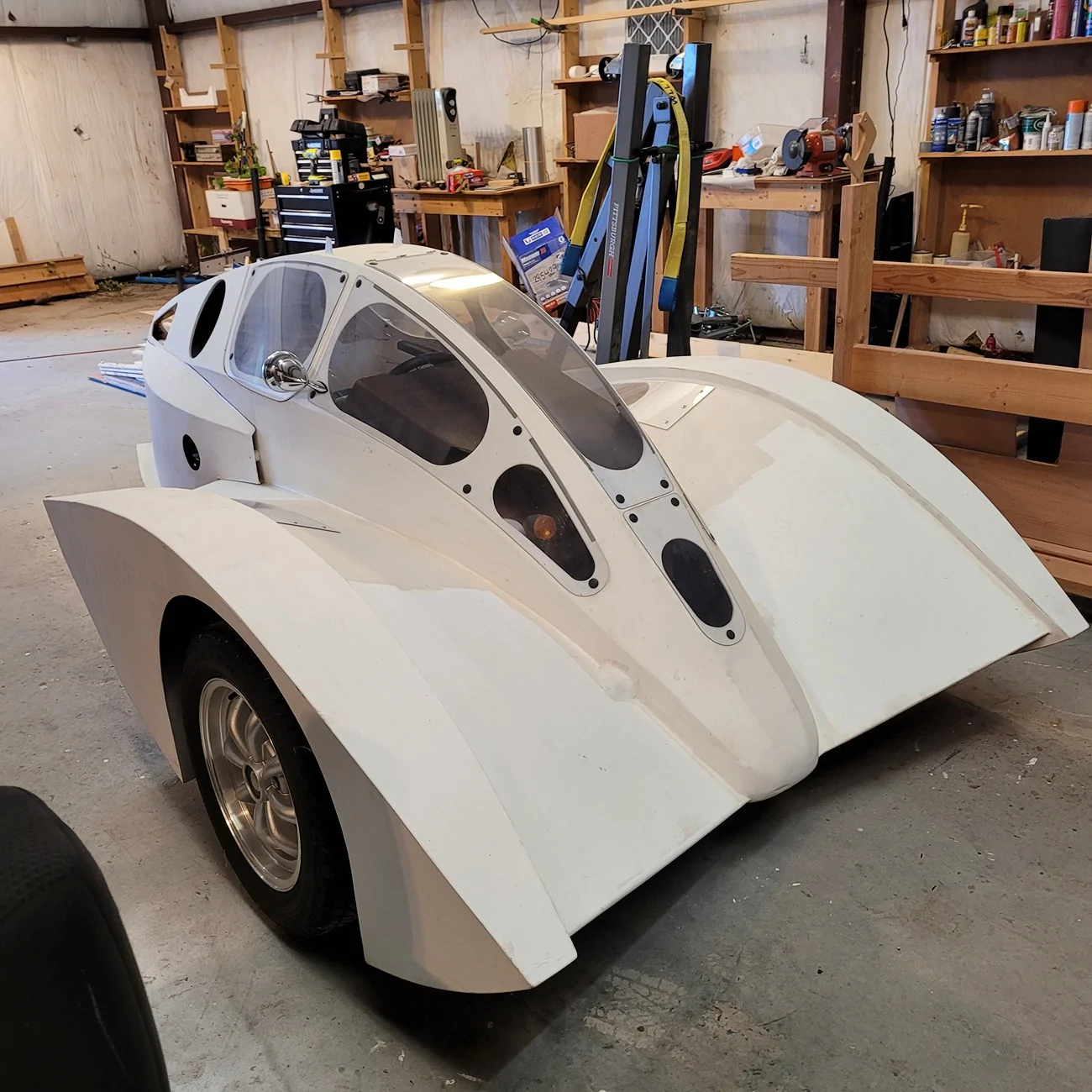
Having built the little PHEV below, which took a at least a full-time year between design, engineering and building, (plus a bunch more time in biz planning, market strategizing, etc.,) I would hope that others (besides Toyota) care about overall efficiency. But I see little evidence of that in the marketplace. (Ford bought Toyota's tech for their Escape hybrid, rather than developing their own. They announced in 2018 that by 2020 90% of their vehicles would be Trucks and SUVs, with the Mustang being the only "sedan".) No amount of finagling will make a vehicle as heavy and boxy as the Lightning (and other pickups and SUVs, by degree) an efficient means for moving a 170 lb person (and usually little else) from point to point. In other countries there is some interest in efficient little cars, but not in the US.

Ford F-150 Lightning Charging While Driving w/ Gas Generator in Bed (Range Extender for F-150 Lightning) - Testing 20240609_181710


So, in the US, why would any manufacturer really care about 38% or 39% or 40% conversion efficiency. The F150 has usually been the best selling vehicle in America, and it gets horrible mileage, and people (other than the lunatic fringe, like me) do not care. And even I, an admitted lunatic, still find excuses for why I need a 6000 lb truck.

About half the people in the US think that climate science is a hoax, and about 90% seem to act as if it is, by buying huge houses, huge cars, huge second homes, and more an more "stuff", every bit of which has a CO2 footprint.

The Prius has been marketed for over 25 years, and its basic engine efficiency has improved only slightly from an excellent 37% in gen one to 38.5% in gen three. At that rate, we could expect 40% by 2050. (Some sources quote Prius efficiency as being 40% now, but that is not the basic combustion efficiency of the engine alone... it includes the effects of improved friction control hybridization, regen, etc.)

I see little to no indication that people at the auto manufacturers are working seriously on efficiency, and clearly, the small generator manufacturers are not. Inverter generators have nice features such as low noise when off load, and stable AC frequency, but the manufacturers have concluded that in the generator and marine worlds, people are happy with low efficiency, with power boat owners not really caring about 2 or 3 mpg efficiency. Bigger and bigger outboards (1200 hp hanging off the back of triple outboard a boat??!!) sell like hotcakes.

In grid-level power generation and in shipping, where low efficiency can be costly, engine efficiency has improved, with very large diesels going over 50% . Simply miniaturizing one of those engines, however does not produce a 50% efficient engine.

In the interests of avoiding wars over oil, and reducing resource consumption and reducing general pollution and reducing CO2 emissions, the most dramatic results can be had from creating and driving much smaller vehicles. My 1990 F150 had 145 hp and worked fine for the needs of both leisure users and workmen. At $13.8 K brand new, is was substantially less than the cost of a current pickup in inflation-adjusted dollars.
 
OP
OP

ZSC100

Well-known member
First Name
Zach
Joined
Mar 29, 2023
Threads
9
Messages
557
Reaction score
594
Location
Tulsa, OK
Vehicles
2022 F150 Lightning SR EG 311A
Occupation
Electrical Engineer
That could be a very long way out into the future. The Prius engine is among the best of the Atkinson cycle car engines, and is 38.5% efficient at its peak. In car sizes, diesels have been, in practice worse, with the Jetta Diesel getting significantly lower mpg figures than the Prius. Of course, the Jetta did not have regen (...but in the EPA tests, (and in the real world) the contribution to overall efficiency from regen is quite modest.) I don't have a Jetta engine chart in front of me, but I doubt that it would show combustion efficiency any higher than the Prius engine.

Having built the little PHEV below, which took a at least a full-time year between design, engineering and building, (plus a bunch more time in biz planning, market strategizing, etc.,) I would hope that others (besides Toyota) care about overall efficiency. But I see little evidence of that in the marketplace. (Ford bought Toyota's tech for their Escape hybrid, rather than developing their own. They announced in 2018 that by 2020 90% of their vehicles would be Trucks and SUVs, with the Mustang being the only "sedan".) No amount of finagling will make a vehicle as heavy and boxy as the Lightning (and other pickups and SUVs, by degree) an efficient means for moving a 170 lb person (and usually little else) from point to point. In other countries there is some interest in efficient little cars, but not in the US.

20240609_181710.webp


So, in the US, why would any manufacturer really care about 38% or 39% or 40% conversion efficiency. The F150 has usually been the best selling vehicle in America, and it gets horrible mileage, and people (other than the lunatic fringe, like me) do not care. And even I, an admitted lunatic, still find excuses for why I need a 6000 lb truck.

About half the people in the US think that climate science is a hoax, and about 90% seem to act as if it is, by buying huge houses, huge cars, huge second homes, and more an more "stuff", every bit of which has a CO2 footprint.

The Prius has been marketed for over 25 years, and its basic engine efficiency has improved only slightly from an excellent 37% in gen one to 38.5% in gen three. At that rate, we could expect 40% by 2050. (Some sources quote Prius efficiency as being 40% now, but that is not the basic combustion efficiency of the engine alone... it includes the effects of improved friction control hybridization, regen, etc.)

I see little to no indication that people at the auto manufacturers are working seriously on efficiency, and clearly, the small generator manufacturers are not. Inverter generators have nice features such as low noise when off load, and stable AC frequency, but the manufacturers have concluded that in the generator and marine worlds, people are happy with low efficiency, with power boat owners not really caring about 2 or 3 mpg efficiency. Bigger and bigger outboards (1200 hp hanging off the back of triple outboard a boat??!!) sell like hotcakes.

In grid-level power generation and in shipping, where low efficiency can be costly, engine efficiency has improved, with very large diesels going over 50% . Simply miniaturizing one of those engines, however does not produce a 50% efficient engine.

In the interests of avoiding wars over oil, and reducing resource consumption and reducing general pollution and reducing CO2 emissions, the most dramatic results can be had from creating and driving much smaller vehicles. My 1990 F150 had 145 hp and worked fine for the needs of both leisure users and workmen. At $13.8 K brand new, is was substantially less than the cost of a current pickup in inflation-adjusted dollars.
I think with very purpose built one RPM & one Load engines we can get to 50% especially with small sub 100HP diesel. It will take some shift in regulation for on-highway ICEs, but I think it's coming. We have to be able to turn on an engine and run it at one finely tuned load and RPM for this to be possible. There may also be some CO2 gas turbine combined cycle possibilities with the battery to accept the power as things wind down. Think if you could recover the waste heat even at 30%, that would get us in the the 60s% overall effeciency.
 

Sponsored

ZeusDriver

Well-known member
Joined
Dec 1, 2025
Threads
7
Messages
138
Reaction score
120
Location
East Coast, USA
Vehicles
2022 Lightning
I think with very purpose built one RPM & one Load engines we can get to 50% especially with small sub 100HP diesel. It will take some shift in regulation for on-highway ICEs, but I think it's coming. We have to be able to turn on an engine and run it at one finely tuned load and RPM for this to be possible. There may also be some CO2 gas turbine combined cycle possibilities with the battery to accept the power as things wind down. Think if you could recover the waste heat even at 30%, that would get us in the the 60s% overall effeciency.
I admire your optimism, and please realize that I am a cranky old fart, so weigh that in any interpretation.

But it is worth considering that the Prius 38.5% figure is already only at one load and one rpm -- every where else, its efficiency is lower -- and in many operating conditions, far lower. (The same is true but more extreme for the Jetta diesel) The Prius engine load is all over the place: the range of loads is smaller than in a conventional old car, (which operates at 0% efficiency when idling in traffic if the battery is already charged) but the engine still spends much of its time lightly loaded, where efficiency is dismal.

In my little PHEV the generator operated mainly at very high load, or not at all, at least in my imagination. But in practice, in charging batteries, the load is not constant, because the charge acceptance rate tapers off as the battery becomes more charged. (Also, if the vehicle is moving, then the drive motors affect the load on the generator.) I built a prototype second engine, which I never installed, but was not expecting better than 30% average efficiency, given its 36% peak. The generator was directly driven by the engine without any belts, or reductions.

I wrote up a patent, but did not file it, for a combined cycle system that would use an engine to provide household electric needs, with the waste heat going into heating water for domestic use, supplementing heat pump heat, (warming ground source water for instance) etc. The patent write up made it all sound feasible.... and maybe it is. Someone younger than me can investigate.

But devising a combined cycle mobile system seems unlikely to produce any substantial overall efficiency gain. Many people have postulated increased overall efficiency for turbo engines -- seems to make sense -- but it does not pan out. I did not follow precisely what you meant by
>> There may also be some CO2 gas turbine combined cycle possibilities with the battery to accept the power as things wind down..<<

Re shift in regulations, I am no fan of polluting more rather than less, but would support exemptions for projects like yours... both for prototyping and for possible subsequent sales in limited numbers, such as 1000 units. In my little PHEV, the regs were for motorcycles, so it was less of a challenge to meet than for a four-wheeled project.

Random thought: The electric machines (DC or AC) in portable and semiportable generators tend to be low efficiency. You could do better with some of the high efficiency brushless motors available... or a repurposed Leaf or Tesla motor, etc. A 3 cylinder Daihatsu motor laid over on its side with remote oil supply would probably fit under a Lightning, if the battery pack were reduced for space.

Your doing good stuff. Carry on.
 
OP
OP

ZSC100

Well-known member
First Name
Zach
Joined
Mar 29, 2023
Threads
9
Messages
557
Reaction score
594
Location
Tulsa, OK
Vehicles
2022 F150 Lightning SR EG 311A
Occupation
Electrical Engineer
I admire your optimism, and please realize that I am a cranky old fart, so weigh that in any interpretation.

But it is worth considering that the Prius 38.5% figure is already only at one load and one rpm -- every where else, its efficiency is lower -- and in many operating conditions, far lower. (The same is true but more extreme for the Jetta diesel) The Prius engine load is all over the place: the range of loads is smaller than in a conventional old car, (which operates at 0% efficiency when idling in traffic if the battery is already charged) but the engine still spends much of its time lightly loaded, where efficiency is dismal.

In my little PHEV the generator operated mainly at very high load, or not at all, at least in my imagination. But in practice, in charging batteries, the load is not constant, because the charge acceptance rate tapers off as the battery becomes more charged. (Also, if the vehicle is moving, then the drive motors affect the load on the generator.) I built a prototype second engine, which I never installed, but was not expecting better than 30% average efficiency, given its 36% peak. The generator was directly driven by the engine without any belts, or reductions.

I wrote up a patent, but did not file it, for a combined cycle system that would use an engine to provide household electric needs, with the waste heat going into heating water for domestic use, supplementing heat pump heat, (warming ground source water for instance) etc. The patent write up made it all sound feasible.... and maybe it is. Someone younger than me can investigate.

But devising a combined cycle mobile system seems unlikely to produce any substantial overall efficiency gain. Many people have postulated increased overall efficiency for turbo engines -- seems to make sense -- but it does not pan out. I did not follow precisely what you meant by
>> There may also be some CO2 gas turbine combined cycle possibilities with the battery to accept the power as things wind down..<<

Re shift in regulations, I am no fan of polluting more rather than less, but would support exemptions for projects like yours... both for prototyping and for possible subsequent sales in limited numbers, such as 1000 units. In my little PHEV, the regs were for motorcycles, so it was less of a challenge to meet than for a four-wheeled project.

Random thought: The electric machines (DC or AC) in portable and semiportable generators tend to be low efficiency. You could do better with some of the high efficiency brushless motors available... or a repurposed Leaf or Tesla motor, etc. A 3 cylinder Daihatsu motor laid over on its side with remote oil supply would probably fit under a Lightning, if the battery pack were reduced for space.

Your doing good stuff. Carry on.
There's a lot of research in 2nd stage heat recovery using CO2 as a refrigerant to drive small turbine generators, condensing in a closed loop. Same with small modular fission reactors. I figure a micro turbine generator can recover heat this way in a vehicle, but without 50 plus mile per gallon targets/penalties for the ICE industry it will never happen. Gas is $2.09/gal in Tulsa right now; That makes an ICE F150 cheaper to drive road trips than the Lightning.
 

ZeusDriver

Well-known member
Joined
Dec 1, 2025
Threads
7
Messages
138
Reaction score
120
Location
East Coast, USA
Vehicles
2022 Lightning
Gas is $2.09/gal in Tulsa right now; That makes an ICE F150 cheaper to drive road trips than the Lightning.
Yes. I find that disturbing, in that it cannot help but set back development. There were a few years when Priuses were very hot sellers, and F150's were not, and the US industry was largely reactive rather than proactive. I was at a talk by Mike Jackson the CEO of Auto Nation (around 2009), in which he advocated for higher gas taxes to foster development of more fuel-efficient vehicles. He seemed like the real deal, in the sense that he was advocating for a policy that would reduce his income.

I wish the US auto industry had a longer term vision. I think China will lead in EVs, and leave the US manufacturers scrambling, just as they were when the Hondas and other Japanese brands were being introduced to this country, showing that cars could be very high quality, yet reasonably priced.

When "Quality is Job One" came out, I was working with Ford and bought an Escort so I could show up in Detroit in something other than a Honda. After having it for about a week, the front right brake caliper fell off. Hmmm.
 

ZeusDriver

Well-known member
Joined
Dec 1, 2025
Threads
7
Messages
138
Reaction score
120
Location
East Coast, USA
Vehicles
2022 Lightning
I happened to receive an ad in my feed for a DC fast charger. $75,000. I ran some numbers and figured that an entity could get a two year payback while charging only 10 cents over the ordinary retail price of electricity. That entailed keeping it busy 10 hours per day, which is probably feasible in the right locations. (Certainly not in Dillon SC, where there is a Supercharger installation with 40 plugs, and I have never seen more than 4 in use.) An entrepreneurial type such as you should start your own network.
Sponsored


Top