
Sponsored

SOH is not battery capacity

Zprime29

Well-known member
First Name
Brandon
Joined
Jul 26, 2022
Threads
45
Messages
2,804
Reaction score
3,077
Location
Tucson, AZ
Vehicles
2022 Lightning ER, 2025 XC90 Recharge
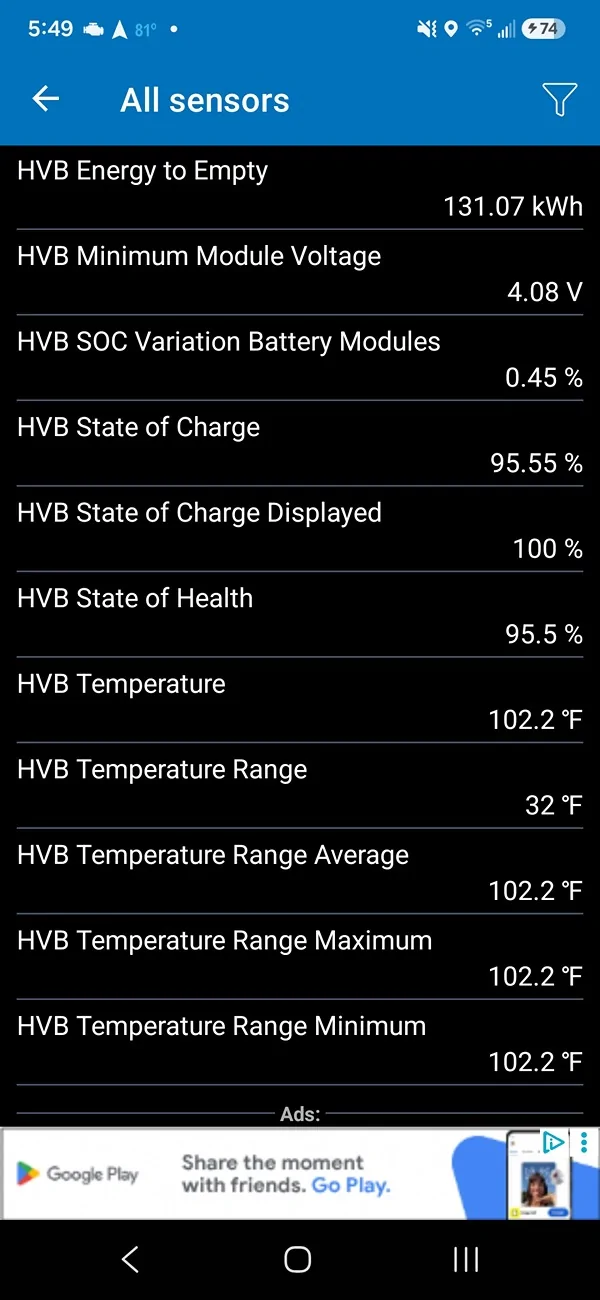
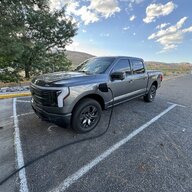
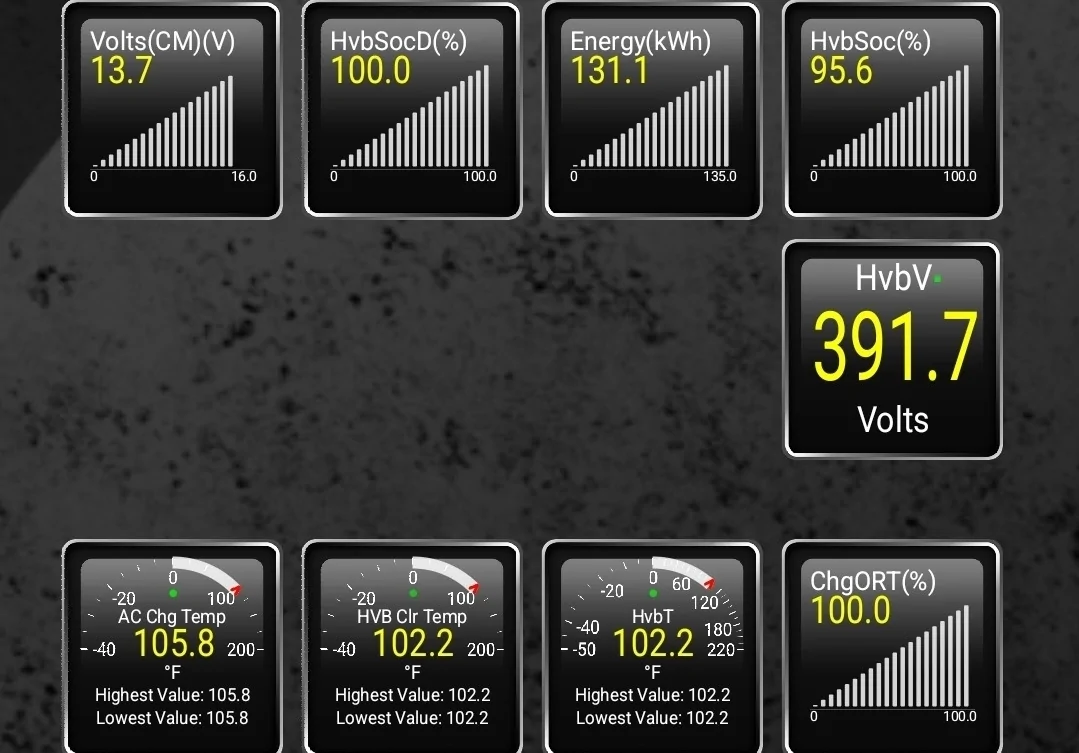
Accidentally charged to 100% after recall updates erased my charge locations. I took the opportunity to check in on my battery health. 131kWh useable capacity (which I haven't seen in a while) and 95.5% SOH. Folks, I hope this convinces you to stop equating SOH to battery capacity.

For those curious, I'm at 63k miles and live in a hot climate. I DCFC 3-4 times a year and have only been under 20% SOC a handful of times (lowest I've been is 13%). I'm not worried one iota about this battery.

Ford F-150 Lightning SOH is not battery capacity 1000014548
Sponsored


Timeless Epoch

Well-known member
First Name
Chad
Joined
Mar 3, 2025
Threads
7
Messages
228
Reaction score
415
Vehicles
2024 F150 Lightning Platinum
Occupation
Professionally: Disaster Recovery - Recreationally: Watchmaker
Ford UK has an FAQ that talks about SOH. Apparently it is viewable within settings for newer EV's available there.

BSOH is defined as the actual energy capacity divided by the energy capacity when the battery was new (in %).

  • A value of 100% means the actual energy capacity is the same as the new energy capacity.
  • A value of 80% means the remaining capacity and range is 80% of the new battery state.

https://www.ford.co.uk/support/how-...-do-i-use-the-battery-state-of-health-monitor

Is it the same thing with just an access difference, I do not know.

I do know that your battery being as warm as it is, would boost your usable capacity a bit. I doubt enough to account for the full discrepancy.
 
OP
OP

Zprime29

Well-known member
First Name
Brandon
Joined
Jul 26, 2022
Threads
45
Messages
2,804
Reaction score
3,077
Location
Tucson, AZ
Vehicles
2022 Lightning ER, 2025 XC90 Recharge
Ford UK has an FAQ that talks about SOH. Apparently it is viewable within settings for newer EV's available there.

BSOH is defined as the actual energy capacity divided by the energy capacity when the battery was new (in %).

  • A value of 100% means the actual energy capacity is the same as the new energy capacity.
  • A value of 80% means the remaining capacity and range is 80% of the new battery state.

https://www.ford.co.uk/support/how-...-do-i-use-the-battery-state-of-health-monitor

Is it the same thing with just an access difference, I do not know.

I do know that your battery being as warm as it is, would boost your usable capacity a bit. I doubt enough to account for the full discrepancy.
It also says, "This feature is available on the Ford Explorer and Ford Capri from model year 2026.75 onwards." I wouldn't be surprised if our SOH is computed differently. My SOH rarely lines up with my useable at 100% SOC. @Ford Motor Company Several times there's been requests for technical deep dives into this kind of information. Is there still a chance of that happening?

I have some screenshots of 100% at different temps from the past, I'll compare voltages when I get a chance.

Does anyone know if there's a PID for "Distance since last calculated" ? I haven't seen that data point before.
 

astrand1

Well-known member
First Name
Alex
Joined
Dec 16, 2021
Threads
10
Messages
774
Reaction score
822
Location
Michigan
Vehicles
2023 Ford F150 Lightning lariat ER
Occupation
Studio truck driver
Maybe I’m missing it but I’ve not seen people equating SOH with SOC. I suppose there could be some that get the 2 confused. I just don’t remember posts with people stating the SOH in regards to capacity.
 

Jim Lewis

Well-known member
First Name
Jim
Joined
Jan 10, 2023
Threads
56
Messages
1,087
Reaction score
1,065
Location
San Antonio, TX
Vehicles
Honda Accord 2017; 2023 Lariat ER
Occupation
Retired
Do you think the HVB Temperature Range represents the temperature range your battery has experienced during operation or when the truck was sitting idle in the environment? That's an interesting statistic.
 

Sponsored
OP
OP

Zprime29

Well-known member
First Name
Brandon
Joined
Jul 26, 2022
Threads
45
Messages
2,804
Reaction score
3,077
Location
Tucson, AZ
Vehicles
2022 Lightning ER, 2025 XC90 Recharge

astrand1

Well-known member
First Name
Alex
Joined
Dec 16, 2021
Threads
10
Messages
774
Reaction score
822
Location
Michigan
Vehicles
2023 Ford F150 Lightning lariat ER
Occupation
Studio truck driver
Based on the post you put up sounds like it more of an interpretation of capacity and trying to figure out range etc. at least that’s how I read it. My point is that I don’t think this is some wide spread problem where people are thinking this. The forums and Facebook groups I’m in this does not seem to be any kind of big issue. But 🤷‍♂️
 

chl

Well-known member
First Name
CHRIS
Joined
Dec 16, 2022
Threads
9
Messages
3,928
Reaction score
2,432
Location
alexandria virginia
Vehicles
2023 LIGHTNING PRO, 2012 Nissan Leaf, 2015 Toyota Prius, 2000 HD 883 Sportster
Occupation
Patent Atty / Electrical Engineer
What OBD scan program did you use?

A 131kWh battery is supposed to be a 143.4kWh battery if you include the buffers (top and bottom of about 5%) according to Ford.

The reading says 131.07kWh is the "energy to empty" but what does "empty" mean? Down to 0% or down to the 5% buffer?

It also says your SOC is 95.55%.

If 131.07kWh is an SOC of 95.55%, then F where F is 100% suggests that full (100% SOC) is 131.07kWh / 95.55% = 137.17kWh. That is somewhat less than the 143.4kWh Ford specs the battery at including buffers so some capacity has been lost.

Assuming 143.4kWh is the actual 100% including buffers, then the SOH would be 137.17 / 143.4 = 95.65%, so 4.35% capacity was lost.

The scan readout also says the SOH is 95.5%.
If we use the SOC number (95.55%) then that suggests the original battery capacity was: 137.17kWh / 95.5% = 143.6kWh which is closer to the Ford spec.

Anyway, we should remember that these numbers depend on some other things, like battery temperature, and how long you waited to let the battery settle after charging.

After a 100% charge, some energy will be used up to balance the battery cells, and the capacity will fall. Also the battery will cool down and the capacity will decrease somewhat as well.

There may be some discrepancies/ differences in the way the SOC vs the SOH is calculated by the truck, round off error, BMS drift, etc.

But these numbers are close enough to give one confidence that the battery is doing well with 63K miles in a hot climate,

Congrats! :)
 
OP
OP

Zprime29

Well-known member
First Name
Brandon
Joined
Jul 26, 2022
Threads
45
Messages
2,804
Reaction score
3,077
Location
Tucson, AZ
Vehicles
2022 Lightning ER, 2025 XC90 Recharge
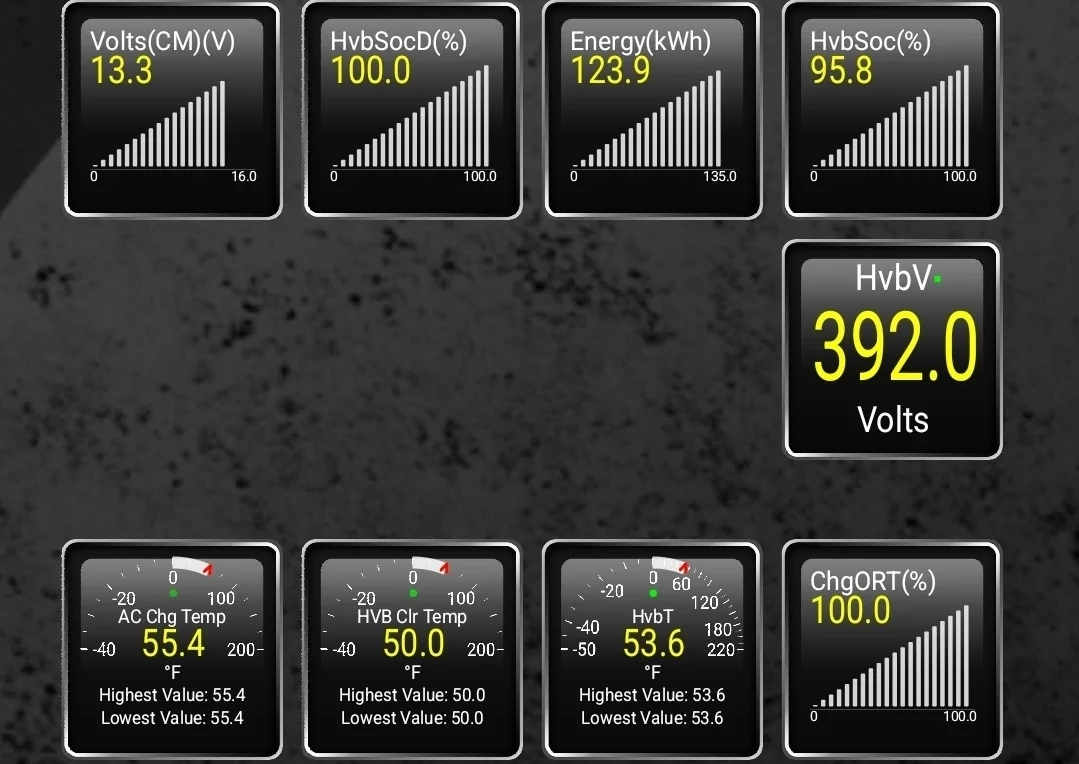
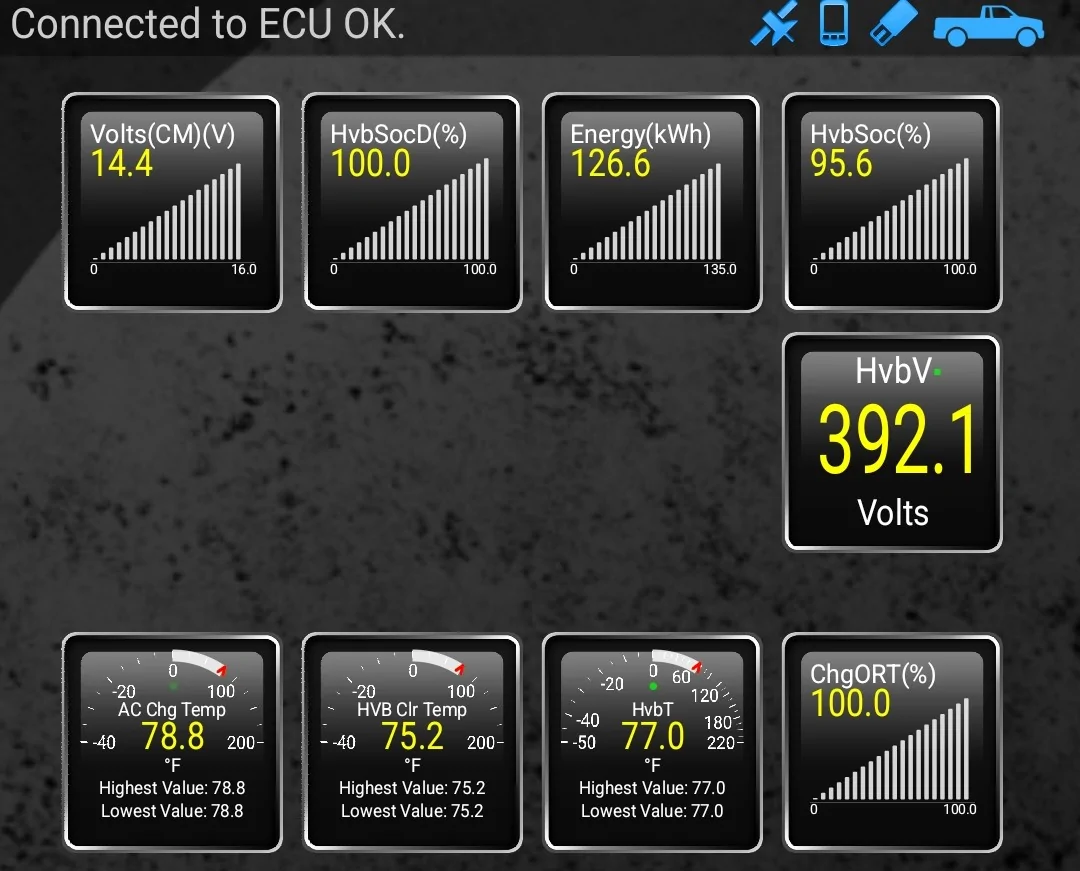
Here's a couple different 100% charges I captured at different temperatures. All end up at the same voltage. We see the usual lower useable energy at the lower temps, but even when I was near ideal in the 70s I didn't get all the way to 131 kWh. That's why I was surprised when it got there this most recent time. As far as I know, temps above 70s are not supposed to increase capacity.

The fact that my SOH has not gone up means that it is not solely tied to useable capacity.
Ford F-150 Lightning SOH is not battery capacity 1000014552
Ford F-150 Lightning SOH is not battery capacity 1000013329
Ford F-150 Lightning SOH is not battery capacity 1000014555


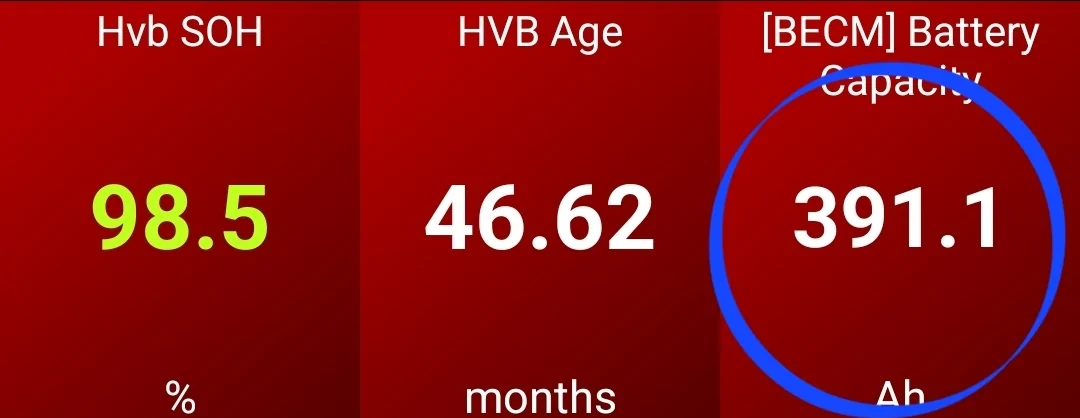
@astrand1 the first link makes a direct association.
It actually tracks the BECM Battery Capacity metric and how it relates as a percentage of design capacity (397Ah).

Screenshot_20260617_182917_Car Scanner.webp
I see similar statements and concerns about SOH very frequently. I only posted a few links, but there are dozens if one searches. If you want to chalk it up to me being bitter about a lower SOH than most, sure there's likely some truth to it. I mainly wanted to provide evidence I can link to when I see someone make the claim.
 

astrand1

Well-known member
First Name
Alex
Joined
Dec 16, 2021
Threads
10
Messages
774
Reaction score
822
Location
Michigan
Vehicles
2023 Ford F150 Lightning lariat ER
Occupation
Studio truck driver
Here's a couple different 100% charges I captured at different temperatures. All end up at the same voltage. We see the usual lower useable energy at the lower temps, but even when I was near ideal in the 70s I didn't get all the way to 131 kWh. That's why I was surprised when it got there this most recent time. As far as I know, temps above 70s are not supposed to increase capacity.

The fact that my SOH has not gone up means that it is not solely tied to useable capacity.
1000014552.webp
1000013329.webp
1000014555.webp


@astrand1 the first link makes a direct association.

I see similar statements and concerns about SOH very frequently. I only posted a few links, but there are dozens if one searches. If you want to chalk it up to me being bitter about a lower SOH than most, sure there's likely some truth to it. I mainly wanted to provide evidence I can link to when I see someone make the claim.
Well I would not call you bitter. I just don’t see it as a big topic talked about in my circles. You may see it more where you are and that’s fair. There have been other discussions around the SOH and how accurate it really is to actual health. I chalk it up more to a guesstimate of the battery health similar to my iPhone when I look at the battery health. Who knows what ford is using to display this info and of course what they are allowing us to see.
 

Sponsored
OP
OP

Zprime29

Well-known member
First Name
Brandon
Joined
Jul 26, 2022
Threads
45
Messages
2,804
Reaction score
3,077
Location
Tucson, AZ
Vehicles
2022 Lightning ER, 2025 XC90 Recharge
What OBD scan program did you use?

A 131kWh battery is supposed to be a 143.4kWh battery if you include the buffers (top and bottom of about 5%) according to Ford.

The reading says 131.07kWh is the "energy to empty" but what does "empty" mean? Down to 0% or down to the 5% buffer?

It also says your SOC is 95.55%.

If 131.07kWh is an SOC of 95.55%, then F where F is 100% suggests that full (100% SOC) is 131.07kWh / 95.55% = 137.17kWh. That is somewhat less than the 143.4kWh Ford specs the battery at including buffers so some capacity has been lost.

Assuming 143.4kWh is the actual 100% including buffers, then the SOH would be 137.17 / 143.4 = 95.65%, so 4.35% capacity was lost.

The scan readout also says the SOH is 95.5%.
If we use the SOC number (95.55%) then that suggests the original battery capacity was: 137.17kWh / 95.5% = 143.6kWh which is closer to the Ford spec.

Anyway, we should remember that these numbers depend on some other things, like battery temperature, and how long you waited to let the battery settle after charging.

After a 100% charge, some energy will be used up to balance the battery cells, and the capacity will fall. Also the battery will cool down and the capacity will decrease somewhat as well.

There may be some discrepancies/ differences in the way the SOC vs the SOH is calculated by the truck, round off error, BMS drift, etc.

But these numbers are close enough to give one confidence that the battery is doing well with 63K miles in a hot climate,

Congrats! :)
Interesting numbers. That 131 kWh was 3 hours after FordPass reported full charge hit. So it had already rested. If it's reporting less than 143 kWh actual capacity by that math, then that means I should be creeping closer to actual 100% SOC than being reported? I find it difficult to believe Ford would allow that to happen, as it increases risk of over charging. Now I'm even more curious to know how these numbers are all connected.
 
  • Like
Reactions: chl

chl

Well-known member
First Name
CHRIS
Joined
Dec 16, 2022
Threads
9
Messages
3,928
Reaction score
2,432
Location
alexandria virginia
Vehicles
2023 LIGHTNING PRO, 2012 Nissan Leaf, 2015 Toyota Prius, 2000 HD 883 Sportster
Occupation
Patent Atty / Electrical Engineer
Here's a couple different 100% charges I captured at different temperatures. All end up at the same voltage. We see the usual lower useable energy at the lower temps, but even when I was near ideal in the 70s I didn't get all the way to 131 kWh. That's why I was surprised when it got there this most recent time. As far as I know, temps above 70s are not supposed to increase capacity.

The fact that my SOH has not gone up means that it is not solely tied to useable capacity.
1000014552.webp
1000013329.webp
1000014555.webp


@astrand1 the first link makes a direct association.

I see similar statements and concerns about SOH very frequently. I only posted a few links, but there are dozens if one searches. If you want to chalk it up to me being bitter about a lower SOH than most, sure there's likely some truth to it. I mainly wanted to provide evidence I can link to when I see someone make the claim.
Your in good shape from the scan.

Variations will happen up and down in the numbers depending on various things.

BMS drift is a real thing - there might be a FORscan way to reset the HVB BMS, not positive about that.

As the battery settles, balances, and cools down, capacity will drop, but it will take some time and it should not be a big drop.

SOH is an measure of existing capacity, but you have to know the starting number to get to it (existing capacity), and that may be why folks equate it with capacity? Non-engineers fudge a lot of values and meaning - they use power for energy a lot, for example...such is life! :)
 

chl

Well-known member
First Name
CHRIS
Joined
Dec 16, 2022
Threads
9
Messages
3,928
Reaction score
2,432
Location
alexandria virginia
Vehicles
2023 LIGHTNING PRO, 2012 Nissan Leaf, 2015 Toyota Prius, 2000 HD 883 Sportster
Occupation
Patent Atty / Electrical Engineer
Interesting numbers. That 131 kWh was 3 hours after FordPass reported full charge hit. So it had already rested. If it's reporting less than 143 kWh actual capacity by that math, then that means I should be creeping closer to actual 100% SOC than being reported? I find it difficult to believe Ford would allow that to happen, as it increases risk of over charging. Now I'm even more curious to know how these numbers are all connected.
So I'd say the 143.4kWh number is and ideal or 'nominal' like 120v at an outlet is - could be plus or minus a few but usually no more than plus or minus 5%.

Small variations in battery cell capacities are normal and production tolerances are usually 2% to 3%, internal resistances can vary small amounts as well. Also battery cells do not all age exactly the same.

That why balancing happens.

Also, scan measurements depend on analog (DC volts) to digital conversion (bits), and small errors can happen in that process as well.

The HV BMS counts coulombs (units of charge) going into the battery as it charges and out as it discharges to arrive at an SOC, but sensors measuring the current are not perfect and small errors in measurement accumulate.The counts are not 100% precise because their resolution may only be 1 to 0.1 mA per sample and the bit rate of the A to D converter is another limitation, 24 bits is higher resolution than 16 bits for example, but not sure what the Lighting uses. But any and every A to D converter has some imprecision.

So we get a ball park idea that's generally good enough for our purposes. If we were launching a space probe, it might not be, but even space probes have to make on-the-fly changes in course to hit their target. The faster they go, the more precision and/or changes are needed.

If they could travel at the speed of light, well that'd be cool, but if the target is a moving object, like a planet or asteroid, and a long way away, like Pluto where signals might take 4 or 5 hours to travel even at the speed of light, some course corrections are inevitable.

:alien:
 
OP
OP

Zprime29

Well-known member
First Name
Brandon
Joined
Jul 26, 2022
Threads
45
Messages
2,804
Reaction score
3,077
Location
Tucson, AZ
Vehicles
2022 Lightning ER, 2025 XC90 Recharge
Your in good shape from the scan.

Variations will happen up and down in the numbers depending on various things.

BMS drift is a real thing - there might be a FORscan way to reset the HVB BMS, not positive about that.

As the battery settles, balances, and cools down, capacity will drop, but it will take some time and it should not be a big drop.

SOH is an measure of existing capacity, but you have to know the starting number to get to it (existing capacity), and that may be why folks equate it with capacity? Non-engineers fudge a lot of values and meaning - they use power for energy a lot, for example...such is life! :)
I'm not worried about the battery, just trying to make sense of it so I'm better educated on it.

As I understand it, voltage will settle after charging is complete, but the useable energy shouldn't change as long as the temperature remains constant. I understand the variation, especially due to A to D conversion. However, those variations will be consistent for measurements taken on the same device (my truck in this case).

Back in March '25, I did an experiment where I charged to 100% and drove my normal commute over a week without charging. When I got down to 14% SoC (displayed) I charged back to 100% in one go.
https://www.f150lightningforum.com/forum/threads/100-range-test-follow-along.25107/post-486237
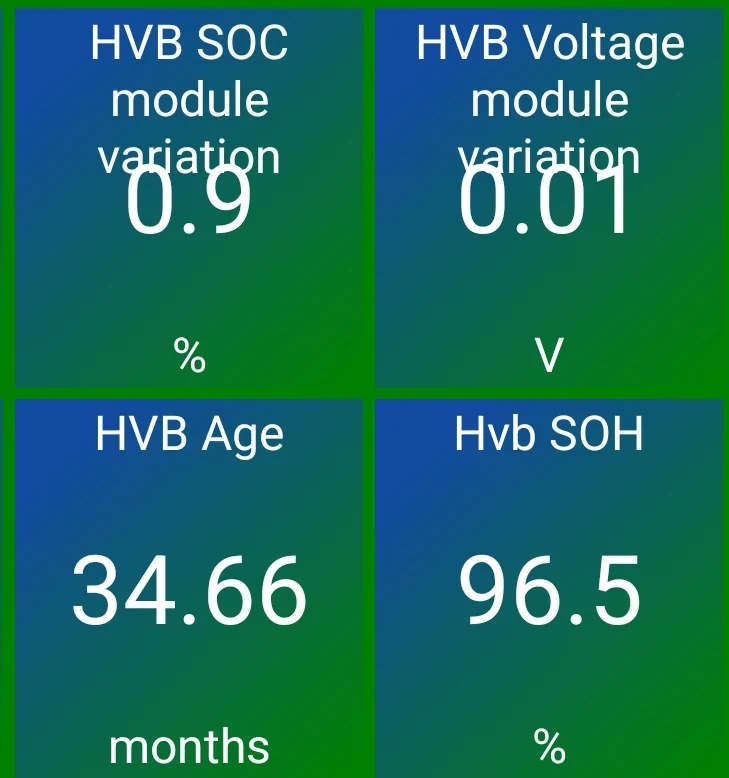
My phone has an additional screenshot it looks like I didn't share that had the SOH from that time.

Ford F-150 Lightning SOH is not battery capacity 1000007537


When you look at my stats, I had less useable energy, temp was in the 70s, and my SOH was higher. The most recent readings have lower variation % and higher useable, but lower SOH.

Also, it dawned on me that we can't divide 131 kWh by 95.5% as that's the useable energy. It's what we can use down to the bottom end buffer. I think it's safe to assume a similar buffer near 0% displayed, so it should be 131 / 0.91 = approx 144.

In all respects, I can still achieve stated useable capacity. But my SOH does not reflect that. I guess that's the main point here.
 
  • Like
Reactions: chl

chl

Well-known member
First Name
CHRIS
Joined
Dec 16, 2022
Threads
9
Messages
3,928
Reaction score
2,432
Location
alexandria virginia
Vehicles
2023 LIGHTNING PRO, 2012 Nissan Leaf, 2015 Toyota Prius, 2000 HD 883 Sportster
Occupation
Patent Atty / Electrical Engineer
I'm not worried about the battery, just trying to make sense of it so I'm better educated on it.

As I understand it, voltage will settle after charging is complete, but the useable energy shouldn't change as long as the temperature remains constant. I understand the variation, especially due to A to D conversion. However, those variations will be consistent for measurements taken on the same device (my truck in this case).

Back in March '25, I did an experiment where I charged to 100% and drove my normal commute over a week without charging. When I got down to 14% SoC (displayed) I charged back to 100% in one go.
https://www.f150lightningforum.com/forum/threads/100-range-test-follow-along.25107/post-486237
My phone has an additional screenshot it looks like I didn't share that had the SOH from that time.

1000007537.webp


When you look at my stats, I had less useable energy, temp was in the 70s, and my SOH was higher. The most recent readings have lower variation % and higher useable, but lower SOH.

Also, it dawned on me that we can't divide 131 kWh by 95.5% as that's the useable energy. It's what we can use down to the bottom end buffer. I think it's safe to assume a similar buffer near 0% displayed, so it should be 131 / 0.91 = approx 144.

In all respects, I can still achieve stated useable capacity. But my SOH does not reflect that. I guess that's the main point here.
Yes I believe I read that the buffers at the top and bottom are 5%.

So the usable energy is roughly 90% of the battery size, which is nominally 143.4kWh (could be up to 148kWh I've read) according to Ford's numbers.

If you use Ford's numbers it is 131/143.4 x 100% = 91.4% (to 131/148 x 100% = 88.5%).

NOTE: Not sure where the 148kWh number comes from but that's about plus 3% and that would be the upper amount of variation one might expect.

So if you have a brand new battery with an SOC (when 100% charged) of 131kWh then your actual SOH if including the buffers could be anywhere from 91% to 88.5%.

What I am not sure about is what the scanner uses to calculate SOH - does it include the buffers or not?
It seems like it might/should. But it could be misleading since what we really care about it the usable energy capacity.

Normal aging will eat up on average 1% to 2% per year of capacity over the life of the battery.
There is a steeper loss at first, I've read it could be 3% or so, then it levels off.

Now where it matters the most may be with the EV battery warranty - 70% loss is the threshold within the years and/or miles number depending on the manufacturer, Ford, Tesla, Nissan, etc.

That number would be 70% of the usable capacity which Ford says is 131kWh in a new ER battery, so 70% of 131kWh = 91kWh. So if your maximum stored energy at 100% charge is 91kWh you know you have reached the 70% threshold.

Your scanner may call that an SOH of roughly 70% (91/131) or if it uses the original nominal capacity with the buffers 91/143.4 = 63%. If it uses some other number like the upper variation of 148% then even less.

One could speculate that when the battery is new and installed in the truck, the system detects the original capacity and stores that number, then that number is detected by the scanner and used for SOH, but I am speculating about that, don't know for sure.

But I think no matter what the scanner says for SOH, we should do the math ourselves and use the 131kWh ER usable energy as the 100% point for SOC and SOH.

If our full charge energy is 131kWh, then our SOC is 100% and our SOH is 100% for the purposes of warranty.

FWIW, when Nissan sold the Leaf in the early days, mine is a 2012, they used the full capacity as their advertised number, i.e., 24kWh, but the actual, usable capacity was about 10% less due to the buffers, so around 21.6kWh.
Sponsored


Top