

Sponsored

I need someone to help me respond to this if possible.

NW Ontario Ford Lightning

Well-known member
First Name
Robert
Joined
Feb 14, 2025
Threads
2
Messages
621
Reaction score
853
Location
NW Ontario Canada
Vehicles
2024 F-150 SR Lightning XLT, 2023 Escape Hybrid
Occupation
Contractor
Nice!
Our system is 13.8 kw of solar, on SRNE string inverters (two, with a third in the works as we plan expansion of the Solar to 18-19 kw (EVs are hungry loads to feed it seems).
For powering up, Air-Con can be a challenge - especially if there is no "soft-start" to lower the in-rush current upon start up.
I am not familiar with the Franklinwh-batteries, but
if your battery system can start up all your existing loads, then the Lightning can just be added via a AC-DC charger, supplying a charging current which doesn't have to match any of the existing loads on your ESS as long as you can normally start up these loads with your system.
With the 2024/5 model the Pro-power can be set to run with the truck off, in the Pro-power settings, which is handy. (not sure if this can be done with the earlier models now).

I set up my DC charger to 1.5kW to be a close match to our average 24-hour energy consumption (37kWh per full day) so the truck is basically 'trickle-charging" the main ESS battery pack via the charger. The truck doesn't need to match big start up loads, just match 24-hour consumption rate.
I am using the EG4 Chargeverter which can be set up for 240v or 120v AC supply by the user.
Sponsored
 
OP
OP
Jodokk

Jodokk

Well-known member
First Name
Me
Joined
Feb 7, 2024
Threads
12
Messages
143
Reaction score
124
Location
NC
Vehicles
22 Lightning Lariat ER, Agate Bl., Max Tow & AT tires. UnderCover Abyss Tonneau
Occupation
College Professor
Nice set-up! I love learning more about these solutions.
Yes, I placed my Easystart Flex last week, and after some tweaking, it worked well. However, it did seem to go back through the "learning" cycle with the truck, as it did with the main house supply when firing up the AC. The first few times just slammed it.
As for the grounding challenges, I've pretty much decided to install an ATS, as several folks have mentioned here. The generator module in my Franklinwh system will be a redundancy, then.
The Franklin has to be tweaked by the installer to allow solar while the generator module is engaged of-grid.
With a regular transfer switch, the Lightning PPOB supply is just part of the main supply as far as the Franklin knows, and it will prioritize the solar, charge that 15kw peak power battery, feed the house, better adhere to code, and do what I want it to do. I have a 2022 Lariat, so I have to leave the truck "on."
 

chl

Well-known member
First Name
CHRIS
Joined
Dec 16, 2022
Threads
10
Messages
3,965
Reaction score
2,457
Location
alexandria virginia
Vehicles
2023 LIGHTNING PRO, 2012 Nissan Leaf, 2015 Toyota Prius, 2000 HD 883 Sportster
Occupation
Patent Atty / Electrical Engineer
How exactly do you propose that happens when the chassis is isolated from ground by the rubber tires.
When you touch the chassis with your bare hand while standing on wet ground, for example.
 

hturnerfamily

Well-known member
First Name
William
Joined
Jan 8, 2022
Threads
50
Messages
2,475
Reaction score
3,212
Location
rural Georgia
Vehicles
22 LIGHTNING PRO IcedBlueSilver 8/23/2022
Occupation
Owner
this has been a well known phenomenon in the Camping industry for many, many years: called 'hot skin'...where the metal siding, or frame, or metal steps, etc on the RV give off a 'tingle' or small 'shock', when the conditions are right... usually when rain or moisture are present, etc...

I've had this condition myself...

"generally, "RV hot skin" refers to the potentially dangerous condition where the metal frame of an RV becomes energized with stray voltage, often due to a faulty ground connection. This can happen when an RV is plugged into a power source with reversed polarity, a bad ground connection, or a wiring fault. Touching an electrified metal part of the RV can cause an electrical shock."

this can happen with both 120v campers and 240v larger Motorhomes or fifth wheels, etc...
as both can use a 120v outlet, with an adapter, or a 240v outlet, with an adapter, as needed....

there are no reports that anyone has ever died or been hospitalized because of this
 

chl

Well-known member
First Name
CHRIS
Joined
Dec 16, 2022
Threads
10
Messages
3,965
Reaction score
2,457
Location
alexandria virginia
Vehicles
2023 LIGHTNING PRO, 2012 Nissan Leaf, 2015 Toyota Prius, 2000 HD 883 Sportster
Occupation
Patent Atty / Electrical Engineer
I'm sure I'm going to touch the chassis while standing in water with bare feet. :rolleyes: Reaching just a bit aren't we?
Well, all I can say is ignore the NEC and OSHA codes at your own peril.

They are there to protect life, limb and property from injury when something goes wrong, like an open ground.

Many of the code specifics were written as a result of some accidental electrocution, fire, or other issue.

And, no offense, but the folks who write the code are the experts, not you.

I am not a licensed electrician, but I have a masters degree in computers and electrical engineering, so I can understand the code pretty well.

As a responsible human being, I would never advise anyone to ignore the code, cut an equipment ground wire, or otherwise screw up in a potentially dangerous fashion.

The code can be somewhat obtuse to the casual reader, I get that.
But I think anyone should be able to understand this video about generators - your truck outlets are from an inverter (DC-to-AC) generator that has a bonded neutral.


No point in continuing to argue about this, just accept that the code is there to protect everyone and follow it, eh?
 

Sponsored

v2h8484

Well-known member
Joined
Mar 3, 2023
Threads
3
Messages
227
Reaction score
119
Location
USA
Vehicles
Tesla Model 3
Well, all I can say is ignore the NEC and OSHA codes at your own peril.
Sure but based on what you have shown for your system you also don't have a code compliant installation. Separately derived systems need to have a proper grounding system including a properly sized GEC. This is clearly stated in the owner's manual for the Generac 6852 transfer switch used/recommended by many on this forum:

Ford F-150 Lightning I need someone to help me respond to this if possible. 1755449684280-vm


(p.7 in
https://prod-generacsoa.azurefd.net/manualsweb/manuals/G0068521/10000012180)

So, it's rather disingenuous for you to keep repeating the code compliance mantra when you are ignoring it yourself.
 

tearitupsports

Well-known member
First Name
Russell
Joined
Jun 1, 2024
Threads
13
Messages
456
Reaction score
515
Location
Cypress, TX
Vehicles
2023 F-150 Lightning Lariat ER
Occupation
Industrial Automation & Controls
Sure but based on what you have shown for your system you also don't have a code compliant installation. Separately derived systems need to have a proper grounding system including a properly sized GEC. This is clearly stated in the owner's manual for the Generac 6852 transfer switch used/recommended by many on this forum:

1755449684280-vm.png


(p.7 in
https://prod-generacsoa.azurefd.net/manualsweb/manuals/G0068521/10000012180)

So, it's rather disingenuous for you to keep repeating the code compliance mantra when you are ignoring it yourself.
Thanks. That is what I was saying in that a neutral transfer switch with the truck is extremely unsafe because it makes all your house completly un-grounded.

Now with the alternate that most people are doing (standard generator input with ground wire disconnected) there is a risk still.
It is not from a short. A short to ground anywhere should still clear, because it can make it back to the truck on the neutral wire and trip the breaker (regardless on if the short is on the house or truck side).
The main issue is that if you somehow used your body to reconnect the ground of the house to the ground of the truck you would create an alternate return path (instead of the neutral).

Now I think the standing in a puddle and touching the truck analogy is quite un-reasonable because the N wire is still in place with basically 0 resistance. You would still have extremely high resistance through the actual earth compared to that.

It could be an issue if you could physically touch the truck with one arm and grounded yourself to the house (say the generator box) with the other. I assume that the truck GFCI is equipment safety of 30mA and not life safety (lower value).

In summary I think the neutral switching transfer switch to be the most dangerous option. Unclipping the ground wire does come with a risk that needs to be fully understood by the homeowner.

Neither option is the safest or code compliant (because there is no code for this new situation).

My plan is to actually get the proper backup equipment going through the charge port. Hopefully that will take care of my needs, and I will re-ground my generator inlet to only be used with non-bonded gas generators.
 

chl

Well-known member
First Name
CHRIS
Joined
Dec 16, 2022
Threads
10
Messages
3,965
Reaction score
2,457
Location
alexandria virginia
Vehicles
2023 LIGHTNING PRO, 2012 Nissan Leaf, 2015 Toyota Prius, 2000 HD 883 Sportster
Occupation
Patent Atty / Electrical Engineer
Thanks. That is what I was saying in that a neutral transfer switch with the truck is extremely unsafe because it makes all your house completly un-grounded.

Now with the alternate that most people are doing (standard generator input with ground wire disconnected) there is a risk still.
It is not from a short. A short to ground anywhere should still clear, because it can make it back to the truck on the neutral wire and trip the breaker (regardless on if the short is on the house or truck side).
The main issue is that if you somehow used your body to reconnect the ground of the house to the ground of the truck you would create an alternate return path (instead of the neutral).

Now I think the standing in a puddle and touching the truck analogy is quite un-reasonable because the N wire is still in place with basically 0 resistance. You would still have extremely high resistance through the actual earth compared to that.

It could be an issue if you could physically touch the truck with one arm and grounded yourself to the house (say the generator box) with the other. I assume that the truck GFCI is equipment safety of 30mA and not life safety (lower value).

In summary I think the neutral switching transfer switch to be the most dangerous option. Unclipping the ground wire does come with a risk that needs to be fully understood by the homeowner.

Neither option is the safest or code compliant (because there is no code for this new situation).

My plan is to actually get the proper backup equipment going through the charge port. Hopefully that will take care of my needs, and I will re-ground my generator inlet to only be used with non-bonded gas generators.
No offense but you do not know what you are talking about.

1) The truck is simply a bonded generator so this is NOT a "new situation."

2) The system, my system with the GENERAC 6853, is grounded from truck to GENERAC ground bus, to circuits and the service panel ground bus, to ground rods attached to the service panel ground bus. So it is completely grounded.

And it IS completely code compliant with a continuous ground.

The truck ground wire is connected to the truck chassis so it is the "generator ground terminal."

You don't seem to understand that the GENERAC transfer switch does not disconnect or switch the grounds, only the hots and neutral. The grounds are all connected together.

3) The human body resistance when wet is very low. For a good earth ground you want soil that is less resistive to current flow, but because you can't change the soil resistance easily, you pound in to the ground 10 foot ground rods, maybe 2 or 3, to make a good low resistance connection. Now if the top layer of the soil is wet and mineral rich, the resistance to the ground loop you have created with a bonded generator and a bonded panel is low enough to deliver a shock. This has happened according to at least one post on this forum (I believe) when the ground wire was disconnected to avoid the GFCI tripping in a Lightning. So it is not theoretical.

If the GFCI trips you won't be electrocuted. But what if you have a pacemaker, arrhythmia, or are up on a metal ladder that touches the truck and fall off?

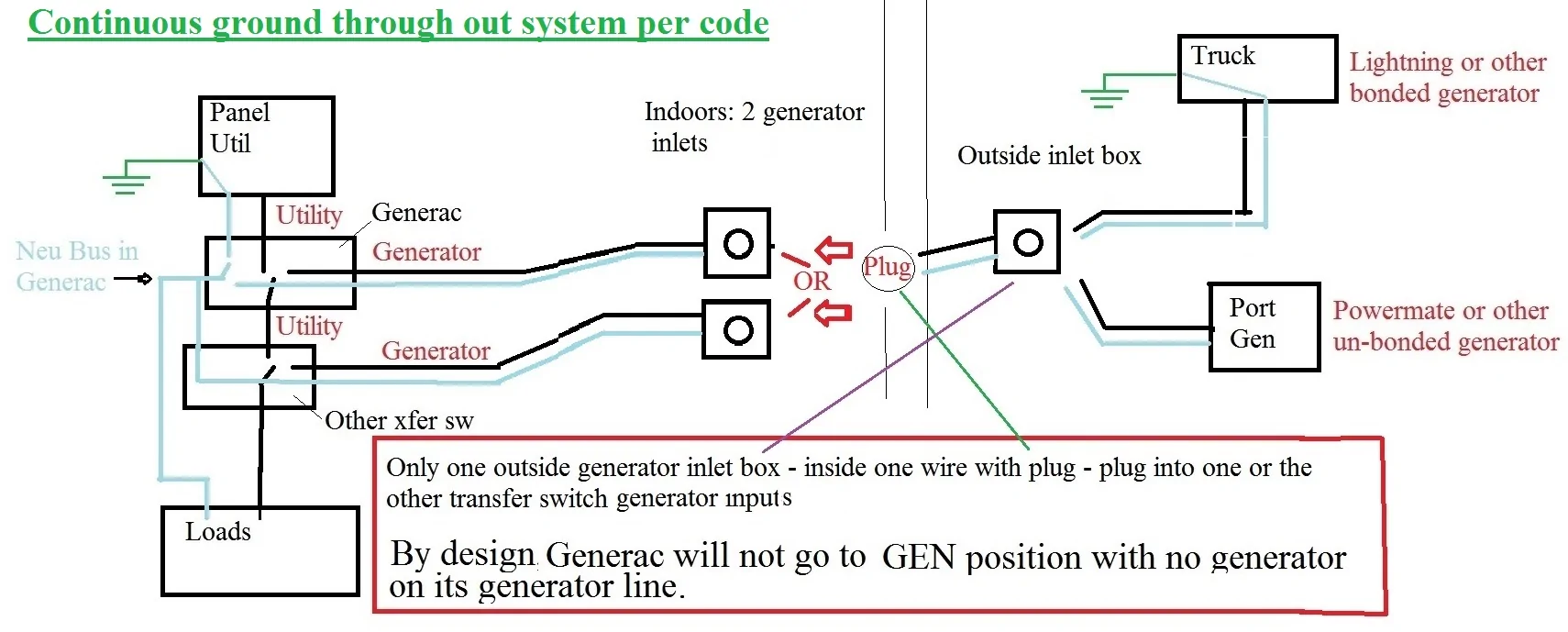
4) In my block diagram I say at the top "Continuous ground through out system per code." I did not draw all the ground wire connections to simplify the drawing, the same way I only drew one black line representing the two hot wires.

Ford F-150 Lightning I need someone to help me respond to this if possible. Block diag of 2 xfer sw hook up w inlet boxes

The blue line (neutral) in the GENERAC is switched as is the black line (representing the two hots).
The ground wires are NOT switched in the GENERAC.

PS: I am an electrical engineer with a masters degree though not a licensed electrician.
 
Last edited:

chl

Well-known member
First Name
CHRIS
Joined
Dec 16, 2022
Threads
10
Messages
3,965
Reaction score
2,457
Location
alexandria virginia
Vehicles
2023 LIGHTNING PRO, 2012 Nissan Leaf, 2015 Toyota Prius, 2000 HD 883 Sportster
Occupation
Patent Atty / Electrical Engineer
Regarding the ground system for a bonded generator - it is also probably a good idea to provide a ground rod and connection near the generator/truck in addition to the ground wire through the house grounding system. That way if there is an interruption in the ground system through the house, the truck/generator will still be earth grounded.

This can be easily done with a ground rod and ground wire connected to the Lightning (or other bonded generator) via an outlet ground pin, or a connection to the metal of the chassis.

Since this is a 30A system with 10AWG for the hots and neutral,

EDIT: {a plug with a 12 AWG ground wire connected would be most convenient in this regard since it can be easily plugged in and removed when not powering the house.}

Upon further review based on a comment, I reviewed the NEC code and it would require 6 AWG wire to a ground rod to be code compliant, so a plug with 12 AWG would not comply.

I had seen a generator ground rod system with 12AWG wire but I hadn't actually looked to see if that was code compliant - my bad. It might suffice as a "supplemental grounding equipment conductor" but I was wrong in the above post - it happens.
 
Last edited:

chl

Well-known member
First Name
CHRIS
Joined
Dec 16, 2022
Threads
10
Messages
3,965
Reaction score
2,457
Location
alexandria virginia
Vehicles
2023 LIGHTNING PRO, 2012 Nissan Leaf, 2015 Toyota Prius, 2000 HD 883 Sportster
Occupation
Patent Atty / Electrical Engineer
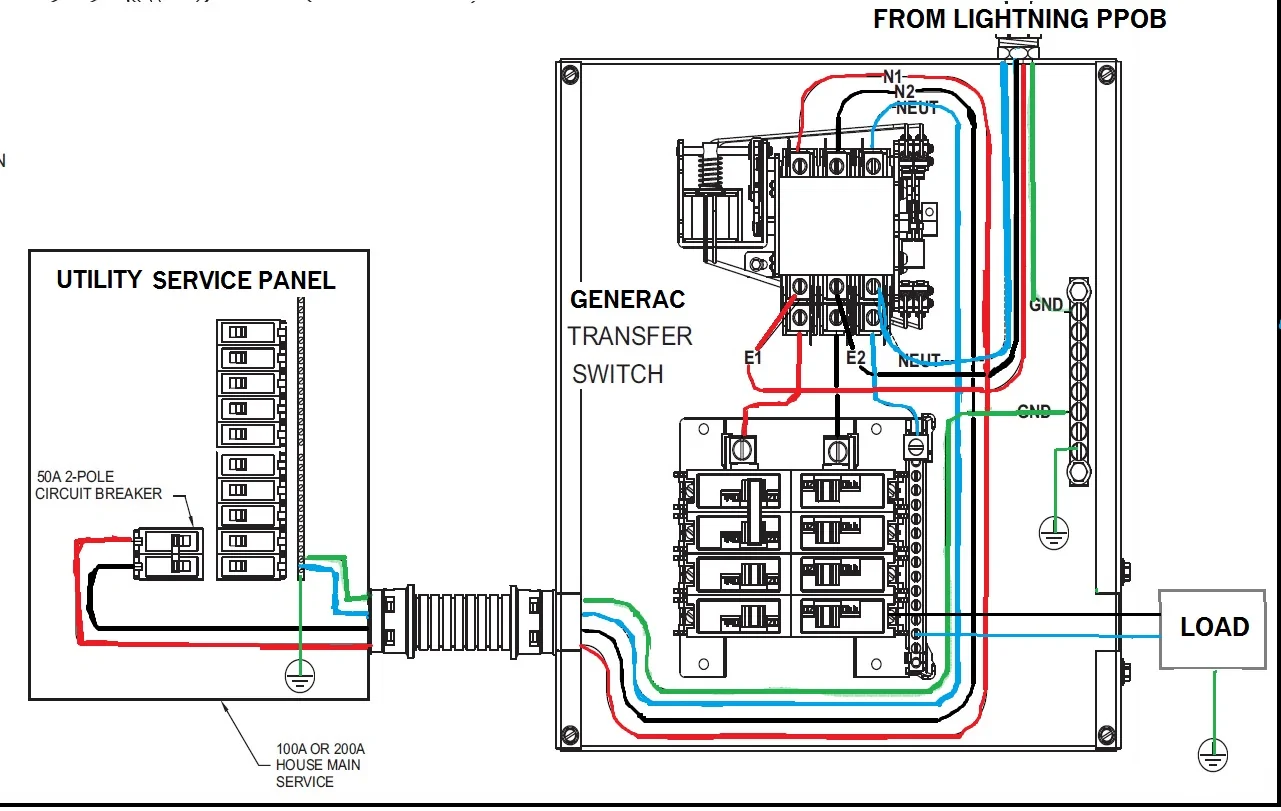
Generac wiring diagram with color added: Hots-black and red; neutral - blue; ground - green; one sample load shown:

Ford F-150 Lightning I need someone to help me respond to this if possible. 00-Generac wiring diagram - detail - colored


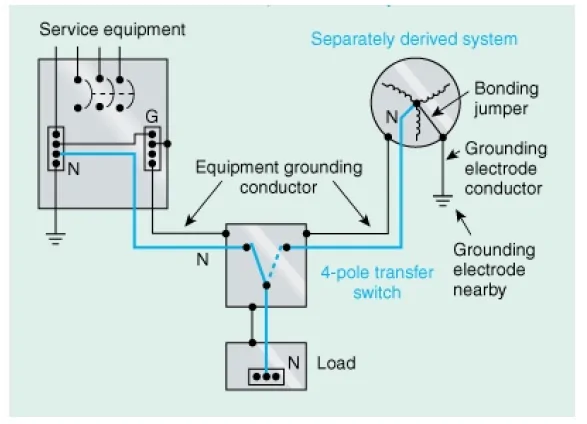
Grounding a bonded-generator powering a dwelling through a neutral switching transfer switch in compliance with NEC. note all grounds are connected and a grounding electrode (e.g., a ground rod) nearby:

Ford F-150 Lightning I need someone to help me respond to this if possible. Properly grounding bonded generator


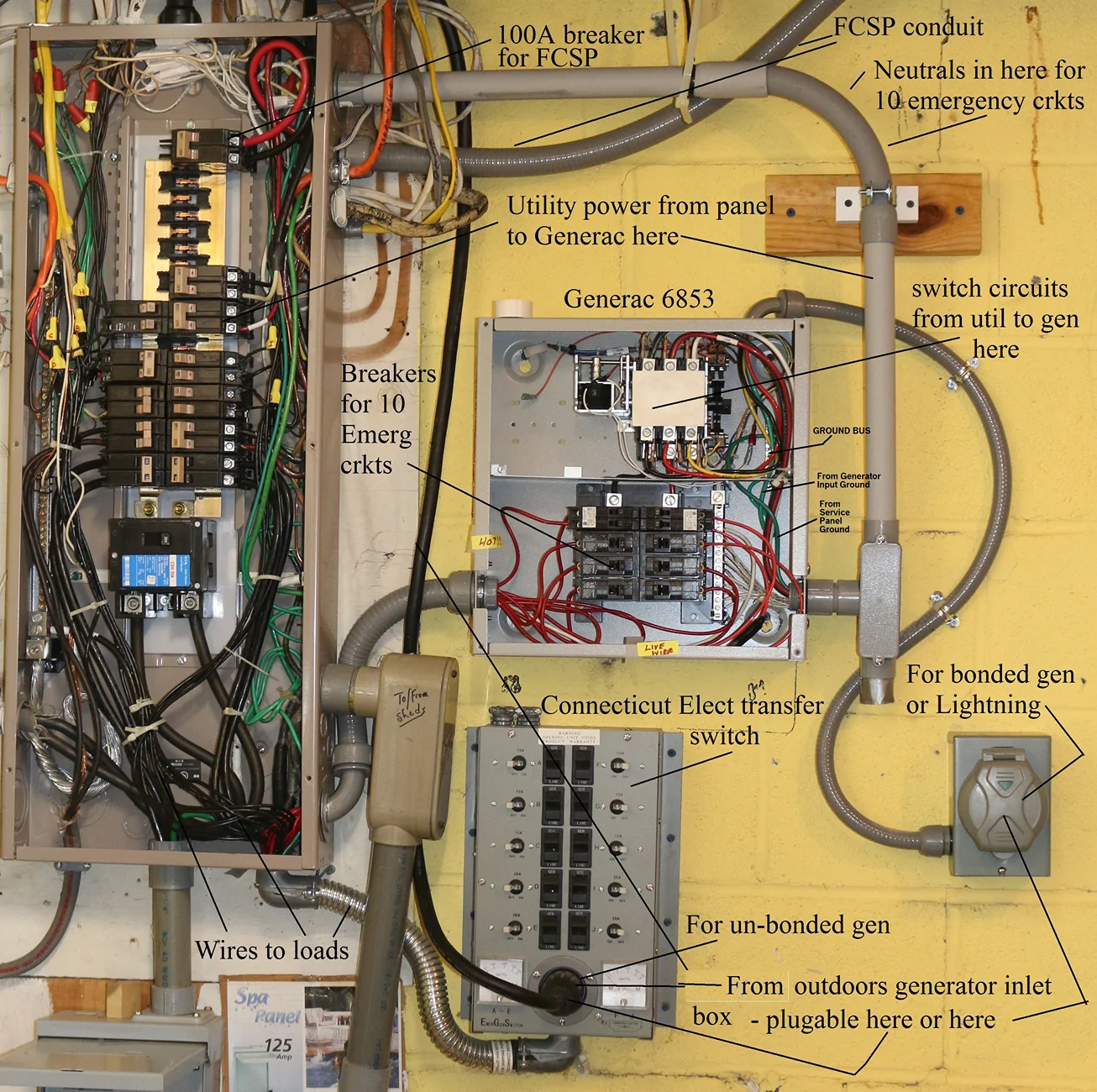
My wired system with 2 transfer switched, old one for a non-bonded generator source, and a GENERAC 6853 for a bonded generator source (e.g., the Lightning PPOB) with ground wires (green) and ground bus in GENERAC now labeled:

Ford F-150 Lightning I need someone to help me respond to this if possible. IMG_5926-final wiring before gen tests


In my system, 10 emergency circuits have been moved into the GENERAC, i.e., the neutrals, the hots, and the breakers for the 10 circuits, thus the 10 circuit neutrals are isolated from the utility neutral and connected to the Lightning neutral, when in generator mode.

All the ground wires are interconnected - no ground wire is cut.

EDIT: the following bracketed text was wrong - has to be 6AWG to the ground rod per code - I hadn't looked it up -my bad. {A modified 5-15P plug with a wire connected only to the ground pin can be plugged into a 120V outlet of the PPOB to connect the Lightning PPOB to a ground rod for an additional "grounding electrode nearby" as shown in the grounding a bonded generator picture above.)

I hope this clarifies how to connect the PPOB through a transfer switch to a dwelling in accordance with the NEC and OSHA codes.
 
Last edited:

Sponsored

v2h8484

Well-known member
Joined
Mar 3, 2023
Threads
3
Messages
227
Reaction score
119
Location
USA
Vehicles
Tesla Model 3
A modified 5-15P plug with a wire connected only to the ground pin can be plugged into a 120V outlet of the PPOB to connect the Lightning PPOB to a ground rod for an additional "grounding electrode nearby" as shown in the grounding a bonded generator picture above.
Nice try but that's not code compliant. The code has specific requirements for the GEC including minimum size (e.g. 6 AWG for typical bare copper wire) and connection method (e.g. welded, bolted, etc.) and plug is an allowed method. Also, for SDS, the GEC must be connected at the same point as the ground-neutral bond which is unlikely to be the outlet on the Lightning.
 

chl

Well-known member
First Name
CHRIS
Joined
Dec 16, 2022
Threads
10
Messages
3,965
Reaction score
2,457
Location
alexandria virginia
Vehicles
2023 LIGHTNING PRO, 2012 Nissan Leaf, 2015 Toyota Prius, 2000 HD 883 Sportster
Occupation
Patent Atty / Electrical Engineer
Nice try but that's not code compliant. The code has specific requirements for the GEC including minimum size (e.g. 6 AWG for typical bare copper wire) and connection method (e.g. welded, bolted, etc.) and plug is an allowed method. Also, for SDS, the GEC must be connected at the same point as the ground-neutral bond which is unlikely to be the outlet on the Lightning.
Yes I agree, I believe 6AWG would be required by the code - I had seen a 12AWG generator ground rod system but I hadn't looked it up, which I should have.

6 AWG seems like "overkill" for a 30A max system, but the code only allows smaller wire for "supplemental" grounding equipment conductors.

I stand corrected and updated/edited the previous post.
 
Last edited:

chl

Well-known member
First Name
CHRIS
Joined
Dec 16, 2022
Threads
10
Messages
3,965
Reaction score
2,457
Location
alexandria virginia
Vehicles
2023 LIGHTNING PRO, 2012 Nissan Leaf, 2015 Toyota Prius, 2000 HD 883 Sportster
Occupation
Patent Atty / Electrical Engineer
Nice try but that's not code compliant. The code has specific requirements for the GEC including minimum size (e.g. 6 AWG for typical bare copper wire) and connection method (e.g. welded, bolted, etc.) and plug is an allowed method. Also, for SDS, the GEC must be connected at the same point as the ground-neutral bond which is unlikely to be the outlet on the Lightning.
Yes I agree, 6AWG would be required by the code...I should have looked it up first.
 

chl

Well-known member
First Name
CHRIS
Joined
Dec 16, 2022
Threads
10
Messages
3,965
Reaction score
2,457
Location
alexandria virginia
Vehicles
2023 LIGHTNING PRO, 2012 Nissan Leaf, 2015 Toyota Prius, 2000 HD 883 Sportster
Occupation
Patent Atty / Electrical Engineer
I forgot about this supplemental video that mentions the 6 AWG requirement and how to set it all up with a GENERAC transfer switch...must be getting old...


chl

Well-known member
First Name
CHRIS
Joined
Dec 16, 2022
Threads
10
Messages
3,965
Reaction score
2,457
Location
alexandria virginia
Vehicles
2023 LIGHTNING PRO, 2012 Nissan Leaf, 2015 Toyota Prius, 2000 HD 883 Sportster
Occupation
Patent Atty / Electrical Engineer
Upon further reflection...

Perhaps the grounding electrode system of the house to which the Lightning ground system is connected would suffice as the code required "grounding electrode system," as apparently shown by Lorenzo Mari in the figure below, who is an expert in grounding systems - see his bio below. After all it is "connected to the ground terminal on the portable generator" (Lightning PPOB) via the ground wire through the GENERAC and the service panel.

However, since there are apparently conflicting opinions on this, I would err on the side of another grounding electrode system near the truck.

So, I wonder where would be a good place to connect a grounding electrode conductor to the Lightning?

Portable generators often provide an easily accessible ground lug suitable for earth grounding connections. Somewhere easily accessible near the PPOB outlet at the back of the truck would be best.

Has anyone made a grounding connection for a ground rod on their Lightning?

---------------------------
OPTIONAL Background follows
---------------------------

GENERAC transfer switch with a bonded generator - grounding requirements

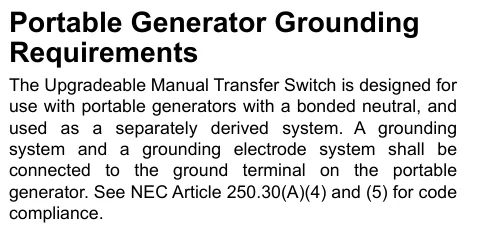
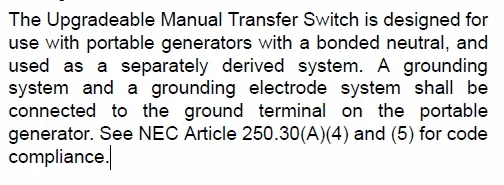
The GENERAC 6853 transfer switch manual says about grounding requirements for use with a bonded generator as a separately derived system:

Ford F-150 Lightning I need someone to help me respond to this if possible. GENERAC grnd req cod


"...A 'grounding system' and a 'grounding electrode system' shall be 'connected to the ground terminal' on the portable generator. See NEC Article 250.34(A)(4) and (5) for code compliance."

In the NEC, a "grounding electrode system" is the composite of "all installed grounding electrodes" at a building or structure that are bonded together "to provide a low-impedance path to the earth."

The NEC contains a list of items that are permitted to be used as grounding electrodes and requires that if any are present, they must all be used to form the "grounding electrode system."

So all grounding electrodes present at a building or structure should be bonded together to form a single, interconnected "grounding electrode system." And if multiple grounding electrodes are installed at a location, they must all be connected to create one unified system.

There are 8 items that are listed in 250.52 as allowable grounding electrodes: Metal Underground Water Pipe, Concrete-encased Electrode, Metal In-ground Support Structure, Ground Ring, Rod and Pipe Electrodes, Plate Electrodes, Other Listed Electrodes, Other local underground metal systems or structures

Equipment Grounding: This requires connecting non-current-carrying metal parts of the electrical system, like metal boxes, conduits, and appliance frames, to ground.

Grounding System: This comprises all ground wiring, equipment grounding, and generally includes the grounding of the neutral of the electrical system. The purpose is to help stabilize system voltages and aid operation of over-current protection devices during a fault.

A generator equipment frame (e.g., the Lightning chassis) is permitted to be the "grounding system." And on the Lightning, the neutral is bonded to the frame and is part of the grounding system. This "grounding system" is connected to the ground terminal of the Lightning in compliance with code.

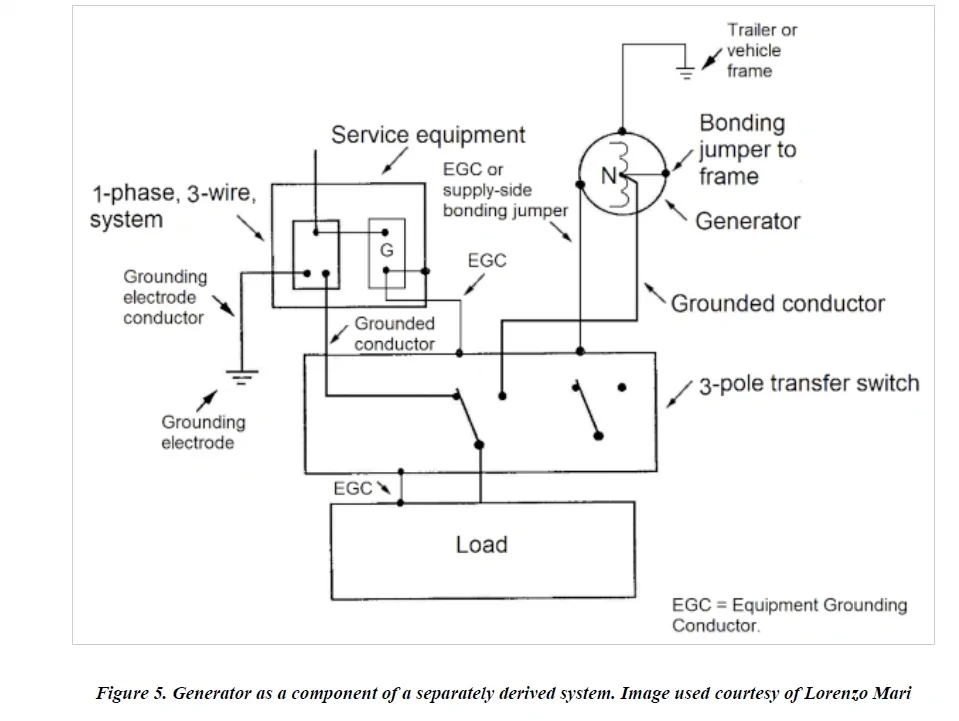
Further, when the ProPower OnBoard (PPOB) is powering the house through the GENERAC transfer switch, the "grounding system" via the ground terminal of the PPOB outlet is connected to the GENERAC ground bus, which is in turn connected to the house panel ground bus as in figure 5 below.

The house panel ground bus is connected to a "grounding electrode system," which in my house comprises several outdoor ground rods and an underground cold water pipe.

The NEC requires a "grounding electrode system" for bonded generators when used as a separately derived system, e.g., the Lightning PPOB powering a house. Typically one would see this in the form of a "nearby" ground rod pounded into the earth and connected by a wire to the generator frame.

From what I have read recently, the "nearby" requirement has been loosened/removed and the "grounding electrode system" can be some distance away as long as it provides a low impedance ground path to the earth.

Since the Lightning neutral is bonded to the frame, and the frame is connected to the ground terminal, and the ground terminal is connected to the house "grounding electrode system" and these provide a low impedance path to the earth, then, is a second "grounding electrode system" connected to the Lightning frame required?

Some would say yes, others would apparently say no. The NEC goes through periodic updates and changes, so perhaps that explains why older versions and posts/videos about it, require a nearby grounding electrode connected to the generator frame.

A recent figure by Lorenzo Mari, Figure 5 below, shows what is purported to be a system compliant with the recent NEC code (2023 version) where no additional nearby "grounding electrode system" for the generator is provided (no nearby ground rod to frame). Also note his bio at the end of this post.

Ford F-150 Lightning I need someone to help me respond to this if possible. Fig 5 house system is grounding system


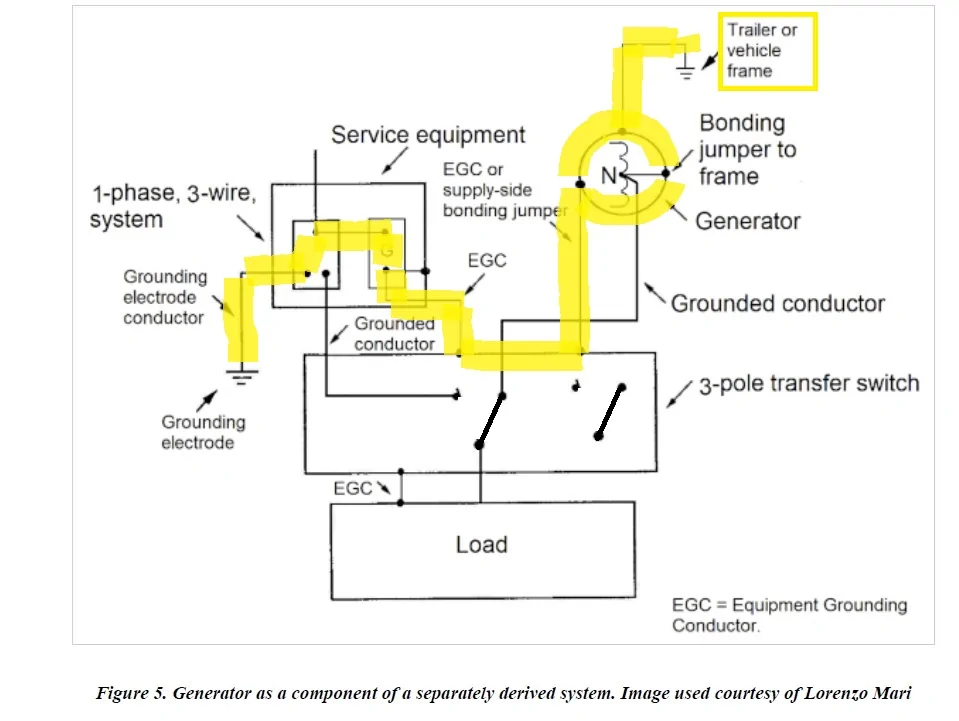
The generator grounding electrode system is apparently the grounding electrode at the service equipment (panel).

The "grounding electrode system" from the generator to the grounding electrode has been highlighted in yellow below (the transfer switch in the highlighted image is shown in the generator connected mode where the grounded conductor - neutral - is switched to the load and not directly connected to the utility neutral).

Ford F-150 Lightning I need someone to help me respond to this if possible. Fig 5 house system is grounding electrode system-path yello


But...

Regardless of Lorenzo Mari's Figure 5 and his expertise, if I want to provide a nearby grounding electrode system for the Lightning, where would be a good place to connect a grounding electrode conductor to the Lightning?

By "good" I mean - easily accessible for connecting to a grounding electrode conductor (#6 wire) and making a good electrical connection to the Lightning chassis (generator frame).

------
BIO: Lorenzo Mari holds a Master of Science degree in Electric Power Engineering from Rensselaer Polytechnic Institute (RPI). He has been a university professor since 1982, teaching topics as electric circuit analysis, electric machinery, power system analysis, and power system grounding.

As such, he has written many articles to be used by students as learning tools. He also created five courses to be taught to electrical engineers in career development programs, i.e., Electrical Installations in Hazardous Locations, National Electrical Code, Electric Machinery, Power and Electronic Grounding Systems and Electric Power Substations Design. As a professional engineer, Mari has written dozens of technical specifications and other documents regarding electrical equipment and installations for major oil, gas and petrochemical capital projects. He has been EPCC Project Manager for some large oil, gas & petrochemical capital projects where he wrote many managerial documents commonly used in this kind of works.
Sponsored


Top