
Sponsored

Can my solar array support my future F150 Lighting driving habits?

CoolViper777

Well-known member
First Name
George
Joined
Feb 6, 2026
Threads
3
Messages
46
Reaction score
21
Location
Pittsburgh
Vehicles
2019 Ford Expedition & potential F150 Lightning owner
Occupation
Software Engineer
I want to get a Lariat with the ER battery. And I want to always charge from my solar panel excess energy, at least as much as possible.

I have a 10.8 kW solar array with Tesla Powerwall 3 (13.5kWh) battery. I'm am shortly adding another 4.5kW of panels, for a grand total of 15kW.

My daily driving habits are 20 to 40 miles daily, with me working from my car between 2 and 3 hours daily on average. The driving is a mix of some interstate highways and local road. Being in Pittsburgh, it's not too cold, unless you are talking Dec through Feb.

So, I wonder, how much battery % does the ER battery use daily, for this scenario? I'd be running the heater in the winter, and A/C in the summer. The milder months, probably just crack the windows when possible.

For the summer, I should generate close to 15kW solar energy when sunny, maybe 1/2 that on a more cloudy day, and 1/4 that on a rainy day. Probably around a max 5-6kWh of house energy usage. So, on a sunny day, that leaves me with maybe 7 to 10kW of excess generation, and less on other days

Any thoughts are appreciated.

Edited, as I realized I accidentally mixed up my kW and kWh.
Sponsored

 
Last edited:

SpaceEVDriver

Well-known member
Joined
Feb 9, 2022
Threads
30
Messages
921
Reaction score
1,854
Location
Arizona
Vehicles
2023 Lightning Lariat ER, 2022 Mustang Mach-E
We would need to know your home power use without the truck.
But with 40 miles daily drive and a mix of highway and slower roads, you can probably count on something like the EPA estimate except when it’s especially cold. An ER battery has an EPA range estimate of 320 miles, so 40 miles is 1/8 or 12.5% of that. And 12.5% of 131 kWh is 16.4 kWh/day. In the summer you’ll use a bit more for AC. And in winter, you’ll use another bit more for the heater. Round it to an average of about 18 kWh/day, 540 kWh per month.

An average energy use per month in PA is about 720-760 kWh. Use 760 kWh/month as an estimate, but it’s a very rough estimate without knowing more about your personal energy use. To get a daily average, 760 kWh / 30 = ~25 kWh/day.

Together, your house and your truck will use about 1300 kWh per month. Again, this is a very rough estimate and assumes you’re driving every day of a 30-day month.

Using this site, you can get an estimate for your solar power production. Plug in your address and other relevant information.
https://pvwatts.nlr.gov/pvwatts.php

Month AC Energy ( kWh )
January 961
February 1,106
March 1,517
April 1,727
May 2,034
June 1,959
July 2,037
August 1,853
September 1,651
October 1,334

November 963
December 828
Annual 17,970

When the sum of your truck and your house energy usage are lower than the number in that rough table, then you theoretically generate enough to replace your driving energy costs.

However, your truck isn’t going to charge for the several hours per day that it’s away from home. You’re not going to want to drain your power station down to zero every night. So, your system is maybe a little undersized for winter generation and full-charging of your truck via solar. If you had a larger home battery (one with enough capacity that it could be used to replace your daily driving energy), you could extend the time you’re able to fully charge your truck from the sun.
 

chriserx

Well-known member
First Name
Chris
Joined
Oct 3, 2025
Threads
4
Messages
767
Reaction score
593
Location
Louisiana
Vehicles
2025 Ford Lightning Flash Job 2 😭
I want to get a Lariat with the ER battery. And I want to always charge from my solar panel excess energy, at least as much as possible.

I have a 10.8 kW solar array with Tesla Powerwall 3 (13.5kWh) battery. I'm am shortly adding another 4.5kW of panels, for a grand total of 15kW.

My daily driving habits are 20 to 40 miles daily, with me working from my car between 2 and 3 hours daily on average. The driving is a mix of some interstate highways and local road. Being in Pittsburgh, it's not too cold, unless you are talking Dec through Feb.

So, I wonder, how much battery % does the ER battery use daily, for this scenario? I'd be running the heater in the winter, and A/C in the summer. The milder months, probably just crack the windows when possible.

For the summer, I should produce close to 15kWh solar energy when sunny, maybe 1/2 that on a more cloudy day, and 1/4 that on a rainy day. Probably around a max 5-6kWh of house energy usage. So, on a sunny day, that leaves me with maybe 7 to 10kWh of excess, and less on other days

Any thoughts are appreciated.
2 mi / kwh
40 mi / 2 mipkWh = 20 kWh
10kWh < 20kWh
So no. And that's assuming you charge during the day.
With the extra solar, it becomes a solid maybe, and then only if you charge in the daylight. If you are grid tied and are offsetting your use, with the extra solar it becomes a definitely, so long as weather permits.

More details would help narrow it but that's a general guide to get you started.
 

Jiji

Well-known member
First Name
Rick
Joined
Aug 5, 2024
Threads
3
Messages
70
Reaction score
87
Location
Finger Lakes, NY
Vehicles
2024 F-150 Lightning
2 mi / kwh
40 mi / 2 mipkWh = 20 kWh
10kWh < 20kWh
So no. And that's assuming you charge during the day.
With the extra solar, it becomes a solid maybe, and then only if you charge in the daylight. If you are grid tied and are offsetting your use, with the extra solar it becomes a definitely, so long as weather permits.
Bad math here. He will produce ~15kWh per hour around solar noon, maybe north of 100kWh per day in the summer time.
 

Jiji

Well-known member
First Name
Rick
Joined
Aug 5, 2024
Threads
3
Messages
70
Reaction score
87
Location
Finger Lakes, NY
Vehicles
2024 F-150 Lightning
Any thoughts are appreciated.
Well I have 25kWp of panels, no storage and produce roughly 26,000 kWh per year of energy with snow soiling, cloudy climate and shading.

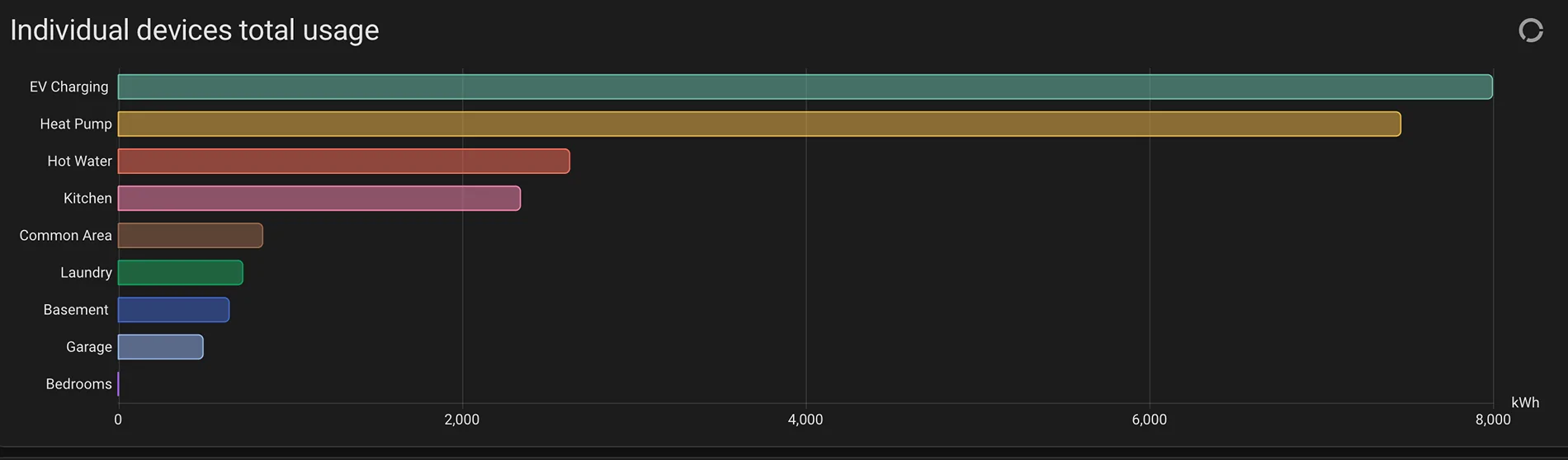
I break even with an all electric house, geothermal heat pump (7500kWh/yr), and a Lightning and two Mach-Es (8000kWh/yr). I think you are fine unless you add more EVs or have electric heat.

Ford F-150 Lightning Can my solar array support my future F150 Lighting driving habits? Screenshot 2026-03-12 at 9.27.19 AM
 

Sponsored

chriserx

Well-known member
First Name
Chris
Joined
Oct 3, 2025
Threads
4
Messages
767
Reaction score
593
Location
Louisiana
Vehicles
2025 Ford Lightning Flash Job 2 😭
Bad math here. He will produce ~15kWh per hour around solar noon, maybe north of 100kWh per day in the summer time.
OP stated 10 kWh excess production, but after rereading in context, maybe they meant 10kW instantaneous production. Those are two completely different things.
 

K6CCC

Well-known member
First Name
Jim
Joined
Sep 12, 2024
Threads
31
Messages
1,117
Reaction score
1,182
Location
Glendora, Calif.
Vehicles
2024 Lightning Flash ER in Antimatter Blue w/9.6 PPO , 2017 Corolla (wife's car)
Occupation
Retired from 2-Way radio systems
I have a 10.8 kW solar array with Tesla Powerwall 3 (13.5kWh) battery. I'm am shortly adding another 4.5kW of panels, for a grand total of 15kW.
Be honest, how much power do you REALLY get out of your 10.8 KW of solar? Assuming fixed panels (not tracking) it depends massively on panel arrangement. Residential panels if mounted on the roof are almost always mounted at the same angles as the roof and therefore not likely at the optimal pointing for solar. Since they are not tracking, they are almost never anywhere near pointed in the correct direction. Also in many homes, some of the panels point one way and some point another. In my case there are 28 panels with 10 on one side of the garage roof, 11 on the other side of the garage roof and 7 on the house roof. Next issue is shading. Are there trees that block the sun for all or some of the panels for some part of the day? I my case, I have about 9 KW of panels and here in sunny southern California, about the best I do is 65 KWH in a day. Usually less than that BTW.

The next part is how much power do you REALLY use. Obviously that varies. My consumption is rather high for a single family home with four people in it, and I NEVER generate as much as I use - and that's before adding the Lightning.
 

cblackride

Member
First Name
Chris
Joined
Feb 4, 2025
Threads
0
Messages
11
Reaction score
8
Vehicles
2025 Ford F 150 Lightning Flash, 2018 Tesla Model 3
Occupation
Retired
My truck draws 6.6kw when plugged into my 240v charger. My system produces less than half that. It will deplete my power wall in about 40 minutes.
 

Aland12345

Member
First Name
Alan
Joined
Aug 17, 2025
Threads
0
Messages
19
Reaction score
32
Vehicles
22 Lightning Pro 23 Tesla model 3 Can Am defender
Occupation
Retired Bio0Medical Engineer
If you have a Tesla Power Wall 3 get the Net Zero App. My wife has a Tesla. We can see exactly how much is used to charge vehicles. How much recharges our two Power Walls. Remember Power Wall can only out put like 11kw max so turn down charger unless it is a bright sunshine day.
 

TenaciousG77

Member
First Name
Greg
Joined
Feb 9, 2026
Threads
2
Messages
12
Reaction score
21
Location
80403
Vehicles
2024 F-150 Lightning Lariat
Here is my back-of-the-envelope calculations for 2025. We do 99% of charging at home, and my trips are about 70% city/suburban and 30% highway. We have a 10 kWh (maximum output) system. Total electric use went up about 66% year-over-year. We lease, so I try to keep our annual mileage within the lease parameters, so we drove 10,300 miles last year. Even with the addition of the truck, we still generated more than we used. One factor that works in our favor is being in Colorado and living at 6,000 feet. The sun is intense, especially during the summer. We net produced on average 1.4 mWh/month from March through August.
 

Sponsored

Jiji

Well-known member
First Name
Rick
Joined
Aug 5, 2024
Threads
3
Messages
70
Reaction score
87
Location
Finger Lakes, NY
Vehicles
2024 F-150 Lightning
OP stated 10 kWh excess production, but after rereading in context, maybe they meant 10kW instantaneous production. Those are two completely different things.
Your utility tariff will matter here. My meter rolls backward when I export and forward when I draw from the grid. As long as I have kWh credits I don't pay for power drawn from the grid. Very sweet deal as I don't have to charge while the sun is shining.

On the other hand if your utility tariff is one where they pay you the wholesale rate for your exports and charge the retail rate with delivery on grid draws then the economics are very different.
 
OP
OP

CoolViper777

Well-known member
First Name
George
Joined
Feb 6, 2026
Threads
3
Messages
46
Reaction score
21
Location
Pittsburgh
Vehicles
2019 Ford Expedition & potential F150 Lightning owner
Occupation
Software Engineer
Thanks for all the replies.

To clarify, my current system is a 10.8kW instantaneous peak system. In other words, when sun is at peak, it will produce approx 10kW per second.

We just had it installed in Oct 2025, so I have not yet experienced spring and summer solar production, but expect it will be near the peak. However, I have seen peak production over the weekend of 9kW /second. In the late fall and or winter, the most I saw was around 7.5 kW / second.

For total daily production, here's a tally. The low production were rainy days.
3/12 - 21.2 kWh as of 3pm EST (will probably hit 25 kWh)
3/11 - 10.4 kWh
3/10 - 12.8 kWh
3/9 - 40.5 kWh
3/8 - 42.3 kWh
3/7 - 23.1 kWh
3/6 - 27.4 kWh
3/5 - 7.1 kWh

As for household maximum usage during warm/hot weather here's my educated guesstimate based on the amps I've seen and label ratings.
1) Central AC - 3.5 kWh x 8 hours average = 28kWh
2) 3 zone minisplit system - 1.0 kWh x 10 average = 10 kWh
3) 3 fridges 1.2kW x 10 hours = 12kwH
4) 1.5 HP variable speed pool pump 2kw x 8 hrs = 16 kWh
5) 5kW Pool HP HEATER - 5kW x 5 hours = 25kWh

It would be rare to hit peak on all. For example the Pool HP HEATER only runs during the spring or early fall for any extended period. Mid June to late Aug, it almost never runs, as the pool can be already too hot. But that is peak AC time.

Mid summer, I'd expect peak of approx 66 kWh. I'd estimate the same in the spring or fall if I'm running the pool heater.

It sure seems like adding the 4.4 kWh of extra solar panels will be needed if I want to have a comfortable margin of power production with an EV.
 
OP
OP

CoolViper777

Well-known member
First Name
George
Joined
Feb 6, 2026
Threads
3
Messages
46
Reaction score
21
Location
Pittsburgh
Vehicles
2019 Ford Expedition & potential F150 Lightning owner
Occupation
Software Engineer
I like it simple. That's a good metric that I can remember. With the addition 4.4 kW of panels I plan to add, I should have that regularly in March through October. If I have enough extra sold to net metering, I may have a nice reserve built up for Nov and December 2026 into Jan 2027


Let's simplify things. Assuming ~ 2 miles/kWh, 7-10 kWh of excess will cover about 14-20 miles of driving.
 
OP
OP

CoolViper777

Well-known member
First Name
George
Joined
Feb 6, 2026
Threads
3
Messages
46
Reaction score
21
Location
Pittsburgh
Vehicles
2019 Ford Expedition & potential F150 Lightning owner
Occupation
Software Engineer
I'm in Pittsburgh PA, and the net metering here pays the exact rate I pay for electricity. My current TOTAL usage rate per kWh is $0.198 (this includes generation, transmission and some other fee I forget). FirstEnergy will credit me $0.198 for anything I send back to them. So, it's a good deal.

Here is my back-of-the-envelope calculations for 2025. We do 99% of charging at home, and my trips are about 70% city/suburban and 30% highway. We have a 10 kWh (maximum output) system. Total electric use went up about 66% year-over-year. We lease, so I try to keep our annual mileage within the lease parameters, so we drove 10,300 miles last year. Even with the addition of the truck, we still generated more than we used. One factor that works in our favor is being in Colorado and living at 6,000 feet. The sun is intense, especially during the summer. We net produced on average 1.4 mWh/month from March through August.

Your utility tariff will matter here. My meter rolls backward when I export and forward when I draw from the grid. As long as I have kWh credits I don't pay for power drawn from the grid. Very sweet deal as I don't have to charge while the sun is shining.

On the other hand if your utility tariff is one where they pay you the wholesale rate for your exports and charge the retail rate with delivery on grid draws then the economics are very different.
Sponsored


Top