

Sponsored

Tesla Supercharger PSA

FloridaMan655321

Well-known member
Joined
Jul 7, 2024
Threads
29
Messages
608
Reaction score
733
Location
Florida
Vehicles
1973 F100, 2024 Flash
VW Beetles up through 1967 had the gas cap in the driver side front under the hood. Up through the late 60’s there was a lot of experimentation with gas cap locations but I think safety and emissions regulations more or less determined today’s locations.
On EVs it can be a vehicle packaging issue with cable harness and power module locations determining location. It will take further standardization of EV components before charge port locations become more uniform. But also short Tesla charging cords will probably disappear within another 5 years.
Yes, but VW didn't own like 90% of the market at that time. Tesla doesn't own 90% now, but they certainly did at one point, and they also were installing superchargers. Then VW (directly/indirectly) started installing superchargers and they did the same type of install that Tesla did. If any one of them would have started doing chargers the way gas stations are installed, then it wouldn't matter where the charge port is.

All this to say, lets say back in the day gas stations were installed the way of superchargers, it would be pretty dumb for some of these ICE manufactures to put the inlet where it is today.....
Sponsored


electricpig

Well-known member
First Name
Tim
Joined
Sep 10, 2024
Threads
1
Messages
255
Reaction score
292
Location
Northwest Arkansas
Vehicles
23 F150 Lightning XLT, Tesla Y
If you weren't taught to always back into parking spaces, then your daddy didn't teach you very well. :wink:

Back when cars didn't have back up cameras, or ultrasonic sensors, parking involved using your eyes and not much else. When there's a car on either side of you blocking your view, backing out of a parking space with your head turned around was a gamble. Pulling forward out of a space was the safest thing you could do.

Nowadays, backup cameras make backing out about as safe, so I guess I'm showing my age. 👀
Ahh but these trucks are far far bigger now making the camera's all bu essential due to such poor visibility. But that does not mean that it's the "right" way, and sure as hell doesn't change the fact that you are driving forward at almost all times. Therefore everyone by simple frequency is going to be far more skilled driving forward in confined spaces. By all means, continue to ignore reality.

As stated previousl, my truck suffered $5K of damage due to someone BACKING into the parking spot next to me. I'm quit sure he's been doing so for many many years, but still clipped my truck. Just because it can be done, doesn't mean it's the safest, least risky, or "the right" way. Pull into or through is inherently less risky.
 

electricpig

Well-known member
First Name
Tim
Joined
Sep 10, 2024
Threads
1
Messages
255
Reaction score
292
Location
Northwest Arkansas
Vehicles
23 F150 Lightning XLT, Tesla Y
Yes, but VW didn't own like 90% of the market at that time. Tesla doesn't own 90% now, but they certainly did at one point, and they also were installing superchargers. Then VW (directly/indirectly) started installing superchargers and they did the same type of install that Tesla did. If any one of them would have started doing chargers the way gas stations are installed, then it wouldn't matter where the charge port is. Therefore d sign for the socket to be in the back would not have been wise.

All this to say, lets say back in the day gas stations were installed the way of superchargers, it would be pretty dumb for some of these ICE manufactures to put the inlet where it is today.....
Superchargers were not available to anyone else when nearly all current US EV's were designed. Almost all CCS chargers were placed at the front of parking spots, or at best to the side in a few cases.

By your logic made a design error by having suc short cables if there was any chance that superchargers would ever be open to non-Teslas.
 

garsh

Well-known member
First Name
Brad
Joined
Dec 28, 2025
Threads
0
Messages
70
Reaction score
81
Location
Pittsburgh
Vehicles
2023 Ford F-150 Lightning Lariat
Ahh but these trucks are far far bigger now making the camera's all but essential
My 1989 Chevy 1500 extended cab pickup was longer than these trucks (smaller cab, but 8-foot bed).

The cameras are only "essential" for people who never learned how to drive and park a vehicle that didn't have one.

Pull into or through is inherently less risky.
And pulling forward out of a parking space is less risky than backing out of a space.
 
Last edited:

SpaceEVDriver

Well-known member
Joined
Feb 9, 2022
Threads
30
Messages
917
Reaction score
1,831
Location
Arizona
Vehicles
2023 Lightning Lariat ER, 2022 Mustang Mach-E
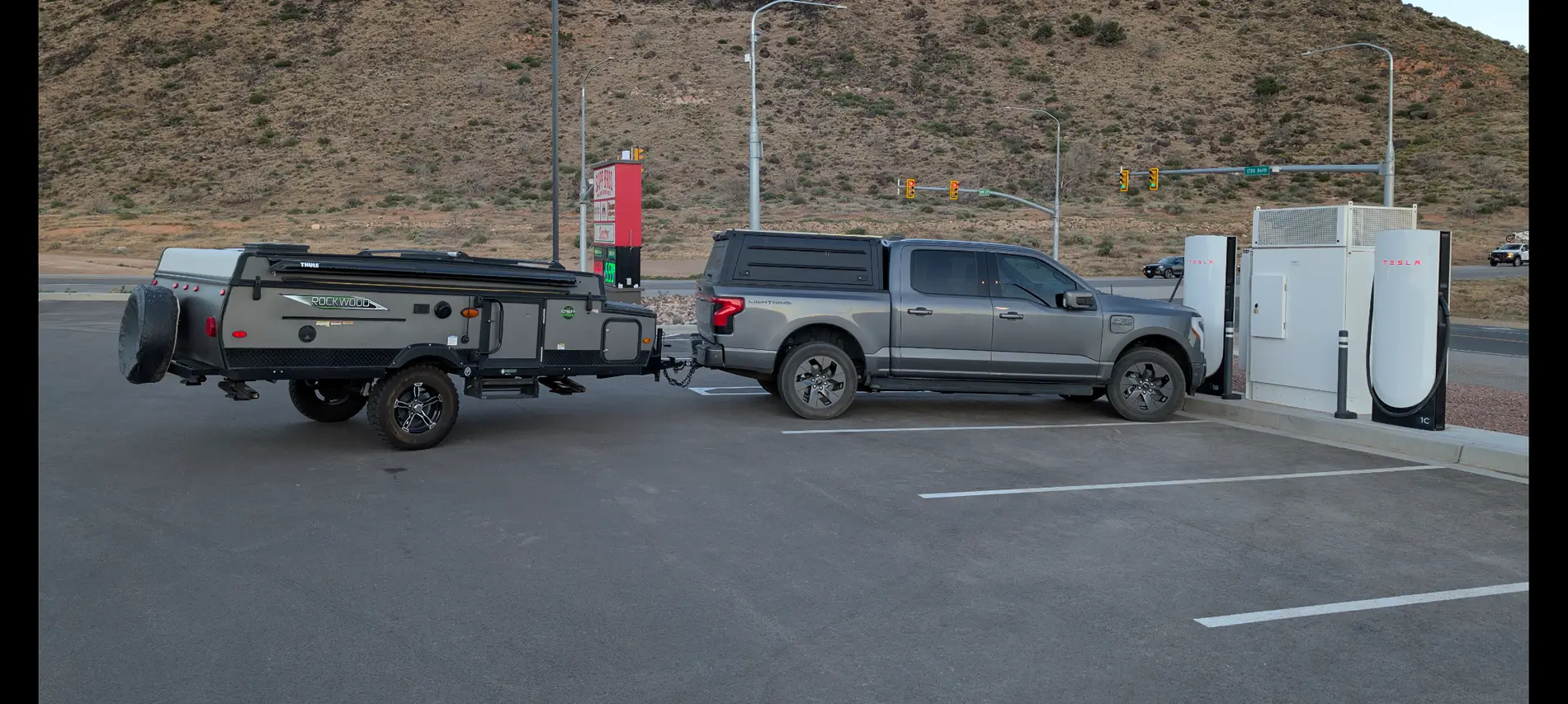
As someone who tows with their truck, the worst placement of a charge port is in the rear of the vehicle.

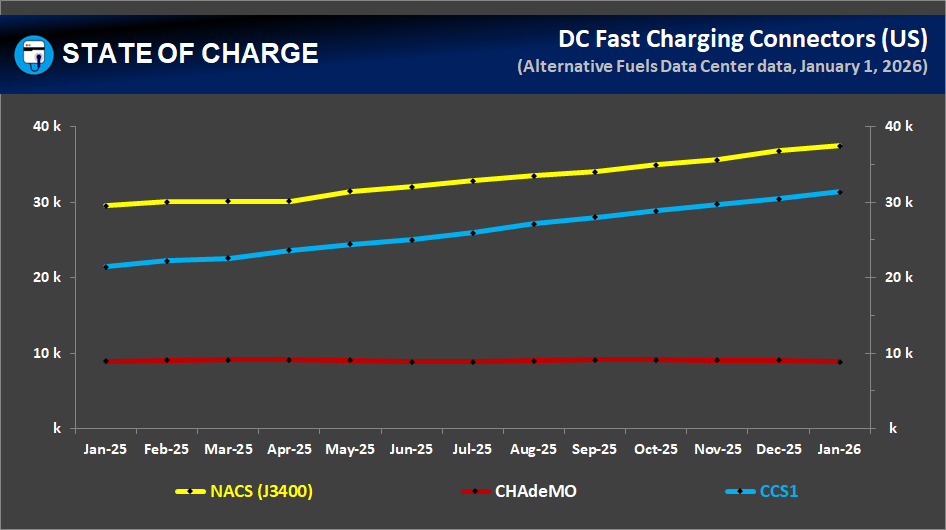
Putting aside all theory, poor past design, and guesses at the future, the facts are that the vast majority of DCFC plugs are CCS1 and are configured as pull-in stations.

The best placement would be passenger front forward of the tire. This would accommodate the SC short cables, would not require dropping the trailer at most charging locations, and would accommodate curb-side charging.

Ford F-150 Lightning Tesla Supercharger PSA 1000014602
 

Sponsored

SpaceEVDriver

Well-known member
Joined
Feb 9, 2022
Threads
30
Messages
917
Reaction score
1,831
Location
Arizona
Vehicles
2023 Lightning Lariat ER, 2022 Mustang Mach-E
I’m not sure that this statement is accurate…..

IMG_0027.png
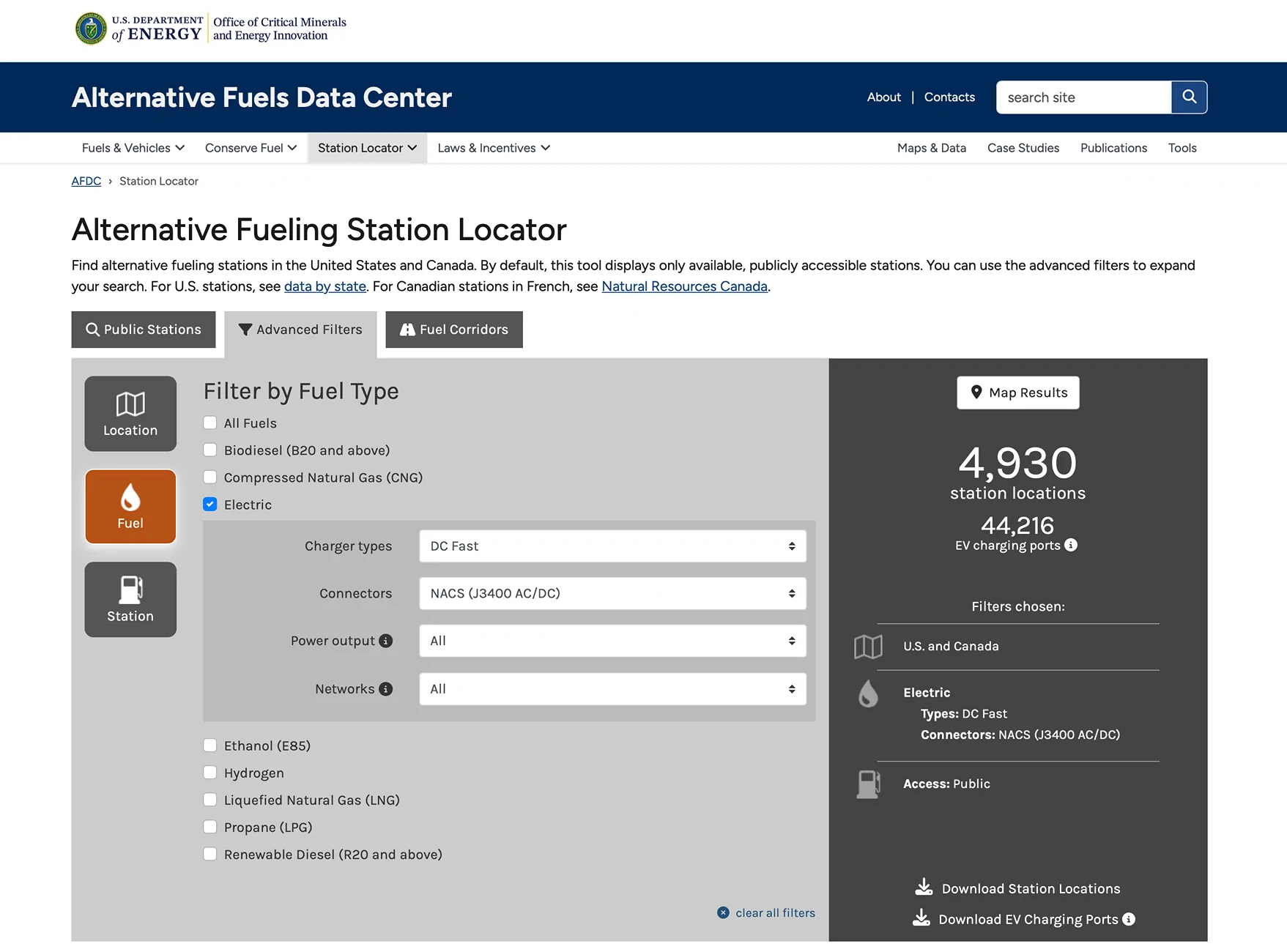
It’s accurate when you remove the V2 and earlier plugs that are useless to non-T vehicles but are always included in the counts because the AFDC doesn’t distinguish between NACS and the proprietary plug shaped like NACS.

But I still should have said stations, not plugs. There are <5000 NACS/Tesla stations that do DCFC and >14,000 CCS1 stations.

Ford F-150 Lightning Tesla Supercharger PSA Screenshot 2026-05-21 at 05.43.43


Ford F-150 Lightning Tesla Supercharger PSA Screenshot 2026-05-21 at 05.44.05
 

hturnerfamily

Well-known member
First Name
William
Joined
Jan 8, 2022
Threads
49
Messages
2,437
Reaction score
3,147
Location
rural Georgia
Vehicles
22 LIGHTNING PRO IcedBlueSilver 8/23/2022
Occupation
Owner
well, Nissan has changed things: a Chargeport on BOTH front quarterpanels : )


although, as you'll see, the 'driver side' is the J1772 for 'at home' easy reach... and the 'passenger side' is the NACS, more in 'line' with the backing-in of Teslas at Supercharger locations, etc.
 
OP
OP
ClevelandBeemer

ClevelandBeemer

Well-known member
Joined
May 10, 2025
Threads
10
Messages
314
Reaction score
389
Vehicles
2025 F150 Lightning Flash 131kWh
It’s accurate when you remove the V2 and earlier plugs that are useless to non-T vehicles but are always included in the counts because the AFDC doesn’t distinguish between NACS and the proprietary plug shaped like NACS.

But I still should have said stations, not plugs. There are <5000 NACS/Tesla stations that do DCFC and >14,000 CCS1 stations.

Screenshot 2026-05-21 at 05.43.43.webp


Screenshot 2026-05-21 at 05.44.05.webp
I see where you’re coming from.

IMO the plug metric is much more relevant than the station metric. Many CCS1 stations have only 2 or 4 plugs that output > 150kw. In a road tripping scenario, <150kw stations are not super helpful. Once removed you find the following breakdown.

CCS1 plugs: 33,774

NACS plugs: 40,654

Even if you stick with stations, you’d need to remove the 22,106 CCS1 plugs that output < 150kw….. Unfortunately, it’s difficult to understand how many CCS1 stations that is because many have a mix of plugs and capabilities.

As an aside, the AFDC site has inaccurate data. If I group the < 50kw and 50kw to 150kw port data, then group the > 150kw to 350kw and > 350kw port data, when the two totals are added it comes to 55,880. However when using the site total for all power output, it gives a total of 39,358 plugs. Quite the discrepancy if you ask me.
 

SpaceEVDriver

Well-known member
Joined
Feb 9, 2022
Threads
30
Messages
917
Reaction score
1,831
Location
Arizona
Vehicles
2023 Lightning Lariat ER, 2022 Mustang Mach-E
I see where you’re coming from.

IMO the plug metric is much more relevant than the station metric. Many CCS1 stations have only 2 or 4 plugs that output > 150kw. In a road tripping scenario, <150kw stations are not super helpful. Once removed you find the following breakdown.

CCS1 plugs: 33,774

NACS plugs: 40,654

Even if you stick with stations, you’d need to remove the 22,106 CCS1 plugs that output < 150kw….. Unfortunately, it’s difficult to understand how many CCS1 stations that is because many have a mix of plugs and capabilities.

As an aside, the AFDC site has inaccurate data. If I group the < 50kw and 50kw to 150kw port data, then group the > 150kw to 350kw and > 350kw port data, when the two totals are added it comes to 55,880. However when using the site total for all power output, it gives a total of 39,358 plugs. Quite the discrepancy if you ask me.
That’s why I download the data and do the analysis myself.

Why would I remove the plugs that output <150 kW? I use them all the time for longer meal stops. They’re more abundant, cheaper and are rarely in use.

Station count is far more relevant than plug count. With only <4k stations available, there just aren’t enough NACS or NACS-looking stations to be useful to me in most of my road trips (about 50,000 miles of road tripping). I can always find a CCS1 station, but NACS stations are few and far between.
 

Sponsored
OP
OP
ClevelandBeemer

ClevelandBeemer

Well-known member
Joined
May 10, 2025
Threads
10
Messages
314
Reaction score
389
Vehicles
2025 F150 Lightning Flash 131kWh
That’s why I download the data and do the analysis myself.

Why would I remove the plugs that output <150 kW? I use them all the time for longer meal stops. They’re more abundant, cheaper and are rarely in use.

Station count is far more relevant than plug count. With only <4k stations available, there just aren’t enough NACS or NACS-looking stations to be useful to me in most of my road trips (about 50,000 miles of road tripping). I can always find a CCS1 station, but NACS stations are few and far between.
Why would you remove those stations? Because unless you’re stopping for 2+ hours the 50kw to 125kw stations are not super useful. Even a sit down restaurant meal stop in my experience is less than 90 minutes, and that’s with a baby. 🤣 Furthermore less than 50kw is really only relevant if you’re going to be stopped for 6+ hours which is getting more into destination charger territory.
 

SpaceEVDriver

Well-known member
Joined
Feb 9, 2022
Threads
30
Messages
917
Reaction score
1,831
Location
Arizona
Vehicles
2023 Lightning Lariat ER, 2022 Mustang Mach-E
Why would you remove those stations? Because unless you’re stopping for 2+ hours the 50kw to 125kw stations are not super useful. Even a sit down restaurant meal stop in my experience is less than 90 minutes, and that’s with a baby. 🤣 Furthermore less than 50kw is really only relevant if you’re going to be stopped for 6+ hours which is getting more into destination charger territory.
Weird.

I live in and travel across charging deserts. A 125 kW or slower charger is often the only DCFC available within driving distance. Those 125 kW and slower chargers are more than “not super useful;” they are critical.

If you want to limit your access, I guess that’s up to you. But those chargers are incredibly valuable to those of us who do a lot of road tripping to far away places while towing.
 
OP
OP
ClevelandBeemer

ClevelandBeemer

Well-known member
Joined
May 10, 2025
Threads
10
Messages
314
Reaction score
389
Vehicles
2025 F150 Lightning Flash 131kWh
Weird.

I live in and travel across charging deserts. A 125 kW or slower charger is often the only DCFC available within driving distance. Those 125 kW and slower chargers are more than “not super useful;” they are critical.

If you want to limit your access, I guess that’s up to you. But those chargers are incredibly valuable to those of us who do a lot of road tripping to far away places while towing.
I suppose it’s down to how much you value your time and where you are located. 🤷🏼‍♂️ Seems like in your case a road trip is more about the journey than the destination, which isn’t necessarily a bad thing.
 

SpaceEVDriver

Well-known member
Joined
Feb 9, 2022
Threads
30
Messages
917
Reaction score
1,831
Location
Arizona
Vehicles
2023 Lightning Lariat ER, 2022 Mustang Mach-E
I suppose it’s down to how much you value your time and where you are located. 🤷🏼‍♂️ Seems like in your case a road trip is more about the journey than the destination, which isn’t necessarily a bad thing.
Don’t get me wrong, I will choose a 350 kW charger over a 125 kW charger when it’s available. But I often don’t have that option when I’m traveling across the US Southwest or parts of the Northwest (Wyoming, Montana, etc). These locations often only have one or two DCFCs within a 100 mile driving distance. We can’t be picky.

Excluding 125 kW chargers from my options would mean I wouldn’t be able to go where I like to go. It is absolutely about the journey. If I’m more concerned with the destination, I’ll fly.

Excluding V2 SCs from the count of NACS stations isn’t about the rate, it’s about the fact that they’re useless to anyone without a brand-T vehicle. Including them would be like including CHAdeMO when counting chargers “available” to my Lightning.
 

K6CCC

Well-known member
First Name
Jim
Joined
Sep 12, 2024
Threads
31
Messages
1,103
Reaction score
1,147
Location
Glendora, Calif.
Vehicles
2024 Lightning Flash ER in Antimatter Blue w/9.6 PPO , 2017 Corolla (wife's car)
Occupation
Retired from 2-Way radio systems
Station count is far more relevant than plug count. With only <4k stations available, there just aren’t enough NACS or NACS-looking stations to be useful to me in most of my road trips (about 50,000 miles of road tripping). I can always find a CCS1 station, but NACS stations are few and far between.
Like everything, that first statement is only partially true. Yes, total station count of CCS-1 may be more, but with so many of them very small plug count and therefore ALWAYS busy does not help... much. Let me give beautiful Baker, CA as an example. There are a total of five DCFC stations. First is a 96 stall Tesla SuperCharger that is not available to any vehicles other than Tesla. Right next to it is a 12 stall E.A. station with 350 KW chargers. To the northeast at the World's tallest thermometer, is a 2 stall EVgo station with 50 KW chargers. Next up to the northeast is a 40 stall Tesla SuperCharger with 325 KW V4 chargers (V3.5 really) that we can use. Lastly there is a EVGateway station with 7 CCS-1 and 1 CHAdeMO 60 KW charger. The E.A. station is almost always busy. I agree that for roadtripping, a 50-60 KW charger is of very limited utility except at an overnight stop. Not useless - especially if it's your only option.
Sponsored


Top