
Sponsored

v2h8484

Well-known member
Joined
Mar 3, 2023
Threads
3
Messages
218
Reaction score
114
Location
USA
Vehicles
Tesla Model 3
Thank you @MapleMan650 @v2h8484 @Maquis for highlighting the need to clarify the code compliance of this use case, and I'll confirm that our documentation is updated. I'm glad to see that users are happy with the feature and are able to use their Ford Lightning in ways that they may not have originally anticipated.

This is an interesting topic, and it's important to both get it right and understand that while very specific code sections must be referenced, it is in fact code-compliant. While there seems to be some confusion, hopefully this will help share some insight on what is clear guidance under the NEC (2020 & 2023 NFPA 70 referenced below), which everyone can access. Please use the references below to confirm:

As EVs equipped with a receptacle(s) for the purposes of exporting power to supply utilization equipment ("EVPE") must follow similar safety requirements as required by the NEC for other sources, such as portable generators (NEC 625.60 - AC Receptacle Outlets Used for EVPE), these guidelines apply:
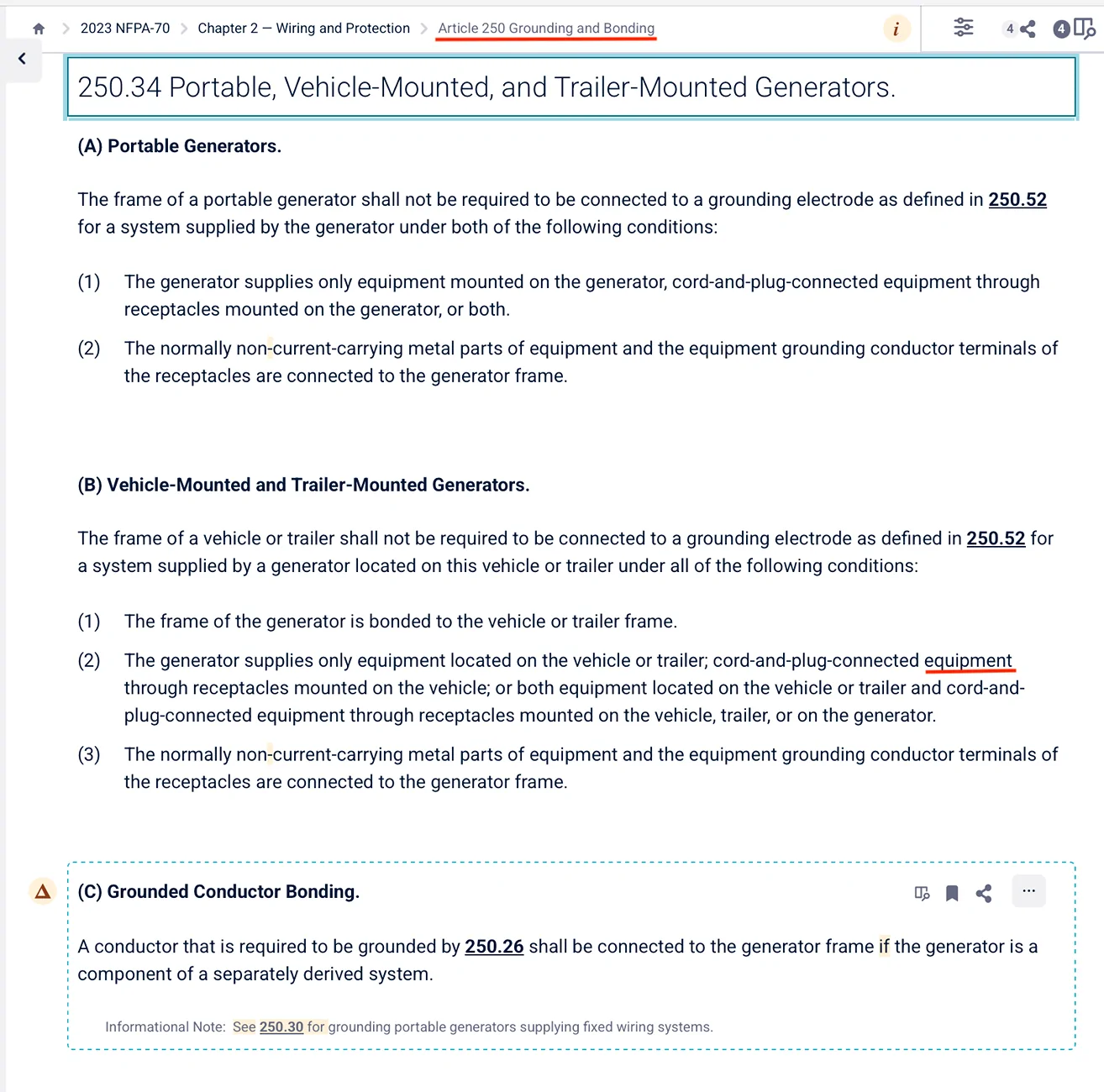
  • Conductor to be grounded, AC systems: NEC 250.26, ...if generator is "separately derived," (NEC 250.34(C))
  • Separately Derived System (2023 NEC 100 Definitions) "...supply output having no direct connections, ...other than those established by grounding and bonding connections."
  • Grounding and Bonding: NEC 250.34(B), for a vehicle mounted generator using a receptacle and a cord-and-plug connection to system equipment ("shall not be required to be connected to a grounding electrode")
Because EVPE are not to be connected to the "Area EPS" (grid), they are integrated at a specifically controlled system input source on the certified & listed FranklinWH ecosystem (the V2L/generator input), and only usable during an islanding event, or if the system is used off-grid only.

Regarding the specifics of the EVPE outlet used under NEC 625.60(D), "various methods" can be used to provide for GFCI requirements (e.g. the Ford Lightning's certified/integrated circuit protection, trip indicator, and reset control button).

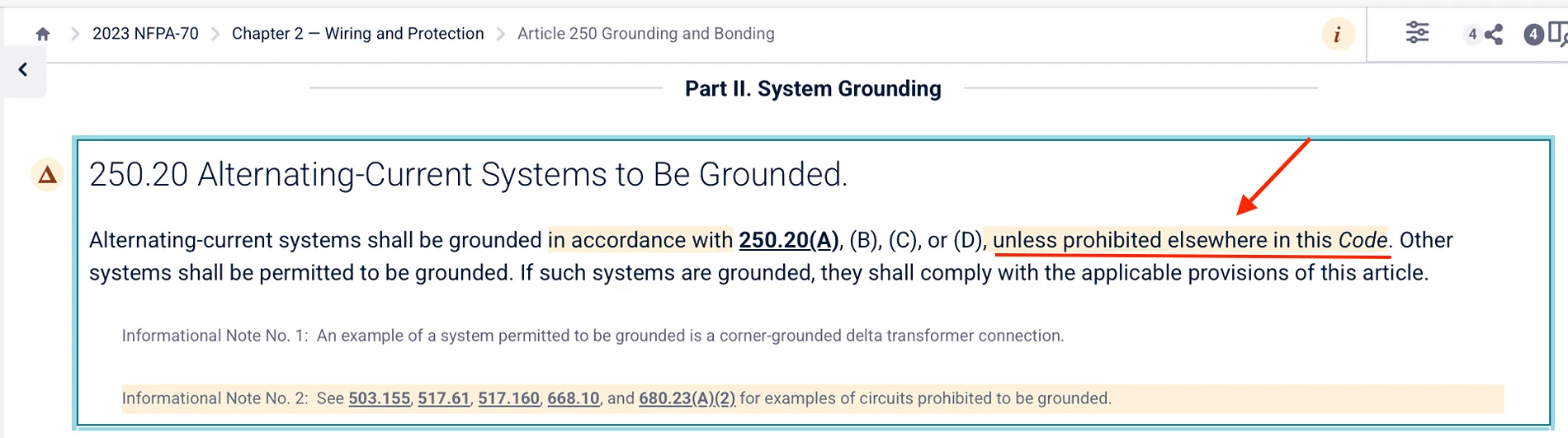
**Putting all of the above together, the GFCI outlet of certified EVPE, like the Ford Lightning, can safely supply "off-board utilization equipment" (the V2L system inlet receptacle) without itself needing to be connected to a grounding electrode as defined in 250.52 ("Grounding Electrodes"). This is because they are by definition not a "separately derived system," and proper guidance for their use is otherwise comprehensive. This means that while the home itself and all other system components remain grounded/bonded as needed (NEC 250.20), the V2L system inlet receptacle equipment, which is only in use (energized/connected) when the EVPE is in use, it "shall not be required to be connected to a grounding electrode," in compliance with NEC 250.34 (vehicle mounted, etc.) and NEC 250.20 (AC Systems to Be Grounded "unless prohibited elsewhere in this Code").

[*EDIT: Whenever there is a question related to code compliance, this word always comes up: "interpretation." This can mean a couple things.
The reality is that only the AHJ can make a "decision" on code-compliance whenever there is a question, and that, too, is linked to "interpretation" (even when there may be different interpretation decisions within one AHJ - e.g. plan reviewer #1, #2, inspector #1, #2, etc).
Among those really concerned and most knowledgable, the answer usually leans towards, "well, in the next code cycle, maybe this will be fixed."
All any responsible OEM can do is make a tested, safe product, and offer a path to code compliance based on as much of the currently published & approved text - which ultimately is also an interpretation up to the AHJ.]
There are several incorrect and confusing statements in the above and I have no interest in addressing them all. As an example, I will just point out that you are misstating what NEC 250.34(B) allows. It only allows a vehicle mounted generator to be ungrounded if it only supplies loads on the vehicle and/or cord and plug loads connected directly to outlets on the vehicle.

You may not like or agree with the code but any generator connected to house wiring must be grounded in order to be code compliant. EV V2X maybe new but vehicle mounted generators are certainly not. They have been around for decades and the code is clear about their grounding requirements. BTW, the code is subject to vendor influence so I would suggest companies like yours try to get representation on the code making panel to change it to be more friendly for your products. As an example, my understanding is that NEC 250.34(B) came about due to heavy influence on the CMP by the entertainment industry.
Sponsored

 
Last edited:
Jay@FranklinWH

New member
First Name
Jay
Joined
Aug 22, 2025
Threads
0
Messages
3
Reaction score
3
Vehicles
F-150 Lightning
Occupation
Product Manager
There are several incorrect and confusing statements in the above and I have no interest in addressing them all. As an example, I will just point out that you are misstating what NEC 250.34(B) allows. It only allows a vehicle mounted generator to be ungrounded if it only supplies loads on the vehicle and/or cord and plug loads connected directly to outlets on the vehicle.

You may not like or agree with the code but any generator connected to house wiring must be grounded in order to be code compliant. EV V2X maybe new but vehicle mounted generators are certainly not. They have been around for decades and the code is clear about their grounding requirements. BTW, the code is subject to vendor influence so I would suggest companies like yours try to get representation on the code making panel to change it to be more friendly for your products. As an example, my understanding is that NEC 250.34(B) came about due to heavy influence on the CMP by the entertainment industry.
@v2h8484 - I actually expected some followup might be needed. Is that your interpretation of this? Please confirm.
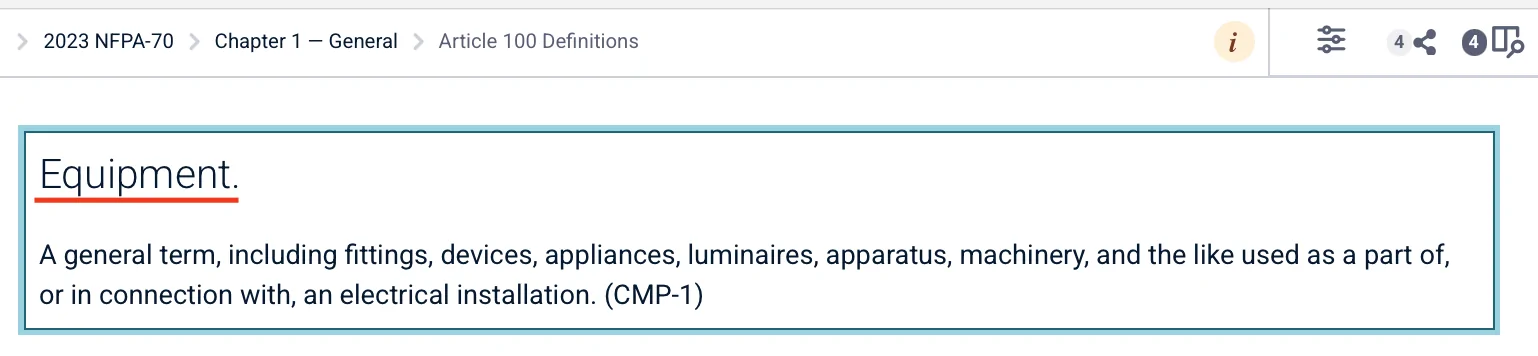
(it appears to not be "loads," as you suggest, but connected "equipment through receptacles mounted on the generator," and the definition of "equipment" and 250.20 main title acknowledges allowance for this.)[*copyrighted content shared for educational purposes]
Ford F-150 Lightning FranklinWH aPower V2L and Pro Power Success! Screenshot 2025-08-31 at 1.15.12 PM

Ford F-150 Lightning FranklinWH aPower V2L and Pro Power Success! Screenshot 2025-08-31 at 1.16.50 PM

Ford F-150 Lightning FranklinWH aPower V2L and Pro Power Success! 2023 NEC 250.20 AC Systems Grounding
 

Elcolochin

Member
First Name
Alex
Joined
Jan 14, 2025
Threads
0
Messages
7
Reaction score
2
Vehicles
F150 Lightning Lariat
Thank you @MapleMan650 @v2h8484 @Maquis for highlighting the need to clarify the code compliance of this use case, and I'll confirm that our documentation is updated. I'm glad to see that users are happy with the feature and are able to use their Ford Lightning in ways that they may not have originally anticipated.

This is an interesting topic, and it's important to both get it right and understand that while very specific code sections must be referenced, it is in fact code-compliant. While there seems to be some confusion, hopefully this will help share some insight on what is clear guidance under the NEC (2020 & 2023 NFPA 70 referenced below), which everyone can access. Please use the references below to confirm:

As EVs equipped with a receptacle(s) for the purposes of exporting power to supply utilization equipment ("EVPE") must follow similar safety requirements as required by the NEC for other sources, such as portable generators (NEC 625.60 - AC Receptacle Outlets Used for EVPE), these guidelines apply:
  • Conductor to be grounded, AC systems: NEC 250.26, ...if generator is "separately derived," (NEC 250.34(C))
  • Separately Derived System (2023 NEC 100 Definitions) "...supply output having no direct connections, ...other than those established by grounding and bonding connections."
  • Grounding and Bonding: NEC 250.34(B), for a vehicle mounted generator using a receptacle and a cord-and-plug connection to system equipment ("shall not be required to be connected to a grounding electrode")
Because EVPE are not to be connected to the "Area EPS" (grid), they are integrated at a specifically controlled system input source on the certified & listed FranklinWH ecosystem (the V2L/generator input), and only usable during an islanding event, or if the system is used off-grid only.

Regarding the specifics of the EVPE outlet used under NEC 625.60(D), "various methods" can be used to provide for GFCI requirements (e.g. the Ford Lightning's certified/integrated circuit protection, trip indicator, and reset control button).

**Putting all of the above together, the GFCI outlet of certified EVPE, like the Ford Lightning, can safely supply "off-board utilization equipment" (the V2L system inlet receptacle) without itself needing to be connected to a grounding electrode as defined in 250.52 ("Grounding Electrodes"). This is because they are by definition not a "separately derived system," and proper guidance for their use is otherwise comprehensive. This means that while the home itself and all other system components remain grounded/bonded as needed (NEC 250.20), the V2L system inlet receptacle equipment, which is only in use (energized/connected) when the EVPE is in use, it "shall not be required to be connected to a grounding electrode," in compliance with NEC 250.34 (vehicle mounted, etc.) and NEC 250.20 (AC Systems to Be Grounded "unless prohibited elsewhere in this Code").

[*EDIT: Whenever there is a question related to code compliance, this word always comes up: "interpretation." This can mean a couple things.
The reality is that only the AHJ can make a "decision" on code-compliance whenever there is a question, and that, too, is linked to "interpretation" (even when there may be different interpretation decisions within one AHJ - e.g. plan reviewer #1, #2, inspector #1, #2, etc).
Among those really concerned and most knowledgable, the answer usually leans towards, "well, in the next code cycle, maybe this will be fixed."
All any responsible OEM can do is make a tested, safe product, and offer a path to code compliance based on as much of the currently published & approved text - which ultimately is also an interpretation up to the AHJ.]
@Jay
Thank you @MapleMan650 @v2h8484 @Maquis for highlighting the need to clarify the code compliance of this use case, and I'll confirm that our documentation is updated. I'm glad to see that users are happy with the feature and are able to use their Ford Lightning in ways that they may not have originally anticipated.

This is an interesting topic, and it's important to both get it right and understand that while very specific code sections must be referenced, it is in fact code-compliant. While there seems to be some confusion, hopefully this will help share some insight on what is clear guidance under the NEC (2020 & 2023 NFPA 70 referenced below), which everyone can access. Please use the references below to confirm:

As EVs equipped with a receptacle(s) for the purposes of exporting power to supply utilization equipment ("EVPE") must follow similar safety requirements as required by the NEC for other sources, such as portable generators (NEC 625.60 - AC Receptacle Outlets Used for EVPE), these guidelines apply:
  • Conductor to be grounded, AC systems: NEC 250.26, ...if generator is "separately derived," (NEC 250.34(C))
  • Separately Derived System (2023 NEC 100 Definitions) "...supply output having no direct connections, ...other than those established by grounding and bonding connections."
  • Grounding and Bonding: NEC 250.34(B), for a vehicle mounted generator using a receptacle and a cord-and-plug connection to system equipment ("shall not be required to be connected to a grounding electrode")
Because EVPE are not to be connected to the "Area EPS" (grid), they are integrated at a specifically controlled system input source on the certified & listed FranklinWH ecosystem (the V2L/generator input), and only usable during an islanding event, or if the system is used off-grid only.

Regarding the specifics of the EVPE outlet used under NEC 625.60(D), "various methods" can be used to provide for GFCI requirements (e.g. the Ford Lightning's certified/integrated circuit protection, trip indicator, and reset control button).

**Putting all of the above together, the GFCI outlet of certified EVPE, like the Ford Lightning, can safely supply "off-board utilization equipment" (the V2L system inlet receptacle) without itself needing to be connected to a grounding electrode as defined in 250.52 ("Grounding Electrodes"). This is because they are by definition not a "separately derived system," and proper guidance for their use is otherwise comprehensive. This means that while the home itself and all other system components remain grounded/bonded as needed (NEC 250.20), the V2L system inlet receptacle equipment, which is only in use (energized/connected) when the EVPE is in use, it "shall not be required to be connected to a grounding electrode," in compliance with NEC 250.34 (vehicle mounted, etc.) and NEC 250.20 (AC Systems to Be Grounded "unless prohibited elsewhere in this Code").

[*EDIT: Whenever there is a question related to code compliance, this word always comes up: "interpretation." This can mean a couple things.
The reality is that only the AHJ can make a "decision" on code-compliance whenever there is a question, and that, too, is linked to "interpretation" (even when there may be different interpretation decisions within one AHJ - e.g. plan reviewer #1, #2, inspector #1, #2, etc).
Among those really concerned and most knowledgable, the answer usually leans towards, "well, in the next code cycle, maybe this will be fixed."
All any responsible OEM can do is make a tested, safe product, and offer a path to code compliance based on as much of the currently published & approved text - which ultimately is also an interpretation up to the AHJ.]
@Jay@FranklinWH and @MapleMan650

I have the Franklin 2 Battery and aGate. I purchased the generator module, but haven't set it up. Waiting for my electrician to schedule some time to do it.
1. My main panel is Square D, is there a particular inlet brand that I need to use? What about the cable to enable V2H?
2. I noticed you said 50amp breaker, is the recommended amp to use?
3. **Most important question** If I enable and start using the V2L feature, does that void the warranty on my F150 Lightning? I've heard some manufacturers have voided EV battery warranties when using bidirectional charging, outside of their proprietary solution (SunRun F150 system).
 

Jodokk

Well-known member
First Name
Me
Joined
Feb 7, 2024
Threads
12
Messages
141
Reaction score
123
Location
NC
Vehicles
22 Lightning Lariat ER, Agate Bl., Max Tow & AT tires. UnderCover Abyss Tonneau
Occupation
College Professor
I agree with you - not having an EGC to the truck is technically a code violation.

But the way it’s implemented, it’s not unsafe.
This convo. I hesitate...
I've been through this so many times now. Even watching some of the YouTubers tip-toe around the issue is familiar.
In that case, even years ago in early Lightning, and even non-Lightning pro-power onboard videos, these folks experience this seemingly intractable issue.
The dread pirate "Ground Fault."
They try "everything," learn that there is a redundant ground issue, AND, that there is only one fix (besides an isolation transformer).
There's usually an obvious time gap, then they (somehow) get it working behind the scenes. But, the liability they would take on by showing how it was actually done is always too much.
However, it always, or nearly always, gets "fixed" by eliminating the extra ground on the truck side. Period.
I don't know how everyone is handling this issue, but I know for sure of certified Franklinwh installers who simply do this at the outlet (quietly) as standard procedure.
It ain't code. Maybe, for this purpose, it should be, but also, I do know some knucklehead, making alsome common mistake, and not doung this "properly" ("properly" and "within code" are NOT mutally exclusive terms) will screw it up for everyone by burning their house down.
Franklin should work with Ford to get this straight. But, what do I know?
 

Maquis

Well-known member
First Name
Dave
Joined
May 20, 2021
Threads
9
Messages
4,197
Reaction score
5,564
Location
Illinois
Vehicles
2021 Mach-E E4-X; 2023 Lightning Lariat ER
This convo. I hesitate...
I've been through this so many times now. Even watching some of the YouTubers tip-toe around the issue is familiar.
In that case, even years ago in early Lightning, and even non-Lightning pro-power onboard videos, these folks experience this seemingly intractable issue.
The dread pirate "Ground Fault."
They try "everything," learn that there is a redundant ground issue, AND, that there is only one fix (besides an isolation transformer).
There's usually an obvious time gap, then they (somehow) get it working behind the scenes. But, the liability they would take on by showing how it was actually done is always too much.
However, it always, or nearly always, gets "fixed" by eliminating the extra ground on the truck side. Period.
I don't know how everyone is handling this issue, but I know for sure of certified Franklinwh installers who simply do this at the outlet (quietly) as standard procedure.
It ain't code. Maybe, for this purpose, it should be, but also, I do know some knucklehead, making alsome common mistake, and not doung this "properly" ("properly" and "within code" are NOT mutally exclusive terms) will screw it up for everyone by burning their house down.
Franklin should work with Ford to get this straight. But, what do I know?
The nuances of ”grounding“ and GFCI implementation involve the minimization of shock hazards and electrocution risk to humans, not preventing fires and burning down houses.
 

Sponsored

Jodokk

Well-known member
First Name
Me
Joined
Feb 7, 2024
Threads
12
Messages
141
Reaction score
123
Location
NC
Vehicles
22 Lightning Lariat ER, Agate Bl., Max Tow & AT tires. UnderCover Abyss Tonneau
Occupation
College Professor
The nuances of ”grounding“ and GFCI implementation involve the minimization of shock hazards and electrocution risk to humans, not preventing fires and burning down houses.
Yes. Thanks.
 

NW Ontario Ford Lightning

Well-known member
First Name
Robert
Joined
Feb 14, 2025
Threads
1
Messages
555
Reaction score
707
Location
NW Ontario Canada
Vehicles
2024 F-150 SR Lightning XLT, 2023 Escape Hybrid
Occupation
Contractor
Part of the reason for buying my Lightning was to have a back up - to the back up,-for the solar-ESS system. I spent quite a bit of time on the topic, both for safety, compliance and convenience. There are well known issues of connecting a bonded "generator" into a grounded home electrical system, ultimately because of multiple ground-N connection points, where we need to limit to just one.
For me the best solution was using the truck power to ONLY run a DC transformer - which simply charges the main house ESS. Since the only wires connected on my home-side of that transformer are DC pos and neg, there is no issue created. The price is a small loss of efficiency due to double conversion DC-AC-DC again. But it is safe, reliable, and the truck doesn't need to be able to start my well pump or power other large loads, since all it does it trickle-charge the main ESS batteries.
This may be helpful for anyone that has a battery-inverter system they can tie into.
 

sysop1

Well-known member
Joined
Aug 2, 2022
Threads
2
Messages
62
Reaction score
84
Location
St.George
Vehicles
Gas
It’s raining, seven PM,
Powerwalls doing what they do.
House is lit, fridge is cold,
internet hasn’t got a clue.

And yeah, I’ve got a Lightning—sure—
great truck, fast, tows like a champ.
But using that as a house backup
is like grabbing a flashlight to light a camp.

Why hunt for keys in a storm,
wonder where the truck is parked,
when the battery lives at home full-time,
quiet, ready, always charged?

A Powerwall doesn’t run errands,
doesn’t forget to plug in at night.
It just sits there, 24/7,
keeping the house on without a fight.

Having a truck just for backup?
That’s commitment in reverse.
The battery that never leaves home
already solved that problem—first.
 

NW Ontario Ford Lightning

Well-known member
First Name
Robert
Joined
Feb 14, 2025
Threads
1
Messages
555
Reaction score
707
Location
NW Ontario Canada
Vehicles
2024 F-150 SR Lightning XLT, 2023 Escape Hybrid
Occupation
Contractor
can your powerwall drive to the free level 3 charger down the road to fill up, and come back to power the house again? LOL.
Sponsored


Top