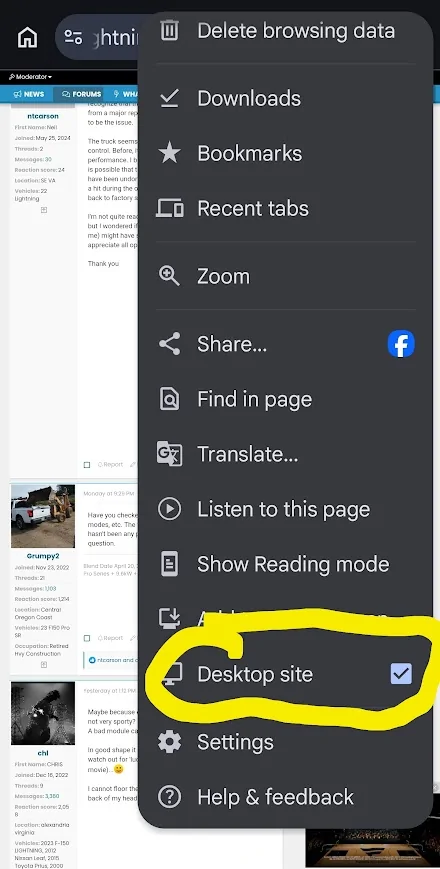
[HIJACK] While on your mobile device, chrome browser, switch viewing mode to 'desktop site' from 3 dOT menu, scroll to the bottom,that will allow you to see advanced editor functions. [/HIJACK]
Here’s what Gemeni AI had to say down below. I don’t know if this is entirely accurate but it makes sense. When I had the front sensor recall done a while back (I think that’s what it was) my truck steering felt extremely soft and drove in an off way. But somehow the system recalibrated itself after about a week of driving and it was fine again.
Gemini:
Sensor recalibration is a critical, yet often invisible, part of modern EV repair. In a vehicle like the F-150 Lightning, the "brain" of the driving dynamics relies heavily on the Inertial Measurement Unit (IMU) and various G-sensors.
When these are out of sync, the truck doesn't just "drive poorly"—it feels fundamentally "off" because the software is misinterpreting the physical forces acting on the chassis.
How the Calibration Affects the "Feel"
The IMU measures pitch, roll, and yaw. If the dealership performed a "PMI" (Programmable Module Installation) or a battery control module update, they are supposed to perform a "Zero-Point Calibration." This tells the truck what "level and still" looks like.
• The "Nervous" Sensation: If the calibration is even a fraction of a degree off, the stability control may think the truck is leaning more than it actually is. It might subtly apply individual brakes (torque vectoring) to "correct" a roll that isn't happening, making the truck feel twitchy or like it's fighting you.
• Damping and Sway: Even without active suspension, the truck uses "Electronic Power Assisted Steering" (EPAS) to compensate for road crown and crosswinds. If the sensors are uncalibrated, this assistance can feel "vague" or "floaty," contributing to that out-of-control feeling.
Why the Battery Repair Matters Here
The battery pack in a Lightning is a structural component. It adds immense rigidity to the frame. By removing and replacing the pack, the physical "flex" of the frame changes slightly.
1. Mechanical Shift: If the pack was reinstalled and the sensors weren't re-zeroed after the truck was back on its wheels with the full weight of the battery, the sensors might be reading a "pre-load" that shouldn't be there.
2. Software Overwrite: Dealers often "flash" every module to the latest firmware during a major warranty repair. This can reset the Steering Angle Sensor (SAS). If the SAS isn't perfectly centered, the truck will feel like it’s "drifting" or "bouncing" as the lane-keep and stability systems try to find the true center.
How to Test This
You can sometimes "reset" the logic of these sensors by performing a simple BMS (Battery Management System) Reset or by driving in a specific pattern (straight line on a flat road at a consistent speed for a few miles) to let the sensors auto-calibrate. However, if the "Zero-Point" was set incorrectly at the dealership, only a professional scan tool (or a deep dive into software like FORScan) can truly recalibrate the lateral and longitudinal G-sensors to zero.
If the truck feels like it’s "walking" over bumps rather than absorbing them, a botched sensor calibration is a very strong candidate.