
Sponsored

Lightning E-Rev 690 to 700 mile range

Jon A

Member
Joined
Mar 15, 2026
Threads
0
Messages
12
Reaction score
1
Location
Montana
Vehicles
2014 GMC 6.2L
Occupation
Engineer
If you could fill up a current lightning in 5 minutes, range would not be an issue. Gas stations as is could easily be converted to charge stations. Same amount of stalls and pull through because the wait times would be the same as a gas fill up.
Gas stations do not need an actual pipeline direct from the refinery in order to keep them supplied with energy. Replace a row of gas pumps with 1-2 MEGAWATT! chargers, and the station does need a "pipeline of copper" directly to it. That will be obscenely expensive to do in even a small percentage of locations where gas is currently available. If you think that's going to happen any time soon then somebody here is clearly in "Magic and Dream land."
But yes the Magic Batteries are talked about as much as the Magic EREV trucks that solves all of life's problems with no draw backs.
You must be joking. "Magic Batteries" have been talked about among the EV crowd for as long as EVs have existed. It's one of the most common subjects on any EV board.

EREVs? Gas truck owners generally have never heard the term, don't know that they are or don't care. And as this very thread (and others on this board) illustrates so definitively, most BEV truck owners despise the very idea of them with a passion. Not the actual trucks based upon actual performance (because they don't exist yet), but the very idea that they might exist someday.
Especially scout, which chose a small generator. That thing is going to be junk, if again, it ever makes it to market.
I agree with you there. That EREV will certainly work much better than your Trabant, but it's bad enough for me to cross it off my list. It really looks like it was a complete afterthought thrown out there at the last minute. If they change their minds, put a decent sized engine under the hood (so tow rating doesn't need to be cut in half) it would be back on my list. It looks like a fantastic truck otherwise.
Biggest issue being the battery is constantly being taxed. The smaller the battery they put in to make it cheaper the faster it will go through its life cycles.
Remember, they aren't using Trabant-sized 16.5 kWh battery. A 92 kWh battery (in the case of the RAM) in an EREV will be less "taxed" than a 98 kWh battery in a BEV (by a long way for some use cases). Also consider never charging it to 100% (because you really don't need to), never draining it to below 17% (because you really don't need to).... And on really long trips/hard long distance towing, it's mostly just along for the ride. Battery life with any vehicle that has one is a concern, but given the above conditions of operation, there's no reason it shouldn't fair pretty well compared with batteries modestly larger in a BEV. Exact details will take real data and vary from owner to owner so bold proclamations one way or the other are silly speculation at this point.
Now you are claiming I don't even know how EREV's work. Oh yes the miracle of providing unlimited energy out of a lawn mower engine theory. If they just would have figured this out sooner, we could have put these lawn mowers in superduties and semis. Heck, if these things are so great, why aren't they starting with a F450 EREV.
The Ram (we don't know what Ford will use yet) at least, is not using a lawn mower engine like your Trabant. The specs for the RAM have been out there for a long time now. If it's so important to you to argue how terrible it will be, maybe spending a few minutes and looking at them may be in order?
Yes, the battery allows a buffer to smooth out short peak power requirements but the engine needs to be big enough to be a net positive into the battery. If not, it means you are depleting the battery and not able to use the truck as per its spec of 14000lb towing without using battery. If you require the battery that means not only will you need to stop for gas but you will also need to stop to charge. That would be a whole lot of LOL.
Again, look at the specs. It will be able to put a net positive into the battery almost all of the time. Have you ever looked at your average power consumption of a towing trip? Up a mountain pass? Do you think maybe, just maybe, using actual data to form an opinion might ever be wise?

Of course you haven't. You have "decided" these powertrains will suck based upon your emotions, your feelings.

I, on the other hand, didn't become so optimistic that these powertrains could be really good, until Ram release the specs on theirs. I then ran the numbers using actual data and it looked really, really good.

EVs are a candy store for Engineers--they provide so much data for us to geek out over. It's really fun! Lots of towing tests are done online providing lots of data. Often, if you can do some math, you can extract the data you need from what is given. Some pertinent examples:

While lots of people have done them, the guys at TFL have done gobs of towing tests on EVs that often provide good data.

Of all their EV towing tests with a large profile trailer at highway speeds, the highest average power consumption I found was just under 80 kW. The Ram generator can produce 130 kW steady state, all day long. That means in those specific tests, the generator would have been able to maintain the SOC of the battery with a whopping 60+% margin of safety.

If you extrapolate a larger trailer, big headwind, higher speeds, etc, you will eat into that and at some point you can hit a limit where power consumption exceeds 130 kW. Is that something that any user will ever experience? With a headwind that big is anybody going to try to keep going that fast?

Those are the questions that need to be answered. Contrary to popular belief, this is the type of case that will be the proof test for an EREV (not hills/mountains). A headwind can last all day long, mountain passes are quite short in comparison, and then you regen down the other side. A high load from wind/aero that lasts for hours is the case that will stress the generator the most.

But from the initial math, it looks like it will be a very strong performer for 99.9% (estimated ;)) of towing situations a 1/2 ton will ever run into. If you can find any tests that document higher average power use, please do post them up as they would be great info!

So now let's consider mountain passes. We have some good data points from TFL in that regard as well. They towed a specific 9K trailer up the Ike with several EVs.

The Lightning used an average of 180.75 kW on the way up, burning 24.1 kWh of the battery. The Ram's generator is capable of 202 kW max power. So if it held that for 8 minutes, it could pass that test without losing any battery SOC at all. It will be a calibration choice, but I'm guessing they wouldn't even bother running the generator in "max power" mode unless the battery SOC gets dangerously low (because it would be a bit obnoxious), which shouldn't happen if you're using tow/haul mode.

With the generator only running at its quiet, lazy 130 kW, you'd be consuming 50.75 kW from the battery on the way up and burn 6.77 kWh from it. The Lightning gained 8 kWh regening down the hill...so think about that for a few seconds and it becomes quite clear the Ram should be able to go up and down mountains like that all day long fairly easily.

I didn't jump to any conclusions based upon my emotions. I used real world towing data to determine what was required from a truck to do a thing. With Rams specs published, I was able to compare those specs to what was required for the task.

I came to the conclusion these powertrains have the potential to be very good at doing "truck things." And with the obvious benefits/savings for daily use, they're pretty compelling option.

If you want links to specific videos and for me to show you how to do the math, I'd be happy to provide it.
with less efficiency due to the extra weight. In other words, a poor BEV experience. and you want a small noisy engine to save costs that now needs to haul around a heavy battery for no reason giving you a poor gas vehicle experience.
OK, let's deal with "all that extra weight...."

Ford's 131 kWh battery weighs about 1800 lbs. The battery for the RAM weighs about 1200 lbs, so you're starting with a 600 lb battery advantage. My educated estimate (with a Sandy Munro assist) is the genset and all the crap that goes with it will run about 800 lbs. So, you're at a whopping 200 lbs weight increase due to the different powertrain.

That's going to have any noticable affect on efficiency, handling, the BEV experience? Really? I think you're exaggerating a bit.

Compared with the best towing BEV, that thing has a battery that weighs about 2800 lbs. So now the EREV weighs 800 lbs less.... But hauling that around every day isn't a problem, because we all know a pound of battery weighs much less than a pound of that icky ICE stuff.... ;)

When Ford comes out with specs for theirs, we can re-do all the math above where specs differ significantly.
Sponsored


 

hturnerfamily

Well-known member
First Name
William
Joined
Jan 8, 2022
Threads
49
Messages
2,380
Reaction score
3,060
Location
rural Georgia
Vehicles
22 LIGHTNING PRO IcedBlueSilver 8/23/2022
Occupation
Owner
I suspect:

- as with many 'new' vehicle designs, there WILL be those who gravitate toward it, although, in the end, no manufacturer is in the business to produce only a 'few' vehicles - it must meet the demands of the masses, and must sell accordingly... in general.

- those who initially purchase an EREV will probably travel great distances, at first, although they will NOT stop to charge, only to REFUEL the generator's tank. They don't have time to 'charge'. Therefore, they will be traveling with gas, just like before... and now carrying a huge and heavy battery pack to go along with it. They will wonder where the 'savings' went.

- those same owners will quickly learn to love the smooth and quiet daily use of their EREV, in EV mode, and start to wonder if they can travel great distances without that loud and expensive-fueled engine having to start up.

- these same new owners will start to join these forums and question why they 'need' a heavy and expensive engine, where there could be a much more useful FRUNK. They will laud the idea that the generator is really worth the 'investment', when they really only like to drive in EV mode, anyway, and since they really don't tow that often, and don't travel long distances that often, really.
 

EV Engineer

Well-known member
First Name
M
Joined
May 22, 2025
Threads
4
Messages
68
Reaction score
97
Vehicles
2023 Ford Lightning XLT
Occupation
Engineer
I suspect:

- as with many 'new' vehicle designs, there WILL be those who gravitate toward it, although, in the end, no manufacturer is in the business to produce only a 'few' vehicles - it must meet the demands of the masses, and must sell accordingly... in general.

- those who initially purchase an EREV will probably travel great distances, at first, although they will NOT stop to charge, only to REFUEL the generator's tank. They don't have time to 'charge'. Therefore, they will be traveling with gas, just like before... and now carrying a huge and heavy battery pack to go along with it. They will wonder where the 'savings' went.

- those same owners will quickly learn to love the smooth and quiet daily use of their EREV, in EV mode, and start to wonder if they can travel great distances without that loud and expensive-fueled engine having to start up.

- these same new owners will start to join these forums and question why they 'need' a heavy and expensive engine, where there could be a much more useful FRUNK. They will laud the idea that the generator is really worth the 'investment', when they really only like to drive in EV mode, anyway, and since they really don't tow that often, and don't travel long distances that often, really.

I thought people were exaggerating but after a year or so in BEV switching to a gas drive-train is just cumbersome.

Kind of hard to explain until you experience. Smooth, quiet, responsive, fast to accelerate and decelerate.

I am convinced for most day to day type things ICE is just an inferior experience.

ICE still has use cases, but BEV is just feels so much better for 90% of the typical American tasks.
 

RLXXI

Well-known member
Joined
Jun 10, 2021
Threads
34
Messages
1,683
Reaction score
1,578
Location
3rd rock
Vehicles
2025 F 150 Flash, 2013 F 150 XLT, 2014 Escape, 2011 Suzuki DR 650SE
Occupation
Automotive Technician
I thought people were exaggerating but after a year or so in BEV switching to a gas drive-train is just cumbersome.

Kind of hard to explain until you experience. Smooth, quiet, responsive, fast to accelerate and decelerate.

I am convinced for most day to day type things ICE is just an inferior experience.

ICE still has use cases, but BEV is just feels so much better for 90% of the typical American tasks.
I don't much care to drive my other truck and I fixed her up real nice. I was just as shocked as you at the change, I think everyone is to be honest. The smoker just seems primitive now.

Ford F-150 Lightning Lightning E-Rev 690 to 700 mile range 54933209875_081d2935e4
 

Shmoe

Well-known member
First Name
Mike
Joined
Jun 30, 2025
Threads
2
Messages
199
Reaction score
362
Vehicles
2024 F-150 Lightning Lariat, 2025 Rivian R1S, Sold-2020 Tesla Model 3 SR+
I don't much care to drive my other truck and I fixed her up real nice. I was just as shocked as you at the change, I think everyone is to be honest. The smoker just seems primitive now.

54933209875_081d2935e4.jpg
They just feel... broken when you drive an ICE at this point.
 

Sponsored

Randys Lightning

Well-known member
First Name
Randy
Joined
Feb 8, 2025
Threads
3
Messages
59
Reaction score
57
Vehicles
24 Lightning, 20, Road Glide, 23 Kaw H2 SX SE, 24 Yamaha FX HO Waverunner, +
Occupation
Ret. US Army Nuclear Artillery and Ret. P&G Mechanical Engineer
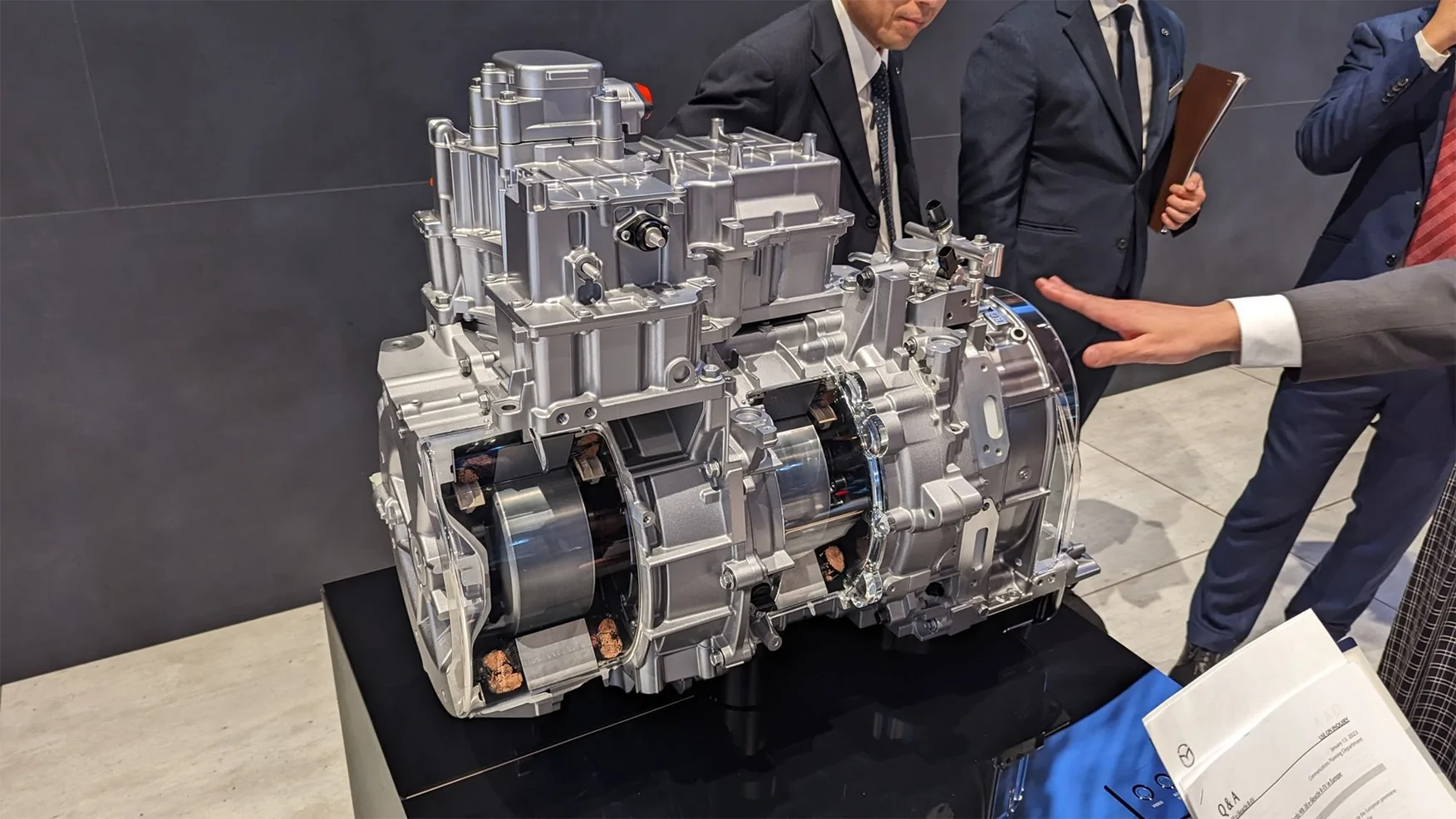
Mazda and Ford are already have been and in bed with each other. Think Ford would be stupid (the CEO) if he went to reinvent a compact stand alone charge unit already proven. The Mazda MX30 Hybrid has no mechanical link from the engine to axles it's a single rotor Rotary that operates at one optimum RPM for charge

Ford F-150 Lightning Lightning E-Rev 690 to 700 mile range 097-mazda-mx-30-r-ev-power-unit-including-rotary-engine-3810049558
 

Rayden

Well-known member
Joined
Aug 11, 2025
Threads
7
Messages
124
Reaction score
128
Vehicles
'23 Lightning Lariat ER
They just feel... broken when you drive an ICE at this point.
Yes, when I drive my wife's Buick Enclave, I get frustrated with how slow and unresponsive it seems. When I drive my Mitsubishi Fuso box truck, it feels like I'm riding a giant tortoise.
 

Randys Lightning

Well-known member
First Name
Randy
Joined
Feb 8, 2025
Threads
3
Messages
59
Reaction score
57
Vehicles
24 Lightning, 20, Road Glide, 23 Kaw H2 SX SE, 24 Yamaha FX HO Waverunner, +
Occupation
Ret. US Army Nuclear Artillery and Ret. P&G Mechanical Engineer
There is new Battery Tech being developed for high energy, fast charge/discharge out there Li ion was just a stepping stone tech. One of the new techs is Capacitor Tech, Carbon Nanotubes stores it's charge Isolated from charge regions (look on-line) My 20 year old Citizen Eco-Drive watch doesn't have a battery, it has a capacitor, same one over 20 years. Ford should work on battery Tech as they already built the Near Perfect, Our, EV Truck. https://www.sciencedirect.com/science/article/abs/pii/S2352492824004975 https://pubs.acs.org/doi/10.1021/acsanm.1c04236?goto=supporting-info
 

Altivec

Well-known member
Joined
Nov 5, 2024
Threads
1
Messages
311
Reaction score
647
Vehicles
2023 Lightning Platinum, 2014 Cadillac ELR
Gas stations do not need an actual pipeline direct from the refinery in order to keep them supplied with energy. Replace a row of gas pumps with 1-2 MEGAWATT! chargers, and the station does need a "pipeline of copper" directly to it. That will be obscenely expensive to do in even a small percentage of locations where gas is currently available. If you think that's going to happen any time soon then somebody here is clearly in "Magic and Dream land."

You must be joking. "Magic Batteries" have been talked about among the EV crowd for as long as EVs have existed. It's one of the most common subjects on any EV board.

EREVs? Gas truck owners generally have never heard the term, don't know that they are or don't care. And as this very thread (and others on this board) illustrates so definitively, most BEV truck owners despise the very idea of them with a passion. Not the actual trucks based upon actual performance (because they don't exist yet), but the very idea that they might exist someday.

I agree with you there. That EREV will certainly work much better than your Trabant, but it's bad enough for me to cross it off my list. It really looks like it was a complete afterthought thrown out there at the last minute. If they change their minds, put a decent sized engine under the hood (so tow rating doesn't need to be cut in half) it would be back on my list. It looks like a fantastic truck otherwise.

Remember, they aren't using Trabant-sized 16.5 kWh battery. A 92 kWh battery (in the case of the RAM) in an EREV will be less "taxed" than a 98 kWh battery in a BEV (by a long way for some use cases). Also consider never charging it to 100% (because you really don't need to), never draining it to below 17% (because you really don't need to).... And on really long trips/hard long distance towing, it's mostly just along for the ride. Battery life with any vehicle that has one is a concern, but given the above conditions of operation, there's no reason it shouldn't fair pretty well compared with batteries modestly larger in a BEV. Exact details will take real data and vary from owner to owner so bold proclamations one way or the other are silly speculation at this point.

The Ram (we don't know what Ford will use yet) at least, is not using a lawn mower engine like your Trabant. The specs for the RAM have been out there for a long time now. If it's so important to you to argue how terrible it will be, maybe spending a few minutes and looking at them may be in order?

Again, look at the specs. It will be able to put a net positive into the battery almost all of the time. Have you ever looked at your average power consumption of a towing trip? Up a mountain pass? Do you think maybe, just maybe, using actual data to form an opinion might ever be wise?

Of course you haven't. You have "decided" these powertrains will suck based upon your emotions, your feelings.

I, on the other hand, didn't become so optimistic that these powertrains could be really good, until Ram release the specs on theirs. I then ran the numbers using actual data and it looked really, really good.

EVs are a candy store for Engineers--they provide so much data for us to geek out over. It's really fun! Lots of towing tests are done online providing lots of data. Often, if you can do some math, you can extract the data you need from what is given. Some pertinent examples:

While lots of people have done them, the guys at TFL have done gobs of towing tests on EVs that often provide good data.

Of all their EV towing tests with a large profile trailer at highway speeds, the highest average power consumption I found was just under 80 kW. The Ram generator can produce 130 kW steady state, all day long. That means in those specific tests, the generator would have been able to maintain the SOC of the battery with a whopping 60+% margin of safety.

If you extrapolate a larger trailer, big headwind, higher speeds, etc, you will eat into that and at some point you can hit a limit where power consumption exceeds 130 kW. Is that something that any user will ever experience? With a headwind that big is anybody going to try to keep going that fast?

Those are the questions that need to be answered. Contrary to popular belief, this is the type of case that will be the proof test for an EREV (not hills/mountains). A headwind can last all day long, mountain passes are quite short in comparison, and then you regen down the other side. A high load from wind/aero that lasts for hours is the case that will stress the generator the most.

But from the initial math, it looks like it will be a very strong performer for 99.9% (estimated ;)) of towing situations a 1/2 ton will ever run into. If you can find any tests that document higher average power use, please do post them up as they would be great info!

So now let's consider mountain passes. We have some good data points from TFL in that regard as well. They towed a specific 9K trailer up the Ike with several EVs.

The Lightning used an average of 180.75 kW on the way up, burning 24.1 kWh of the battery. The Ram's generator is capable of 202 kW max power. So if it held that for 8 minutes, it could pass that test without losing any battery SOC at all. It will be a calibration choice, but I'm guessing they wouldn't even bother running the generator in "max power" mode unless the battery SOC gets dangerously low (because it would be a bit obnoxious), which shouldn't happen if you're using tow/haul mode.

With the generator only running at its quiet, lazy 130 kW, you'd be consuming 50.75 kW from the battery on the way up and burn 6.77 kWh from it. The Lightning gained 8 kWh regening down the hill...so think about that for a few seconds and it becomes quite clear the Ram should be able to go up and down mountains like that all day long fairly easily.

I didn't jump to any conclusions based upon my emotions. I used real world towing data to determine what was required from a truck to do a thing. With Rams specs published, I was able to compare those specs to what was required for the task.

I came to the conclusion these powertrains have the potential to be very good at doing "truck things." And with the obvious benefits/savings for daily use, they're pretty compelling option.

If you want links to specific videos and for me to show you how to do the math, I'd be happy to provide it.

OK, let's deal with "all that extra weight...."

Ford's 131 kWh battery weighs about 1800 lbs. The battery for the RAM weighs about 1200 lbs, so you're starting with a 600 lb battery advantage. My educated estimate (with a Sandy Munro assist) is the genset and all the crap that goes with it will run about 800 lbs. So, you're at a whopping 200 lbs weight increase due to the different powertrain.

That's going to have any noticable affect on efficiency, handling, the BEV experience? Really? I think you're exaggerating a bit.

Compared with the best towing BEV, that thing has a battery that weighs about 2800 lbs. So now the EREV weighs 800 lbs less.... But hauling that around every day isn't a problem, because we all know a pound of battery weighs much less than a pound of that icky ICE stuff.... ;)

When Ford comes out with specs for theirs, we can re-do all the math above where specs differ significantly.
I think you are misunderstanding what I am saying. I never said that a decent EREV is not possible to build. Notice that I said the Scout is going to be garbage but I never said anything about the RAM. For me the verdict is still out on whether or not the RAM will be 'decent'. Yes the specs are all there but until real world testing and data come out, it's just vaporware to me.

What makes an EREV 'decent' is based on the size of the battery and the size of the engine. The bigger you go in those areas, the more of a chance it has to overcome EREV’s shortfalls and make it useable (Scout’s EREV will not). The problem is, the bigger you go with those things the more the weight and the price goes up. Did Ram get the mix right. Maybe. Them starting off with a battery almost the size of the standard range Lightning is nice, and also adding a decent V6 is also nice. So you are right, the data to make it useable is there. Where my math isn't mathing is how is this supposed to be cheaper than a lightning. It can’t be cheaper to build than a standard range lightning because it essentially has everything, including the battery size. So at the very minimum, this will be in the Extended range lightning price range. So If you want to call that cheap... great. But I don't see the masses calling that cheap and choosing an EREV because it’s a great bargain compared to other offerings. In other words, EREV’s will be something that customers will have to be knowledgeable about and want to pay extra for even though you said the average person hasn’t even heard of EREV, which I agree.

So let's say RAM gets this formula right and it's a 'decent' EREV. Decent means it works and does what it's supposed to do. You can use your truck as an EV (to save money) when you stick around town and you can use your truck like an ICE truck when you go on long trips. Great…. I think you would agree, that if you don't plan on doing both of those things, there is no point in getting an EREV. Right? So if this is true, then both EV driving and ICE driving are important to the buyer. So lets break this down.

From your posts, you seem to be very knowledgeable in physics so I am hoping you also agree that the more mass you have, the more energy that is required to move it. Nothing new here. so let's start with when you want to use your EREV as an ICE truck. Its competition in this mode is a regular ICE truck with a V6. Which one is going to be more efficient? The one with just the V6 or the one that has a V6 but also needs to haul around a 1200lb battery. I am sure you would agree, the V6 ICE truck is going to be more efficient and handle better due to less weight.

Now let's switch over to EV mode. You did all these calculations on weight... sure sure, even though you didn't add in a fuel tank c/w fuel, exhaust, engine cooling, inverters, etc. Lets go with this EREV being the same weight as an extended range lightning but with a battery that is even smaller than the standard range. Since the ER Lightning and EREV weigh the same and are priced the same, that will be its competition. Which of these trucks are going to have a better EV experience. Clearly you agree that the EREV is going to have significantly less range, efficiency, PAK level performance because it weighs the same but has a much smaller battery.

So although you claim I am making my decisions based on emotion, I am not. It’s based on logic, science and experience. I didn’t even go into the maintenance side of things. I have no doubt that a ā€˜decent’ EREV is possible to build but my point is why would anyone want one. An EREV provides a worse experience against their ICE and BEV counterparts when in those modes. You are paying high end top dollar to get a ā€˜decent’ truck that has a worse experience no matter how you drive it. Again. For what reason…To save a few dollars for the few times you use it as an EV in town but then give all the savings back in maintenance. If my use case requires me to drive/tow long distances, I am going with an ICE truck that is cheaper to begin with, more efficient and not needing to deal with any of this nonsense. If my use case is driving under 150miles per day 99% of the time, like mine is, I am going to enjoy the benefits of a more efficient BEV with a frunk and never deal with gas and maintenance. There maybe some niche circumstances where an EREV may make sense but for the majority of people it makes no sense. Once reviews start coming out showing how it’s the worst of both worlds, EREV’s will become a blip/fad in automotive history.
Sponsored


Top