

Sponsored

Possible radiator leak?

chl

Well-known member
First Name
CHRIS
Joined
Dec 16, 2022
Threads
9
Messages
3,652
Reaction score
2,250
Location
alexandria virginia
Vehicles
2023 LIGHTNING PRO, 2012 Nissan Leaf, 2015 Toyota Prius, 2000 HD 883 Sportster
Occupation
Patent Atty / Electrical Engineer
Took my truck in yesterday for the recall, the oily stain on my condenser, and I asked about the three year brake fluid change. I got the truck back today with the following.

26SB6 Lightbar recall: The truck passed the lightbar recall inspection and Ford approved the pictures. So recall complete for me and no parts needed.

Oily stain on a:c condenser viewed through louvers. Truck is out of warranty so paid $200 for an A/C diagnostic to check on the greasy looking condenser stain. See my post on this stain.

https://www.f150lightningforum.com/forum/threads/possible-radiator-leak.36407/

No leaks found. They pulled all the Freon from both systems (max tow package) and found no decrease in specified levels. They cleaned the stain for me and I guess I’ll just monitor cabin, battery, and motor cooling.

They seemed unaware of the 3 year brake fluid change recommended in the owners manual. Service advisor said they generally recommend fluid changes at the 5 year point. Pretty dry climate here in Arizona so I’ll kick that can down the road to 4-5 years.
My understanding of the heating and cooling systems in my 2023 F-150 Lightning - some later years have a heat pump, mine does not...

The max tow package does NOT use Freon to cool the motor or battery - it uses the --a refrigerant to cool-- the same Motocraft P-OAT Coolant as --is done in-- the systems without the max tow package. The battery and motor coolant loop (an additional loop = two loops with the max tow package) are separate from the HVAC A/C system --but a control valve can loop some of the refrigerant through a chiller to cool the P-OAT that cools the motor and battery--.

"Freon" is not used for the HVAC A/C system it uses "R-1234yf an eco-friendly and highly efficient refrigerant" which is different from Freon and does not punch a hole in the Ozone layer of the earth the way Freon did. It does not contain Chlorine and breaks does within 11 days in the atmosphere on average, so they tell me. It has an Ozone Depletion Potential 9ODP) of zero.

To warm the cabin, the resistive heater (PTC - Positive Temperature Coefficient heater) heats the P-OAT liquid which is circulated through a heat exchanger behind the dash and air is blown over that to warm the cabin. The PTC is also responsible for warming the battery. Diverter valves change to flow of the liquid depending on how it is needed.

Anyway, that's my understanding.

It seems the Ford mechanics are misstating what they did if they said they pulled Freon from the max tow system.

{EDITED to correct my mistake about the cooling}
Sponsored

 
Last edited:
K6CCC

Well-known member
First Name
Jim
Joined
Sep 12, 2024
Threads
31
Messages
1,174
Reaction score
1,262
Location
Glendora, Calif.
Vehicles
2024 Lightning Flash ER in Antimatter Blue w/9.6 PPO , 2017 Corolla (wife's car)
Occupation
Retired from 2-Way radio systems
It seems the Ford mechanics are misstating what they did if they said they pulled Freon from the max tow system.
My guess is that the use of the term Freon is old memory usage. People will be calling AC refrigerant "Freon" for the next few decades.

And yes, my understanding of the system matches what you said.
 

chl

Well-known member
First Name
CHRIS
Joined
Dec 16, 2022
Threads
9
Messages
3,652
Reaction score
2,250
Location
alexandria virginia
Vehicles
2023 LIGHTNING PRO, 2012 Nissan Leaf, 2015 Toyota Prius, 2000 HD 883 Sportster
Occupation
Patent Atty / Electrical Engineer
My guess is that the use of the term Freon is old memory usage. People will be calling AC refrigerant "Freon" for the next few decades.

And yes, my understanding of the system matches what you said.
Yes old habits die hard...
Glad I got the system right. ⚽ ⚽ ⚽ ⚽
 
Last edited:

TaxmanHog

Moderator
Moderator
First Name
Noel
Joined
Jan 19, 2022
Threads
235
Messages
16,666
Reaction score
18,850
Location
SE. Mass.
Vehicles
2022 Lightning Lariat-ER & 2024 HD Road Glide CVO-ST
Occupation
Retired
Anyway, that's my understanding.

It seems the Ford mechanics are misstating what they did if they said they pulled Freon from the max tow system.
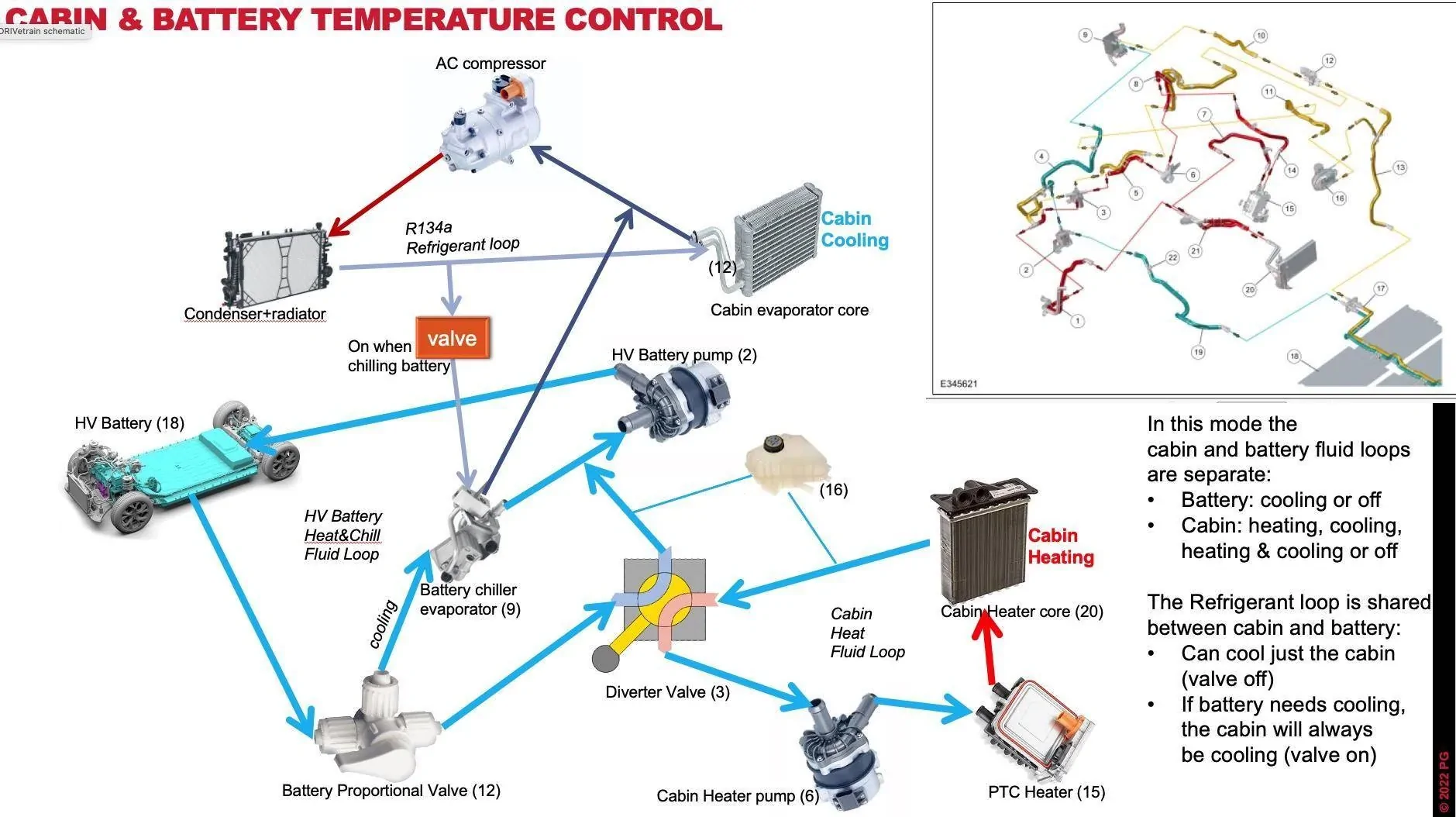
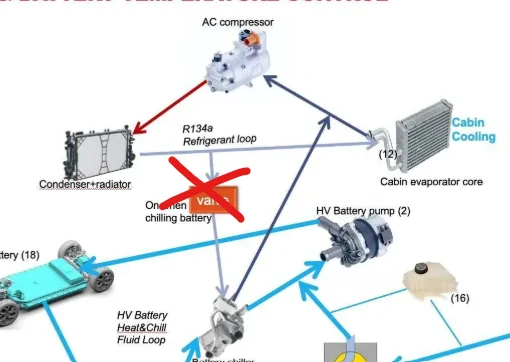
There IS a 'freon" based HEAT EXCHANGER to cool down the glycol based coolant.

Yes, Glycol circulates in the HVB and drive motors.

The drive motors have an OIL to GLYCOL exchanger as well, moving the motor heat to the battery pack in winter and further up the coolant conversion process to the freon based heat exchanger to boost heat extraction when the GLYCOL radiator can't cut the mustard.

Item #9

Ford F-150 Lightning Possible radiator leak? 1781322032035-hx


Ford F-150 Lightning Possible radiator leak? 1781321985902-5k
 
  • Like
Reactions: chl
OP
OP
NAVEWO

NAVEWO

Well-known member
Joined
Jun 19, 2024
Threads
2
Messages
64
Reaction score
76
Location
Tucson, Arizona
Vehicles
2023 Ford F150 Lightning Lariat ER Max Tow
Occupation
Retired USAF Navigator/Electronic Warfare Officer
My apologies for use of the term "Freon" in the context of my post. When I first dropped off the truck...my service advisor had the service manager come out and look at the "stain". I distinctly recall him saying he could not smell "freon". So I suppose that stuck in my head and I should have used the term "refrigerant" as we were clearly looking at the two condensers to the best of my knowledge through the louvers.

Here is what the service ticket said:
"Customer states sees possible leak on condenser through front lower grill. Verified fluid type stain on condenser, checked ssm's and tsb's, none related to customer concern, hooked up a/c machine to inspect pressures system was not low, vacuumed and recharged both systems to spec, added dye to both systems, performed black light inspection on system, no leaks found at this time, retested system operation, good, system operating normal at this time."

Possibly related???
In August 2024, I took the truck in after a road trip to Phoenix in summer heat and was concerned to see the battery temperature was very high...within the "normal" range but almost touching the upper limit. Here is what that service ticket said:
"Coolant system low, HV battery refrigerant system 2 oz low. High ambient temperatures. Unable to duplicate concern upon arrival. No DTC's present, no TSB's/SSM's apply at this time. Noted coolant level below min level. Filled coolant bottle to max spec. Inspected for leaks, no visible leaks found at this time. R+I 12V battery access cover. Found oil present on HV battery refrigerant system service port caps. Monitored PCM ACRP_B Press PID. PID reading 125 PSI, manifold gauge reading 100 psi, Recovered 0.276 kg R1234YF. R+I frunk trim and stowage bin. Found oil present on 2nd HV battery refrigerant system service port cap. Replaced HV battery refrigerant system low side and both high side service port schroeder valves. Vacuumed and charged refrigerant system with 0.312 kg R1234YF, static pressure 105 psi ambient temperature 85 degrees F. "

I'm not sure there is a path from these previously repaired leaks found in August 2024 down to the condensers where I first saw the "stain" in April of 2026. Maybe the "stain" was from those earlier leaks and I just never noticed. I do not regularly get down on my knees to look through the louvers so that stain could have been there since 2024 maybe??? Now, I do a visual inspection through the louvers and have purchased and installed a Grill Guard. It has not been long but so far, no trace of the stain has reappeared.

Other than the "stain" I've had no trouble with either cabin a/c or battery/motor temps via gauges. Even in high 100 plus temperatures they never seem to rise much past 1/4 way above "normal" and I can usually bring the gauge back down by driving for awhile in either Sport or Tow Haul mode.

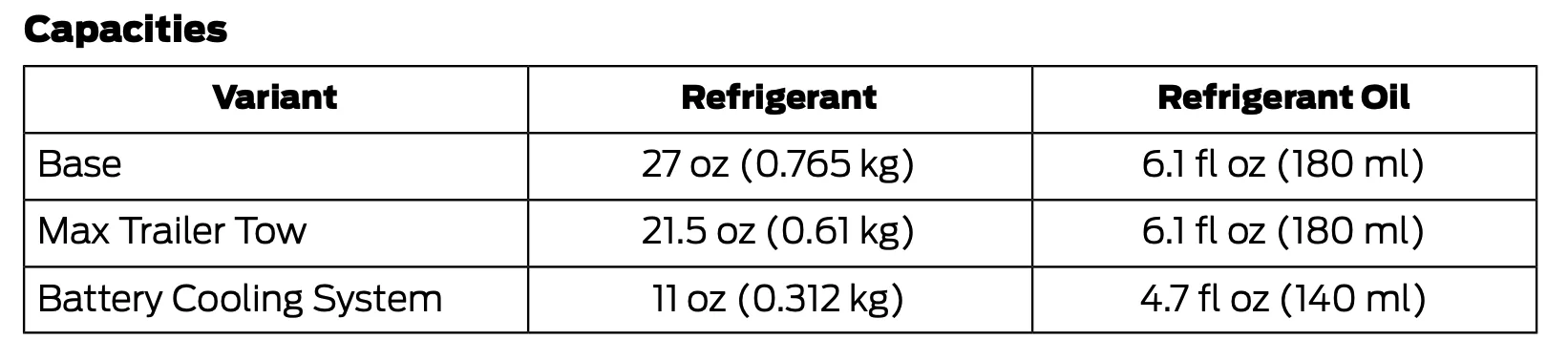
These are the "refrigerant" capacities listed in the 2023 Owner's Manual. Maybe someone can enlighten me...trucks with max tow would get the 21.5 oz of refrigerant plus 6.1 oz of oil in addition to the BASE 27 oz of refrigerant plus 6.1 oz oil for the "cabin" system. So does that mean a total of 48.5 oz of refrigerant and 12.2 oz of oil. What is the additional 11 oz of refrigerant and 4.7 oz of oil listed as Battery Cooling System for??? Just curious...I do not have the equipment or skill to touch any of these systems.

Ford F-150 Lightning Possible radiator leak? Screenshot 2026-06-12 at 8.33.22 PM
 

Sponsored

chl

Well-known member
First Name
CHRIS
Joined
Dec 16, 2022
Threads
9
Messages
3,652
Reaction score
2,250
Location
alexandria virginia
Vehicles
2023 LIGHTNING PRO, 2012 Nissan Leaf, 2015 Toyota Prius, 2000 HD 883 Sportster
Occupation
Patent Atty / Electrical Engineer
There IS a 'freon" based HEAT EXCHANGER to cool down the glycol based coolant.

Yes, Glycol circulates in the HVB and drive motors.

The drive motors have an OIL to GLYCOL exchanger as well, moving the motor heat to the battery pack in winter and further up the coolant conversion process to the freon based heat exchanger to boost heat extraction when the GLYCOL radiator can't cut the mustard.

Item #9

1781322032035-hx.webp


1781321985902-5k.webp
Aha, interesting.
I see now, the refrigerant R-1234yf (Freon substitute) can be used to cool the P-OAT liquid cooling the battery by passing through that item 9 "battery chiller evaporator" controlled by the box labelled 'valve."
I missed that, so I was wrong - the refrigerant IS used to help cool the motor and battery.
My bad.
 

chl

Well-known member
First Name
CHRIS
Joined
Dec 16, 2022
Threads
9
Messages
3,652
Reaction score
2,250
Location
alexandria virginia
Vehicles
2023 LIGHTNING PRO, 2012 Nissan Leaf, 2015 Toyota Prius, 2000 HD 883 Sportster
Occupation
Patent Atty / Electrical Engineer
My apologies for use of the term "Freon" in the context of my post. When I first dropped off the truck...my service advisor had the service manager come out and look at the "stain". I distinctly recall him saying he could not smell "freon". So I suppose that stuck in my head and I should have used the term "refrigerant" as we were clearly looking at the two condensers to the best of my knowledge through the louvers.

Here is what the service ticket said:
"Customer states sees possible leak on condenser through front lower grill. Verified fluid type stain on condenser, checked ssm's and tsb's, none related to customer concern, hooked up a/c machine to inspect pressures system was not low, vacuumed and recharged both systems to spec, added dye to both systems, performed black light inspection on system, no leaks found at this time, retested system operation, good, system operating normal at this time."

Possibly related???
In August 2024, I took the truck in after a road trip to Phoenix in summer heat and was concerned to see the battery temperature was very high...within the "normal" range but almost touching the upper limit. Here is what that service ticket said:
"Coolant system low, HV battery refrigerant system 2 oz low. High ambient temperatures. Unable to duplicate concern upon arrival. No DTC's present, no TSB's/SSM's apply at this time. Noted coolant level below min level. Filled coolant bottle to max spec. Inspected for leaks, no visible leaks found at this time. R+I 12V battery access cover. Found oil present on HV battery refrigerant system service port caps. Monitored PCM ACRP_B Press PID. PID reading 125 PSI, manifold gauge reading 100 psi, Recovered 0.276 kg R1234YF. R+I frunk trim and stowage bin. Found oil present on 2nd HV battery refrigerant system service port cap. Replaced HV battery refrigerant system low side and both high side service port schroeder valves. Vacuumed and charged refrigerant system with 0.312 kg R1234YF, static pressure 105 psi ambient temperature 85 degrees F. "

I'm not sure there is a path from these previously repaired leaks found in August 2024 down to the condensers where I first saw the "stain" in April of 2026. Maybe the "stain" was from those earlier leaks and I just never noticed. I do not regularly get down on my knees to look through the louvers so that stain could have been there since 2024 maybe??? Now, I do a visual inspection through the louvers and have purchased and installed a Grill Guard. It has not been long but so far, no trace of the stain has reappeared.

Other than the "stain" I've had no trouble with either cabin a/c or battery/motor temps via gauges. Even in high 100 plus temperatures they never seem to rise much past 1/4 way above "normal" and I can usually bring the gauge back down by driving for awhile in either Sport or Tow Haul mode.

These are the "refrigerant" capacities listed in the 2023 Owner's Manual. Maybe someone can enlighten me...trucks with max tow would get the 21.5 oz of refrigerant plus 6.1 oz of oil in addition to the BASE 27 oz of refrigerant plus 6.1 oz oil for the "cabin" system. So does that mean a total of 48.5 oz of refrigerant and 12.2 oz of oil. What is the additional 11 oz of refrigerant and 4.7 oz of oil listed as Battery Cooling System for??? Just curious...I do not have the equipment or skill to touch any of these systems.

Screenshot 2026-06-12 at 8.33.22 PM.webp
Yea, maybe the stains were there from before, but always good to watch for leaks.
There have been a few reports of what smelled like 'Freon" when trying to us the A/C cooling.
I had an intermittent smell like that with no cooling one extremely hot day after parking in the open sun on an asphalt parking lot with the truck off the first summer I had the truck.

Now I keep the truck on with A/C running in the summer when I park in the sun at a shopping center for example, to keep everything cool, battery and cabin.
 

TaxmanHog

Moderator
Moderator
First Name
Noel
Joined
Jan 19, 2022
Threads
235
Messages
16,666
Reaction score
18,850
Location
SE. Mass.
Vehicles
2022 Lightning Lariat-ER & 2024 HD Road Glide CVO-ST
Occupation
Retired
I was going to ask if anyone knows how the whole heating/cooling system works on a max tow and now I regret that thought. 😳
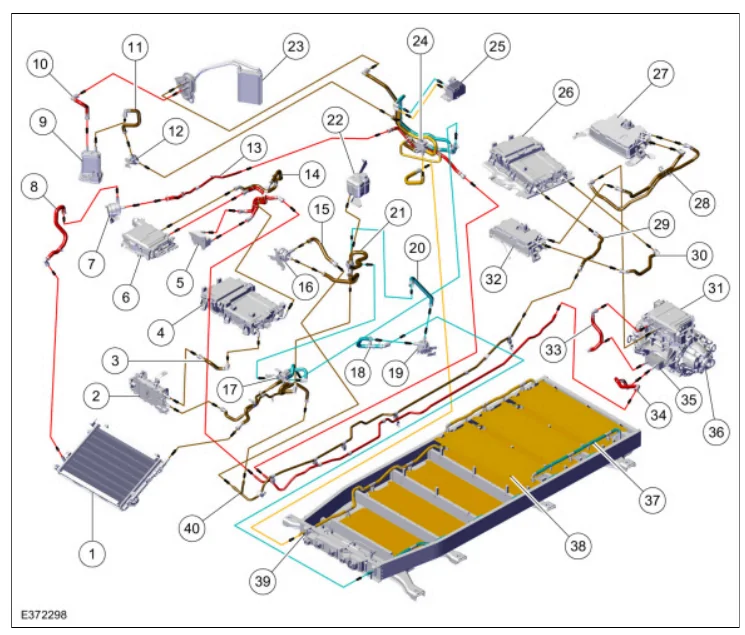
We don't have exact diagrams of the Max Tow system.

The first graphic I pasted above is actually from a MME, we speculate that Lightnings without max tow are designed in the same fashion.

What would be distinct on MAX tow trucks is a second AC compressor which is directly connected to the chiller {#9} with no diversion piping between the primary AC compressor which would then have the sole task of cooling the cabin.

Ford F-150 Lightning Possible radiator leak? 1781365180799-ml
 

chl

Well-known member
First Name
CHRIS
Joined
Dec 16, 2022
Threads
9
Messages
3,652
Reaction score
2,250
Location
alexandria virginia
Vehicles
2023 LIGHTNING PRO, 2012 Nissan Leaf, 2015 Toyota Prius, 2000 HD 883 Sportster
Occupation
Patent Atty / Electrical Engineer
We don't have exact diagrams of the Max Tow system.

The first graphic I pasted above is actually from a MME, we speculate that Lightnings without max tow are designed in the same fashion.

What would be distinct on MAX tow trucks is a second AC compressor which is directly connected to the chiller {#9} with no diversion piping between the primary AC compressor which would then have the sole task of cooling the cabin.

1781365180799-ml.webp
That's where my confusion came from...
I've read this but never found a diagram of the whole shebang:

"Upgraded Cooling System: Adds a secondary battery cooling loop, high-capacity radiator, and specialized cooling lines to the battery pack. This prevents battery thermal throttling under heavy, sustained loads..."

Maybe a parts supply site or a service manual would have an image - just haven't located one yet...a lot of images to sort out, just haven't had the time...

https://www.google.com/search?sca_e...2ahUKEwiYxsS97YSVAxU-MlkFHYaVPT4QuIIBegQIOxAA
Sponsored


Top