there's no way to know without trying it... it's mostly the weight, though...
also, on a similar 'MODE' question, as to range impact... over the long-term, no 'mode' is going to necessarily give or take more 'range'... the laws of physics are going to bring them all to almost the same exact number, over the miles... it's more about your personal preference, and what amount of REGEN you like most...
Thanks.
I wonder if they make something that attaches between the rear of the truck and the front of the trailer to make the whole rig basically one object moving through the airstream. Something stretchy and yet able to deflect air?
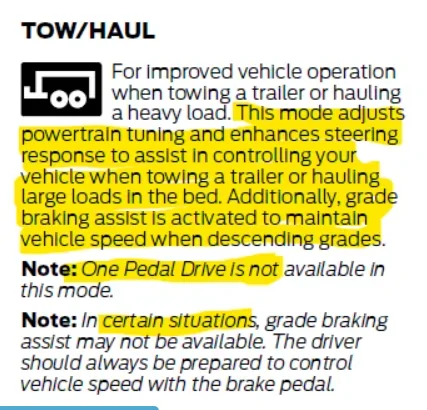
I agree with Taxman Hog. You should tow in the tow mode. The braking system is enhanced, the cooling system is enhanced if you have the max tow package, the trailer brake controller will not work in normal mode, hill decent control is active if you have max tow, the motor is optimized in tow mode to tow appropriately, and steering is optimized.
It's not worth reducing your safety or the safety of others to increase your range by a few percent, if any.
I do not think it's mostly the weight. I think it's mostly the air resistance, which varies with the shape and also increases with speed. I'm sure towed weight has some effect, certainly on acceleration, but imho that is not the major effect overall.
I do not think it's mostly the weight. I think it's mostly the air resistance, which varies with the shape and also increases with speed. I'm sure towed weight has some effect, certainly on acceleration, but imho that is not the major effect overall.
I agree with you that weight is not a significant factor and I may have the best real world test possible.
I towed my 4000# 19' travel trailer 800 miles from Pittsburgh to Birmingham, AL to trade it for a new 5800# 27' trailer.
I drove the exact route both ways in similar temperatures over six day.
On the way down I averaged 1.2 mi/kWh on the way back 1.1
At first glance you might say the weight difference caused that small reduction in range. Perhaps. But more telling is that my new camper is 1' wider and 1' taller making for a 10% larger front surface area.
I may do a separate write up on the trip but I will say the charging infrastructure has improved by leaps and bound since I got the truck three years ago. I70 to Cincinnati and I 65 south to Birmingham has chargers at least every 80 miles with a decent number being Pilot/Flying J with pull throughs.
I agree with you that weight is not a significant factor and I may have the best real world test possible.
I towed my 4000# 19' travel trailer 800 miles from Pittsburgh to Birmingham, AL to trade it for a new 5800# 27' trailer.
I drove the exact route both ways in similar temperatures over six day.
On the way down I averaged 1.2 mi/kWh on the way back 1.1
At first glance you might say the weight difference caused that small reduction in range. Perhaps. But more telling is that my new camper is 1' wider and 1' taller making for a 10% larger front surface area.
I may do a separate write up on the trip but I will say the charging infrastructure has improved by leaps and bound since I got the truck three years ago. I70 to Cincinnati and I 65 south to Birmingham has chargers at least every 80 miles with a decent number being Pilot/Flying J with pull throughs.