

Sponsored
Charging While Driving w/ Gas Generator in Bed (Range Extender for F-150 Lightning) - Testing

WXman
Well-known member
- Joined
- Aug 16, 2025
- Threads
- 21
- Messages
- 485
- Reaction score
- 566
- Location
- Central Kentucky
- Vehicles
- 2025 F-150 Lightning Flash
- Occupation
- Meteorology/Transportation
For some of us, sitting at a charger for 45 minutes every 80 miles defeats the purpose of having a truck.Another option for the poll should be:
-I don't want this, it takes up cargo capacity and defeats the purpose of having a truck.
Seeing as how a MAJORITY of electricity comes from dinosaur juice, I suggest you sell your truck and purchase a bicycle.How about the simple one? "I'm not interested in burning dinosaur juice"
Yep, range extending is the future in my opinion, and Ford/Ram already had plans in the works 3 or 4 years ago.Lastly, there are multiple tale-tale signs that Ford already planned this. I just figured out how to enable it.
Yes, when on a trip down the interstate, 30 miles can literally be the difference between walking and having a successful trip to the campsite.30 to 50 extra miles could make all the difference sometimes. I love thr idea of having a range extender. I'd probably use a large LFP battery pack in the bed or trailer I'm pulling and a pure-sine-inverter to make the 240V connection.
I'm eager to see this project unfold. I'm already shopping 50 amp 240 volt generators so I can charge my truck to full while I sleep at the camp sites. Being able to extend the distance between charge stations would be a sweet addition.
PJnc284
Well-known member
- Joined
- Sep 30, 2024
- Threads
- 0
- Messages
- 1,238
- Reaction score
- 1,407
- Location
- Garner, NC
- Vehicles
- 2023 Ford F150 Lightning Lariat ER
Not sure it's going to make a huge difference since the rate of discharge is still much faster than any level 2 charger. Unless I'm misunderstanding, Zach added about 18.92kWh in a little over 2 hours which took 3 gallons of gas in the most recent video. So each hour, that's adding about 8.6kWh while the truck is using 35-40 @70mph. From 100%, that buys you an extra hour of driving (4 hrs with ER and 3 with SR) with a bit more gas or about 30minutes from 80% for subsequent charges. Obviously, that's assuming everything is absolutely perfect. Cold temps, elevation changes, speed and towing would all negatively impact the range as usual.For some of us, sitting at a charger for 45 minutes every 80 miles defeats the purpose of having a truck.
I'd still like to see a real world test. SR v SR with Generator v ER over 500 and 1000 miles. Bonus points if out of spec is involved and we get 8 hours of video.

ElectrifyingMe25
Well-known member
I'm like many on this forum, we are all looking forward to the availability of the CWD feature.Not sure it's going to make a huge difference since the rate of discharge is still much faster than any level 2 charger. Unless I'm misunderstanding, Zach added about 18.92kWh in a little over 2 hours which took 3 gallons of gas in the most recent video. So each hour, that's adding about 8.6kWh while the truck is using 35-40 @70mph. From 100%, that buys you an extra hour of driving (4 hrs with ER and 3 with SR) with a bit more gas or about 30minutes from 80% for subsequent charges. Obviously, that's assuming everything is absolutely perfect. Cold temps, elevation changes, speed and towing would all negatively impact the range as usual.
I'd still like to see a real world test. SR v SR with Generator v ER over 500 and 1000 miles. Bonus points if out of spec is involved and we get 8 hours of video.
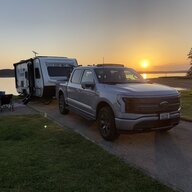
Thank God for ambitious electrical engineers.
MidAtlanticLightningClub
Well-known member
Since you are so knowledgeable about this, please tell me where I am supposed to be pouring dinosaur juice into my solar panels. I can't seem to find the port for that.Seeing as how a MAJORITY of electricity comes from dinosaur juice, I suggest you sell your truck and purchase a bicycle.

Sponsored

hturnerfamily
Well-known member
- First Name
- William
- Joined
- Jan 8, 2022
- Threads
- 50
- Messages
- 2,475
- Reaction score
- 3,214
- Location
- rural Georgia
- Vehicles
- 22 LIGHTNING PRO IcedBlueSilver 8/23/2022
- Occupation
- Owner
some thoughts:
For some of us, sitting at a charger for 45 minutes every 80 miles defeats the purpose of having a truck.
*** I think you're slightly 'overestimating' the facts, when most of us never do this***
Seeing as how a MAJORITY of electricity comes from dinosaur juice, I suggest you sell your truck and purchase a bicycle.
*** well, if you're referring to 'coal', some generation certainly uses that 'juice', although rocks in the earth are hardly 'juice'. We could go back to using it just to provide some semblance of heat in our homes, but...
Natural gas, another 'major' source, comes directly out of the ground, under pressure, and wanting to be used. I suppose that would be dino 'burps', maybe, or 'gas'. : )
Uranium-235 is the most common fuel, though other heavy elements like plutonium can also be used
I would doubt any dinos had anything much to do with Uranium-235 as the most common fuel for Nuclear power, though other heavy elements like plutonium can also be used...
Water and Geothermal are great for a few areas, and wind and solar, are, well, somewhat sketchy for 'constant' power generation... and likely nothing to do with dinos.***
Yep, range extending is the future in my opinion, and Ford/Ram already had plans in the works 3 or 4 years ago.
*** Thinking of 'needing' a range extender is part of the psychological aspect when considering 'accepting' the premise of Electric Vehicles - you must 'change' your mindset and relax to the realities of how it works... but, yes, we are a nation of 'do it now, go now, and go ALL THE WAY now'... we have little patience, in the grand scheme of things.
If we had started with electric vehicles, well, maybe we did, we'd have a more 'accepting' view of trucks that can travel up to 300+ miles without stopping, or even 'only' 100 miles while towing things that early electric vehicle owners, like with the Baker Electric 'buggy', could not even have dreamed of.***
Yes, when on a trip down the interstate, 30 miles can literally be the difference between walking and having a successful trip to the campsite.
***while that 'sounds' logical, it is flawed. Just like having enough gas in the tank is a 'requirement' of well-meaning travelers, that, in itself, has proven to be not always a part of a drivers planning - the stranded gas or diesel vehicle on the side of the 'interstate' leads to the fact that planning is the primary factor, not 'lack of fuel', although the fuel, or the lack of it, is certainly the symptom.
Planning for long-range travel in an EV is primary. It will continue to be until the end of time, no matter how many new and improved DC Fast Charging and Level 2 Charging options are springing up along the way.
There will ALWAYS be someone who 'forgot' to do the one most important thing.
Report back here, though, the first time you ever see one.***
I'm eager to see this project unfold. I'm already shopping 50 amp 240 volt generators so I can charge my truck to full while I sleep at the camp sites. Being able to extend the distance between charge stations would be a sweet addition.
I would hope that no one would ever expose themselves, and their families and neighbors, to a loud constant-running high-output gas generator running for hours and hours and hours and hours and hours and hours on end. Most NO campgrounds or campsites would allow this, I hope.
This MIGHT could be acceptable WHILE the vehicle is traveling, especially on the interstates, etc., which seems to be the premise of the RAM REV, with front trunk engine generator, and other similar ideas, like the SCOUT Harvester rear-mounted engine generator.
ENJOY!
For some of us, sitting at a charger for 45 minutes every 80 miles defeats the purpose of having a truck.
*** I think you're slightly 'overestimating' the facts, when most of us never do this***
Seeing as how a MAJORITY of electricity comes from dinosaur juice, I suggest you sell your truck and purchase a bicycle.
*** well, if you're referring to 'coal', some generation certainly uses that 'juice', although rocks in the earth are hardly 'juice'. We could go back to using it just to provide some semblance of heat in our homes, but...
Natural gas, another 'major' source, comes directly out of the ground, under pressure, and wanting to be used. I suppose that would be dino 'burps', maybe, or 'gas'. : )
Uranium-235 is the most common fuel, though other heavy elements like plutonium can also be used
I would doubt any dinos had anything much to do with Uranium-235 as the most common fuel for Nuclear power, though other heavy elements like plutonium can also be used...
Water and Geothermal are great for a few areas, and wind and solar, are, well, somewhat sketchy for 'constant' power generation... and likely nothing to do with dinos.***
Yep, range extending is the future in my opinion, and Ford/Ram already had plans in the works 3 or 4 years ago.
*** Thinking of 'needing' a range extender is part of the psychological aspect when considering 'accepting' the premise of Electric Vehicles - you must 'change' your mindset and relax to the realities of how it works... but, yes, we are a nation of 'do it now, go now, and go ALL THE WAY now'... we have little patience, in the grand scheme of things.
If we had started with electric vehicles, well, maybe we did, we'd have a more 'accepting' view of trucks that can travel up to 300+ miles without stopping, or even 'only' 100 miles while towing things that early electric vehicle owners, like with the Baker Electric 'buggy', could not even have dreamed of.***
Yes, when on a trip down the interstate, 30 miles can literally be the difference between walking and having a successful trip to the campsite.
***while that 'sounds' logical, it is flawed. Just like having enough gas in the tank is a 'requirement' of well-meaning travelers, that, in itself, has proven to be not always a part of a drivers planning - the stranded gas or diesel vehicle on the side of the 'interstate' leads to the fact that planning is the primary factor, not 'lack of fuel', although the fuel, or the lack of it, is certainly the symptom.
Planning for long-range travel in an EV is primary. It will continue to be until the end of time, no matter how many new and improved DC Fast Charging and Level 2 Charging options are springing up along the way.
There will ALWAYS be someone who 'forgot' to do the one most important thing.
Report back here, though, the first time you ever see one.***
I'm eager to see this project unfold. I'm already shopping 50 amp 240 volt generators so I can charge my truck to full while I sleep at the camp sites. Being able to extend the distance between charge stations would be a sweet addition.
I would hope that no one would ever expose themselves, and their families and neighbors, to a loud constant-running high-output gas generator running for hours and hours and hours and hours and hours and hours on end. Most NO campgrounds or campsites would allow this, I hope.
This MIGHT could be acceptable WHILE the vehicle is traveling, especially on the interstates, etc., which seems to be the premise of the RAM REV, with front trunk engine generator, and other similar ideas, like the SCOUT Harvester rear-mounted engine generator.
ENJOY!
ElectrifyingMe25
Well-known member
some thoughts:
For some of us, sitting at a charger for 45 minutes every 80 miles defeats the purpose of having a truck.
*** I think you're slightly 'overestimating' the facts, when most of us never do this***
Seeing as how a MAJORITY of electricity comes from dinosaur juice, I suggest you sell your truck and purchase a bicycle.
*** well, if you're referring to 'coal', some generation certainly uses that 'juice', although rocks in the earth are hardly 'juice'. We could go back to using it just to provide some semblance of heat in our homes, but...
Natural gas, another 'major' source, comes directly out of the ground, under pressure, and wanting to be used. I suppose that would be dino 'burps', maybe, or 'gas'. : )
Uranium-235 is the most common fuel, though other heavy elements like plutonium can also be used
I would doubt any dinos had anything much to do with Uranium-235 as the most common fuel for Nuclear power, though other heavy elements like plutonium can also be used...
Water and Geothermal are great for a few areas, and wind and solar, are, well, somewhat sketchy for 'constant' power generation... and likely nothing to do with dinos.***
Yep, range extending is the future in my opinion, and Ford/Ram already had plans in the works 3 or 4 years ago.
*** Thinking of 'needing' a range extender is part of the psychological aspect when considering 'accepting' the premise of Electric Vehicles - you must 'change' your mindset and relax to the realities of how it works... but, yes, we are a nation of 'do it now, go now, and go ALL THE WAY now'... we have little patience, in the grand scheme of things.
If we had started with electric vehicles, well, maybe we did, we'd have a more 'accepting' view of trucks that can travel up to 300+ miles without stopping, or even 'only' 100 miles while towing things that early electric vehicle owners, like with the Baker Electric 'buggy', could not even have dreamed of.***
Yes, when on a trip down the interstate, 30 miles can literally be the difference between walking and having a successful trip to the campsite.
***while that 'sounds' logical, it is flawed. Just like having enough gas in the tank is a 'requirement' of well-meaning travelers, that, in itself, has proven to be not always a part of a drivers planning - the stranded gas or diesel vehicle on the side of the 'interstate' leads to the fact that planning is the primary factor, not 'lack of fuel', although the fuel, or the lack of it, is certainly the symptom.
Planning for long-range travel in an EV is primary. It will continue to be until the end of time, no matter how many new and improved DC Fast Charging and Level 2 Charging options are springing up along the way.
There will ALWAYS be someone who 'forgot' to do the one most important thing.
Report back here, though, the first time you ever see one.***
I'm eager to see this project unfold. I'm already shopping 50 amp 240 volt generators so I can charge my truck to full while I sleep at the camp sites. Being able to extend the distance between charge stations would be a sweet addition.
I would hope that no one would ever expose themselves, and their families and neighbors, to a loud constant-running high-output gas generator running for hours and hours and hours and hours and hours and hours on end. Most NO campgrounds or campsites would allow this, I hope.
This MIGHT could be acceptable WHILE the vehicle is traveling, especially on the interstates, etc., which seems to be the premise of the RAM REV, with front trunk engine generator, and other similar ideas, like the SCOUT Harvester rear-mounted engine generator.
ENJOY!
Here you go. Mercedes van using CWD. Enjoy.some thoughts:
For some of us, sitting at a charger for 45 minutes every 80 miles defeats the purpose of having a truck.
*** I think you're slightly 'overestimating' the facts, when most of us never do this***
Seeing as how a MAJORITY of electricity comes from dinosaur juice, I suggest you sell your truck and purchase a bicycle.
*** well, if you're referring to 'coal', some generation certainly uses that 'juice', although rocks in the earth are hardly 'juice'. We could go back to using it just to provide some semblance of heat in our homes, but...
Natural gas, another 'major' source, comes directly out of the ground, under pressure, and wanting to be used. I suppose that would be dino 'burps', maybe, or 'gas'. : )
Uranium-235 is the most common fuel, though other heavy elements like plutonium can also be used
I would doubt any dinos had anything much to do with Uranium-235 as the most common fuel for Nuclear power, though other heavy elements like plutonium can also be used...
Water and Geothermal are great for a few areas, and wind and solar, are, well, somewhat sketchy for 'constant' power generation... and likely nothing to do with dinos.***
Yep, range extending is the future in my opinion, and Ford/Ram already had plans in the works 3 or 4 years ago.
*** Thinking of 'needing' a range extender is part of the psychological aspect when considering 'accepting' the premise of Electric Vehicles - you must 'change' your mindset and relax to the realities of how it works... but, yes, we are a nation of 'do it now, go now, and go ALL THE WAY now'... we have little patience, in the grand scheme of things.
If we had started with electric vehicles, well, maybe we did, we'd have a more 'accepting' view of trucks that can travel up to 300+ miles without stopping, or even 'only' 100 miles while towing things that early electric vehicle owners, like with the Baker Electric 'buggy', could not even have dreamed of.***
Yes, when on a trip down the interstate, 30 miles can literally be the difference between walking and having a successful trip to the campsite.
***while that 'sounds' logical, it is flawed. Just like having enough gas in the tank is a 'requirement' of well-meaning travelers, that, in itself, has proven to be not always a part of a drivers planning - the stranded gas or diesel vehicle on the side of the 'interstate' leads to the fact that planning is the primary factor, not 'lack of fuel', although the fuel, or the lack of it, is certainly the symptom.
Planning for long-range travel in an EV is primary. It will continue to be until the end of time, no matter how many new and improved DC Fast Charging and Level 2 Charging options are springing up along the way.
There will ALWAYS be someone who 'forgot' to do the one most important thing.
Report back here, though, the first time you ever see one.***
I'm eager to see this project unfold. I'm already shopping 50 amp 240 volt generators so I can charge my truck to full while I sleep at the camp sites. Being able to extend the distance between charge stations would be a sweet addition.
I would hope that no one would ever expose themselves, and their families and neighbors, to a loud constant-running high-output gas generator running for hours and hours and hours and hours and hours and hours on end. Most NO campgrounds or campsites would allow this, I hope.
This MIGHT could be acceptable WHILE the vehicle is traveling, especially on the interstates, etc., which seems to be the premise of the RAM REV, with front trunk engine generator, and other similar ideas, like the SCOUT Harvester rear-mounted engine generator.
ENJOY!

NW Ontario Ford Lightning
Well-known member
- First Name
- Robert
- Joined
- Feb 14, 2025
- Threads
- 2
- Messages
- 621
- Reaction score
- 853
- Location
- NW Ontario Canada
- Vehicles
- 2024 F-150 SR Lightning XLT, 2023 Escape Hybrid
- Occupation
- Contractor
Utility electricity sources depend on where you live.
I live in a place with 100% utility electricity coming from a combination of hydro, bio-mass, wind and solar.
The last coal fired plant was shuttered in 2014.
I live in a place with 100% utility electricity coming from a combination of hydro, bio-mass, wind and solar.
The last coal fired plant was shuttered in 2014.

fhteagle
Well-known member
Very true.Utility electricity sources depend on where you live.
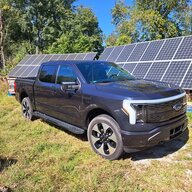
Here's the best source I know of to explore the generation mix in any particular place.
https://app.electricitymaps.com/map/72h/fifteen_minutes
Not perfect data by any stretch of the imagination, but it's the most legible format that I've seen.
Traconesu
Well-known member
- First Name
- Patrick
- Joined
- Aug 23, 2022
- Threads
- 4
- Messages
- 305
- Reaction score
- 188
- Location
- Quad cities, Illinois
- Vehicles
- Ford lightning platinum
- Occupation
- Retired
Why don't they people who like this idea just buy a hybrid electric. I'm sure it would be more efficient.I wouldn't want to drive 60 on the highway, I'd get ran over.
When I recalculate for 70MPH, I get a addition of 88 miles. Considering you'd have to stop for fuel now, as well as charge, it wouldn't be worth it to me. Also, you are still not in Silverado EV territory.
For me, for as much as I have zero love for Chevy, If I had a requirement of greater than 250 miles between DCFC stops, I'd just bite the bullet and get the Chevy.
Here is my math:
Typical driver is going to go from 80% to 15% during a road trip, so 65% battery consumption between charges.
65% of 131KWh is 85.5Kwh consumed between charges. I get about 2.1Mi/KWh when doing 70MPH. 85.15 KWh X 2.1 Mi/KWh is 178.8 miles of usable range between DCFC-ing. Our baseline.
Even though we are driving 70MPH, we are going to average closer to 65MPH when you consider 1 or 2 stops in between. That means it takes us (178.8/65) 2.75 hours to drive that distance.
Which means we are consuming 31KW/h. A 48A charge is going to deliver about 10KW, meaning it reduces the burden on the battery to 21KW/h.
85.15KWh usable between DCFC, used at a rate of 21Kw/h, means 4.1 hours range. At 65MPH average, that is 266.5 miles or 87.7 miles of additional range.
EDIT: For fun I recalculated, using the same math, for towing at 1mi/KWh and the additional range is 15.5 miles between DCFC.

Sponsored
Traconesu
Well-known member
- First Name
- Patrick
- Joined
- Aug 23, 2022
- Threads
- 4
- Messages
- 305
- Reaction score
- 188
- Location
- Quad cities, Illinois
- Vehicles
- Ford lightning platinum
- Occupation
- Retired
I can't understand why anyone would want to return to gas. But with this that's what they are doing.Martin is about ready to take the first real road trip with this system towing, so look for that in a few weeks.
Shaw1984
Member
I got to make a Tulsa, Gainesville TX, Midland, Amarillo, and back to Tulsa round trip over two days this week in my 2024 Flash. The CWD sounds very interesting to me if it could save some fast charging wait time. I love this truck compared to the ICE version. The amount of maintenance I do not have to do or worry about is fantastic. Driving that far sure takes some time at the charger though.
Last edited:
Traconesu
Well-known member
- First Name
- Patrick
- Joined
- Aug 23, 2022
- Threads
- 4
- Messages
- 305
- Reaction score
- 188
- Location
- Quad cities, Illinois
- Vehicles
- Ford lightning platinum
- Occupation
- Retired
I'd much prefer seeing a parallel battery connector located in the bed where you could plug in an auxiliary battery than using a generator. That would make much more sense for an all electric vehicle.We would never sell a product that would allow you to pull off with a charger connected. This is a professional implementation of a feature Ford has already made provisions for behind the scenes. It will be fully tested and 100% safe before we ever offer it to anyone for DIY use.
PJnc284
Well-known member
- Joined
- Sep 30, 2024
- Threads
- 0
- Messages
- 1,238
- Reaction score
- 1,407
- Location
- Garner, NC
- Vehicles
- 2023 Ford F150 Lightning Lariat ER
Then you have to worry about cooling and I'm sure that would open up a whole different can of worms to tie into the existing battery. Not to mention weight and more time spent charging. Now what would be cool is if you could charge both separately but then you'd probably get yelled at for taking 2 stalls.I'd much prefer seeing a parallel battery connector located in the bed where you could plug in an auxiliary battery than using a generator. That would make much more sense for an all electric vehicle.
With a 10-gallon tank, OP's generator is like having an extra 60kWh+ battery in the bed but you likely wouldn't go far enough to see the full amount in either a SR or ER as you'd be out of charge long before the tank was empty. OP was only adding about 9.6 kW to the battery while using 30+/hr under fairly ideal conditions and with a generator larger than I'm sure most will have. Increase speed, hit a headwind, elevation or cold temps and it's probably more like 45+ which really cuts down on the benefit of cwd.For amusement purposes, I ran the numbers to pull my 24ft boat. The one time I tried it, I got about .8mi/kWh over 80 miles @60mph on flat roads and a nice day. So that's just over 100 miles in an ER. That would be about 1:40 of driving but for giggles we'll say I got the same as the OP got in 2 hours (~19kWh). From 100-0, that gets me about 13 extra miles.
ZSC100
Well-known member
- Thread starter
- #90
Power you add to your truck with any source can be put into prospective really easy when you take your speed and divide it by your efficiency, that gives you the KW that it takes to drive at that given speed. Let's take your 24ft boat example 60mph / 0.8mi/kWh = 75kW. If you have an ER and a 20kW+ generator you can reduce that by 19kW with a generator; that's 1/4 of your load so you'd increase your mileage by around 25%. That's not very good and probably not worth the system.Then you have to worry about cooling and I'm sure that would open up a whole different can of worms to tie into the existing battery. Not to mention weight and more time spent charging. Now what would be cool is if you could charge both separately but then you'd probably get yelled at for taking 2 stalls.
For amusement purposes, I ran the numbers to pull my 24ft boat. The one time I tried it, I got about .8mi/kWh over 80 miles @60mph on flat roads and a nice day. So that's just over 100 miles in an ER. That would be about 1:40 of driving but for giggles we'll say I got the same as the OP got in 2 hours (~19kWh). From 100-0, that gets me about 13 extra miles.
If you take your truck @ 75mph getting 1.9mi/kwhr, that's 39kW, so a 19kW generator would be about half therefore doubling your range.
Sponsored
Similar threads
- Replies
- 126
- Views
- 44,399

- Replies
- 22
- Views
- 12,053

- Replies
- 27
- Views
- 31,893


- Replies
- 6
- Views
- 4,917

