
Sponsored

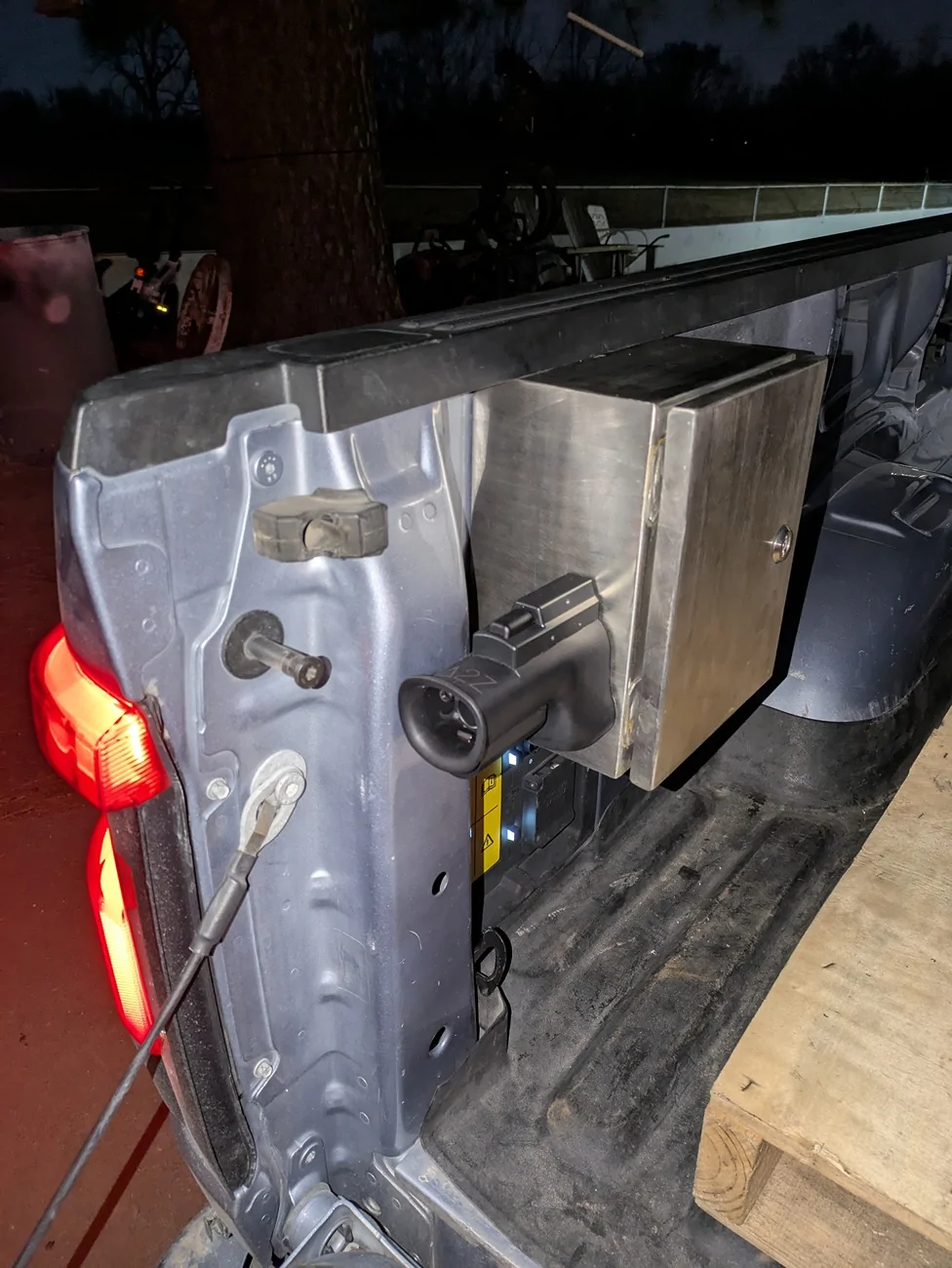
My interest in a DIY kit that adds a J1772 port to the bed and allows CWD?


  • Total voters
    178

PJnc284

Well-known member
Joined
Sep 30, 2024
Threads
0
Messages
1,235
Reaction score
1,402
Location
Garner, NC
Vehicles
2023 Ford F150 Lightning Lariat ER
A FCSP or Grizzl-e 80 strapped to a 550lb beast sure is an interesting albeit expensive prospect. Was wondering how the limitation of the nema 14/50 would be bypassed but guess you can hardwire. Westinghouse 28,000/20,000-Watt Tri-Fuel Gas, Propane, Natural Gas Powered Portable Generator with Remote Electric Start WGen20000TFc - The Home Depot

"Our exclusive 125A 240V AC lug connector lets a licensed electrician hardwire the generator directly to your home for full power delivery."

13 hrs on 25% load for 17 gallons. Wonder how much 100% would be. ~3 hrs? :cwl:
Sponsored

 
Last edited:

NW Ontario Ford Lightning

Well-known member
First Name
Robert
Joined
Feb 14, 2025
Threads
2
Messages
621
Reaction score
853
Location
NW Ontario Canada
Vehicles
2024 F-150 SR Lightning XLT, 2023 Escape Hybrid
Occupation
Contractor
30 to 50 extra miles could make all the difference sometimes. I love thr idea of having a range extender. I'd probably use a large LFP battery pack in the bed or trailer I'm pulling and a pure-sine-inverter to make the 240V connection.
Working on this now; Warning - TLDR follows...
I have been building an inverter and three 15.5kWh battery packs into a box that fits in the bed with the tonneau cover over it. The system is sized to fit into the truck bed perfectly, but I have plans for it to also power a few other things when not needed in the truck.
The output is max 13.5kW from the inverter - which can power my 48A Grizzl-E charger, after losses the charger feeds 10.3kW to the Lightning. I can't use 80A charger in a SR, and the 48A charger keeps wire sizes breakers and fuses in a range that is easier to work with.

For my use (getting to a remote fishing lake) I need 28kWh on hwy to the access road, then 19kW on the forest roads to the lake. The round trip at 94kWh is "too tight to chance it", and I have power needs while camping that also need some additional reserve power. There is no grid anywhere near the lake. This summer I did the trip but hauled a generator to power the destination charger for a few hours to top up the truck. - hated the noise, but got me through.

I plan to use the auxiliary battery set up instead of a generator, and can do this while parked at the lake, but it would be 'very cool' to be able to charge while driving, in case something 'happens', and I need to return before having time for the auxiliary battery to top off the truck battery.

Running the numbers in my situation:
driving 1 hour 105km/hr main hwy - 28kWh used, but the CWD would add back 10.3 kWh for a net used of 17.7kWh in the first hour of the trip.
Then turn onto the forestry road and drive for 1 hour using 19kWh (slow going gravel roads) and the CWD would add back 10.3 kWh for a net used of only 8.7 kWh.
Arrive at the lake with the Truck SOC at: 98-17.7 -8.7 = 71.6kWh (plenty to turn around and make it home if needed). The Auxiliary battery packs started at 45.5kWh and upon arrival at the lake these are down to 23kWh. Leave the Auxiliary packs charging the Lightning until low voltage shut-off will add a further 20.6 kWh to the truck; 71.6 + 20.6 = 92kWh in the truck while sitting at the lake.

I can use 20 kWh camping/cooking and still have 72kWh for the return trip, and by the numbers arrive back home with 25kWh in the 'tank', or a bit less if wind/cold/rain cut into the efficiency during the return trip. The numbers are encouraging, and even if lower efficiency and higher loads are the reality, there is pleanty to spare.

The test will be using just three of my 15.5kWh battery packs, however I have ten of these, and a couple more could be added to the truck bed, if needed. Three packs weigh 600 lbs and add "net of losses" about 41.5kWh making my SR Lightning into a 139kWh extra-ER when needed.
Next I need to confirm how the LFP packs do under load, watch the temperatures and see how they perform.
 

ElectrifyingMe25

Well-known member
First Name
Trav
Joined
Jul 31, 2025
Threads
15
Messages
153
Reaction score
193
Vehicles
F150 Lightning, XLT, 2023
Occupation
Engineer
Working on this now; Warning - TLDR follows...
I have been building an inverter and three 15.5kWh battery packs into a box that fits in the bed with the tonneau cover over it. The system is sized to fit into the truck bed perfectly, but I have plans for it to also power a few other things when not needed in the truck.
The output is max 13.5kW from the inverter - which can power my 48A Grizzl-E charger, after losses the charger feeds 10.3kW to the Lightning. I can't use 80A charger in a SR, and the 48A charger keeps wire sizes breakers and fuses in a range that is easier to work with.

For my use (getting to a remote fishing lake) I need 28kWh on hwy to the access road, then 19kW on the forest roads to the lake. The round trip at 94kWh is "too tight to chance it", and I have power needs while camping that also need some additional reserve power. There is no grid anywhere near the lake. This summer I did the trip but hauled a generator to power the destination charger for a few hours to top up the truck. - hated the noise, but got me through.

I plan to use the auxiliary battery set up instead of a generator, and can do this while parked at the lake, but it would be 'very cool' to be able to charge while driving, in case something 'happens', and I need to return before having time for the auxiliary battery to top off the truck battery.

Running the numbers in my situation:
driving 1 hour 105km/hr main hwy - 28kWh used, but the CWD would add back 10.3 kWh for a net used of 17.7kWh in the first hour of the trip.
Then turn onto the forestry road and drive for 1 hour using 19kWh (slow going gravel roads) and the CWD would add back 10.3 kWh for a net used of only 8.7 kWh.
Arrive at the lake with the Truck SOC at: 98-17.7 -8.7 = 71.6kWh (plenty to turn around and make it home if needed). The Auxiliary battery packs started at 45.5kWh and upon arrival at the lake these are down to 23kWh. Leave the Auxiliary packs charging the Lightning until low voltage shut-off will add a further 20.6 kWh to the truck; 71.6 + 20.6 = 92kWh in the truck while sitting at the lake.

I can use 20 kWh camping/cooking and still have 72kWh for the return trip, and by the numbers arrive back home with 25kWh in the 'tank', or a bit less if wind/cold/rain cut into the efficiency during the return trip. The numbers are encouraging, and even if lower efficiency and higher loads are the reality, there is pleanty to spare.

The test will be using just three of my 15.5kWh battery packs, however I have ten of these, and a couple more could be added to the truck bed, if needed. Three packs weigh 600 lbs and add "net of losses" about 41.5kWh making my SR Lightning into a 139kWh extra-ER when needed.
Next I need to confirm how the LFP packs do under load, watch the temperatures and see how they perform.
Bravo, my good man. I am proud of your innovation and determination. You are making a great contribution to the CWD efforts.

I look forward to hearing about your results.
 

Traconesu

Well-known member
First Name
Patrick
Joined
Aug 23, 2022
Threads
4
Messages
305
Reaction score
188
Location
Quad cities, Illinois
Vehicles
Ford lightning platinum
Occupation
Retired
Then you have to worry about cooling and I'm sure that would open up a whole different can of worms to tie into the existing battery. Not to mention weight and more time spent charging. Now what would be cool is if you could charge both separately but then you'd probably get yelled at for taking 2 stalls. :cwl: With a 10-gallon tank, OP's generator is like having an extra 60kWh+ battery in the bed but you likely wouldn't go far enough to see the full amount in either a SR or ER as you'd be out of charge long before the tank was empty. OP was only adding about 9.6 kW to the battery while using 30+/hr under fairly ideal conditions and with a generator larger than I'm sure most will have. Increase speed, hit a headwind, elevation or cold temps and it's probably more like 45+ which really cuts down on the benefit of cwd.

For amusement purposes, I ran the numbers to pull my 24ft boat. The one time I tried it, I got about .8mi/kWh over 80 miles @60mph on flat roads and a nice day. So that's just over 100 miles in an ER. That would be about 1:40 of driving but for giggles we'll say I got the same as the OP got in 2 hours (~19kWh). From 100-0, that gets me about 13 extra miles.
All this is why I wouldn't have purchased my lightning if I had to depend on public chargers. I drive locally, no public chargers and often use my excess solar to charge my truck. My round trips into town seldom exceed 60 miles total. And only 2-3 trips a week. Sometimes 1 per week.
 

scruvs

Well-known member
Joined
Aug 7, 2023
Threads
8
Messages
102
Reaction score
84
Location
Florida
Vehicles
2023 F-150 Lightning XLT Standard Range
This is why we're simply making a DIY bed port kit that enables CWD.
Is it safe to assume that it's much harder to move CCS to that driver-side bed location instead of only adding J1772? I'd love to have a CCS port in that location for Tesla Superchargers.
 

Sponsored
OP
OP

ZSC100

Well-known member
First Name
Zach
Joined
Mar 29, 2023
Threads
11
Messages
740
Reaction score
888
Location
Tulsa, OK
Vehicles
2022 F150 Lightning SR EG 311A
Occupation
Electrical Engineer
Is it safe to assume that it's much harder to move CCS to that driver-side bed location instead of only adding J1772? I'd love to have a CCS port in that location for Tesla Superchargers.
It's doable, and I've done it, but yes there are lots of complications and cost associated. The wire to play it safe without having to do lots of temperature monitoring is expensive and hard to deal with.

Ford F-150 Lightning Charging While Driving w/ Gas Generator in Bed (Range Extender for F-150 Lightning) - Testing 1760996757000-


And, again, TE Connectivity has absolutely Tier 1 locked all the HVDC connectors from the public so to make this mod you have to splice cables which lots of owners are scared to death to do, thinking it will void their warranty and such. It's really sad this power of fear that the OEMS wield over owners. It stifles creativity and innovation.
 

fhteagle

Well-known member
First Name
D
Joined
Jun 15, 2025
Threads
7
Messages
201
Reaction score
294
Vehicles
'22 Lightning Lariat, '23 MYLR, '13 Forester, sold '13 Volt
It's doable, and I've done it, but yes there are lots of complications and cost associated. The wire to play it safe without having to do lots of temperature monitoring is expensive and hard to deal with.

1760996757000-eb.webp
Are y'all contemplating this being an option in the CWD kit ecosystem?
 
OP
OP

ZSC100

Well-known member
First Name
Zach
Joined
Mar 29, 2023
Threads
11
Messages
740
Reaction score
888
Location
Tulsa, OK
Vehicles
2022 F150 Lightning SR EG 311A
Occupation
Electrical Engineer
Not at this
Are y'all contemplating this being an option in the CWD kit ecosystem?
Not at this time. It's about $500 in parts and the market research I've done just doesn't show demand.
 

Traconesu

Well-known member
First Name
Patrick
Joined
Aug 23, 2022
Threads
4
Messages
305
Reaction score
188
Location
Quad cities, Illinois
Vehicles
Ford lightning platinum
Occupation
Retired
30 to 50 extra miles could make all the difference sometimes. I love thr idea of having a range extender. I'd probably use a large LFP battery pack in the bed or trailer I'm pulling and a pure-sine-inverter to make the 240V connection.
It seems like an awfully big expense, large generator, cabling and everything else require to be able to charge while driving, to get 30-50 extra mileage per charge. I'm so thankful I only need to use my lightning locally without ever worrying about running out of energy. I do sympathize with those that could use that extra 30-50 miles.
 
OP
OP

ZSC100

Well-known member
First Name
Zach
Joined
Mar 29, 2023
Threads
11
Messages
740
Reaction score
888
Location
Tulsa, OK
Vehicles
2022 F150 Lightning SR EG 311A
Occupation
Electrical Engineer
It seems like an awfully big expense, large generator, cabling and everything else require to be able to charge while driving, to get 30-50 extra mileage per charge. I'm so thankful I only need to use my lightning locally without ever worrying about running out of energy. I do sympathize with those that could use that extra 30-50 miles.
It's over double the range if you can generate at 19kW. It takes 30kW to drive at moderate highway speed, it you generate 19kW, say 2kW is lost, that means you are only using 13kW on the highway. With an ER you can drive for 10hr non-stop with that, 700mi.
 

Sponsored

PJnc284

Well-known member
Joined
Sep 30, 2024
Threads
0
Messages
1,235
Reaction score
1,402
Location
Garner, NC
Vehicles
2023 Ford F150 Lightning Lariat ER
It's over double the range if you can generate at 19kW. It takes 30kW to drive at moderate highway speed, it you generate 19kW, say 2kW is lost, that means you are only using 13kW on the highway. With an ER you can drive for 10hr non-stop with that, 700mi.
10 hours might be a stretch and you'd probably get run over at the speeds required. Chatgpt says the Westinghouse 28kW (20kW) I listed earlier running near the max would be about 3gal/hr so maybe 5-6hrs if lucky on the 17 gallon tank. Problem with the larger generators is the weight. That ends up being almost 650lbs with a full tank so 1/3 of your payload and you'd probably want a larger one so you're not running near 100% capacity for a long duration.

Check my math but I took a 135 mile drive this morning and stuck to 70mph on I40 from Raleigh to Wilmington, NC. Reasonably flat terrain with minimal wind but the temp was only about 45F here in eastern NC this morning. Dash showed 1.8mi/kWh. Got home and charged from 18%-80% on my FCSP today and averaged about 15.8kW to the battery (according to the difference in energy remaining in Car Scanner) over the 5 hrs it took. So at that rate, it would be a net used of 70/1.8=~39kW-15.8kW=23.2kW. Assuming no degradation, 131/23.2 = 5.6 hrs or ~400 miles at 70. That's roughly 10mi/gal. That is a substantial increase over the 235 miles or 3.5hrs I'd get on just battery though. 2.1mi/kWh would give you a theoretical 7.5hrs and over 500 miles at 70mph assuming a sufficient fuel tank. I'd need a couple breaks before the truck would.

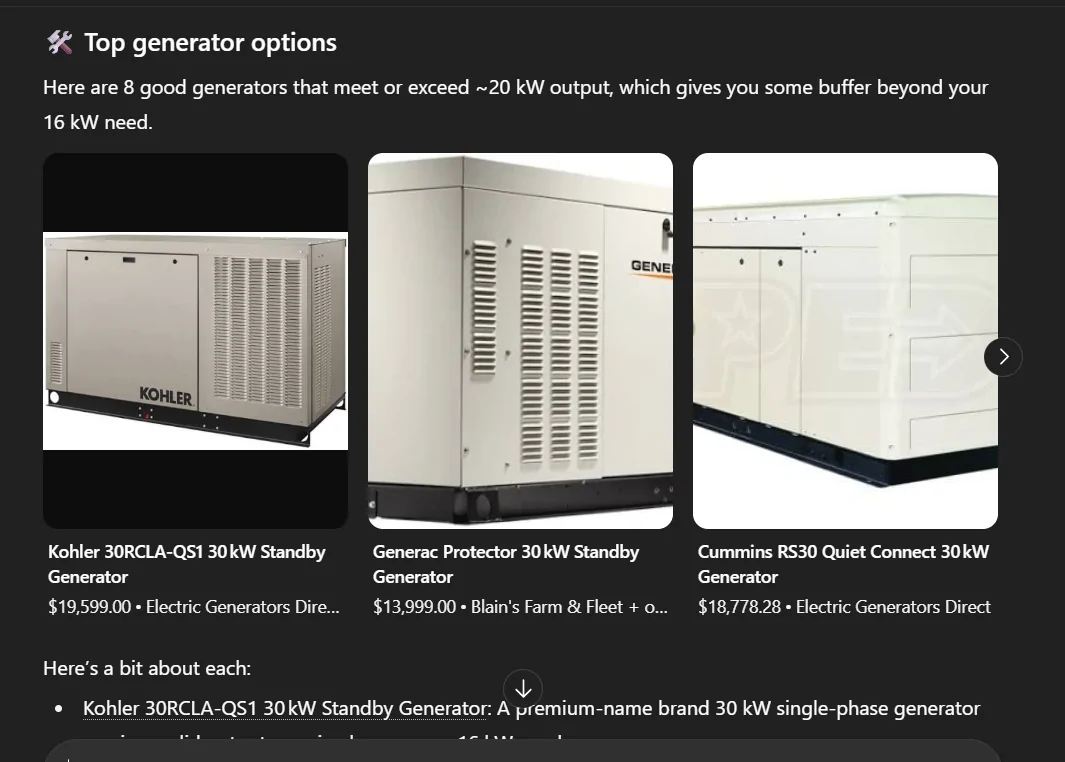
And gotta love chatgpt. Asked it for alternatives to the westinghouse and got this. Guess I should've mentioned it needed to fit in the bed first. :cwl:

Ford F-150 Lightning Charging While Driving w/ Gas Generator in Bed (Range Extender for F-150 Lightning) - Testing 1761351582622-d8


It really likes Winco Vehicle Mounted Generator - EC22000VE-17, 19 kW, 35 HP Briggs & Stratton, 3-Phase, 240 Volts for some reason.
 
OP
OP

ZSC100

Well-known member
First Name
Zach
Joined
Mar 29, 2023
Threads
11
Messages
740
Reaction score
888
Location
Tulsa, OK
Vehicles
2022 F150 Lightning SR EG 311A
Occupation
Electrical Engineer
10 hours might be a stretch and you'd probably get run over at the speeds required. Chatgpt says the Westinghouse 28kW (20kW) I listed earlier running near the max would be about 3gal/hr so maybe 5-6hrs if lucky on the 17 gallon tank. Problem with the larger generators is the weight. That ends up being almost 650lbs with a full tank so 1/3 of your payload and you'd probably want a larger one so you're not running near 100% capacity for a long duration.

Check my math but I took a 135 mile drive this morning and stuck to 70mph on I40 from Raleigh to Wilmington, NC. Reasonably flat terrain with minimal wind but the temp was only about 45F here in eastern NC this morning. Dash showed 1.8mi/kWh. Got home and charged from 18%-80% on my FCSP today and averaged about 15.8kW to the battery (according to the difference in energy remaining in Car Scanner) over the 5 hrs it took. So at that rate, it would be a net used of 70/1.8=~39kW-15.8kW=23.2kW. Assuming no degradation, 131/23.2 = 5.6 hrs or ~400 miles at 70. That's roughly 10mi/gal. That is a substantial increase over the 235 miles or 3.5hrs I'd get on just battery though. 2.1mi/kWh would give you a theoretical 7.5hrs and over 500 miles at 70mph assuming a sufficient fuel tank. I'd need a couple breaks before the truck would.

And gotta love chatgpt. Asked it for alternatives to the westinghouse and got this. Guess I should've mentioned it needed to fit in the bed first. :cwl:

1761351582622-d8.webp


It really likes Winco Vehicle Mounted Generator - EC22000VE-17, 19 kW, 35 HP Briggs & Stratton, 3-Phase, 240 Volts for some reason.
Yeah prime power generators are enormous. It just speaks to the different longevity and duty of a generator meant to run 100% duty, versus a little portable generator meant to be used every once in a while. I figure these portable generators when ran hard are probably good for less than 1000 hours of operation before they are trash.

The math for sustained power usage in the truck is really easy It's just your speed divided by your efficiency. So, if you are going 70 mph at 1.8 efficiency That means your truck was using a sustained 38kW to drive at 70mph. Dropping just 5mph would make a huge difference; you can see the non-linearity because you've got two factors, both helping as you slow down.

Still, if you were able to generate half of your sustained driving load you would double your range. Yeah, no way you're generating 19kW for 10 hours straight without stopping for fuel. But that's the beauty of a generator for interstate travel, you can stop at any gas station and in 5minutes you're back on the highway. I'm working on getting a water cooled diesel generator right now that is small form factor and can fit in the back and I'm planning to try and harvest the heat from it this winter and do more testing. Small generators are like 30% efficient so if I could use the waste heat that would really be nice.
 

Traconesu

Well-known member
First Name
Patrick
Joined
Aug 23, 2022
Threads
4
Messages
305
Reaction score
188
Location
Quad cities, Illinois
Vehicles
Ford lightning platinum
Occupation
Retired
It's over double the range if you can generate at 19kW. It takes 30kW to drive at moderate highway speed, it you generate 19kW, say 2kW is lost, that means you are only using 13kW on the highway. With an ER you can drive for 10hr non-stop with that, 700mi.
That would require a very large generator to produce 19kw per hour. You're probably looking at a 28 kw generator. Westinghouse makes one that has a run capability of 20 kw per hour with a 17 gallon fuel tank that would run at full load for just over 4 hours.
Generating that kind of power eats a lot of gasoline. To drive those 10 hours with the generator at full load would use approximately 37.5 gallons of gasoline. Add that expense to the roughly $4000 generator and the unknown cost of the DIY conversion.
 

Traconesu

Well-known member
First Name
Patrick
Joined
Aug 23, 2022
Threads
4
Messages
305
Reaction score
188
Location
Quad cities, Illinois
Vehicles
Ford lightning platinum
Occupation
Retired
That would require a very large generator to produce 19kw per hour. You're probably looking at a 28 kw generator. Westinghouse makes one that has a run capability of 20 kw per hour with a 17 gallon fuel tank that would run at full load for just over 4 hours.
Generating that kind of power eats a lot of gasoline. To drive those 10 hours with the generator at full load would use approximately 37.5 gallons of gasoline. Add that expense to the roughly $4000 generator and the unknown cost of the DIY conversion.
Maybe closer to 43 gallons of gasoline.
 

Traconesu

Well-known member
First Name
Patrick
Joined
Aug 23, 2022
Threads
4
Messages
305
Reaction score
188
Location
Quad cities, Illinois
Vehicles
Ford lightning platinum
Occupation
Retired
10 hours might be a stretch and you'd probably get run over at the speeds required. Chatgpt says the Westinghouse 28kW (20kW) I listed earlier running near the max would be about 3gal/hr so maybe 5-6hrs if lucky on the 17 gallon tank. Problem with the larger generators is the weight. That ends up being almost 650lbs with a full tank so 1/3 of your payload and you'd probably want a larger one so you're not running near 100% capacity for a long duration.

Check my math but I took a 135 mile drive this morning and stuck to 70mph on I40 from Raleigh to Wilmington, NC. Reasonably flat terrain with minimal wind but the temp was only about 45F here in eastern NC this morning. Dash showed 1.8mi/kWh. Got home and charged from 18%-80% on my FCSP today and averaged about 15.8kW to the battery (according to the difference in energy remaining in Car Scanner) over the 5 hrs it took. So at that rate, it would be a net used of 70/1.8=~39kW-15.8kW=23.2kW. Assuming no degradation, 131/23.2 = 5.6 hrs or ~400 miles at 70. That's roughly 10mi/gal. That is a substantial increase over the 235 miles or 3.5hrs I'd get on just battery though. 2.1mi/kWh would give you a theoretical 7.5hrs and over 500 miles at 70mph assuming a sufficient fuel tank. I'd need a couple breaks before the truck would.

And gotta love chatgpt. Asked it for alternatives to the westinghouse and got this. Guess I should've mentioned it needed to fit in the bed first. :cwl:

1761351582622-d8.webp


It really likes Winco Vehicle Mounted Generator - EC22000VE-17, 19 kW, 35 HP Briggs & Stratton, 3-Phase, 240 Volts for some reason.
Most of those larger 30 kw > generators run on propane or natural gas.
Sponsored


Top