
Sponsored

In Production Solid State Battery Tech? Potential for Aftermarket Lightning Pack upgrades?!

ZeusDriver

Well-known member
Joined
Dec 1, 2025
Threads
9
Messages
191
Reaction score
165
Location
East Coast, USA
Vehicles
2022 Lightning
As I poke around more, my skepticism is eroding. Matt Ferrell, Two Bit DaVinci, and Ziroth all know the subject matter, and seem to be finding the tech and Donut Lab's approach plausible. We know that SSBs are already here, and we know that there are many possible approaches, so it seems not completely crazy that a group of small companies can come up with something workable.

I rented space at Cornell University's technology park many decades ago, and saw that putting a bunch of people and small companies in close proximity can foster a climate in which cool stuff happens. Finland (from which you can spit into Estonia) has that small town community feel (in my little bit of experience there.) (They had the biggest cell phone company in the world for a while.)

The first Tesla was developed, before Musk's involvement in a garage shop environment... and that has gone well, at least financially.

I believe that as huge companies go, Toyota is better at innovating than Ford, so I would expect that their SSB efforts will see production before Ford's. But even Toyota is slow moving as compared to small entrepreneurial outfits. Close to a decade before Toyota brought out their Prime PHEVS, several garage shops were already converting Priuses into PHEVS.

The overriding reason for my having built my prototype PHEV as a three-wheeler was that as a motorcycle, I could avoid many of the regulation and ethical issues of developing a "car." (Modelling, and then testing how a battery pack behaves is a crash is no small task.) Aptera (scam or not) talked about taking that route for the same reason. Combine that reasoning with the current ability to demonstrate 5 minute charging at a 350kW charger on a motorcycle's comparatively small battery (but not on a car or truck's big one), and starting with a motorcycle makes sense, I think.

We will see soon enough.
Sponsored

 
Last edited:

chriserx

Well-known member
First Name
Chris
Joined
Oct 3, 2025
Threads
1
Messages
510
Reaction score
370
Location
Louisiana
Vehicles
2025 Ford Lightning Flash Job 2 😭
As I poke around more, my skepticism is eroding. Matt Ferrell, Two Bit DaVinci, and Ziroth all know the subject matter, and seem to be finding the tech and Donut Lab's approach plausible. We know that SSBs are already here, and we know that there are many possible approaches, so it seems not completely crazy that a group of small companies can come up with something workable.

I rented space at Cornell University's technology park many decades ago, and saw that putting a bunch of people and small companies in close proximity can foster a climate in which cool stuff happens. Finland (from which you can spit into Estonia) has that small town community feel (in my little bit of experience there.) (They had the biggest cell phone company in the world for a while.)

The first Tesla was developed, before Musk's involvement in a garage shop environment... and that has gone well, at least financially.

I believe that as huge companies go, Toyota is better at innovating than Ford, so I would expect that their SSB efforts will see production before Ford's. But even Toyota is slow moving as compared to small entrepreneurial outfits. Close to a decade before Toyota brought out their Prime PHEVS, several garage shops were already converting Priuses into PHEVS.

The overriding reason for my having built my prototype PHEV as a three-wheeler was that as a motorcycle, I could avoid many of the regulation and ethical issues of developing a "car." (Modelling, and then testing how a battery pack behaves is a crash is no small task.) Aptera (scam or not) talked about taking that route for the same reason. Combine that reasoning with the current ability to demonstrate 5 minute charging at a 350kW charger on a motorcycle's comparatively small battery (but not on a car or truck's big one), and starting with a motorcycle makes sense, I think.

We will see soon enough.
We are certainly approaching the crossroads where it's commercially viable. Maybe your state's DOT regulations are different but at last check, Louisiana basically required receipts for all the parts, a seatbelt, appropriate lighting, horn and some kinda safety check that it wouldn't fall apart on the road. I kinda assumed it'd be similar in most jurisdictions. I only saw the video of it charging at just over 100 kw, do they have one higher?
 

TaxmanHog

Moderator
Moderator
First Name
Noel
Joined
Jan 19, 2022
Threads
218
Messages
15,960
Reaction score
17,898
Location
SE. Mass.
Vehicles
2022 Lightning Lariat-ER & 2024 HD Road Glide CVO-ST
Occupation
Retired
More from the doubters corner


flabrent

Well-known member
First Name
Brent
Joined
Sep 6, 2025
Threads
4
Messages
100
Reaction score
157
Location
Florida Panhandle
Vehicles
'25 Ford Lightning Flash Job 2
Wow! tomorrow we'll have a motorcycle powered by "Donut".
My Magic 8 ball say's next week we'll have a car powered by "Croissant" and tractor-trailers powered by "Bagel". LOL!
Until I can actually buy one and ride it, it's nothing more than vaporware.
 

Sponsored

chriserx

Well-known member
First Name
Chris
Joined
Oct 3, 2025
Threads
1
Messages
510
Reaction score
370
Location
Louisiana
Vehicles
2025 Ford Lightning Flash Job 2 😭
Wow! tomorrow we'll have a motorcycle powered by "Donut".
My Magic 8 ball say's next week we'll have a car powered by "Croissant" and tractor-trailers powered by "Bagel". LOL!
Until I can actually buy one and ride it, it's nothing more than vaporware.
Too bad they didn't didn't go with bagel, the battery coulda been the cheese on top.
 

ZeusDriver

Well-known member
Joined
Dec 1, 2025
Threads
9
Messages
191
Reaction score
165
Location
East Coast, USA
Vehicles
2022 Lightning
We are certainly approaching the crossroads where it's commercially viable. Maybe your state's DOT regulations are different but at last check, Louisiana basically required receipts for all the parts, a seatbelt, appropriate lighting, horn and some kinda safety check that it wouldn't fall apart on the road. I kinda assumed it'd be similar in most jurisdictions. I only saw the video of it charging at just over 100 kw, do they have one higher?
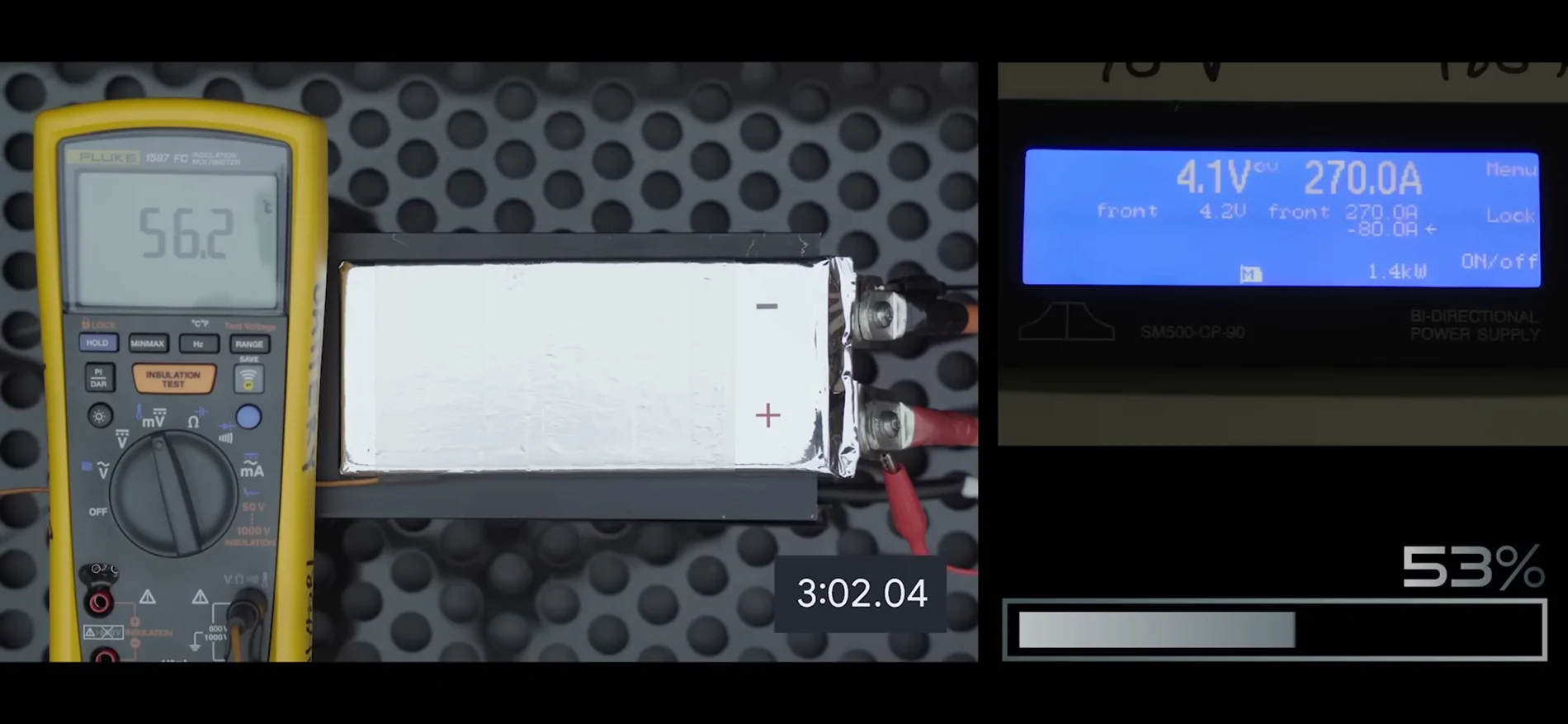
I doubt that the video of a Donut "cell" charging was real or actually representative of an actual charging cycle in an actual preproduction prototype. The leads and terminals are just too small for 270 amps. No, I have not seen anything that clearly shows one of their cells or batteries charging at 10-12 C. Nor have I seen anything that would indicate that the cell that is shown in the video is actually one of theirs... certainly It looks mothing like the plastic mockup shown at CES. If they are close to production, then they would have to have a pre-production prototype that looks just like the production unit. (Although, when I was promoting my little vehicle, the next prototype was going to look much different that the working one... so perhaps they can be excused for showing up at CES with a fake cell. Wild optimism, some ADHD, the effect of people around you saying YES! YES!... all can lead to bad PR decisions. )

But all that is somewhat beside the point that I was attempting to make, that being:
Charging a 33kWh battery (as claimed in the Verge) in 5 minutes requires a 396kW charger. 6 minutes would be close enough to convince many people, and that would require 330kW. 350kW chargers are widely available around the world, even in the less developed countries (such as the US). To charge a car with a 100 kWh battery in 5 minutes requires a 1.2 Megawatt level charger. Those are very hard to find. So, if this thing really exists, then putting it first into a motorcycle means that you could demo charging on an existing charger, found even in pretty small towns in the US. (Dillon SC, far from being a big city, has 40 350kW chargers in one location.)

So, now, and for the next 5-10 years, megawatt chargers are very rare, so if you wanted to have customers demoing your batteries charging in 6 minutes at superchargers all around the country, a motorcycle would be required. People no longer buy cars or trucks with 33kWh batteries. (Unless, of course, they are PHEVS, in which case the problem of limited range is "solved": just drive on gas. That also solves the problem of finding a supercharger nearby when your GOM is reading 10 miles to go.)

I was still taking college physics classes at age 70, when covid put an end to that. But most people are not thrilled by physics, and need something tangible, like seeing a bike pull up to a charger and leave in five minutes to show that really fast, convenient charging is a reality, not just a bunch of incomprehensible math.

Back when I was sourcing batteries for my prototype, 10C charging briefly was possible without destroying LiFePo4 cells. Regen in the prototype was powerful enough to smoke the rear tire (partly for that 10 C reason, although also because of bad design). The battery leads were welding cable with about 8 times the cross section of those in the video, and the amperage in the prototype ranged up to 300.

Re commercial viability of boutique little cars, I think you are right. I haven't done any recent research, having been involved in other projects, but my sense is that the same states in which standards are permissive, are also those in which EVs have not been popular. (In states like CA and NY, the emission standards have been even more restrictive than the fed standards... and in those states, EVs are popular. ) If I don't kick off first, after finishing up my current project, I will look into the car project again.
 

ZeusDriver

Well-known member
Joined
Dec 1, 2025
Threads
9
Messages
191
Reaction score
165
Location
East Coast, USA
Vehicles
2022 Lightning
Wow! tomorrow we'll have a motorcycle powered by "Donut".
My Magic 8 ball say's next week we'll have a car powered by "Croissant" and tractor-trailers powered by "Bagel". LOL!
Until I can actually buy one and ride it, it's nothing more than vaporware.
Sorry, Bagel is incorrect. This from Donut Lab, via AI:
"Donut Lab is pleased to announce the availability of several new architectures for their award winning and fantastic battery designs. For Cell phones, we have the "Potato Chip. " For motorcycles, the very successful and current production "Donut." For cars, the "Croissant;" for trucks, the "Baguette", and for ships, the "Wonder Bread".
 

chriserx

Well-known member
First Name
Chris
Joined
Oct 3, 2025
Threads
1
Messages
510
Reaction score
370
Location
Louisiana
Vehicles
2025 Ford Lightning Flash Job 2 😭
I doubt that the video of a Donut "cell" charging was real or actually representative of an actual charging cycle in an actual preproduction prototype. The leads and terminals are just too small for 270 amps. No, I have not seen anything that clearly shows one of their cells or batteries charging at 10-12 C. Nor have I seen anything that would indicate that the cell that is shown in the video is actually one of theirs... certainly It looks mothing like the plastic mockup shown at CES. If they are close to production, then they would have to have a pre-production prototype that looks just like the production unit. (Although, when I was promoting my little vehicle, the next prototype was going to look much different that the working one... so perhaps they can be excused for showing up at CES with a fake cell. Wild optimism, some ADHD, the effect of people around you saying YES! YES!... all can lead to bad PR decisions. )

But all that is somewhat beside the point that I was attempting to make, that being:
Charging a 33kWh battery (as claimed in the Verge) in 5 minutes requires a 396kW charger. 6 minutes would be close enough to convince many people, and that would require 330kW. 350kW chargers are widely available around the world, even in the less developed countries (such as the US). To charge a car with a 100 kWh battery in 5 minutes requires a 1.2 Megawatt level charger. Those are very hard to find. So, if this thing really exists, then putting it first into a motorcycle means that you could demo charging on an existing charger, found even in pretty small towns in the US. (Dillon SC, far from being a big city, has 40 350kW chargers in one location.)

So, now, and for the next 5-10 years, megawatt chargers are very rare, so if you wanted to have customers demoing your batteries charging in 6 minutes at superchargers all around the country, a motorcycle would be required. People no longer buy cars or trucks with 33kWh batteries. (Unless, of course, they are PHEVS, in which case the problem of limited range is "solved": just drive on gas. That also solves the problem of finding a supercharger nearby when your GOM is reading 10 miles to go.)

I was still taking college physics classes at age 70, when covid put an end to that. But most people are not thrilled by physics, and need something tangible, like seeing a bike pull up to a charger and leave in five minutes to show that really fast, convenient charging is a reality, not just a bunch of incomprehensible math.

Back when I was sourcing batteries for my prototype, 10C charging briefly was possible without destroying LiFePo4 cells. Regen in the prototype was powerful enough to smoke the rear tire (partly for that 10 C reason, although also because of bad design). The battery leads were welding cable with about 8 times the cross section of those in the video, and the amperage in the prototype ranged up to 300.

Re commercial viability of boutique little cars, I think you are right. I haven't done any recent research, having been involved in other projects, but my sense is that the same states in which standards are permissive, are also those in which EVs have not been popular. (In states like CA and NY, the emission standards have been even more restrictive than the fed standards... and in those states, EVs are popular. ) If I don't kick off first, after finishing up my current project, I will look into the car project again.
You made me rewatch the cell charging section, in it he does use the word pack and not cell or module. The clip does appear to show a single cell. The power supply shown has a 90A capacity, while only one is shown, that doesn't preclude it from being paralleled with 2 extra units, which would line up perfectly with their 270A charge rate. If you look at the lug thickness vs terminal vs wire size, it is more or less appropriate. It's very difficult to tell scale but the full wire size including insulation is larger than the largest portion of the knob turn on the handheld. I haven't looked up the multimeter but note it appears to have a 'degrees celcius', I assumed originally that it was percentage, but it is likely actually temperature. I'm not gonna speculate whether or not this is more than vaporware, but it is at the very least, plausible.

For reference:
Ford F-150 Lightning In Production Solid State Battery Tech?  Potential for Aftermarket Lightning Pack upgrades?! IMG_3081
 

ZeusDriver

Well-known member
Joined
Dec 1, 2025
Threads
9
Messages
191
Reaction score
165
Location
East Coast, USA
Vehicles
2022 Lightning
I'm not gonna speculate whether or not this is more than vaporware, but it is at the very least, plausible.
Yes, I think so too.

At the same time, I think that the couple seconds that show the "test" are incredibly brief, (in comparison to the total length of the video, which is mainly marketing hype.) It is also oddly composed, with the supply not actually seen as connected to the cell. If I wanted to convince someone that this is really representative of an actual test in progress, then I'd want to show the actual connections, starting with at least a wide shot showing the power supplies, a quick explanation of there being three in parallel, a slow zoom into the Fluke showing temperature rise, a slow zoom into the power supply showing amperage and voltage, and some voice over explaining it all in some detail. Even all that can be easily faked, but not so easily faked as just some arbitrary values on a power supply readout split-screened with the cell: there is nothing showing that the poser supply is really connected to the cell, which seems like the stunningly obvious thing to show.

And having the person running the test explaining the connections and approach as he or she goes, could make good, engaging video:

"Here is the cell at room temperature. As we turn on the power supply, you can see that the amperage is initially low, and then very quickly rises to 270 amps as we increase the power supply voltage to 4.1 volts, where the power supply will hold it for the duration of this test. The temperature is slowly rising, but as you will see, the rise is quite slow. We will speed up the video to 20 times normal so that you can see the temperature rise. Now, we are at about half fully charged, and the temperature is 56.7 degrees C. Scalding hot, but well within the capabilities of the cell..."

There is nothing of a trade secret nature to be lost in a slower, more clear explanation. The cell chemistry is certainly well-hidden in its pouch.

Yesterday, I had one brief trip in my Lightning in which I got 4.1 miles per kWh. I could show you a real video of my dash... PROOF that my truck gets 400 miles per charge! The Donut video comes across that way to me. But who knows?
 

Sponsored

chriserx

Well-known member
First Name
Chris
Joined
Oct 3, 2025
Threads
1
Messages
510
Reaction score
370
Location
Louisiana
Vehicles
2025 Ford Lightning Flash Job 2 😭
Yes, I think so too.

At the same time, I think that the couple seconds that show the "test" are incredibly brief, (in comparison to the total length of the video, which is mainly marketing hype.) It is also oddly composed, with the supply not actually seen as connected to the cell. If I wanted to convince someone that this is really representative of an actual test in progress, then I'd want to show the actual connections, starting with at least a wide shot showing the power supplies, a quick explanation of there being three in parallel, a slow zoom into the Fluke showing temperature rise, a slow zoom into the power supply showing amperage and voltage, and some voice over explaining it all in some detail. Even all that can be easily faked, but not so easily faked as just some arbitrary values on a power supply readout split-screened with the cell: there is nothing showing that the poser supply is really connected to the cell, which seems like the stunningly obvious thing to show.

And having the person running the test explaining the connections and approach as he or she goes, could make good, engaging video:

"Here is the cell at room temperature. As we turn on the power supply, you can see that the amperage is initially low, and then very quickly rises to 270 amps as we increase the power supply voltage to 4.1 volts, where the power supply will hold it for the duration of this test. The temperature is slowly rising, but as you will see, the rise is quite slow. We will speed up the video to 20 times normal so that you can see the temperature rise. Now, we are at about half fully charged, and the temperature is 56.7 degrees C. Scalding hot, but well within the capabilities of the cell..."

There is nothing of a trade secret nature to be lost in a slower, more clear explanation. The cell chemistry is certainly well-hidden in its pouch.

Yesterday, I had one brief trip in my Lightning in which I got 4.1 miles per kWh. I could show you a real video of my dash... PROOF that my truck gets 400 miles per charge! The Donut video comes across that way to me. But who knows?
Agreed for the most part except the scalding, but at the same time, the target audience isn't us, it's marketing for investments and OEM purchasers as a teaser.
 

chriserx

Well-known member
First Name
Chris
Joined
Oct 3, 2025
Threads
1
Messages
510
Reaction score
370
Location
Louisiana
Vehicles
2025 Ford Lightning Flash Job 2 😭

ZeusDriver

Well-known member
Joined
Dec 1, 2025
Threads
9
Messages
191
Reaction score
165
Location
East Coast, USA
Vehicles
2022 Lightning
When I was doing things to make, rather then lose, money, I spent a lot of time in switchgear rooms in industrial plants. The feed into these plants is often something like 11,000 or 13,800 volts, and the main switchgear rooms had many roll-out circuit breakers about the size of a dishwasher. Downstream from these were many smaller switchgear rooms (all around the plant) fed with 3 phase 480. The size of breakers (and associated contactors) were somewhat less intimidating, but those pieces were still big and quite loud. Hundreds of those in a typical large plant. Some electric motors in plants are about the weight of two Lightnings. Here is one:
https://www.caseyusa.com/products/s...-1194-rpm-690v-siemens-inverter-duty-ac-motor

Why do I mention that? Partly to say that pushing a lot of power around is very common. So providing enough megawatt chargers is certainly easily doable, given sufficient $billions. In the woefully underutilized Tesla station in Dillon SC (w/ 40 350 kW hoses) 12 of those could be converted into 4 megawatt chargers, and there would still be twenty eight 350's left for the 6 cars per day that show up. (I'm making up that last figure, but I have passed through about 10 times and have never seen more than 2 or 3 vehicles charging).

So, I am not too worried about all the megawatt chargers required to charge all these SSB cars coming up. I expect the number of such cars to be relatively small, and of course, they don't all have to charge at megawatt chargers -- fun, but unnecessary. The number of SSB vehicles might grow at about rate of EV growth. They are also not necessarily going any further than the current total-electric-car-miles-per-day. For those EV drivers who are driving 12,000 miles per year, their usage will probably not change at all, even if they suddenly went to SSB cars -- they are still only driving 40 miles per day, 300 days per year. Home charging won't change at all: existing panels don't generally support anything greater than the current EVSEs.

Will an SSB meeting the claims of Donut make ICE's "irrelevant?" I have my doubts. Doesn't the Lightning already make the ICE "irrelevant" for most of us?
Sponsored


Top