

Sponsored

Maxx

Well-known member
Joined
Jul 15, 2021
Threads
49
Messages
2,293
Reaction score
2,811
Location
MD
Vehicles
23 Pro, Sky RL, Frontier, Aurora V8, Buicks, ....
why the truck is still doing that after 2 weeks, which is when I thought it was supposed to deep sleep.
I don’t know how this truck thinks but wouldn’t deep sleep makes more sense when Truck is unplugged? At an airport long term parking, saving juice is more important than plugged in at home. Just speculating on how Ford maybe thinking.
Sponsored


Maquis

Well-known member
First Name
Dave
Joined
May 20, 2021
Threads
9
Messages
4,176
Reaction score
5,538
Location
Illinois
Vehicles
2021 Mach-E E4-X; 2023 Lightning Lariat ER
I wonder what dealerships would do when these things would sit outside on the lots during the below freezing months.
They let them sit right next to the ICE trucks. And they’re fine.
 

Adventureboy

Well-known member
First Name
Jonathan
Joined
Jan 30, 2023
Threads
1
Messages
1,085
Reaction score
1,060
Location
Ontario
Vehicles
2023 F150 Lightning Lariat
The change in cycle is probably a combination of the temperature rise and your truck going into power saver mode. Much more frequent when the temperature was lower. I've seen the same on mine - in the -20°C range, it seems to heat once every 4-5 hours.
I am curious how many times your 12v battery cycled in that time. Unfortunately, when plugged in, it only charges the 12v when it is charging the HVB. I wonder if it also charges the 12v during a HVB heating cycle. If I had to guess, I'd say no. There are a couple of little sub-steps along the graph. That may be 12v charge cycles. It looks like 8 of them over the 16 days with 2 close to each other on the 17th - that may be the transition to power save mode. That is in line with my observed 2-day cycle on the 12v charging when it is cold and less frequent above freezing.
 

dlwhitlinger

Member
First Name
Dave
Joined
Jan 23, 2023
Threads
0
Messages
8
Reaction score
9
Location
Woodinville, WA
Vehicles
F150
The BMS is designed to heat the battery if the pack temp drops to an unknown temperature level regardless of any departure times being set. That is if the truck is connected to a level 2 EVSE. That would count for the majority of the KWhs used. Those temps would certainly trigger the BMS.

A smaller portion would be the BMS charging the 12v when it dropped to a predetermined low charge state.

In my opinion leaving the truck plugged in while away (or at all times, ABC) is the right way to go.
Does anyone know if the Charge Time setting effects the BMSs ability to heat the battery? I've had my truck set to only charge between 6pm and 6am. Does this limit the BMSs ability to temperature regulate outside of that charge window?
 

Sponsored

The Weatherman

Well-known member
First Name
Dean
Joined
Apr 20, 2023
Threads
31
Messages
1,806
Reaction score
2,572
Location
South Central KY
Vehicles
2022 RR F150 Lightning Lariat ER, 2020 Explorer PL
Occupation
Retired
I don’t have any authoritative source to quote however, based on the need to protect the battery from extremely cold conditions which can damage the battery, I believe the BMS does monitor the battery temp and will provide a heating level necessary outside your charging schedule.

There is a distinction between charging and battery heating.
 
OP
OP

MattVT

Active member
First Name
Matt
Joined
Sep 17, 2025
Threads
5
Messages
32
Reaction score
83
Location
Vermont
Vehicles
2025 F-150 Lightning Lariat
I don’t know how this truck thinks but wouldn’t deep sleep makes more sense when Truck is unplugged?
That would make sense to me too, but my understanding from what I had read was that deep sleep occurs have 2 weeks of no driving, regardless of charging / plugged-in status.

The change in cycle is probably a combination of the temperature rise and your truck going into power saver mode. Much more frequent when the temperature was lower. I've seen the same on mine - in the -20°C range, it seems to heat once every 4-5 hours.
I am curious how many times your 12v battery cycled in that time. Unfortunately, when plugged in, it only charges the 12v when it is charging the HVB. I wonder if it also charges the 12v during a HVB heating cycle. If I had to guess, I'd say no. There are a couple of little sub-steps along the graph. That may be 12v charge cycles. It looks like 8 of them over the 16 days with 2 close to each other on the 17th - that may be the transition to power save mode. That is in line with my observed 2-day cycle on the 12v charging when it is cold and less frequent above freezing.
When you say power saver mode, are you thinking that is what happens after ~7 days? If so, is that documented anywhere? First time I've come across that term, but it certainly aligns with how I read the charts.

I did include a graph of the 12V battery status, as reported via the FordPass API in Home Assistant. The data from the API is frustratingly infrequently updated, so it's hard to ascertain exactly what's happening, but it looks to me like the 12V battery dropped and then climbed back up again - twice. But they don't look like charging cycles because they're very slow to climb (multiple days), and they don't obviously seem correlated with outdoor temperature either.

The only other relevant data point to share is that in the most recent API update, it shows my battery voltage is 13.25V as of right now (still not driven since December 10). AGM batteries aren't my forte, but that seems high for an unloaded battery, so perhaps that's indicative that there's a trickle charger connected internally to it?
 

TaxmanHog

Moderator
Moderator
First Name
Noel
Joined
Jan 19, 2022
Threads
212
Messages
15,695
Reaction score
17,594
Location
SE. Mass.
Vehicles
2022 Lightning Lariat-ER & 2024 HD Road Glide CVO-ST
Occupation
Retired
Does anyone know if the Charge Time setting effects the BMSs ability to heat the battery? I've had my truck set to only charge between 6pm and 6am. Does this limit the BMSs ability to temperature regulate outside of that charge window?
This time frame coincides with the coldest periods of time in general.

Are you defining the charging scheme with the Sync & Ford App, or through a third party type of EVSE (Emporia, others)?

With Sync, the truck will continue to draw energy if needed outside the "CHARGING" window but not specifically for charging, but to power the PTC and allow battery warming if/when the BMS thinks it's needed. Other EVSE's restrict energy delivery regardless of purpose.
 

dlwhitlinger

Member
First Name
Dave
Joined
Jan 23, 2023
Threads
0
Messages
8
Reaction score
9
Location
Woodinville, WA
Vehicles
F150
This time frame coincides with the coldest periods of time in general.

Are you defining the charging scheme with the Sync & Ford App, or through a third party type of EVSE (Emporia, others)?

With Sync, the truck will continue to draw energy if needed outside the "CHARGING" window but not specifically for charging, but to power the PTC and allow battery warming if/when the BMS thinks it's needed. Other EVSE's restrict energy delivery regardless of purpose.
Yeah, I have the Ford Pro Charger and set up the charge window via Sync and the Ford Pass app... Good to know that it will still take care of the batteries outside of the charge window settings. Thanks!
 

Adventureboy

Well-known member
First Name
Jonathan
Joined
Jan 30, 2023
Threads
1
Messages
1,085
Reaction score
1,060
Location
Ontario
Vehicles
2023 F150 Lightning Lariat
That would make sense to me too, but my understanding from what I had read was that deep sleep occurs have 2 weeks of no driving, regardless of charging / plugged-in status.


When you say power saver mode, are you thinking that is what happens after ~7 days? If so, is that documented anywhere? First time I've come across that term, but it certainly aligns with how I read the charts.

I did include a graph of the 12V battery status, as reported via the FordPass API in Home Assistant. The data from the API is frustratingly infrequently updated, so it's hard to ascertain exactly what's happening, but it looks to me like the 12V battery dropped and then climbed back up again - twice. But they don't look like charging cycles because they're very slow to climb (multiple days), and they don't obviously seem correlated with outdoor temperature either.

The only other relevant data point to share is that in the most recent API update, it shows my battery voltage is 13.25V as of right now (still not driven since December 10). AGM batteries aren't my forte, but that seems high for an unloaded battery, so perhaps that's indicative that there's a trickle charger connected internally to it?
HA polling will probably prevent the truck from going into power saver mode so the longer cycles are probably just the warmer weather in your case. The HA API will keep modules alive or light them up when it polls. That could actually cause the 12v battery to discharge faster. Your HA information is probably not frequent enough to be accurate for tracking the 12v discharge cycles. My experience in the cold is that the 12v will cycle every few days (discharges to about 40% SOC then charges whether plugged in or not). It is much less frequent when it goes into power saver mode or if it is warmer. Unfortunately, the actual algorithm Ford uses for this is not published and it has changed over the years. It it triggered by a number of events like the 14-day limit but can also be triggered by discharge cycles - actual number of cycles is unknown but it used to be 1 when I first got the truck in 2023.
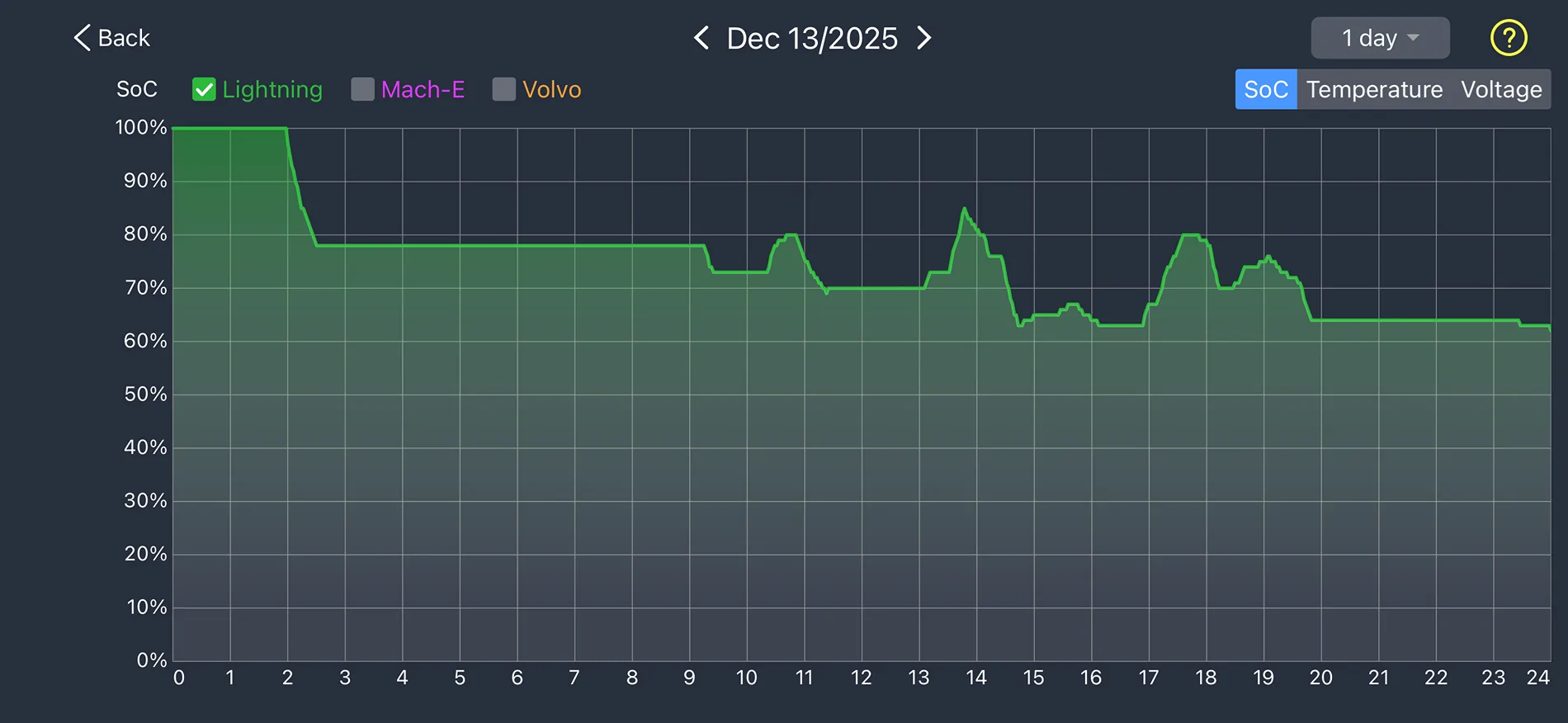
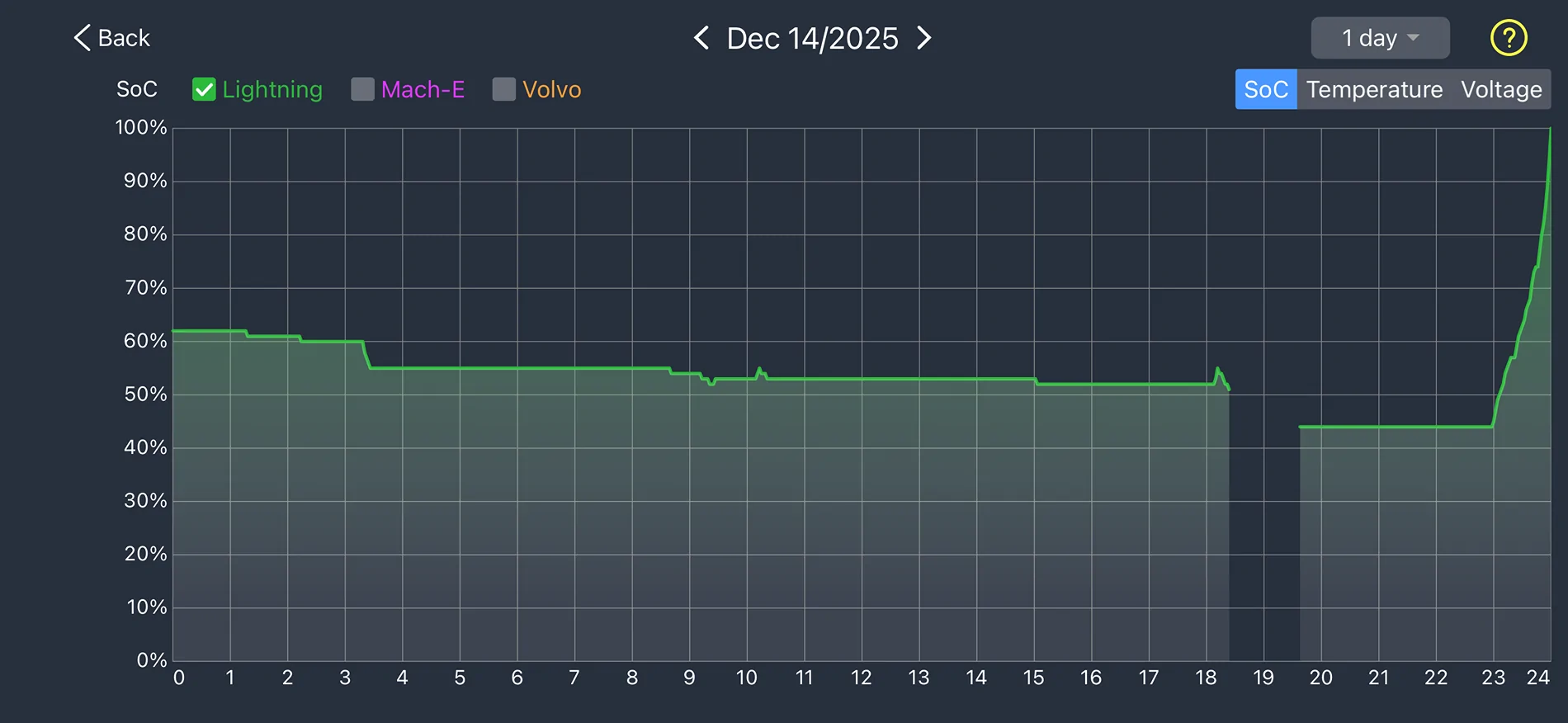
I track mine daily, although I don't have anything recent for more than a couple of days but here is an example of my 12v discharge rate. The jumps on Dec. 13th were driveway shuffles which involved uplugging, moving the truck and replugging, but over 2 days the 12v dropped below 50% SOC and then charged when the HVB charge cycle kicked off at 11pm Dec. 14th. It would probably been about 3-4 days without the driveway shuffles.
Ford F-150 Lightning Charging while parked & unused (over 2 weeks) in cold weather - recorded data 1766938486118-wy

Ford F-150 Lightning Charging while parked & unused (over 2 weeks) in cold weather - recorded data 1766938960865-2r
 

Sponsored
OP
OP

MattVT

Active member
First Name
Matt
Joined
Sep 17, 2025
Threads
5
Messages
32
Reaction score
83
Location
Vermont
Vehicles
2025 F-150 Lightning Lariat
HA polling will probably prevent the truck from going into power saver mode so the longer cycles are probably just the warmer weather in your case. The HA API will keep modules alive or light them up when it polls. That could actually cause the 12v battery to discharge faster. Your HA information is probably not frequent enough to be accurate for tracking the 12v discharge cycles.
Are you implying that polling the API actually directly polls the truck itself? My understanding is that polling the API is entirely independent of the connectivity between the truck and Ford’s servers, unless the API call I make is non-idempotent - ie requesting a change to some state such as remote start.

The API polling interval in Home Assistant is much faster than the data update rate itself.

Based on my 12V monitoring (infrequent as it is), I’ve not seen the 12V battery status drop below ~90% in the past 18 days of being parked up and plugged in. Combined with it currently reporting the voltage as 13.25V, that makes me think it’s doing something to actively maintain the 12V battery.

Either way, I find it super irritating and disappointing that there isn’t a better way to read data and telemetrics from the truck in near real-time. It’s sitting there with access to power and WiFi - it’s purely a business decision to restrict its communication to Ford’s poorly supported, cloud-dependent API.

If it weren’t for Ford’s recent demonstration of their lack of commitment to the Lightning, I’d rig up some local hardware to measure and track these things more accurately and reliably.
 

Adventureboy

Well-known member
First Name
Jonathan
Joined
Jan 30, 2023
Threads
1
Messages
1,085
Reaction score
1,060
Location
Ontario
Vehicles
2023 F150 Lightning Lariat
Are you implying that polling the API actually directly polls the truck itself? My understanding is that polling the API is entirely independent of the connectivity between the truck and Ford’s servers

Based on my 12V monitoring (infrequent as it is), I’ve not seen the 12V battery status drop below ~90% in the past 18 days of being parked up and plugged in. Combined with it currently reporting the voltage as 13.25V, that makes me think it’s doing something to actively maintain the 12V battery.
No, HA polls the Ford servers. Older version of the HA/Ford server combination used to cause a refresh every poll. It seems they have fixed this. I installed the older version and had to uninstall it since the constant polling caused the 12v to discharge.

Looking at your charts more closely, it seems the 12v charger is kicking on with the HVB heat cycles. Thats why it stays at 100% when the heat cycles are frequent. It slows down and your 12v SOC drops when the heat cycles are less frequent. Dec 25 drop of 7% over 8 hours without a heat cycle is normal.

Conclusion: The HVB heat cycle kicks in the 12v charger (this is good).

With a healthy 12v, and without the heat cycle, the truck normally loses about 15-20% in the first hour or so then slows down to about 10% per day if left undisturbed.
 

chl

Well-known member
First Name
CHRIS
Joined
Dec 16, 2022
Threads
7
Messages
2,394
Reaction score
1,478
Location
alexandria virginia
Vehicles
2023 F-150 LIGHTNING, 2012 Nissan Leaf, 2015 Toyota Prius, 2000 HD 883 Sportster
Occupation
Patent Atty / Electrical Engineer
That would make sense to me too, but my understanding from what I had read was that deep sleep occurs have 2 weeks of no driving, regardless of charging / plugged-in status.


When you say power saver mode, are you thinking that is what happens after ~7 days? If so, is that documented anywhere? First time I've come across that term, but it certainly aligns with how I read the charts.

I did include a graph of the 12V battery status, as reported via the FordPass API in Home Assistant. The data from the API is frustratingly infrequently updated, so it's hard to ascertain exactly what's happening, but it looks to me like the 12V battery dropped and then climbed back up again - twice. But they don't look like charging cycles because they're very slow to climb (multiple days), and they don't obviously seem correlated with outdoor temperature either.

The only other relevant data point to share is that in the most recent API update, it shows my battery voltage is 13.25V as of right now (still not driven since December 10). AGM batteries aren't my forte, but that seems high for an unloaded battery, so perhaps that's indicative that there's a trickle charger connected internally to it?
Interesting, thanks for posting your data.

From what I read the AGM battery fully charged terminal voltage can vary by manufacturer, and 13.2V or so is not uncommon. Anywhere from 12.5V to 13.4V seems to be the norm fully charged.

The thing about your graph of the 12v battery that I find interesting is how the truck lets it go apparently as low as 85% and only takes it back to 90%, even when presumably charging the HVB for a short period of time.

That agrees with what some others have noted about AGM batteries needing a long period of time to get the last 20% (80% to 100%) charge, and also that lower current longer HVB charge cycles help keep the 12V battery topped off and healthy.

https://www.macheforum.com/site/threads/how-to-recondition-service-your-12v-battery.11069/

It does not appear to me the battery heat cycles contribute to charging the 12V battery. The 12v battery dropped until around the time you remotely turned on the truck then its voltage rose a bit and perhaps those other rises were when the truck was charging the battery? Although there was a big drop in 12V SOC around the 26th when there was a big jump in EVSE energy usage - maybe the truck was turned on then and the 12V system had a big load jump?

The best thing for these Lightning AGM batteries, or any 12V battery for that matter, for longevity, is to keep it as close to 100% for as long/often as possible. Avoiding going below 50% SOC and avoiding high charging currents are important as well for longevity.

It seems apparent from the many posts about the 12V battery problems, and from your data, that the way the truck handles charging/maintaining the 12V battery contributes to them not attaining an optimum life span. Which is why I keep mine on an AGM mode trickle charger when not in use.

The truck using an average 4kWh of energy per day in your data is an average power of 167W to warm the batteries. I wonder what battery temperature threshold causes the heater to kick in when plugged in?

It would be interesting to see the energy use spikes when the heater kicked in with respect to temperature.

I have not noticed any measurable energy use as reported by the FCSP when temps are in the 40Fs. Somewhere I think Ford suggested/recommended keeping the truck plugged in when temps fall below the 40Fs and that is when I begin to see it in the FCSP usage.
 

Adventureboy

Well-known member
First Name
Jonathan
Joined
Jan 30, 2023
Threads
1
Messages
1,085
Reaction score
1,060
Location
Ontario
Vehicles
2023 F150 Lightning Lariat
It does not appear to me the battery heat cycles contribute to charging the 12V battery.
It appears to me that the heat cycles do cause the DC-DC charger to kick in, but it is hard to tell without a proper monitor on the 12v. I had a heat cycle between 6am-7am on Dec. 26th and my 12v SOC jumped about 15% during the same period. The OP's 12v held 100% through the initial several days which is not normal without heat cycles charging. When plugged in above freezing with no heating cycles, the 12v will discharge 10-20% per day.

I'll watch mine over the next few days. It will be cold here, so heat cycling should happen.
 

TaxmanHog

Moderator
Moderator
First Name
Noel
Joined
Jan 19, 2022
Threads
212
Messages
15,695
Reaction score
17,594
Location
SE. Mass.
Vehicles
2022 Lightning Lariat-ER & 2024 HD Road Glide CVO-ST
Occupation
Retired
It appears to me that the heat cycles do cause the DC-DC charger to kick in, but it is hard to tell without a proper monitor on the 12v.
FACT, when the HVB contactor closes to energize the 400V bus, offering power to the PTC, it's also offering power to the DC/DC charging converter, that helps keep the 12v system sustained while the higher current devices are running.
Sponsored


Top