
Sponsored

Frunk Ventilation

HelloToast

Member
First Name
Jeff
Joined
Jun 26, 2024
Threads
1
Messages
16
Reaction score
6
Location
AZ
Vehicles
2023 Lightning Platinum Agate Black
Has anyone successfully ventilated their frunk?

I have a dual-fuel generator that fits in the ice well (Pulsar GX400BN). I'm thinking about running it WITH THE FRUNK LID CLOSED to minimize generator noise while camping. The generator will need combustion air and to have the exhaust vented to the exterior. There's already a duck-bill water drain installed, but there doesn't appear to be any existing ventilation for combustion or exhaust air.

My intent is to fuel the generator with propane (but the dual-fuel capacity would allow gasoline use in a pinch). The generator output is primarily intended for recharging a power station (Bluetti Apex 300 with the DC Hub I use while camping). This also allows me to field-charge the truck via the 30 amp generator plug with the F-150 wall charger.

I would appreciate any guidance.

Thanks
Sponsored
 

BhamDCam

Well-known member
Joined
Aug 12, 2023
Threads
6
Messages
241
Reaction score
332
Location
Birmingham
Vehicles
2023 F-150 Lightning Pro ER
I think you’d be better off putting the generator on the ground and building an insulated enclosure (leaving one side open) to go around the generator to block most of the noise.
 

RickLightning

Well-known member
Joined
Jan 17, 2022
Threads
116
Messages
7,441
Reaction score
10,246
Location
SE MI
Vehicles
'22 Lightning ER Lariat,'22 Mach-E Premium 4X
In addition to exhaust, what about heat buildup? Running a propane or gasoline engine in a closed frunk sounds like a disaster waiting to happen.

I am also wondering why you aren't simply powering things with the Lightning...
 

Runaway Tractor

Well-known member
Joined
Jan 25, 2024
Threads
15
Messages
736
Reaction score
1,270
Location
USA
Vehicles
Yes
The answer is no. There is no good way to provide the ventilation required. You need fresh air, exhaust air, and ambient heat ventilation. And then you have carbon monoxide literally filling up the frunk which WILL be pushed into the cabin. It will also stink up the whole truck. No. Just no. Please don't.

There are many designs and ideas out there on YouTube for inexpensive enclosures for portable generators to muffle the sound.
 

Sponsored

Lytning

Well-known member
Joined
Jan 8, 2022
Threads
12
Messages
752
Reaction score
1,299
Location
Georgia
Vehicles
Prev: 2000 SVT Lightning; Now: 2022 BEV Lightning
Occupation
Engineer
From OSHA ...

• Never use a generator indoors or in enclosed
spaces such as garages, crawl spaces, and
basements. NOTE: Open windows and doors
may NOT prevent CO from building up when a
generator is located in an enclosed space.
• Make sure a generator has 3 to 4 feet of clear
space on all sides and above it to ensure
adequate ventilation.
• Do not use a generator outdoors if its placement
near doors, windows, and vents could allow CO
to enter and build up in occupied spaces.
 

B177y

Well-known member
First Name
Bill
Joined
Jul 16, 2024
Threads
17
Messages
822
Reaction score
1,140
Location
Olympic Peninsula, WA
Vehicles
'24 Pro SSV ER Max Tow, '23 MME Premium, '20 Bolt
My intent is to fuel the generator with propane (but the dual-fuel capacity would allow gasoline use in a pinch). The generator output is primarily intended for recharging a power station (Bluetti Apex 300 with the DC Hub I use while camping).
Your Lightning is a silent power station with outlets scattered all around. Use the Lightning to recharge your Bluetti if you can't reach your electric load with an extension cord from directly from the Lightning.


I have a dual-fuel generator that fits in the ice well (Pulsar GX400BN)....
This also allows me to field-charge the truck via the 30 amp generator plug with the F-150 wall charger.
The Pulsar is only a 4000 watt generator. The 30 amp plug is only 120 volt. The Ford charger only charges at 1200 Watts on 120 volt. This will be painfully slow and not worth the hassle.

I would appreciate any guidance.
1. Don't run a generator in your frunk. If you have a shell or cover on your bed, don't run it in there either.

2. Power whatever you need while camping directly from the Lightning power outlets. If that is impractical, use the Lightning to recharge your Bluetti and take the Bluetti where you need it.

3. Charge the Lightning before you head into the wild so that you have battery available to use and get back to civilization. There are very few camping places that you drive to that are far enough away from a DCFC that you can't charge before you hit the campsite. I just powered my travel trailer running everything for my family for three days and only used about 10% of the Lightning battery per day. Recharging your 4000 watt Bluetti or just running your camping load from the Lightning will hardly use anything.
 

Athrun88

Well-known member
Joined
Sep 30, 2024
Threads
0
Messages
378
Reaction score
456
Location
Toronto, Ontario, Canada
Vehicles
2024 F150 Lightning Lariat ER Avalanche
Going to echo everyone else above me: not a good idea.

That area was not designed, or intended, for any sort of use like what you want to use it for. Better way would be to build an insulated enclosure with the proper one-way airflow to promote clean combustion in the bed of the truck. Off the top of my head, I'm thinking some 2x4s, plywood, and heat/fire resistant insulation with some of those flappy exhaust covers and some PC fans to push/pull air in/out of the enclosure.

Probably could come up with something that looks pretty decent that is semi-permanent that will suit your needs without having to deal with the frunk. Enclosure could house the generator, power station, and fuel cell all in one as well. I would solely rely on the generator/Bluetti power station to run everything else and preserve the Lightning for getting around. Either that or get a powerstation that will give true 240V out of the 30A plug, though I think you'd need an adapter.
 

chl

Well-known member
First Name
CHRIS
Joined
Dec 16, 2022
Threads
10
Messages
3,991
Reaction score
2,481
Location
alexandria virginia
Vehicles
2023 LIGHTNING PRO, 2012 Nissan Leaf, 2015 Toyota Prius, 2000 HD 883 Sportster
Occupation
Patent Atty / Electrical Engineer
Agree - don't try it.

Doesn't your Platinum have an ER 131kWh battery? And that isn't enough?

Well, must be a really distant/remote camping area I guess...

A safe alternative would be a portable battery backup system - they don't make noise.

Yes they are more expensive, but safety first.

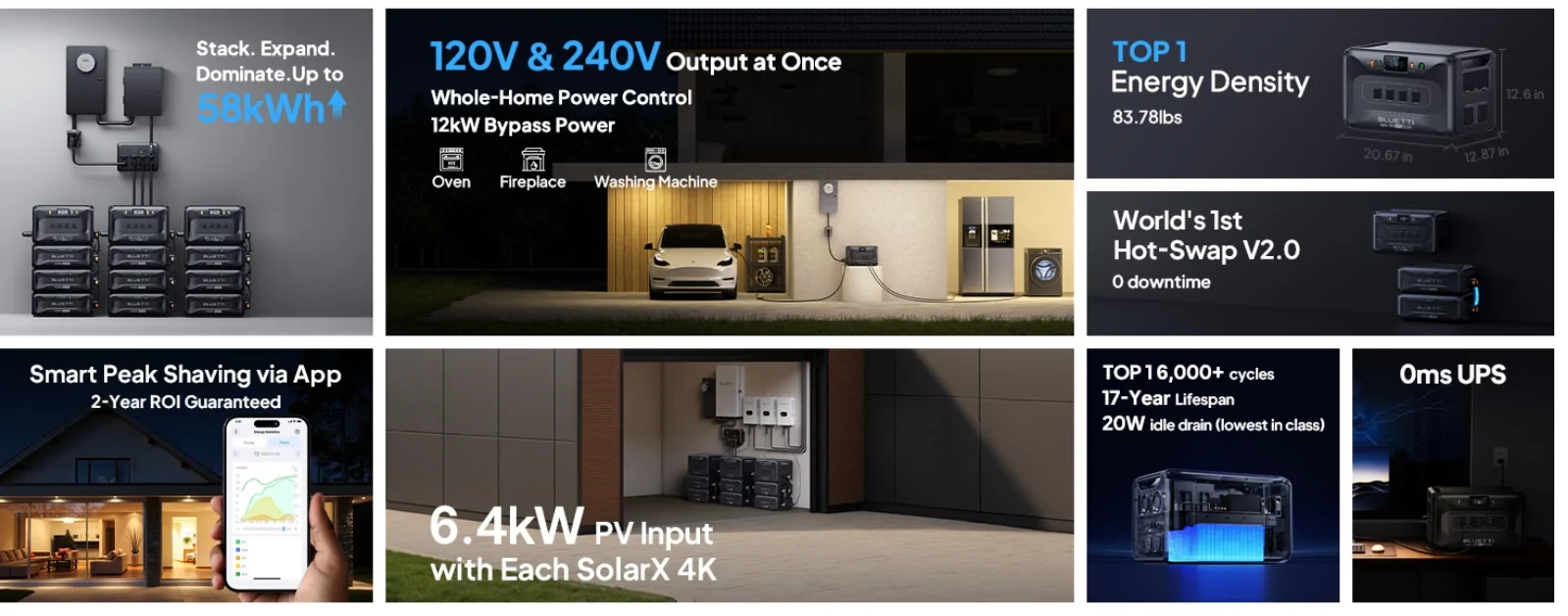
This one has 2.762kWh energy storage and both 120V and 240V output....not a lot for charging an EV unless you had a bank of them, but 1 might be enough for camping? I have no experience with them just an example from a search on Amazon. Caveat emptor.

Ford F-150 Lightning Frunk Ventilation battery system


https://www.amazon.com/BLUETTI-Apex...y+backup+with+240v+output,aps,158&sr=8-3&th=1
 

Sponsored

Heliian

Well-known member
Joined
Mar 9, 2023
Threads
5
Messages
2,084
Reaction score
2,422
Location
Canada
Vehicles
2023 LR Lariat, code name "Boogaloo"
No, it will catch on fire or worse. You shouldn't even run one in the box of your truck.
 
OP
OP
HelloToast

HelloToast

Member
First Name
Jeff
Joined
Jun 26, 2024
Threads
1
Messages
16
Reaction score
6
Location
AZ
Vehicles
2023 Lightning Platinum Agate Black
That scares me. Putting any ICE into an enclosure that was not specifically designed for the purpose sounds like a recipe for disaster.
Thank you. I understand & agree in principle. Please forgive my lengthy reply. It's intended to address multiple Forum responses.

Below are real world adventures that were (in part) intended to stress me and the EV systems. I concluded the hardware & software was pretty darn good, but still susceptible. I'm trying to minimize susceptibility:

1. I've been stranded several times in the western part of the US. Generally I was traveling in low population areas with minimal EV support, but they also included times when satellite coverage was weak and/or the navigation was simply wrong. More often than not the charging stations were Level 1 & maybe Level 2, poorly maintained and took hours to add a few miles of charge so I could limp to a viable Level 3 charger.

2. I get it. EV infrastructure isn't perfect. The software isn't perfect. The hardware isn't perfect. I'm certainly not perfect. In every case, I was able to correct for it and resume travel. The problem is I was often down to a final solution that was a single deviation away from not being a solution at all. For example:

a) Last year I was traveling Highway 50 across northern NV (the "Loneliest Road in America") and was directed to the only Level 3 charger (Fallon NV is a cool little town). No one had reported them as being offline because wasps had been building nests in the charging cable bays. The pins simply couldn't make contact. I reported the outage & the chargers were taken off-line to "help" subsequent EVs, but that didn't help me at 11 PM on a weekend. I was stuck overnight strapped to a Level 2 charger (& was happy to have that - Thank you Fallon Ford);

b) This summer I was traveling in central CA in high headwinds. The range was seriously impacted such that the software regularly recalculated the range. A fellow Lightning traveler (carrying no load) recharged with me at the prior stop. Both his & my software calculated an 80% charge as sufficient to get both of us to the next Level 3 chargers. I was carrying a full load, so I charged to 90%. We both barely limped to the next charger. For what it's worth, you can add substantial range by slowing your speed, but in the end, when you're nearly out of power (e.g. <2%) slowing down doesn't help. The remaining power seems to dissipate faster when it's nearly exhausted;

c) Again, under heavy headwinds, I crept to a halt about 3 miles short of the charging station (about 30 miles short of the software's projected range). In that case, a geni would have saved me a tow and the multi-hour delay. Sitting in a baking vehicle with no AC isn't the best experience, but having a power station capable of keeping my portable AC, refrigerator & phone functioning was well worth those investments;

d) The software/hardware often (if not always) fails to report Tesla Superchargers. Sometimes those are the only Level 3 chargers available in more remote locations. In Utah there were instances of me being directed to Level 1 & Level 2 chargers, but zero Level 3 chargers when in point of fact, multiple Tesla superchargers were available only an interchange or two away. This was a consistent problem across Utah where Tesla locations were dominant.

It's because of these experiences that I no longer use the vehicle charge for remote camping needs. I have used (& continue to use) the vehicle charge for day-to-day camping that's more proximate to Level 3 chargers, but I now use a separate power station and can monitor my electrical use more closely & allow me & my pups to survive delays

Thanks again.

Going to echo everyone else above me: not a good idea.

That area was not designed, or intended, for any sort of use like what you want to use it for. Better way would be to build an insulated enclosure with the proper one-way airflow to promote clean combustion in the bed of the truck. Off the top of my head, I'm thinking some 2x4s, plywood, and heat/fire resistant insulation with some of those flappy exhaust covers and some PC fans to push/pull air in/out of the enclosure.

Probably could come up with something that looks pretty decent that is semi-permanent that will suit your needs without having to deal with the frunk. Enclosure could house the generator, power station, and fuel cell all in one as well. I would solely rely on the generator/Bluetti power station to run everything else and preserve the Lightning for getting around. Either that or get a powerstation that will give true 240V out of the 30A plug, though I think you'd need an adapter.


From OSHA ...

• Never use a generator indoors or in enclosed
spaces such as garages, crawl spaces, and
basements. NOTE: Open windows and doors
may NOT prevent CO from building up when a
generator is located in an enclosed space.
• Make sure a generator has 3 to 4 feet of clear
space on all sides and above it to ensure
adequate ventilation.
• Do not use a generator outdoors if its placement
near doors, windows, and vents could allow CO
to enter and build up in occupied spaces.
Thank you. I agree with your concerns.

My intent was to only use a geni to recharge (either a work station or, if circumstances dictate, the vehicle to add enough power to get me to a viable charger). Operating it in a closed frunk is only proposed when ventilation would allow heat and exhaust to be removed. I can easily add a temperature and noxious fume detector. If I were stranded roadside, there would be little need to close the frunk. Minimizing noise is a side benefit necessary for limited circumstances.
 
OP
OP
HelloToast

HelloToast

Member
First Name
Jeff
Joined
Jun 26, 2024
Threads
1
Messages
16
Reaction score
6
Location
AZ
Vehicles
2023 Lightning Platinum Agate Black
Going to echo everyone else above me: not a good idea.

That area was not designed, or intended, for any sort of use like what you want to use it for. Better way would be to build an insulated enclosure with the proper one-way airflow to promote clean combustion in the bed of the truck. Off the top of my head, I'm thinking some 2x4s, plywood, and heat/fire resistant insulation with some of those flappy exhaust covers and some PC fans to push/pull air in/out of the enclosure.

Probably could come up with something that looks pretty decent that is semi-permanent that will suit your needs without having to deal with the frunk. Enclosure could house the generator, power station, and fuel cell all in one as well. I would solely rely on the generator/Bluetti power station to run everything else and preserve the Lightning for getting around. Either that or get a power station that will give true 240V out of the 30A plug, though I think you'd need an adapter.
I hear you.

The frunk is designed to support 120v and low voltage appliances. It seems logical to want to ventilate/drain those when the power to supply them is provided. As noted in the above response, I'm looking for what the frunk can do as opposed to what it was originally designed to do.

The Pulsar generator includes a 30a RV outlet. That allows me to plug in Ford's Level 2 charger (to charge the vehicle itself) and/or the Bluetti Apex 300. This particular Bluetti can also output true 240v. While that would improve vehicle recharging speed, workstation battery requirements (for remote 240v use) limits it's practicality. I rely on the Bluetti for remote camping although I do use the vehicle charge for camping when a Level 3 charger is near(er).

It's really a space issue: If I carry the geni, it needs to go either in the bed or in the frunk. In either case, I can remove & operate it more remotely to reduce noise, fuel and exhaust nuisance. I have investigated building a simple noise shed, but again, it's a space issue.

Thank you
 
OP
OP
HelloToast

HelloToast

Member
First Name
Jeff
Joined
Jun 26, 2024
Threads
1
Messages
16
Reaction score
6
Location
AZ
Vehicles
2023 Lightning Platinum Agate Black
Thank you. I understand & agree in principle. Please forgive my lengthy reply. It's intended to address multiple Forum responses.

Below are real world adventures that were (in part) intended to stress me and the EV systems. I concluded the hardware & software was pretty darn good, but still susceptible. I'm trying to minimize susceptibility:

1. I've been stranded several times in the western part of the US. Generally I was traveling in low population areas with minimal EV support, but they also included times when satellite coverage was weak and/or the navigation was simply wrong. More often than not the charging stations were Level 1 & maybe Level 2, poorly maintained and took hours to add a few miles of charge so I could limp to a viable Level 3 charger.

2. I get it. EV infrastructure isn't perfect. The software isn't perfect. The hardware isn't perfect. I'm certainly not perfect. In every case, I was able to correct for it and resume travel. The problem is I was often down to a final solution that was a single deviation away from not being a solution at all. For example:

a) Last year I was traveling Highway 50 across northern NV (the "Loneliest Road in America") and was directed to the only Level 3 charger (Fallon NV is a cool little town). No one had reported them as being offline because wasps had been building nests in the charging cable bays. The pins simply couldn't make contact. I reported the outage & the chargers were taken off-line to "help" subsequent EVs, but that didn't help me at 11 PM on a weekend. I was stuck overnight strapped to a Level 2 charger (& was happy to have that - Thank you Fallon Ford);

b) This summer I was traveling in central CA in high headwinds. The range was seriously impacted such that the software regularly recalculated the range. A fellow Lightning traveler (carrying no load) recharged with me at the prior stop. Both his & my software calculated an 80% charge as sufficient to get both of us to the next Level 3 chargers. I was carrying a full load, so I charged to 90%. We both barely limped to the next charger. For what it's worth, you can add substantial range by slowing your speed, but in the end, when you're nearly out of power (e.g. <2%) slowing down doesn't help. The remaining power seems to dissipate faster when it's nearly exhausted;

c) Again, under heavy headwinds, I crept to a halt about 3 miles short of the charging station (about 30 miles short of the software's projected range). In that case, a geni would have saved me a tow and the multi-hour delay. Sitting in a baking vehicle with no AC isn't the best experience, but having a power station capable of keeping my portable AC, refrigerator & phone functioning was well worth those investments;

d) The software/hardware often (if not always) fails to report Tesla Superchargers. Sometimes those are the only Level 3 chargers available in more remote locations. In Utah there were instances of me being directed to Level 1 & Level 2 chargers, but zero Level 3 chargers when in point of fact, multiple Tesla superchargers were available only an interchange or two away. This was a consistent problem across Utah where Tesla locations were dominant.

It's because of these experiences that I no longer use the vehicle charge for remote camping needs. I have used (& continue to use) the vehicle charge for day-to-day camping that's more proximate to Level 3 chargers, but I now use a separate power station and can monitor my electrical use more closely & allow me & my pups to survive delays

Thanks again.


Thank you. I agree with your concerns.

My intent was to only use a geni to recharge (either a work station or, if circumstances dictate, the vehicle to add enough power to get me to a viable charger). Operating it in a closed frunk is only proposed when ventilation would allow heat and exhaust to be removed. I can easily add a temperature and noxious fume detector. If I were stranded roadside, there would be little need to close the frunk. Minimizing noise is a side benefit necessary for limited circumstances.
No, it will catch on fire or worse. You shouldn't even run one in the box of your truck.
Thank you. I understand.

The scenario(s) for needing to run a geni (as silently as possible) are remote. Under most conditions I would just run it outside of the truck (from neither the frunk nor the bed). However, based on my in-field experiences (see above), I determined I need to carry a geni for remote travel. I'm just trying to solve for the widest range of contingencies which would include the potential need for not just carrying the geni, but operating it covertly.

Thanks again
 
OP
OP
HelloToast

HelloToast

Member
First Name
Jeff
Joined
Jun 26, 2024
Threads
1
Messages
16
Reaction score
6
Location
AZ
Vehicles
2023 Lightning Platinum Agate Black
That scares me. Putting any ICE into an enclosure that was not specifically designed for the purpose sounds like a recipe for disaster.
I understand & generally agree. It's just that the result of several remote trips (see some examples above) suggest I need to carry a geni to supplement my emergency energy needs.

If I have to carry a geni, it needs to go somewhere. In a perfect world, I wouldn't need to relocate the geni every time I need to use it. In any event, I wouldn't occupy the vehicle when the geni was in use, but if it were absolutely necessary for me to do so, I want to minimize the dangers.

Thanks again
Sponsored


Top