
Sponsored

EREV - A Horsepower Math Problem?

ZeusDriver

Well-known member
Joined
Dec 1, 2025
Threads
5
Messages
72
Reaction score
53
Location
East Coast, USA
Vehicles
2022 Lightning
I don’t understand why @Ford Motor Company did not reduce the F-150 BEV Lightning manufacturing capacity to meet the market size. Then, reconfigure the freed up capacity to produce Ranger and Maverick BEV’s. The charging infrastructure is getting better every day. I expect the market share for BEV’s will steadily increase as charging infrastructure and vehicle choices continue to expand.
Yes. Either reduce capacity to meet market size, or actually promote the trucks adequately to increase market share. I have not met a Ford salesperson who knew much about the Lightning... maybe there are some in California.

Jim Farley seems unable to set a course and stick to it. I was considering a Maverick when I bought the Lightning. Certainly would have purchased a new Maverick BEV if one were available, instead of this used Lightning. Back in 2021 I was on the list for a Lightning pro, but got off the list when they jacked up the price. I am no fan of bait and switch.
Sponsored


Skidrowe

Well-known member
First Name
Gideon
Joined
Dec 22, 2021
Threads
8
Messages
295
Reaction score
507
Location
Texas
Vehicles
2022 F-150 Lightning ER, 2014 Honda Pilot
Ya'll need to stop throwing HP and KW together in this thread it just makes it confusing jumping back and forth and that they dont really represent the same idea in this construct.

The Lightning stores kwh, and uses kw while driving.
2.0mi/kwh at 70mph is 35kw average, meaning you use 35kwh in one hour. To maintain even steven you need a generator to output 35kw continuously.

Assuming you are pulling a trailer and getting 1.0mi/kwh you need a generator capable of 70kw.

The question is if Ford will engineer for zero average battery depletion in a worse case situation, or allow allow battery SOC to drop while driving (you can bet they will, they have to).

My estimate, ~70kw. Steady state towing a modestly sized RV or a heavy but small trailer. Doing that in the mountains will deplete your battery.

Battery will be 70-90 kw, just below SR now, saving battery. This marches the performance figure.
If you had a 70kwh battery going 70mph at 1 mile per kwh (due to load), you would discharge the battery in 1 hour. That would be a 1C discharge rate. Even if you had a generator that could run at 70kw and output it continuously for an hour to charge the battery the whole time, that battery would have to have a 2C rating and that thing would get HOT! The current ER batteries charge just above 1C for about 5 minutes at the beginning of a charge session before dropping down below 1C to about .7C for the majority of the remaining charge cycle. It would take a different battery chemistry and/or a significantly improved cooling mechanism for the battery.

I've been curious how efficient a generator Ford can manufacture. It will likely have to be diesel and a rough estimate is that a 70kw diesel generator would burn 5-6 gallons of diesel per hour at 100% load. That would be $30 of diesel to go 140 miles with a big load. Or 23-28 mpg with a limited range.

If you increased the battery capacity and generator output, it would increase range at a non-linear rate because you wouldn't also increase the distance (speed) you'd go in an hour. So then the battery would be discharging at a less than 1C rate and leave more room to charge simultaneously without heating the battery up as much. I wonder where the sweet spot would be between battery size, generator output, and total range.

The possibility of thermal runaway increases (I don't know if it's significant) if the cooling mechanism fails while the battery is both charging and discharging at a high rate. Safety measures would have to throttle your power output and charge rate from the generator and would result in a significantly different towing experience than the peak performance of these batteries and motors are capable of.

Despite me not being interested in anything but a battery powered EV, I'm really curious how the engineers at Ford will balance and overcome all these limitations of modern EV batteries and ICE technology. Solving problems is fun. Reading how others solved them is a close second.
 

bthanos

Well-known member
First Name
Bill
Joined
Dec 3, 2024
Threads
8
Messages
111
Reaction score
160
Vehicles
2023 F150 Lightning Platinum
Occupation
System Architecture (retired)
Two best features of Lightning get traded for EREV Generator

Frunk
Silence

And maintenance added
 

Firn

Well-known member
Joined
Aug 26, 2024
Threads
28
Messages
1,430
Reaction score
1,543
Location
USA
Vehicles
23 Pro ER
If you had a 70kwh battery going 70mph at 1 mile per kwh (due to load), you would discharge the battery in 1 hour. That would be a 1C discharge rate. Even if you had a generator that could run at 70kw and output it continuously for an hour to charge the battery the whole time, that battery would have to have a 2C rating and that thing would get HOT! The current ER batteries charge just above 1C for about 5 minutes at the beginning of a charge session before dropping down below 1C to about .7C for the majority of the remaining charge cycle. It would take a different battery chemistry and/or a significantly improved cooling mechanism for the battery.

I've been curious how efficient a generator Ford can manufacture. It will likely have to be diesel and a rough estimate is that a 70kw diesel generator would burn 5-6 gallons of diesel per hour at 100% load. That would be $30 of diesel to go 140 miles with a big load. Or 23-28 mpg with a limited range.

If you increased the battery capacity and generator output, it would increase range at a non-linear rate because you wouldn't also increase the distance (speed) you'd go in an hour. So then the battery would be discharging at a less than 1C rate and leave more room to charge simultaneously without heating the battery up as much. I wonder where the sweet spot would be between battery size, generator output, and total range.

The possibility of thermal runaway increases (I don't know if it's significant) if the cooling mechanism fails while the battery is both charging and discharging at a high rate. Safety measures would have to throttle your power output and charge rate from the generator and would result in a significantly different towing experience than the peak performance of these batteries and motors are capable of.

Despite me not being interested in anything but a battery powered EV, I'm really curious how the engineers at Ford will balance and overcome all these limitations of modern EV batteries and ICE technology. Solving problems is fun. Reading how others solved them is a close second.
The battery is not simultaneously charging at 1C, and discharging at 1C, giving you 2C. The energy from the generator doesnt travel "through" the battery, that energy is going to the motors, from there the flow of energy varies from into the battery to out of the battery depending on the current condition.
 

Mal106

Well-known member
First Name
Mal
Joined
May 9, 2025
Threads
4
Messages
141
Reaction score
113
Location
SW VA
Vehicles
2025 Lightning Flash
Occupation
Retired Pilot
Just heard Farley say that the dismal EV sales since the incentives went away forced the decision. I feel this was very shortsighted. Everyone knew and expected that. No one knows when or if the demand will return in the US but EVs continue to grow in market share in practically the rest of the world. To eliminate the best or second best selling full size EV truck and much of the battery manufacture to support it may well be missing out on growing demand and cheaper batteries.

I have an MBA (unused) and realize the multi billion charges will help the balance sheet but I certainly hate to see accounting hocus pocus kill a vehicle with a great potential for profit if US consumers see the light.
 

Sponsored

Skidrowe

Well-known member
First Name
Gideon
Joined
Dec 22, 2021
Threads
8
Messages
295
Reaction score
507
Location
Texas
Vehicles
2022 F-150 Lightning ER, 2014 Honda Pilot
The battery is not simultaneously charging at 1C, and discharging at 1C, giving you 2C. The energy from the generator doesnt travel "through" the battery, that energy is going to the motors, from there the flow of energy varies from into the battery to out of the battery depending on the current condition.
I think I saw too many generalizations of "The generator will not be mechanically (keyword here) connected to the drivetrain" and conflated it to mean it will only send energy to the battery and not the motors. In a quick search, I was unable to find direct evidence to support what was in my head.

It makes more sense to have the motors drawing off both energy sources and thus reducing the rate at which the battery is depleted. And whatever mechanism lets the battery draw the power output from the motor during regenerative braking, will also let it draw the excess power the generator is outputting beyond the need of the motors to maintain speed (or accelerate) as you mentioned with your comment on energy flow.

700 miles is still a lot. My 2014 3.5 liter Eco boost didn't get 400 miles of range of combined driving on 30 gallons of gas. Maybe it would on a freeway road trip. But I can't see them putting in the 300 mile range battery of my lightning AND using that Eco boost engine as a generator while maintaining the same efficiency of both. The full gas tank weight alone would reduce the battery range. I wonder what sort of synergy they're expecting from the battery/generator to warrant a 700 mile range promise. The same goes for towing range while still expecting the current lightning towing performance.
 

ZeusDriver

Well-known member
Joined
Dec 1, 2025
Threads
5
Messages
72
Reaction score
53
Location
East Coast, USA
Vehicles
2022 Lightning
700 miles is still a lot. My 2014 3.5 liter Eco boost didn't get 400 miles of range of combined driving on 30 gallons of gas.
This number was no doubt picked to be 10 more than the 690 claimed by the RAM. Probably 200 miles on battery + 500 miles on a 25 gallon tank at 20 mpg. Goodbye frunk. Still a very tight squeeze. Seems like a revision of the front motor would be required.
 

Newton

Well-known member
Joined
May 27, 2021
Threads
11
Messages
489
Reaction score
658
Location
WA State
Vehicles
VW e-Golf, 2023 Lightning Lariat SR, Kia EV6, Toyota T-100
I saw someone quote the RamCharge, saying it has a 130kw generator. If some of the recent math is correct that you need 35kw ~ 70kw to keep driving at 70mph then this could be filling you up at twice the rate you are depleting.

I think what will be interesting is, as you say above, the range extender needs to know when to kick in and at what level to keep the battery. I can just imagine the Guess-o-Meter they will have to build to get that right!
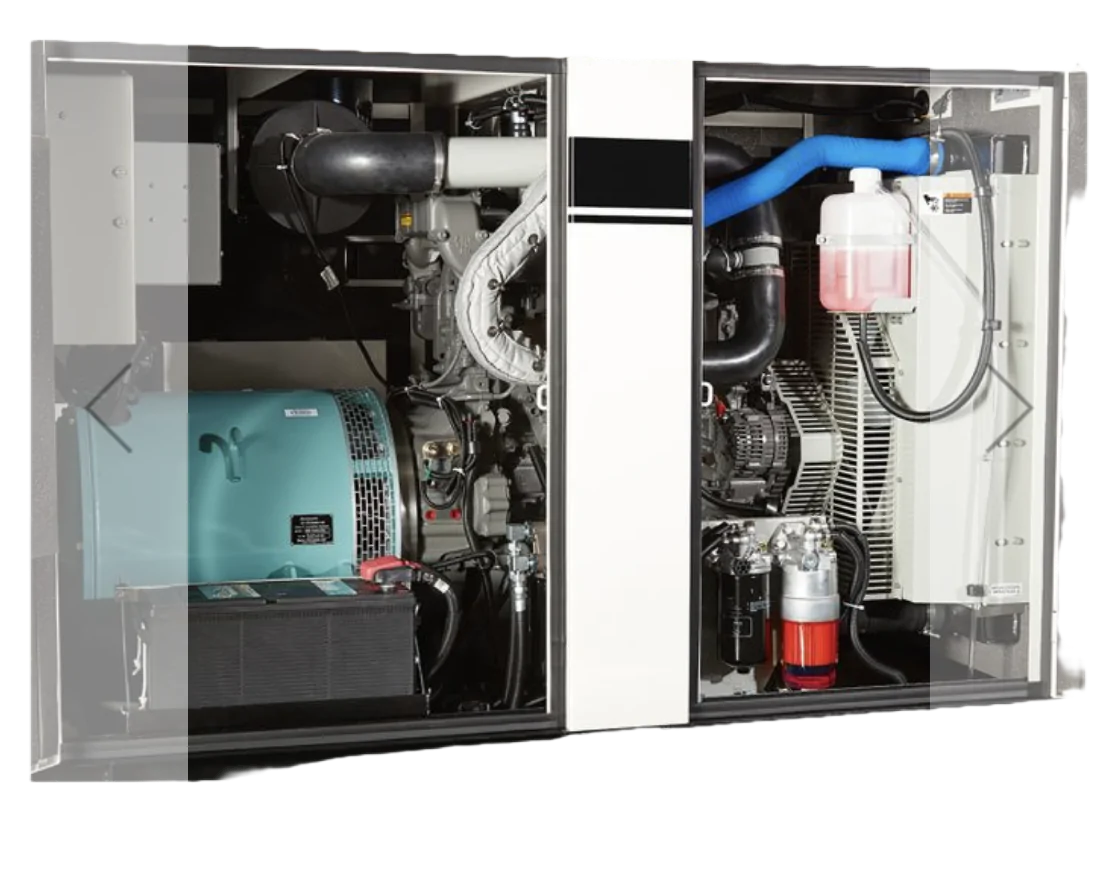
There is no way that it is a 130kW generator. This is what a 100kW generator looks like (and it costs $100,000)

Ford F-150 Lightning EREV - A Horsepower Math Problem? 1766121550220-nr
 

gregoryhcain

Well-known member
First Name
Gregory
Joined
Sep 16, 2022
Threads
0
Messages
76
Reaction score
167
Location
Steilacoom, WA
Vehicles
Toyota 4Runner, Nissan Pickup
Occupation
Physician
They must use a shoe horn to fit it all I
In:

The generator in the new Ram 1500 Ramcharger (its official name) is an onboard unit rated at 130 kW.


This generator is not connected to the wheels; its sole job is to convert mechanical energy from the gas engine into electricity to either charge the battery or power the electric drive motors directly.


Key Technical Specs


The system is powered by a familiar engine, but it operates in a unique "series hybrid" or Extended Range Electric Vehicle (EREV) configuration:


• Engine (Range Extender): A 3.6-liter Pentastar V6.


• Generator Output: 130 kW (with a peak mechanical engine output of roughly 202 kW to ensure the generator can run at peak efficiency).


• Battery Size: 92 kWh (liquid-cooled).


• Total Range: Up to 690 miles (targeted).


• Fuel Tank: 27 gallons.


How it Works


Unlike a traditional hybrid (like a Prius or a Ford F-150 PowerBoost), the Ramcharger’s gas engine has no mechanical link to the wheels.


1. The V6 engine turns the 130 kW generator.


2. The generator sends that electricity to the 92 kWh battery or directly to the front (250 kW) and rear (238 kW) electric motors.


3. Because the engine doesn't have to shift gears or deal with varying road speeds, it can run at its most efficient RPM to keep the truck moving or charging, even while towing up to 14,000 lbs.


Power Outlets


The truck also uses its battery and generator system to act as a mobile power station for tools or homes:


• Total Outboard Power: Up to 7.2 kW.


• Bed Outlets: Includes both 120V and 240V plugs.”
 

chriserx

Well-known member
First Name
Chris
Joined
Oct 3, 2025
Threads
1
Messages
230
Reaction score
150
Location
Louisiana
Vehicles
2025 Ford Lightning Flash Job 2 😭
There is no way that it is a 130kW generator. This is what a 100kW generator looks like (and it costs $100,000)

1766121550220-nr.webp
I mean I get what you're trying to say, but between the trailer and 169 gal fuel tank it's a little hard to visualize the difference. Until you realize it's a 5.2L diesel engine. Most people can visualize that.
 

Sponsored

Newton

Well-known member
Joined
May 27, 2021
Threads
11
Messages
489
Reaction score
658
Location
WA State
Vehicles
VW e-Golf, 2023 Lightning Lariat SR, Kia EV6, Toyota T-100
Here it is with the doors open. The blue cylinder is the important part, a very large and heavy alternator. For scale, look at the battery.

From what I have read I get the impression that the REV is 30kW , and even that is a big ask for a gasoline Pentastar V6. I would question the longevity of that system, although I'm a diesel guy so I suppose I am biased.

Ford F-150 Lightning EREV - A Horsepower Math Problem? 1766128768972-g3
 

grottomatic

New member
Joined
Dec 19, 2025
Threads
0
Messages
1
Reaction score
2
Location
US
Vehicles
2025 Lightning Flash
I think the EREV is an interesting concept, been done in a few ways before, namely the BMW i3 with range extender. For a truck with a described emphasis on towing, ford has to assure that it will not get into a low SOC/low power state during rigorous towing events such as Eisenhower/Vail Pass or other areas with multiple climbs and descents.

I assume Ford will need to have a generator that can feed the DC bus (not necessarily the battery) and motors at close to peak demand (200kW) without dropping SOC too much leaving the truck in a derate condition pulling a max load. Without a large genset, you could get into a condition where you did not have the SOC to pull a load at highway speeds if you did not start the climb without sufficient battery percentage, eliminating the advantage of an ERV. I suspect that Ford will need to run the generator 100% of the time in Tow/Haul mode to ensure SOC for climbs and Ford will force tow/haul mode anytime a 7 pin connector is detected.

This limits the engine/genset options for Ford - they might be able to use an ecoboost 4 such as the 2.3 in the ranger to supply 120kw-150kiw but the engine will be stressed and perhaps very noisy. An ecoboost 2.7 would do this easily at lower RPM and noise. I tend to think they will want a 4 for packaging but may need to use a 6, such as the 2.7 or 3.3NA to supply adequate genset power at peak load.

You will need to have a relatively large battery as buffer for max tow, if the motor can produce 120-150kw to the DC bus for the motors, then the battery will need to supply 70-50kw, sustained to generate 200kw (or more). This gives you an hour or less of max capability with a reasonable sized battery of 70-80kwh.

Running a motor at peak to feed the bus in max towing conditions will burn a lot of fuel, perhaps more than a ICE only truck given efficiency losses of the genset, DC bus, and electric motors. To hit "700 miles" the truck will have to have a considerably sized fuel tank - prob at least 25 gallons.

Dropping 50kwH of battery gives you some weight savings from the BEV, but enough for a genset and the capability to carry 25 gallons of fuel? and still have reasonable payload?

EREVs are a tough engineering problem. I'm surprised that they aren't doing this in a super duty platform to carry weight. It seems they may be approaching a 7500 lb vehicle.

This vehicle will also be very expensive - you get the full cost of the pack, genset and HV conduit, extreme cooling needs for what will become a very hot engine, battery, and electric motors.

Ford will need to make some breakthroughs that make this attractive to buyers at a reasonable cost.
 

MrH42

Well-known member
First Name
Mike
Joined
Dec 3, 2023
Threads
1
Messages
53
Reaction score
51
Location
Cincinnati, OH
Vehicles
2023 Lariat ER, 2024 Miata
Here it is with the doors open. The blue cylinder is the important part, a very large and heavy alternator. For scale, look at the battery.

From what I have read I get the impression that the REV is 30kW , and even that is a big ask for a gasoline Pentastar V6. I would question the longevity of that system, although I'm a diesel guy so I suppose I am biased.

1766128768972-g3.webp

...what?

30 kW is not a "big ask" for a V6 pentastar. Do you not realize that kW is just a measure of power? 30 kW = 40 hp. Pentastars have been making 200-300 hp peak for over a decade. You'd want to optimize it for this use case, but 30 kW is not some sort of unachievable power output.

Generators for buildings are larger for a lot of different reasons (cooling, need to sustain output indefinitely, less focus on packaging efficiency, etc).
 

Lomilar

Active member
First Name
Fritz
Joined
May 18, 2024
Threads
0
Messages
33
Reaction score
39
Location
Camas, WA
Vehicles
2024 F150 Lightning Flash
https://www.f150lightningforum.com/forum/threads/important-update-ford-ev-roadmap-future-of-f-150-lightning-erev-next-gen-model-⛔-admin-warning-no-politics.33426/post-618051
So the above states that you need half a Miata engine (80 hp) to keep the truck running on level ground with gas at 80mph forever. If you assume trailer (~halves the efficiency per Aging Wheels, thereby ~doubling the power requirement) and grade (halves the efficiency again per this, again, doubling the power requirement) then you need a peak horsepower of 80*2*2, or 320hp to be able to tow up a 5% grade using just gas forever.

However, not all grades last forever, and cabbage hill (one of the worst) is 7 miles at 6%. If you're able to store energy, you can target 50% energy and as long as you have ~28 miles in the battery, you can come out the other side and regen while generating to give you back those 28 miles in a hurry.

I think realistically a 200hp engine could handle this along with a 50kwh battery, but I haven't done the real engineering to figure out the actual answer here.
 
Last edited:

VAF84

Well-known member
Joined
Oct 20, 2023
Threads
24
Messages
259
Reaction score
262
Location
Central Texas
Vehicles
2024 Sierra EV Denali
Occupation
Consultant
I think the EREV is an interesting concept, been done in a few ways before, namely the BMW i3 with range extender. For a truck with a described emphasis on towing, ford has to assure that it will not get into a low SOC/low power state during rigorous towing events such as Eisenhower/Vail Pass or other areas with multiple climbs and descents.

I assume Ford will need to have a generator that can feed the DC bus (not necessarily the battery) and motors at close to peak demand (200kW) without dropping SOC too much leaving the truck in a derate condition pulling a max load. Without a large genset, you could get into a condition where you did not have the SOC to pull a load at highway speeds if you did not start the climb without sufficient battery percentage, eliminating the advantage of an ERV. I suspect that Ford will need to run the generator 100% of the time in Tow/Haul mode to ensure SOC for climbs and Ford will force tow/haul mode anytime a 7 pin connector is detected.

This limits the engine/genset options for Ford - they might be able to use an ecoboost 4 such as the 2.3 in the ranger to supply 120kw-150kiw but the engine will be stressed and perhaps very noisy. An ecoboost 2.7 would do this easily at lower RPM and noise. I tend to think they will want a 4 for packaging but may need to use a 6, such as the 2.7 or 3.3NA to supply adequate genset power at peak load.

You will need to have a relatively large battery as buffer for max tow, if the motor can produce 120-150kw to the DC bus for the motors, then the battery will need to supply 70-50kw, sustained to generate 200kw (or more). This gives you an hour or less of max capability with a reasonable sized battery of 70-80kwh.

Running a motor at peak to feed the bus in max towing conditions will burn a lot of fuel, perhaps more than a ICE only truck given efficiency losses of the genset, DC bus, and electric motors. To hit "700 miles" the truck will have to have a considerably sized fuel tank - prob at least 25 gallons.

Dropping 50kwH of battery gives you some weight savings from the BEV, but enough for a genset and the capability to carry 25 gallons of fuel? and still have reasonable payload?

EREVs are a tough engineering problem. I'm surprised that they aren't doing this in a super duty platform to carry weight. It seems they may be approaching a 7500 lb vehicle.

This vehicle will also be very expensive - you get the full cost of the pack, genset and HV conduit, extreme cooling needs for what will become a very hot engine, battery, and electric motors.

Ford will need to make some breakthroughs that make this attractive to buyers at a reasonable cost.
All of this just sounds terrible. Whether it’s a V6 Pentastar, or a 2.7 Turbo, who wants this? Those are power plants that already power full sized pickup trucks, and require all of the regular maintenance, expenses, inconveniences of an ICE vehicle. Then throw in the battery and all of its potential issues. Not to mention that if going the turbo route, that further increases complexity and failure points.

I still don’t think this moves the needle for the traditional truck buyer. A lot of old school guys will still not like that they can’t fix it themselves if something goes wrong, and new gen will want pure EV. The price is likely to be equal or more than pure EV with the extra hardware.

I love reading the technical aspects of this experiment, but the more I read, the less I believe you’re average Joe is going to sink their hard owned money into this.
Sponsored


Top