

Sponsored

12V battery replacement poll

Will you replace your 12V battery proactively or when it fails?


  • Total voters
    211

mr.Magoo

Well-known member
Joined
May 27, 2022
Threads
26
Messages
1,110
Reaction score
1,416
Location
Michigan
Vehicles
2022 Lariat ER, AMB
56% of 35Ah = 21Ah and 79% of 35Ah = 27.65Ah so
56% to 79% in 15 min is: 27.65Ah - 21Ah = 6.65Ah in 15minutes, or
6.65Ah / .25h = 26.6A not 52A
Well, I did ballpark an average of 30A, so there's that, we're really not that far apart.
The 52A is a snapshot in time, it's whatever the value is at the time the reading is taken, no one ever claimed it was continous, in fact, I even mentioned that it tapers off pretty quickly.

IF the Ford Lightning battery gets deeply discharged which 40% would be, then I would expect the Lightning BMS to start with a low current when recovering them.
Here's a 0% >> 100% cycle from when I learned the hard way that leaving the truck in neutral somehow doesn't shut the truck off and drains your battery. If we focus on the first hour, and add an average calculation, you can see that the average current during that hour is 16.3A and the SoC at the end of it is 55% and while 16.3A isn't 55% of 35Ah I'd personally say it's close enough to where the numbers seem accurate. And in that instance you have a peak current of 35A.

Ford F-150 Lightning 12V battery replacement poll 1763874742455-r0

Ford F-150 Lightning 12V battery replacement poll 1763875305880-


A deeply discharged AGM should start with a low current at around 10% of its Ah rating. So for this 35Ah battery, about 3.5A.
I don't know what to tell you except that it doesn't. (see charts)


The changes to the BMS software has elimintated some of the low SOC OTA problems, but please don't tell me it will lead to overcurrent charging problems!
As stated before,if my data is correct (which I belive it is) they've actually reduced the charge current, so while it still may be (probably is) a contributing factor to the relative short life span, it's actually been improved.


Not over-thinking it, just using industry standard AGM charging specifications which leads me to question those numbers.

They just don't compute with proper engineering.
With proper engineering there would never be any recalls, now would there ? ;-)

While I don't disagree with you, I also have no reason to belive my numbers (well, they're not really mine, they're from the truck) are incorrect, so that can only lead to the conclusion that Ford isn't following charging specifications / reccomendations.
Sponsored


 

chl

Well-known member
First Name
CHRIS
Joined
Dec 16, 2022
Threads
9
Messages
3,824
Reaction score
2,361
Location
alexandria virginia
Vehicles
2023 LIGHTNING PRO, 2012 Nissan Leaf, 2015 Toyota Prius, 2000 HD 883 Sportster
Occupation
Patent Atty / Electrical Engineer
Well, I did ballpark an average of 30A, so there's that, we're really not that far apart.
The 52A is a snapshot in time, it's whatever the value is at the time the reading is taken, no one ever claimed it was continous, in fact, I even mentioned that it tapers off pretty quickly.


Here's a 0% >> 100% cycle from when I learned the hard way that leaving the truck in neutral somehow doesn't shut the truck off and drains your battery. If we focus on the first hour, and add an average calculation, you can see that the average current during that hour is 16.3A and the SoC at the end of it is 55% and while 16.3A isn't 55% of 35Ah I'd personally say it's close enough to where the numbers seem accurate. And in that instance you have a peak current of 35A.

1763874742455-r0.webp

1763875305880-bw.webp


I don't know what to tell you except that it doesn't. (see charts)


As stated before,if my data is correct (which I belive it is) they've actually reduced the charge current, so while it still may be (probably is) a contributing factor to the relative short life span, it's actually been improved.


With proper engineering there would never be any recalls, now would there ? ;-)

While I don't disagree with you, I also have no reason to belive my numbers (well, they're not really mine, they're from the truck) are incorrect, so that can only lead to the conclusion that Ford isn't following charging specifications / reccomendations.
I think the current that is being measured and reported on the graphs is MORE than just the battery charging current.

If the truck is ON, then there are all kinds of other 12V systems running, battery and converter cooling, the computer, etc. and they are being power through that line you have you ammeter on. Even when the truck is off, some 12v systems are running (computer charge timer for example).

How much of the 12v system's current is being used to charge the battery though?

Well, the BMS is controlling that and it seems that the ammeter is down stream of the BMS in the picture.

The question is how much current is the BMS passing through to the battery though?

One of the functions of the BMS is to control the charging current that gets to the battery. It limits the amount of current getting into the battery from the DC-DC converter so that the battery is not overhcharged.

Some portion of that graph of the current in the 12V system is getting through the BMS to charge the battery, but not 70A, in my opinion.

The specs say the system uses a max of 300W for the 12v battery charger.

----from a search but consistent with what we know----

Functions of the 12V BMS
  • Monitors the battery: The BMS continuously tracks the 12V battery's voltage, current, and temperature to ensure safe operation.
  • Protects the battery: It prevents overcharging and over-discharging, which can damage the battery and shorten its lifespan.
  • Integrates with the high-voltage battery: The BMS can automatically draw power from the high-voltage (HV) battery to recharge the 12V battery when needed. This happens when the 12V battery's state of charge drops below 30% (immediately) or 40% (after a 48-hour delay).
  • Manages charging: The BMS controls the DC-DC converter to charge the 12V battery when the truck is running or plugged in.
  • Performs load shedding: If the 12V battery's charge is critically low and the truck is off, the BMS may reduce or shed power to non-essential accessories to conserve energy for starting the vehicle.
  • Allows for manual reset: After a 12V battery replacement or disconnection, the BMS requires a manual reset to prevent false low-battery warnings

----
Anyway we have gotten a bit off-topic.

Last point: Anybody who wants their 12v AGM battery to last, will get a trickle charger with an AGM mode and keep the AGM battery at 100% when the truck is not being driven.

A $30-$40 trickle charger is a lot less expensive than a new battery out of warranty, not to mention the inconvenience of being stranded somewhere with no juice.
 

mr.Magoo

Well-known member
Joined
May 27, 2022
Threads
26
Messages
1,110
Reaction score
1,416
Location
Michigan
Vehicles
2022 Lariat ER, AMB
I think the current that is being measured and reported on the graphs is MORE than just the battery charging current.

How much of the 12v system's current is being used to charge the battery though?

Well, the BMS is controlling that and it seems that the ammeter is down stream of the BMS in the picture.

The question is how much current is the BMS passing through to the battery though?

One of the functions of the BMS is to control the charging current that gets to the battery. It limits the amount of current getting into the battery from the DC-DC converter so that the battery is not overhcharged.
Unlike voltage (that drops with distance and more) current can't just dissapear, or go anywhere else (unless there's a branch downstream of course).

AI in your searches seem to think that you're talking about BMSystem, but the BMSensor on the battery is just that, a sensor, it's not a "valve" that adjusts the flow of current like a faucet, it's just a current sensor, so measuring before or after the sensor makes no difference.

In the case of that cable / sensor, the current either goes TO the battery (i.e. charging, positive value) or it goes FROM the battery TO the vehicle (consumption, a , negative value). Normally the truck (and with that the DC/DC) is ON and in that case the DC/DC charger/power supply takes care of the consumption which is why you rarely see a negative value with the DC/DC / Truck on.

The specs say the system uses a max of 300W for the 12v battery charger.
I'm wondering where you got that information from ? My guess is here.
That's talking about the "emergency" charge and it's 300W - hours - or basically 20Ah (or there abouts) but it doesn't say anything about max charging current/wattage, 100A for 10min and then 3A the remaining 50min will also achive 20Ah or 300 Wh.

If you're interested, the same document talks about how the BMSensor is connected to the BCM and how all that works (component description on page 6)


Anyway we have gotten a bit off-topic.
Agreed, this will be the last from me on the subject in this thread.
 
Last edited:

NW Ontario Ford Lightning

Well-known member
First Name
Robert
Joined
Feb 14, 2025
Threads
2
Messages
618
Reaction score
849
Location
NW Ontario Canada
Vehicles
2024 F-150 SR Lightning XLT, 2023 Escape Hybrid
Occupation
Contractor
Interesting thread:
clearly we hear of problems with the 12v AGM batteries from members, resulting in issues such as the truck missing or not finishing an OTA update, or some operational issue at start up, or in some cases a member reports not being able to operate the door locks/start the truck due to low AGM SOC.

This indicates a problem with the 12v battery management - but what is the problem exactly?:
1) does the system allow the 12v SOC to drop to very low unacceptable values resulting in shortening the battery life;
2) or does the system use excessively high charging current that shorten the AGM battery life.
3) or does it do both.

In practical terms, does it really matter which is the cause? The AGM batteries are "happy" to be left at 100% SOC without life-shortening consequences, why not trickle charge them?

What is the potential harm in adding a 12v AGM trickle charger ?
 

Lytning

Well-known member
Joined
Jan 8, 2022
Threads
12
Messages
745
Reaction score
1,283
Location
Georgia
Vehicles
Prev: 2000 SVT Lightning; Now: 2022 BEV Lightning
Occupation
Engineer
Hello, Brian, not AI, @Ford Motor Company,

Can you find out and inform us what the maximum charge rate is to the 12 volt battery in our Lightnings?

Thank you,

Steve
 

Sponsored

EVpower

Well-known member
First Name
Steve
Joined
Dec 24, 2023
Threads
2
Messages
65
Reaction score
74
Location
Northern California
Vehicles
2023 F-150 Lightning Lariat, Bronco II
Occupation
Electrical Engineer
I am 28 months into the OEM low voltage battery and have had several battery tests reports recently indicate weak-recharge. What is Fords standard for test results which would call for a warranty replacement of the LV battery?

I'll add that when I have checked the charging current it has been about 40 amps. That does seem high for a 35 AH AGM battery based on the general industry recommendations.

Steve
 
  • Like
Reactions: chl

chl

Well-known member
First Name
CHRIS
Joined
Dec 16, 2022
Threads
9
Messages
3,824
Reaction score
2,361
Location
alexandria virginia
Vehicles
2023 LIGHTNING PRO, 2012 Nissan Leaf, 2015 Toyota Prius, 2000 HD 883 Sportster
Occupation
Patent Atty / Electrical Engineer
Unlike voltage (that drops with distance and more) current can't just dissapear, or go anywhere else (unless there's a branch downstream of course).

AI in your searches seem to think that you're talking about BMSystem, but the BMSensor on the battery is just that, a sensor, it's not a "valve" that adjusts the flow of current like a faucet, it's just a current sensor, so measuring before or after the sensor makes no difference.

In the case of that cable / sensor, the current either goes TO the battery (i.e. charging, positive value) or it goes FROM the battery TO the vehicle (consumption, a , negative value). Normally the truck (and with that the DC/DC) is ON and in that case the DC/DC charger/power supply takes care of the consumption which is why you rarely see a negative value with the DC/DC / Truck on.


I'm wondering where you got that information from ? My guess is here.
That's talking about the "emergency" charge and it's 300W - hours - or basically 20Ah (or there abouts) but it doesn't say anything about max charging current/wattage, 100A for 10min and then 3A the remaining 50min will also achive 20Ah or 300 Wh.

If you're interested, the same document talks about how the BMSensor is connected to the BCM and how all that works (component description on page 6)


Agreed, this will be the last from me on the subject in this thread.
Thanks for the linked document. I had seen the "300Wh" written as 300W in another Ford document or video which seems to have been an error.

Yes, nowhere does that document specify the charging current.

If we assumed the standard max current of 30% of 35Ah, a charging current of 10.5A, and a standard AGM charging voltage of 13-15 volts, say 14V, then that's about a 2 hour charge session to add the 30Wh or energy: 14V x 10.5A = 147W; 300Wh / 147W = 2.04 hours.

That does not seem unreasonably long to me.

Of course, that passage you linked me to is talking about a situation where the battery is at 40% or lower. With that low an SOC, my understanding is one would want to start with a lower current to avoid damaging the battery.

The document you linked to says about the BMS:

The Battery Monitoring is clamped directly to the negative terminal of the battery and grounds to the vehicle at the chassis ground connection point through the negative battery cable and eyelet. It is part of the negative battery cable and cannot be serviced separately....
Should the battery need to be isolated, this should be done by disconnecting the ground
eyelet at the chassis ground.


While that is not particularly clear, I had seen something like that in another Ford document, and it sounded to me like it was saying the BMS is in series between the negative terminal and the truck ground via the ground eyelet. That led to my assumption, which I admit may be wrong, that the BMS did act like a 'valve' as you put it to control the charge current since it seems to connect the battery negative post to the rest of the 12v system via the eyelet, which would include the DC-DC converter.

The BMS is part of a system that regulates the 12v battery charging. That would be done by controlling the charging current and voltage one way or another. It is not unheard of for a sensor to also be a switch ("valve") to control what it is sensing.

Without a wiring diagram or clearer language, I cannot be sure however how that charging control is accomplished.

However it works, it seems to me that those large current levels (70A for example) in the graph would have to be the DC-DC converter current powering the rest of the 12V system (computer, cooling pumps, etc.) which were on at the time the measurement was taken, since it is hard for me to imagine a 70A charging current for the 12v battery.

If we find out from Ford that they are, in fact, using a 70A charging current, then keeping the battery topped off with a more reasonable current level from a trickle charger would be all the more important for long battery life.
 

mr.Magoo

Well-known member
Joined
May 27, 2022
Threads
26
Messages
1,110
Reaction score
1,416
Location
Michigan
Vehicles
2022 Lariat ER, AMB
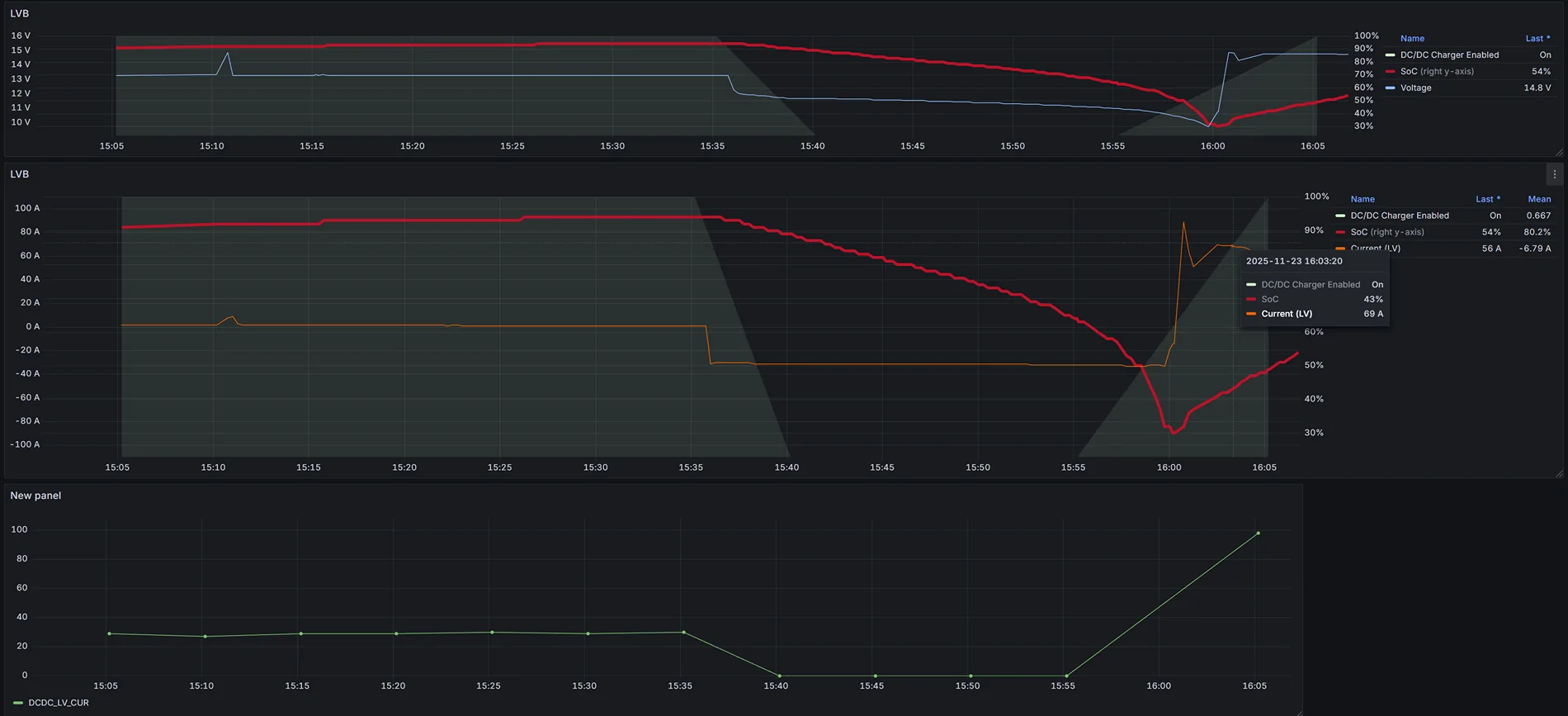
Sorry, just one more, since I decided to repeat my "mistake" from earlier this year in the name of science.

If you leave the truck in neutral it'll only partially shut off after the 30min timer, but somehow it remains in neutral and all the electronics is still alive, effectively draining your 12V battery, and fast.

As you can see on the orange line (battery current) it's being "topped off" with 1A, the rest of the vehicle power (12V) consumtion is supplied by the DC/DC converter ~29-30A.

When the vehicle shuts off, around 3.35pm, you see the orange line drop to -31A because power is now drawn from the battery, and similarly you can see the green line drop to 0A because the DC/DC converter is now OFF.

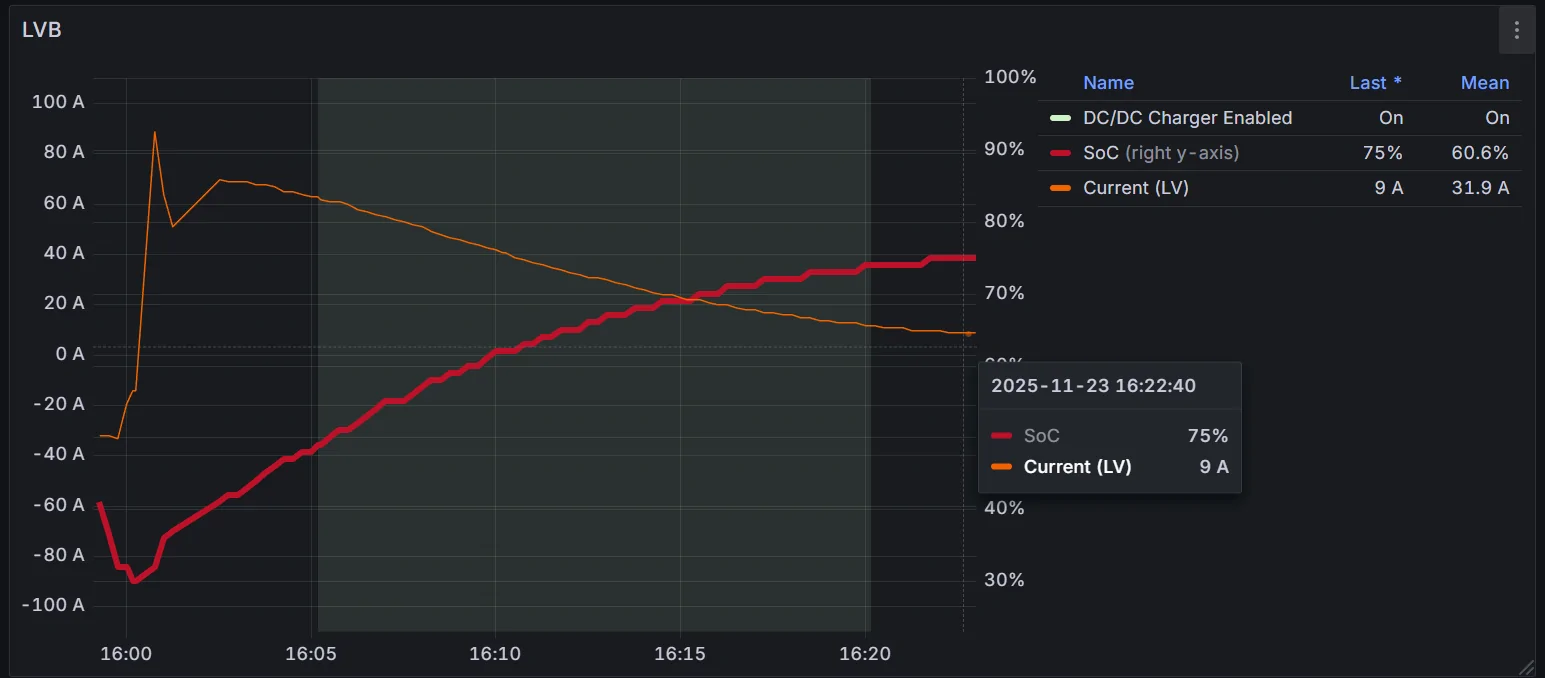
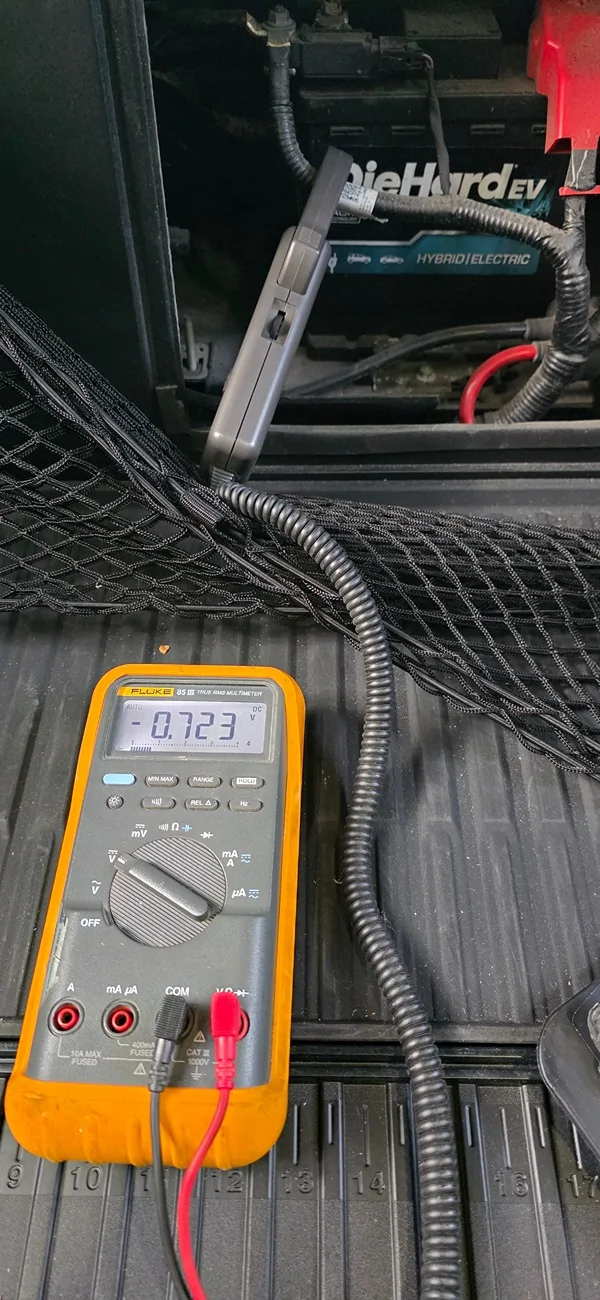
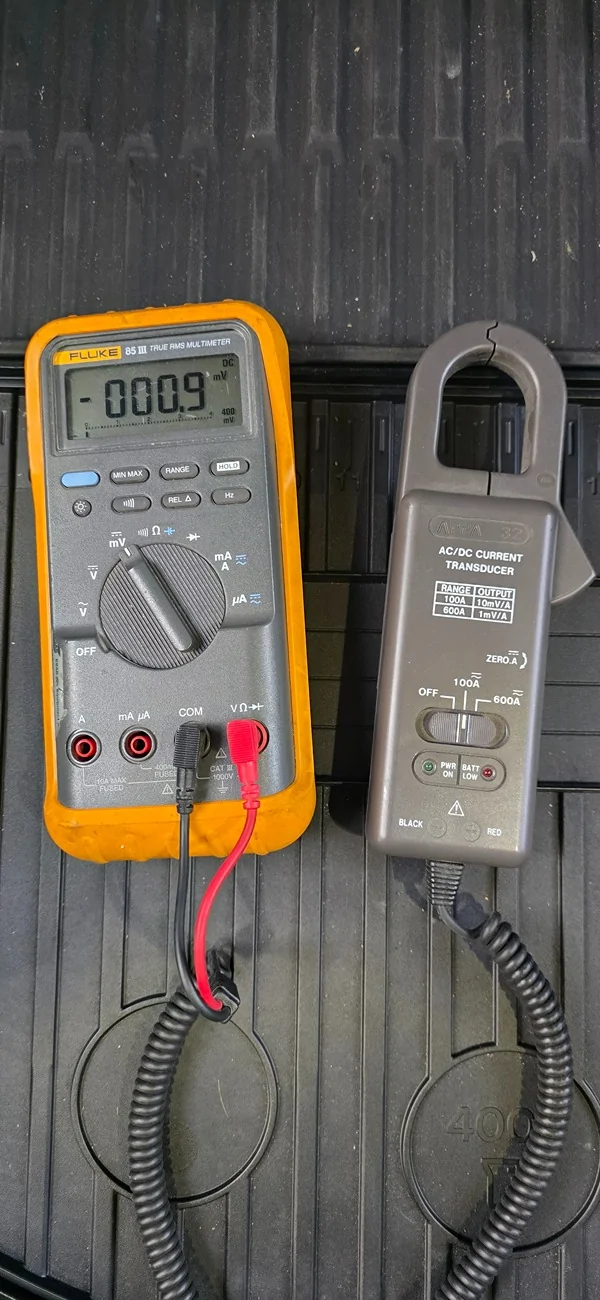
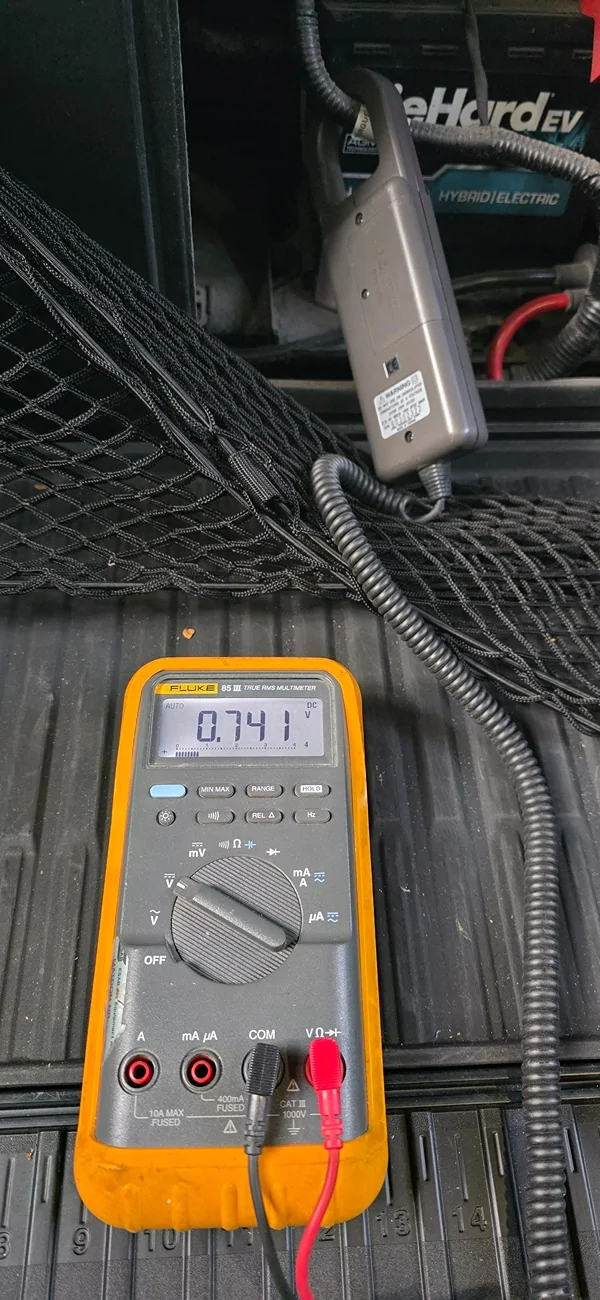
At 4pm SoC have already reached 30% and I rush outside and start the truck back up and set up my multimeter / clamp meter. And as you can see the clamp meter is registering 72A and the Truck is saying it's 69/70A, you can also see the 12V side of the DC/DC converter jump to 100A, 30 for the truck (as per before) and 70A to the battery.

20min later the current is down to a more sensible 9A and SoC is back up to 75%


Ford F-150 Lightning 12V battery replacement poll 1763932431085-zi
Ford F-150 Lightning 12V battery replacement poll 1763933031302-ek
Ford F-150 Lightning 12V battery replacement poll 20251123_160241
Ford F-150 Lightning 12V battery replacement poll 20251123_160217
Ford F-150 Lightning 12V battery replacement poll 20251123_160301
 

bmwhitetx

Well-known member
First Name
Bruce
Joined
May 21, 2021
Threads
48
Messages
3,177
Reaction score
4,602
Location
DFW-Texas
Vehicles
2022 F150 Lightning Lariat ER
Occupation
Retired engineer
@chl The BMS (sensor) monitors the current through it and reports that along with temperature and battery age to the BCM via the LIN bus. The BCM then provides the PCM with a SOC and the PCM decides a voltage setpoint for the DC-DC converter (e.g., I've seen 13.7V and 14.4V) which affects how fast or slow the battery will charge (accept current). The SOBDMC also gets involved.

There is not a specific charging current. If Brian says a single number, he's wrong. The current varies and dependent on the voltage the DC-DC has been instructed to provide and other 12V loads. It doesn't provide a constant current. But the BMS tells the system the current flowing in and out of it - and by the PCM adjusting voltage then current can be somewhat regulated in and out of the battery. I see you're also an EE - think KVL, KCL, Ohm's law.

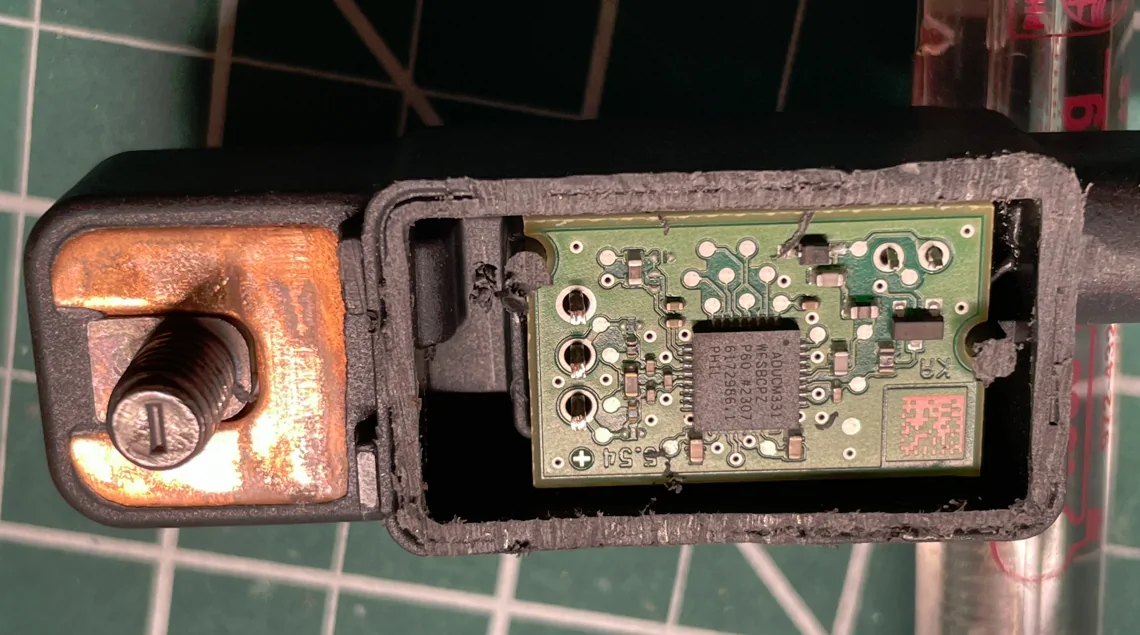
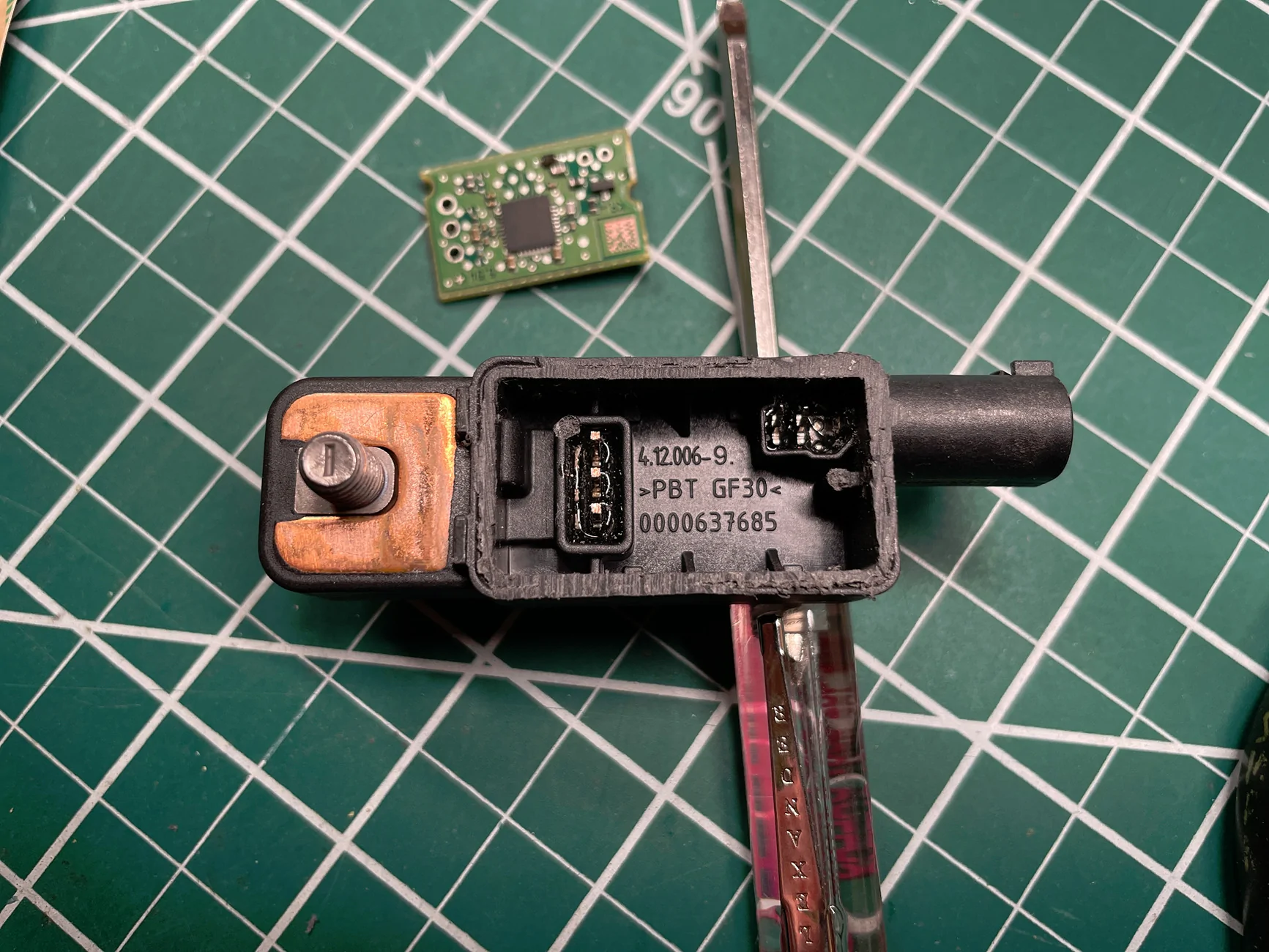
I have taken a BMS apart - it has a microprocessor so its doing some calculations. There is definitely no switch, valve, contactor, etc. It has a current sensor (Hall Effect?) built into the plastic between the input and output lugs.

You might want to spend $29 on a 3-day subscription to PTS. The Service manual has wiring diagrams, system operation description, etc. Much better source than any AI.

Ford F-150 Lightning 12V battery replacement poll 1763939726073-0j

PICS: LIN bus and battery positive enter from two pins on upper right. My best guess is current sensor and battery negative are present on the three large pins on the left.
Ford F-150 Lightning 12V battery replacement poll BMS Sensor Inside (6)
 
Last edited:

chl

Well-known member
First Name
CHRIS
Joined
Dec 16, 2022
Threads
9
Messages
3,824
Reaction score
2,361
Location
alexandria virginia
Vehicles
2023 LIGHTNING PRO, 2012 Nissan Leaf, 2015 Toyota Prius, 2000 HD 883 Sportster
Occupation
Patent Atty / Electrical Engineer
@chl The BMS (sensor) monitors the current through it and reports that along with temperature and battery age to the BCM via the LIN bus. The BCM then provides the PCM with a SOC and the PCM decides a voltage setpoint for the DC-DC converter (e.g., I've seen 13.7V and 14.4V) which affects how fast or slow the battery will charge (accept current). The SOBDMC also gets involved.

There is not a specific charging current. If Brian says a single number, he's wrong. The current varies and dependent on the voltage the DC-DC has been instructed to provide and other 12V loads. It doesn't provide a constant current. But the BMS tells the system the current flowing in and out of it - and by the PCM adjusting voltage then current can be somewhat regulated in and out of the battery. I see you're also an EE - think KVL, KCL, Ohm's law.

I have taken a BMS apart - it has a microprocessor so its doing some calculations. There is definitely no switch, valve, contactor, etc. It has a current sensor (Hall Effect?) built into the plastic between the input and output lugs.

You might want to spend $29 on a 3-day subscription to PTS. The Service manual has wiring diagrams, system operation description, etc. Much better source than any AI.

1763939726073-0j.webp

PICS: LIN bus and battery positive enter from two pins on upper right. My best guess is current sensor and battery negative are present on the three large pins on the left.
BMS Sensor Inside (6).webp
Thanks.

Yea, I dug in to the whole thing a little deeper and see I had assumed a couple things that did not pan out.

The BMS sensor is just a sensor/calculator giving the rest of the battery control system the information needed to control 12v battery charging, so it does not act as a valve/switch,

There are several components involved, and the thingy that charges the 12v battery is the DC-DC Converter Control Module (CCM).

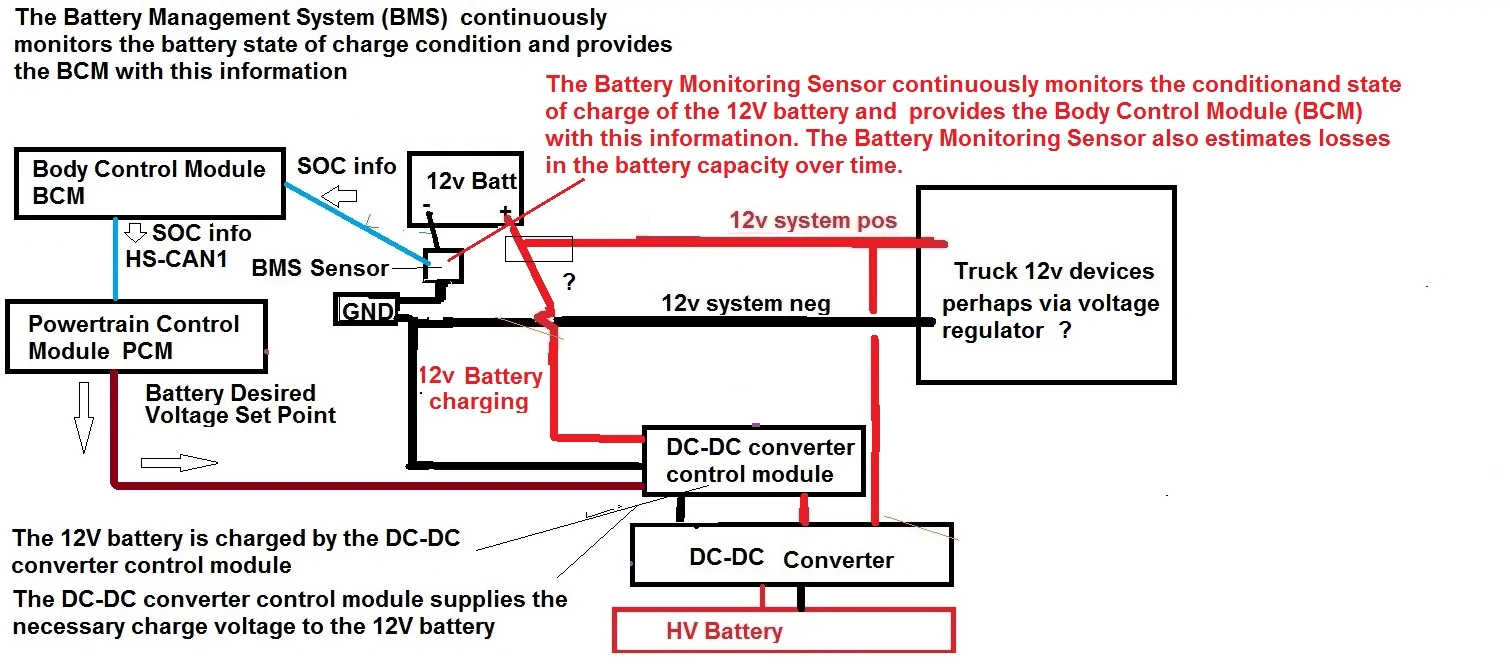
I haven't found a lot of detail about the wiring, but I threw together a block diagram of what I could discern from the Ford docs. I stuck the text into the image (with some corrections for spelling - like battery was spelled 'batter' sometimes):

Ford F-150 Lightning 12V battery replacement poll DC-DC-Battery-12v system block diagram


If the charging voltage is 14.4v and if the measured charging current is really high, that's a sign of a badly depleted battery (the lower the SOC the higher the charging current).

And it is also a sign that Ford did not put any (enough) current limiting circuitry in the charging system, which is...bad. High currents will ruin an AGM over time permanently. Maybe it's an issue with the BMS sensor.

Like I've mentioned before, as I understand it, the maximum recommended charging current for an AGM is generally 30% of the Ah rating. So those currents others are reporting, if really just the charging current, are a bad sign.

I'd like to see a wiring diagram some day - I'm curious about how the DC-DC CCM is wired to charge the battery per the description I read. Is there a separate charge path or does the whole DC-DC converter output voltage rise to charge the battery?

This was the description I used for the block diagram taken from a document that was linked above somewhere:
----

12V Battery Charging System

The 12V battery is charged by the DC-DC converter control module. The Battery Management System (BMS) continuously monitors the battery state of charge condition and provides the BCM with this information. The BCM communicates this information to the PCM over the HS-CAN1. The PCM communicates the battery desire setpoint to the DC-DC converter control module which supplies the necessary charge voltage to the 12V battery....

Battery Monitoring Sensor
The Battery Monitoring Sensor continuously monitors the conditionand state of charge of the 12V battery and provides the Body Control Module (BCM) with this informatinon. The Battery Monitoring Sensor also estimates losses in the battery capacity over time.

The Battery Monitoring Sensor is clamped directly to the negative terminal of the battery and grounds to the vehicle at the chassis ground connection point through the negative battery cable and eyelet. It is part of the negative battery cable and cannot be serviced separately....the battery need to be isolated, this should be done by disconnecting the ground eyelet at the chassis ground.

Body Control Module (BCM)
The Body Control Module (BCM) monitors the Battery Monitoring Sensor and provides the Powertrain Control Module (PCM) with battery state of charge information.

Powertrain Control Module (PCM)
The PCM provides desired voltage set point to the DC-DC converter control module.

Direct Current-Direct Current (DC-DC) Converter Control Module (CCM)
The DC-DC converter control module is responsible for maintaining and charging the 12V battery. It is enabled when the high voltage battery contactors have closed, providing high-voltage power to the DC-DC converter control.

---

Whatever happened to keeping things simple, eh?
 

Sponsored

mr.Magoo

Well-known member
Joined
May 27, 2022
Threads
26
Messages
1,110
Reaction score
1,416
Location
Michigan
Vehicles
2022 Lariat ER, AMB
Seems to me they'd be much better off going with a 65Ah battery instead and bumping the "emergency" threshhold to, say, 70% SoC. It would achive the same results with less wear and more reserve capacity. I doubt weight savings is a thing on a 7000lbs vehicle and cost difference would be neglible, especially if you account for having to replace a bunch of batteries under warranrty.
 

DCAZEV

Member
First Name
David
Joined
Sep 23, 2024
Threads
0
Messages
19
Reaction score
10
Location
Phoenix, AZ
Vehicles
2023 F-150 Lightning Lariat ER / Avalanche / Max Tow /
Occupation
Self Employed
I Live in AZ and I learned the hard way (in the past with my other ICE vehicles). I replace my 12V batteries at the 24 month mark. Most dealerships and auto parts stores down here in AZ recommend replacing the 12V batteries between 18 & 36 months. I don't like the idea of being stranded (anywhere). Rock Auto has the 12V batteries for like $110 or so. Cheap insurance in my opinion. (I also use my truck for truck, so any down time requires a rental vehicle, etc.).
 

sicamoose

Member
First Name
Simon
Joined
Aug 1, 2023
Threads
2
Messages
23
Reaction score
11
Location
Vernon, BC
Vehicles
2022 Ford Lightning Lariat
Occupation
Self employed
I have a '22. Mine was replaced under warranty 2.5 years into ownership
 

chl

Well-known member
First Name
CHRIS
Joined
Dec 16, 2022
Threads
9
Messages
3,824
Reaction score
2,361
Location
alexandria virginia
Vehicles
2023 LIGHTNING PRO, 2012 Nissan Leaf, 2015 Toyota Prius, 2000 HD 883 Sportster
Occupation
Patent Atty / Electrical Engineer
Assuming those high charging current measurements people are reporting are really the battery charging current and do not include the DC-DC converter powering other 12v systems, then I would say the battery involved is deeply discharged, and may (probably) become damaged by the high charging current being seen.

This is my reasoning - if there is anything you see wrong with it, please let me know.

----

In general, an AGM battery's charging current should not exceed 30% of the Ah rating.
For the Lightning batteries, this is 0.3 x 35(Ah) = 10.5A.

The Lightning Battery Management System sensor for the 12v battery, along with the other components of the Battery Management System for the 12v battery, controls the charge voltage applied to the battery but it should also limit the charging current to no more than 10.5A to avoid damaging the battery.

The lower the 12v battery state of charge, the lower the internal resistance and the higher the current will be when a charging voltage is applied. The charging voltage for an AGM typically 14.5V or so, but generally no more than 15V.

However, an AGM battery with a very low state of charge should be charged slowly with an initial low current to avoid battery damage. That is the current has to be controlled by the battery management system/charger.

The same lower current requirement is true of a damaged AGM battery. A damaged AGM battery's internal resistance will be higher than normal due to sulfation and it should be charged at a lower current for a longer time to avoid further and permanent damage.

Therefore, I think that if the 12v battery charging current is really above 10.5A as some are reporting, that is a sign of:
(1) a depleted battery (SOC below 40-50%), and
(2) a Battery Management System that is not limiting the charge current to a safe and acceptable level of below 10.5A.

This will result in a shorter battery lifespan and damage to the battery.

----

The solution I am using to avoid damage to the 12v AGM battery and avoid premature battery failure is to keep the battery topped off my using a trickle charger with an AGM mode when the truck is not in use.
Sponsored


Top