

Out of principle (if your state is 30days like most) you need to call the BEV team immediately and tell them you will file a buyback claim on day 31 over this.
When my first module failed 2 years ago I sent a demand letter requesting buyback. Got their attention but it still took 30+ days. In the end, I didn't pursue since they repaired it.Can we do a buy back 3+ years into ownership??
No, for a current problem, but if you were out the truck because of service within your state's time you can retroactively ask for a buyback based on that experience. Also, assuming your state has a 30-day in service with no resolution clause (which most do). What likely ends up in most cases is that Ford will settle for an amount much less than what the buyback would cost them. But that amount is still usually very generous If you actually got the truck back eventually and are satisfied.Can we do a buy back 3+ years into ownership??
Final update. Got the truck back today after 17 days in shop. Turns out the battery module was not on back-order and was in fact at the dealer earlier this week. The BEV team was given incorrect info according to a Ford insider.Minor update. Truck has been at dealer for almost two weeks still waiting on repair. As usual Dealer info is sparse ("waiting on part"). I called the BEV team and they said the part is back-ordered and shows no in-stock ETA.
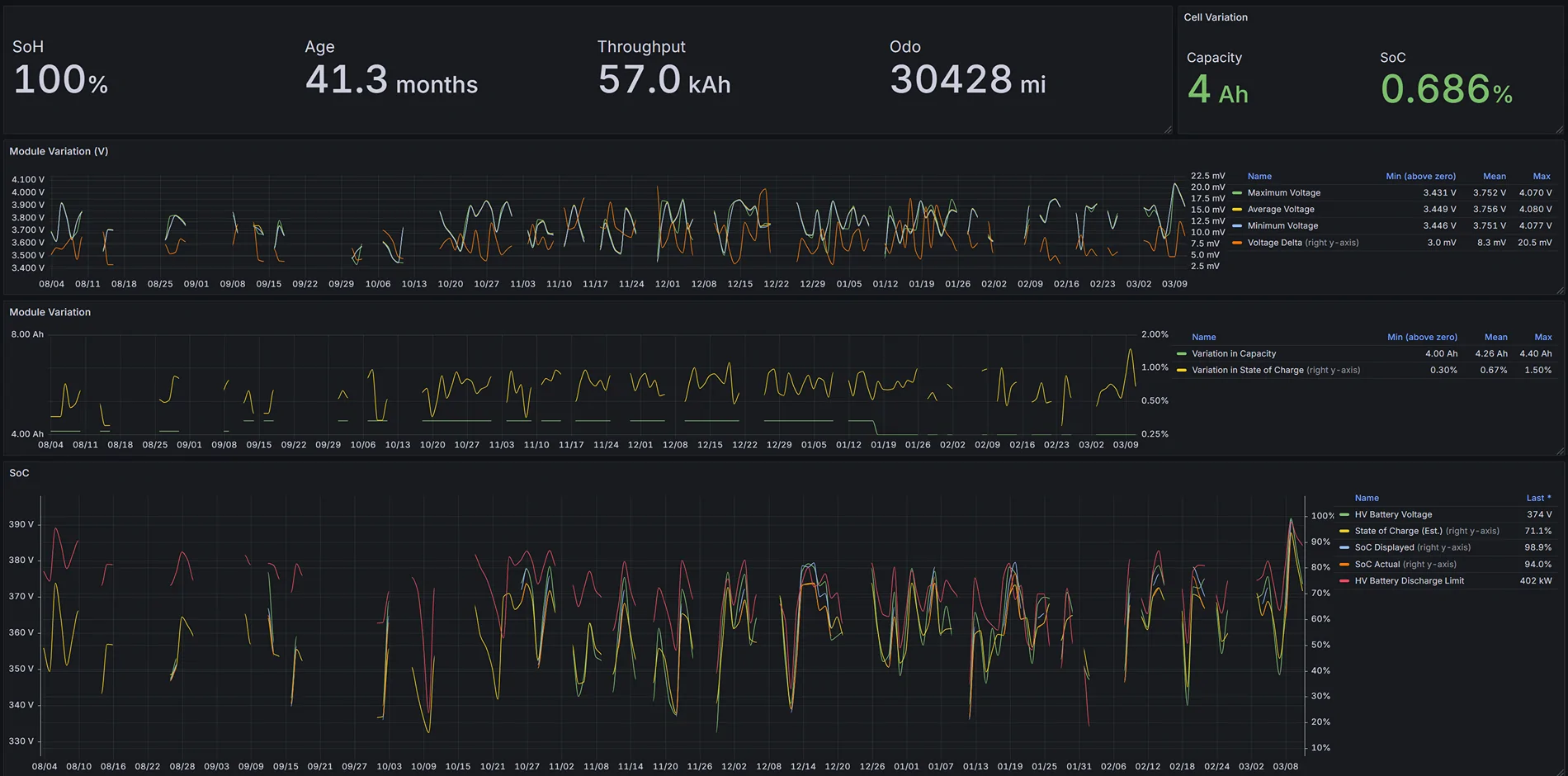
You have a graph in the first post with a low variation on 7 Dec. It was much higher in your next measurement dot datapoint (a month later?). What happened in the time between to your next dot? Did your truck balance the cells in the next month? Did you have 99-100% charges or leave it OFF for 48h+ to trigger the mid-charge rebalance?Ok, one more interesting tidbit. It has been suggested in the early posts here that the battery pack will balance cells while charging from 99+ to 100%. That may be true, but the Workshop Manual also states that cell balancing occurs anytime the SOC is 15%+ and the vehicle has been off for 48 hours. The BECM will discharge cells that are high.
I think those slight variations under 1% are due to different SOC and then rounding. The voltage deviations are very small with just a few significant digits.You have a graph in the first post with a low variation on 7 Dec. It was much higher in your next measurement dot datapoint (a month later?). What happened in the time between to your next dot? Did your truck balance the cells in the next month? Did you have 99-100% charges or leave it OFF for 48h+ to trigger the mid-charge rebalance?
We shouldn't be shocked by anything they do..This is just another example of how Ford doesn't really know how to build software for EVs![]()
This experience doesn't instill confidence in the truck's ability to reliably balance battery cells outside of the 99-100% cycle. Sorry it happened. Thanks for sharing.The last time I charged to 100% was May ‘25. The truck routinely sits for 48+ hours between starts. The increase in January of this year was due to the module going bad. It did not display an error or DTCs and the only symptom was it wouldn’t charge above 83-84%. I only charge to 85% so didn’t notice anything amiss.
It was only when I tried to charge to 100% that the issue presented itself and @GoodSam pointed out the SSM.
Yes I found it odd that they balance by discharging the high cells by closing a circuit (presumably across a bleed resistor). But modules are “bad” when one cell goes below the threshold. So there are 95 high cells and the one lone low cell. Can’t imagine they discharge the 95.This is interesting the 48hr thing. I can't fathom why Ford would've done this and/or how no one has brought this to light yet. For most people I guess this never comes into play. For an ever day driver most people aren't leaving their trick idle (and not fully charged) for more than 48hrs at a time. Depending on if this is even real and was fully implemented could explain people's 12V issue on vehicles that sit unused. The BECM (which includes the BMS) operates on 12V, so after 48hrs does the truck wake up the DCDC while it balances? Does it attempt to balance even if the cells are already balanced within a threshold of %? So many questions here, that again don't really pertain to 90+% of owners? On the surface this seems like a terrible idea and implementation of balancing. It's not helping range, as balancing without charging only hurts range. This is just another example of how Ford doesn't really know how to build software for EVs![]()