

I think he intended to say the opposite....Huh? 2.4 to 1.8?
Sponsored
I think he intended to say the opposite....Huh? 2.4 to 1.8?

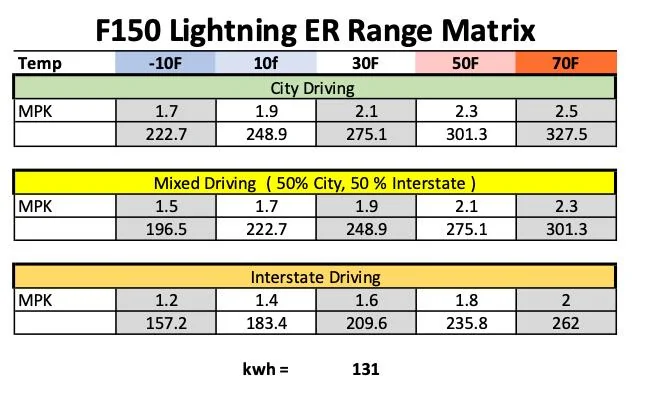
Higher number is better hopefully you just transposed those numbers?I noticed the same thing in my truck. I found out on this forum that the truck does way better when you set the leave time on the ford pass app to precondition the battery. I also learned that you should pay attention to the kWh rate. I had not preconditioned the battery before and was getting 2.4kWh and after I started conditioning the battery I was able to get 1.8kWh Which is a huge improvement. Also I learned here that charging every day to 80-90% is better than charging to 100%. Research this here on the forum. Tons of great info from guys who know a lot about this topic! Happy travels


But the GOM isn't just another percent "fuel" gauge; we've had a percent "fuel" gauge since day 1 (though only through OTAs did we get the numerical indicator) that being the right-side outer ring. Using that and your current efficiency rating (m/kWh)you can determine your distance to empty.The GOM is just another % "fuel" gauge - miles to empty, believe it, but don't blindly, mindlessly rely on it as you drive the "fuel" off. Treat it just like the fuel gauge on any vehicle. As Reagan famously said "Trust but Verify"

lol. This should have been more specific, for sure.…… before was getting 2.4kWh and after I started conditioning the battery I was able to get 1.8kWh Which is a huge improvement.…….
Huh? 2.4 to 1.8?
Higher number is better hopefully you just transposed those numbers?
We assume he’s referencing mi/kWh, but he could be referring to kWh/mi. I think that’s how it’s presented outside the US. And how Tesla presents it. Which make comparison And communicationI think he intended to say the opposite....

Ok if kWh/mi then it would be like 0.450. I think my ABRP is set for 447 Wh/milol. This should have been more specific, for sure.
We assume he’s referencing mi/kWh, but he could be referring to kWh/mi. I think that’s how it’s presented outside the US. And how Tesla presents it. Which make comparison And communication
sooo confusing.
Tell me about it.but yeah, 2 ways to describe the same can be confusing

Yes I realized that I did that now you mentioned it. Thank you. I noticed that yesterday driving my son to the airport I got 2.8 kWh preconditioning the battery and that was with the air conditioner on.Higher number is better hopefully you just transposed those numbers?
Huh? 2.4 to 1.8?
Thank you, for catching my mistake. I corrected it.I think he intended to say the opposite....
My precondition does not involve AC right now ?Yes I realized that I did that now you mentioned it. Thank you. I noticed that yesterday driving my son to the airport I got 2.8 kWh preconditioning the battery and that was with the air conditioner on.

Need a big town / small city driving, because I get around 3 when driving to/from work. A lot of 35mph driving with a little bit of 45-55.Print, Cut, Paste over your Guess-O-Meter. Problem solved.

Kind of reminds me of an old S10 I had, with the 4.3l v6, manual, single cab, I was always getting 20+ mpg (often 25 or more) even with cold conditions. The State I lived in at the time had kind of low speed limits, so that helped, but I was always surprised what good mph it got vs what the EPA rated. Also, I wasn't hypermiling at all, I was in my early 20s, so you can guess how efficient I was driving.This subject has been a huge frustration for EV and hybrid Mfr’s for decades. The 2004 Toyota Prius was originally rated as a 60mpg car. That was true at 60mph or less and driven delicately.
But the average consumer didn’t drive like that, and complained like hell that Toyota was misleading. They later changed it to like 48mpg.
Sad, because I could consistently get 60mpg.
(If exploited with extreme driving techniques, hypermiling with outrageous speed fluctuations , it could get 100mpg. Yes 100mpg !)
It’s been the same struggle with consumers, conditioned by gas cars, ever since.
Bottom line, EV drivetrains are extremely efficient, but extremely affected by the “varaiables”…., which are many.

Yes the city driving does great mileage. Yesterday I was getting 3-3.4 mi kWh As long as you keep your foot out of it it’s amazingly efficient.Need a big town / small city driving, because I get around 3 when driving to/from work. A lot of 35mph driving with a little bit of 45-55.

I like to keep my center console display on "this trip" and keep tabs on my miles/kw efficiency. My average seems to be around 2 miles/kw.This is an interesting thing to say.
Because the computer is telling you the ‘variables you don’t give a care about‘ are, in fact, effecting your range. Disregard or denial will not change that.
Why do you believe you should get an arbitrary “300 miles” from a 100% charge, regardless ?
You can always determine your range by multiplying your average mi/kWh by remaining battery capacity.
Remaining battery capacity is battery % x 131 kWh.
But don’t waste your time, it’s the same calculation being displayed to you .