

Sponsored
OP
OP

jwrezz
Well-known member
- Thread starter
- #17
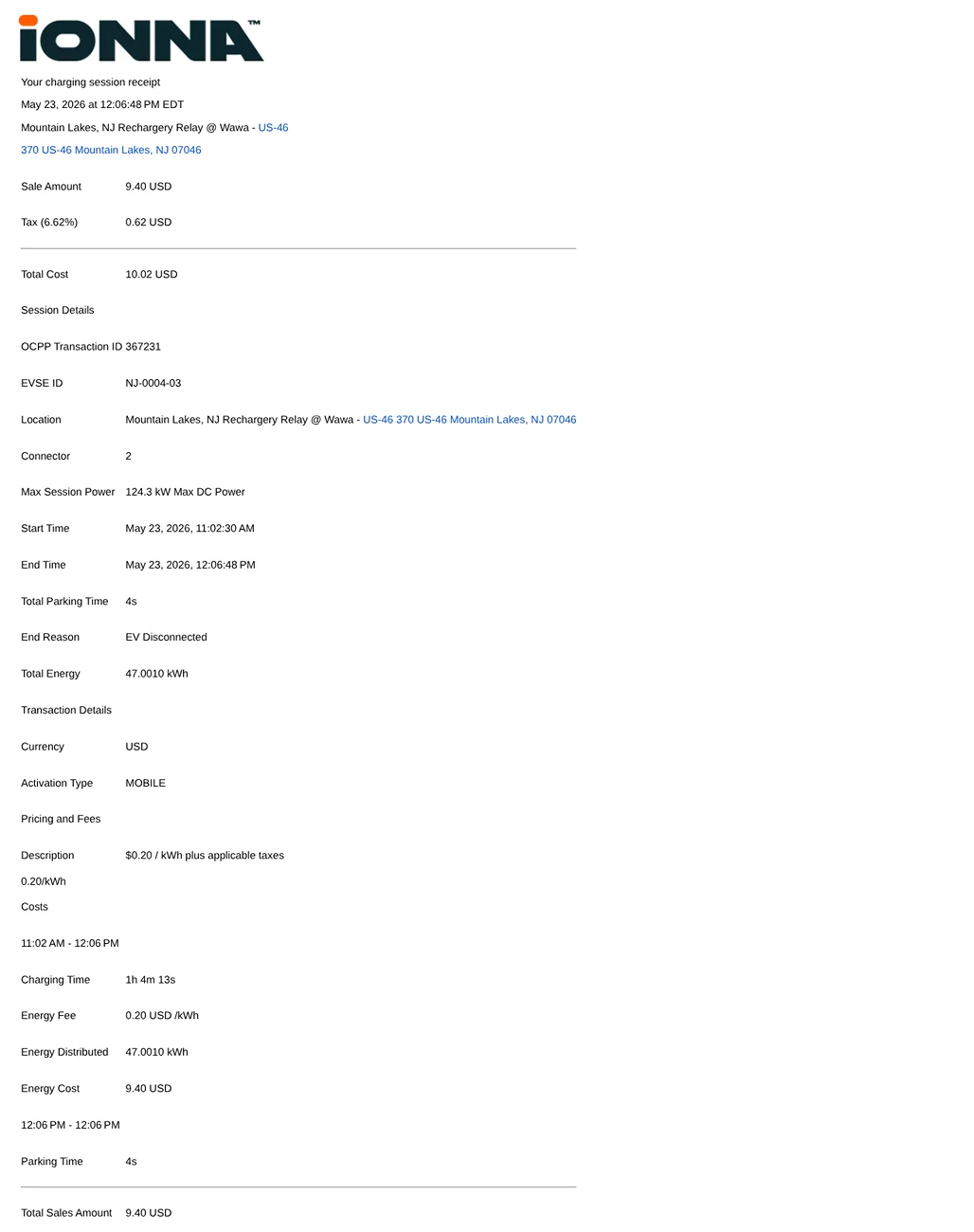
Of course, and I did! I just was wondering the discrepancy between Ford's 41kwh and Ionna's 47kwh. Sorry for going nuts with the responses. Happy Friday, y'all!Should I expect National Grid to discount my energy services by 8% because of conversion losses?????? Of course not that's ludacris!
Ionna and all DCFC charging services are charging us the total cost of services including the energy they buy from local grid services, equipment depreciation, local lease/land rental fees for the parking lot space they're allocated, etc.
Take the ~20 cent discount for what it was and enjoy.

The Ford value is the net to HVB, it should match the Ford App recent charging record.I just was wondering the discrepancy between Ford's 41kwh and Ionna's 47kwh.
Should they use that for the billing information?
I agree that they shouldn't, it should show 47 kwh in the Ford Plug & Charge email/notification.
Last edited:
OP
OP
jwrezz
Well-known member
- Thread starter
- #19
As soon as Ionna responded with the 47kwh, I knew Ford was counting the amount put/stored in the battery and Ionna was counting the amount that left their charger. Just like my outlet with sensors says it's putting out 40-42 amps or 10kw, but the truck says it's receiving 8.9kw.The Ford value is the net to HVB, it should match the Ford App recent charging record.
Should they use that for the billing information?
I agree that they shouldn't, it should show 47 kwh in the Ford Plug & Charge email/notification.
Maquis
Well-known member
But it’s not the same. L2 AC to DC conversion losses are in the vehicle. L3 conversion is in the charging cabinet.As soon as Ionna responded with the 47kwh, I knew Ford was counting the amount put/stored in the battery and Ionna was counting the amount that left their charger. Just like my outlet with sensors says it's putting out 40-42 amps or 10kw, but the truck says it's receiving 8.9kw.
Sponsored
OP
OP
jwrezz
Well-known member
- Thread starter
- #21
But aren't there losses in the truck? No AC to DC. Conversion losses of course, but DC fast charging is a much higher rate than any level 2 charging. I know heat is generated. I know that it has to slow down as the battery gets more full. These have got to be losses in some way.But it’s not the same. L2 AC to DC conversion losses are in the vehicle. L3 conversion is in the charging cabinet.
Only in the sense of cooling system consumption, but not to the tune of 6 kwh worth, the majority of the value is on the DCFC cabinet conversion, and the data is simply flawed in Ford Reporting.These have got to be losses in some way.
RickLightning
Well-known member
I have no inside knowledge...
I would question, and likely @Charge_Rob could answer, if Ford is being sent the wrong data field, or if Ford is reading the wrong data field.
IONNA is a recent add to Plug & Charge. A simple request by someone on an IONNA charge, either activated by the Ford app or Plug & Charge, with the IONNA receipt, would validate if this is a one-off or a programming issue.
The COST is not in question, so perhaps someone didn't check the data exchange properly.
I would question, and likely @Charge_Rob could answer, if Ford is being sent the wrong data field, or if Ford is reading the wrong data field.
IONNA is a recent add to Plug & Charge. A simple request by someone on an IONNA charge, either activated by the Ford app or Plug & Charge, with the IONNA receipt, would validate if this is a one-off or a programming issue.
The COST is not in question, so perhaps someone didn't check the data exchange properly.
Maquis
Well-known member
The truck cannot dissipate 6 kWh of energy losses in that short of time just sitting there without a catastrophic thermal event. The losses in the truck will be an order of magnitude less.But aren't there losses in the truck? No AC to DC. Conversion losses of course, but DC fast charging is a much higher rate than any level 2 charging. I know heat is generated. I know that it has to slow down as the battery gets more full. These have got to be losses in some way.
The only possibilities I see are either Ionna is charging for their gross power input from the utility, or some kind of data error like Rick mentioned.

fhteagle
Well-known member
A small amount to resistive heating in wires, a large amount to resistive heating in cells themselves, yes.But aren't there losses in the truck?
Charge speed, aka amps, does slow down above 80% SOC. This would make the biggest factor in resistive heating losses _less_ for DCFC above 80% SOC.
41/47 = 87% . If Ionna was measuring pre conversion AC grid input, and the truck was measuring and reporting to Ford post heat loss SOC gain, this is a reasonable split to my mind.
Last edited:
Sponsored

Grumpy2
Well-known member
- Joined
- Nov 23, 2022
- Threads
- 22
- Messages
- 1,145
- Reaction score
- 1,268
- Location
- Central Oregon Coast
- Vehicles
- 23 F150 Pro SR
- Occupation
- Retired Hvy Construction
Ionna may have been started to be a self-supporting company with minimal profit but at the same time designed to pay back all startup costs as well as all operating expenses as condition change.
In operation of the station the only large variable cost may be the power demand cost. I believe the customer is normally charged this demand cost based on their peak demand during the pay period. Such as peak demand over the month. But is it possible EV charging stations are charged a variable demand power from the utility on a much shorter period, say peak demand each hour, instead of day or month?
Tesla now has variable charging costs, perhaps for this reason?
Ionna advertises a low fixed charging cost. To cover the demand costs the charging station has two choices, raise their fixed rate on an hourly basis enough to cover these variable costs, OR find a way to charge the customer a fraction more kWs at their low fixed rate advertised to cover the variable demand costs? On a typical 15-20 minute charge, this small faction of a kW would not be noticed.
In this case where the customer charged continuously for over an hour, that fraction more kWs became more obvious.
Possible ???
In operation of the station the only large variable cost may be the power demand cost. I believe the customer is normally charged this demand cost based on their peak demand during the pay period. Such as peak demand over the month. But is it possible EV charging stations are charged a variable demand power from the utility on a much shorter period, say peak demand each hour, instead of day or month?
Tesla now has variable charging costs, perhaps for this reason?
Ionna advertises a low fixed charging cost. To cover the demand costs the charging station has two choices, raise their fixed rate on an hourly basis enough to cover these variable costs, OR find a way to charge the customer a fraction more kWs at their low fixed rate advertised to cover the variable demand costs? On a typical 15-20 minute charge, this small faction of a kW would not be noticed.
In this case where the customer charged continuously for over an hour, that fraction more kWs became more obvious.
Possible ???
Ionna was running a 20 cent kwh promotion, they're already eating costs to gain customer awareness and market share where they operate.In this case where the customer charged continuously for over an hour, that fraction more kWs became more obvious.
Charge_Rob
Well-known member
DC charging absolutely has losses - the AC to DC conversion has losses (why the charger has fans running), the cable has losses, the truck has losses due to charging overhead and heat generation in the battery. There's no energy transfer that is completely lossless.DC charging doesn't have loss. Nor is there any issue with AC running, since you receive the juice...
IONNA, like EA (but not Tesla), advertises a rate BEFORE TAX. Their ad, below, states that.
If you run HVAC while charging, you use some of that power. It won't show in the power added to the truck in the Ford app.
One of the disadvantages of Plug & Charge at a dispenser without a screen, like IONNA or Tesla, is that you lack visibility to anything during the session.
$10.02 / 1.06625 = $9.40.
$9.40/41=23 cents.
$9.40/47=20 cents.
Therefore, you were billed for 47kWh plus tax.
Unfortunately, my conclusion would be that Ford has a data issue with IONNA. You received 47kWh.

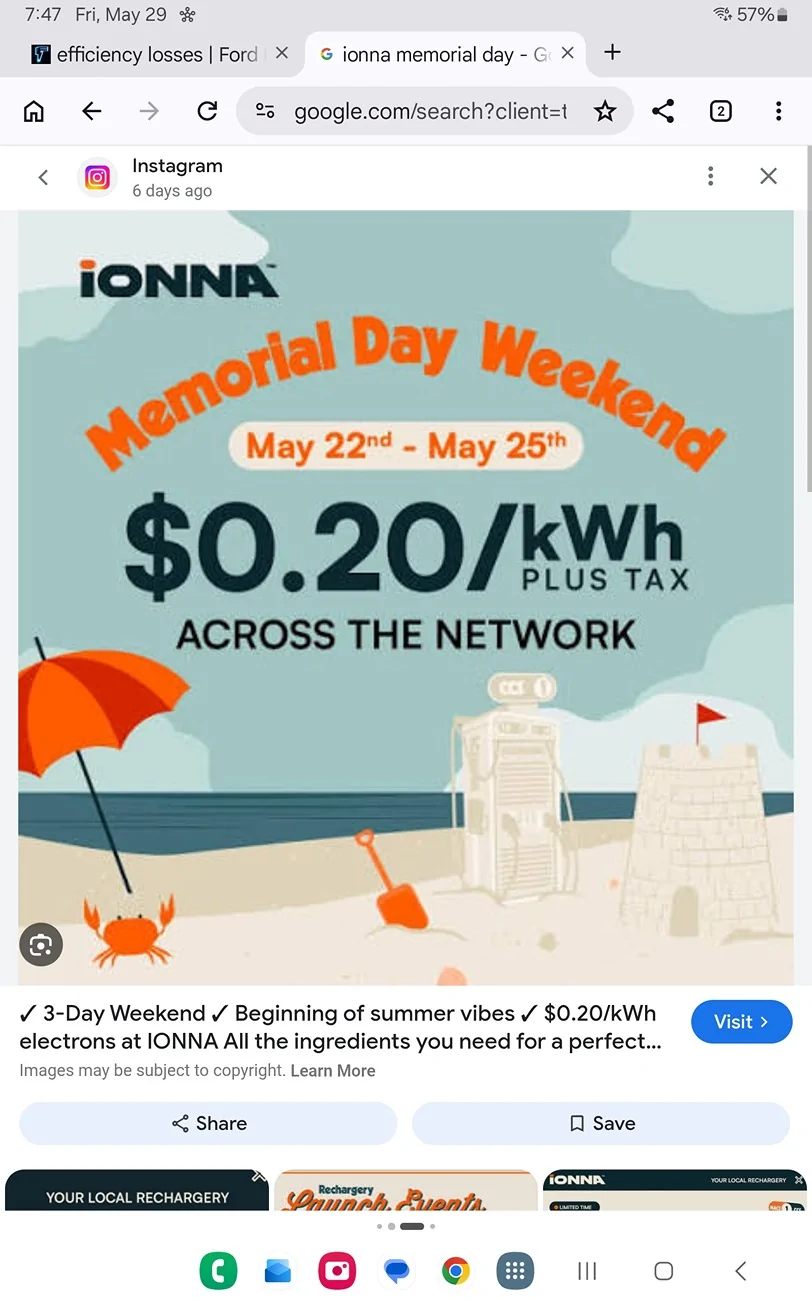
Charge_Rob
Well-known member
The receipt from Ford shows the price and kWh provided by the CPO.I reached out to Ionna after using Plug and Charge at my last session because Ionna offered $.20/kwh rates over the weekend. Ford sent me my email receipt showing 41 kwh delivered and $10.02 billed. This worked out to about $.23/kwh plus tax. Ionna replied with my receipt showing 47 kwh delivered, $.20/kwh plus tax. I'm assuming Ionna shows the kwh they dispensed and Ford shows the kwh that the truck received, not accounting for efficiency losses.
The Ford app shows the kWh that was calculated by the truck.
For my recent IONNA Janesville charge, the Ford receipt shows 90.259 kWh for $21.75, and the Ford app shows 89.2 kWh added as calculated by the truck.
90.259 * $0.20 = 18.05 * 5.5% sales tax (WI 5% + Rock County 0.5%) = $19.05 + $0.03/kWh WI charging excise tax = $21.75
So the calculation seems right to my non tax professional eyes.
The kWh on the receipt should generally be larger than the kWh in the Ford app charge history tab because the truck doesn't know about losses between the metering device in the charger and the battery pack in the truck.
RickLightning
Well-known member
DC charging absolutely has losses - the AC to DC conversion has losses (why the charger has fans running), the cable has losses, the truck has losses due to charging overhead and heat generation in the battery. There's no energy transfer that is completely lossless.
As you demonstrated, the "losses" are negligible. 1- 89.2/90.259 = 1.17%The receipt from Ford shows the price and kWh provided by the CPO.
The Ford app shows the kWh that was calculated by the truck.
For my recent IONNA Janesville charge, the Ford receipt shows 90.259 kWh for $21.75, and the Ford app shows 89.2 kWh added as calculated by the truck.
90.259 * $0.20 = 18.05 * 5.5% sales tax (WI 5% + Rock County 0.5%) = $19.05 + $0.03/kWh WI charging excise tax = $21.75
So the calculation seems right to my non tax professional eyes.
The kWh on the receipt should generally be larger than the kWh in the Ford app charge history tab because the truck doesn't know about losses between the metering device in the charger and the battery pack in the truck.
You pay for what the machine says in DC charging. Unlike a home charger with 7% loss or higher.
And, you just showed how Ford has CORRECT data, so the issue must be on the IONNA receipt the OP got.
Sponsored


