
Sponsored

efficiency losses

jwrezz

Well-known member
First Name
John
Joined
Aug 29, 2025
Threads
15
Messages
349
Reaction score
220
Location
07054
Vehicles
1996 Ford ExplorerXLT, 2006 Subaru OBS LLBean, 2024 Ford F150 Lightning Lariat
Occupation
Teacher/Firefighter
I reached out to Ionna after using Plug and Charge at my last session because Ionna offered $.20/kwh rates over the weekend. Ford sent me my email receipt showing 41 kwh delivered and $10.02 billed. This worked out to about $.23/kwh plus tax. Ionna replied with my receipt showing 47 kwh delivered, $.20/kwh plus tax. I'm assuming Ionna shows the kwh they dispensed and Ford shows the kwh that the truck received, not accounting for efficiency losses.
Sponsored
 

bmwhitetx

Well-known member
First Name
Bruce
Joined
May 21, 2021
Threads
48
Messages
3,157
Reaction score
4,534
Location
DFW-Texas
Vehicles
2022 F150 Lightning Lariat ER
Occupation
Retired engineer
What does your charge history show in the Ford app? It reports kWh into the battery.
 
Last edited:
OP
OP
jwrezz

jwrezz

Well-known member
First Name
John
Joined
Aug 29, 2025
Threads
15
Messages
349
Reaction score
220
Location
07054
Vehicles
1996 Ford ExplorerXLT, 2006 Subaru OBS LLBean, 2024 Ford F150 Lightning Lariat
Occupation
Teacher/Firefighter
The Ford app, the receipt from Ford and the Ford website all say 41kwh. Ionna says 47kwh.
 
OP
OP
jwrezz

jwrezz

Well-known member
First Name
John
Joined
Aug 29, 2025
Threads
15
Messages
349
Reaction score
220
Location
07054
Vehicles
1996 Ford ExplorerXLT, 2006 Subaru OBS LLBean, 2024 Ford F150 Lightning Lariat
Occupation
Teacher/Firefighter
I suspect Ionna are using the AC input power from the utility. Just a guess.
I'm sure there are losses at both ends, but I do not think they can say I got 47kwh of energy if it didn't make it to the truck. I think 47 was sent to the truck and 6 were lost to heat and other inefficiencies after the AC to DC conversion.
 

Sponsored

Maquis

Well-known member
First Name
Dave
Joined
May 20, 2021
Threads
9
Messages
4,390
Reaction score
5,895
Location
Illinois
Vehicles
2021 Mach-E E4-X; 2023 Lightning Lariat ER
I'm sure there are losses at both ends, but I do not think they can say I got 47kwh of energy if it didn't make it to the truck. I think 47 was sent to the truck and 6 were lost to heat and other inefficiencies after the AC to DC conversion.
The only way the truck could have sunk an extra 6 kWh is if it were extremely cold and the heater was needed to warm the battery while charging.
When DC charging, there’s nothing between the charge port and the battery except conductors and the main contactors. Dissipating 6 kwh in that circuit would have burned your truck down.
 

TaxmanHog

Moderator
Moderator
First Name
Noel
Joined
Jan 19, 2022
Threads
234
Messages
16,598
Reaction score
18,742
Location
SE. Mass.
Vehicles
2022 Lightning Lariat-ER & 2024 HD Road Glide CVO-ST
Occupation
Retired
I think 47 was sent to the truck and 6 were lost to heat and other inefficiencies after the AC to DC conversion.
Exactly so, I don't think it's unfair they charge for the gross AC energy coming into DCFC converter. I don't DCFC as much these days, so I haven't tracked percentages much.

While the truck side losses are still present with the HVB cooling / heating system operation, not as much as the on board charger in a level 2 conversion process but net energy to the battery is always less, only about 92% in my experiences for level 2.

btw, does your state charge sales or excise tax on commercial charging services?

Massachusetts charges the general sales tax for the gross cost, some providers price in the taxes on the cents per KWH rate, example {20 cents becomes 21.25 cents with the 6.25% sales tax} while other list / itemize it separately on the final invoice.
 
Last edited:

dorbi

Member
Joined
May 13, 2026
Threads
0
Messages
6
Reaction score
5
Location
WA
Vehicles
'05 Silverado, '21 ID.4
Were you sitting in the truck with A/C on too? That could account for some of the delta as well.
 

DavidS

Well-known member
First Name
DAVID
Joined
Dec 27, 2025
Threads
0
Messages
140
Reaction score
109
Location
Green Bay, WI
Vehicles
F150 Lightning Lariat
WI taxes $0.03/kwh. (Plus a $175/year EV registration fee)
my last EA charge session showed 30.8 kWh into the truck and 38 kWh from the charger. Charge losses increase when charging over 80%. In my case, I charged from 66 to 90% before an out and back trip into the chargerless wilderness of northern WI so my efficiency was not great.
 

RickLightning

Well-known member
Joined
Jan 17, 2022
Threads
113
Messages
7,142
Reaction score
9,797
Location
SE MI
Vehicles
'22 Lightning ER Lariat,'22 Mach-E Premium 4X
I reached out to Ionna after using Plug and Charge at my last session because Ionna offered $.20/kwh rates over the weekend. Ford sent me my email receipt showing 41 kwh delivered and $10.02 billed. This worked out to about $.23/kwh plus tax. Ionna replied with my receipt showing 47 kwh delivered, $.20/kwh plus tax. I'm assuming Ionna shows the kwh they dispensed and Ford shows the kwh that the truck received, not accounting for efficiency losses.
DC charging doesn't have loss. Nor is there any issue with AC running, since you receive the juice...

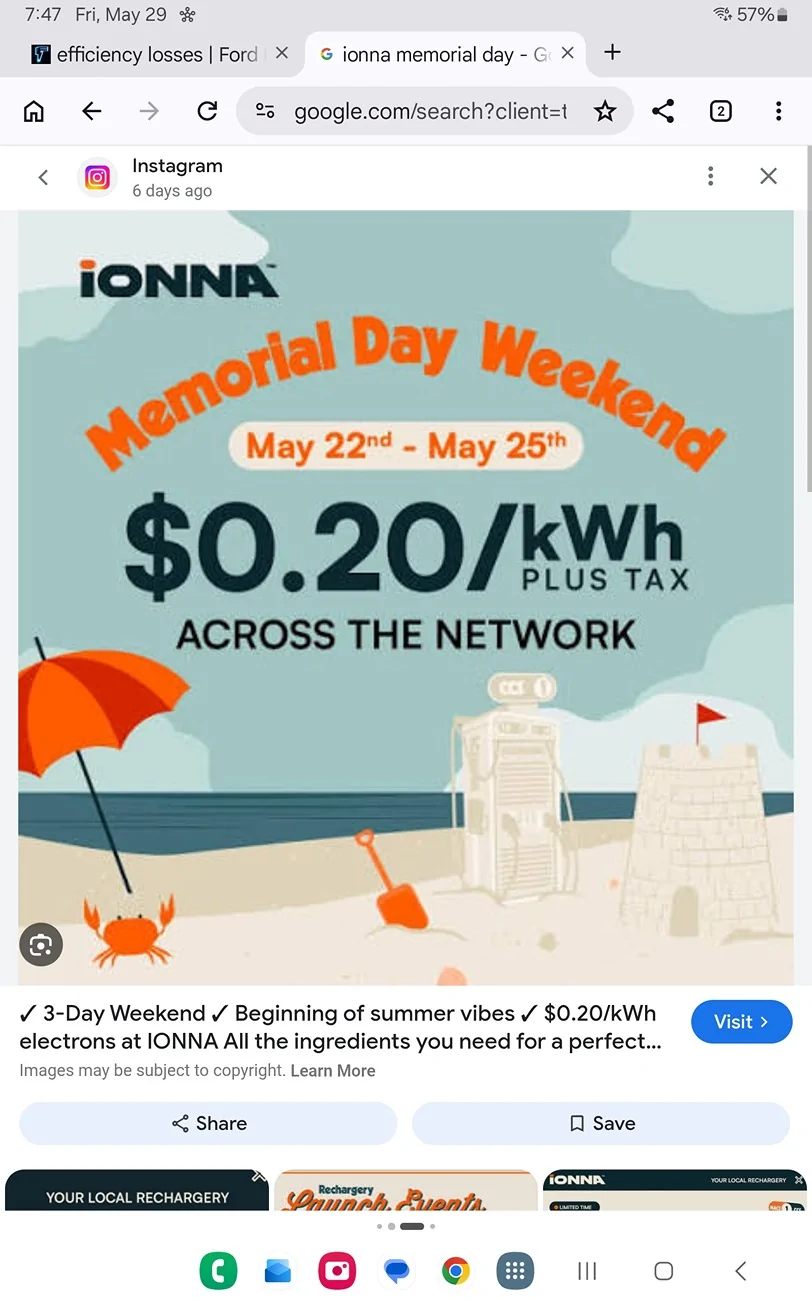
IONNA, like EA (but not Tesla), advertises a rate BEFORE TAX. Their ad, below, states that.

If you run HVAC while charging, you use some of that power. It won't show in the power added to the truck in the Ford app.

One of the disadvantages of Plug & Charge at a dispenser without a screen, like IONNA or Tesla, is that you lack visibility to anything during the session.

$10.02 / 1.06625 = $9.40.

$9.40/41=23 cents.
$9.40/47=20 cents.

Therefore, you were billed for 47kWh plus tax.

Unfortunately, my conclusion would be that Ford has a data issue with IONNA. You received 47kWh.

Ford F-150 Lightning efficiency losses 1000007698
 

Sponsored

RickLightning

Well-known member
Joined
Jan 17, 2022
Threads
113
Messages
7,142
Reaction score
9,797
Location
SE MI
Vehicles
'22 Lightning ER Lariat,'22 Mach-E Premium 4X
I'm sure there are losses at both ends, but I do not think they can say I got 47kwh of energy if it didn't make it to the truck. I think 47 was sent to the truck and 6 were lost to heat and other inefficiencies after the AC to DC conversion.
There is no conversion....
 
OP
OP
jwrezz

jwrezz

Well-known member
First Name
John
Joined
Aug 29, 2025
Threads
15
Messages
349
Reaction score
220
Location
07054
Vehicles
1996 Ford ExplorerXLT, 2006 Subaru OBS LLBean, 2024 Ford F150 Lightning Lariat
Occupation
Teacher/Firefighter
Is there no heat loss while DCFC? Especially since I did go past 80%. I know I received 47kwh, and I know the tax was added after the fact. No HVAC was used. I also think that 47kwh was sent, for which 6 is not accounted, by Ford's reasoning anyway. Oh, and Ionna has a screen. What sucked was that it's one screen shared between two stalls and I couldn't use it as the other vehicle owner was paying his tab.
 
OP
OP
jwrezz

jwrezz

Well-known member
First Name
John
Joined
Aug 29, 2025
Threads
15
Messages
349
Reaction score
220
Location
07054
Vehicles
1996 Ford ExplorerXLT, 2006 Subaru OBS LLBean, 2024 Ford F150 Lightning Lariat
Occupation
Teacher/Firefighter
Were you sitting in the truck with A/C on too? That could account for some of the delta as well.
Nope. Walked down to the local VFD's memorial day services.
 
OP
OP
jwrezz

jwrezz

Well-known member
First Name
John
Joined
Aug 29, 2025
Threads
15
Messages
349
Reaction score
220
Location
07054
Vehicles
1996 Ford ExplorerXLT, 2006 Subaru OBS LLBean, 2024 Ford F150 Lightning Lariat
Occupation
Teacher/Firefighter
Exactly so, I don't think it's unfair they charge for the gross AC energy coming into DCFC converter. I don't DCFC as much these days, so I haven't tracked percentages much.

While the truck side losses are still present with the HVB cooling / heating system operation, not as much as the on board charger in a level 2 conversion process but net energy to the battery is always less, only about 92% in my experiences for level 2.

btw, does your state charge sales or excise tax on commercial charging services?

Massachusetts charges the general sales tax for the gross cost, some providers price in the taxes on the cents per KWH rate, example {20 cents becomes 21.25 cents with the 6.25% sales tax} while other list / itemize it separately on the final invoice.
Yes, to the sales tax. It's accounted for in the receipt I asked for from Ionna. I'm thinking there is certainly heat generated while shoving 160+kw into a battery, and also while trying to shove energy in after that 80% mark is reached. That's why DCFC is no bueno for battery health if used frequently.

From google's AI generated results, (and yes, we can eleminate the AC/DC conversion part):

DC Fast Charging (DCFC) efficiency losses typically range from 5% to 10%, meaning 90% to 95% of the electricity pulled from the grid successfully reaches your EV's battery. These losses occur during energy conversion, thermal management, and battery preconditioning. [1, 2, 3, 4, 5]

Key Factors Driving DCFC Losses
  • AC/DC Conversion: The grid supplies Alternating Current (AC), which the DCFC cabinet must convert to High-Voltage Direct Current (DC). This active conversion generates significant heat, accounting for about half of the total efficiency loss. [1, 2, 3]
  • Active Cooling: DCFC cables (often liquid-cooled) and the charging station's internal components require substantial active cooling to prevent overheating during high-power sessions. A portion of the energy you pay for powers these cooling systems rather than entering your vehicle. [1, 2, 3]
  • Vehicle Thermal Management: When you plug in, your EV's Battery Management System (BMS) actively monitors and maintains the battery's temperature. High-speed charging creates internal resistance and heat, requiring the car to run its own thermal management system, drawing power from the charger to keep the battery within a safe charging window. [1, 2]

The Cost Difference: DCFC vs. Level 2
Because you only pay for the net energy delivered to the battery at a public DCFC, the charger's conversion and cooling losses are shouldered by the charging network. Conversely, when you use a Level 2 AC charger at home, the vehicle's onboard charger performs the conversion, and you pay for the \(\approx 10\%\) energy lost as heat right on your home utility bill. [1, 2, 3]

Long-Term Battery Degradation
While DCFC efficiency losses only affect the energy billed per session, high-frequency DCFC use (relying on fast chargers for more than 12% of total charging sessions) can contribute to an additional 1% in average annual battery degradation compared to mostly using Level 2 chargers. [1]
For further details on maximizing charging efficiency and battery health, refer to the Geotab EV Battery Health Study or explore the technical equipment breakdowns on PowerFlex's DCFC Guide. [1, 2]
 

TaxmanHog

Moderator
Moderator
First Name
Noel
Joined
Jan 19, 2022
Threads
234
Messages
16,598
Reaction score
18,742
Location
SE. Mass.
Vehicles
2022 Lightning Lariat-ER & 2024 HD Road Glide CVO-ST
Occupation
Retired
Should I expect National Grid to discount my energy services by 8% because of conversion losses?????? Of course not that's ludacris!

Ionna and all DCFC charging services are charging us the total cost of services including the energy they buy from local grid services, equipment depreciation, local lease/land rental fees for the parking lot space they're allocated, etc.


Take the ~20 cent discount for what it was and enjoy.
Sponsored


Top