
Sponsored

Range not close to as advertised

RickKeen

Well-known member
First Name
Rick
Joined
Sep 14, 2022
Threads
47
Messages
717
Reaction score
937
Location
Minnesota
Vehicles
F150L SR Pro
Occupation
sw engineering manager,
I'm not talking about ... driving faster. I'm making a simple point. Accelerating quickly has little impact on REAL WORLD driving efficiency.
if you accelerate quickly, even if your maximum speed is the same, you ARE driving faster on average. You spend more time at the higher speed.
 

HOTAS

Well-known member
First Name
Greg
Joined
Dec 5, 2024
Threads
15
Messages
181
Reaction score
345
Vehicles
ā€˜24 Lightning Flash, Tesla MY, Chevy Volt, PiPrius
Occupation
Airbus Pilot
Most everyone know that as speed doubles, drag quadruples. That’s why driving fast consumes more energy.
The same hold true for electrical current.
In a word, I²R losses. The motor windings, cables and the inverter all have some resistance (R), which is why motors and inverters, batteries need cooling systems, the resistance causes them to get warm when they pass current. The more current they pass (i.e. the more power the motor is delivering) the greater the losses, and because these losses are proportional to the square of the current ….if you double the current (so double the power) then the losses increase by a factor of four. It takes significantly more battery power to accelerate rapidly than slowly.

This has been proven so many times in EV’S and PHEV’S (full electric output). There really is no debate. Combine both quadrupled drag and quadrupled resistance to the delivery of the energy to overcome it and you got a lot of wasted energy.
Simple.
AND Regeneration can never recover energy lost as heat, and regen itself has I²R losses that create more heat. THUS WHY the regen balance argument is also invalid.

Acceleration AND Speed are THE TWO biggest range killers.
Accelerate moderately and immediately taper back as speed increases, your range will increase significantly. For some folks it will be 20% more range.
 
Last edited:

HOTAS

Well-known member
First Name
Greg
Joined
Dec 5, 2024
Threads
15
Messages
181
Reaction score
345
Vehicles
ā€˜24 Lightning Flash, Tesla MY, Chevy Volt, PiPrius
Occupation
Airbus Pilot
The Chevy Volt had a neat energy display that included kW demand Of the motor under acceleration. An efficient rule of thumb we used during acceleration was take your current speed and cut it in half, that number was then the limit for max kW demand displayed during acceleration.
All of a sudden everyone was exceeding the advertised EV only battery range of the Volt..

Limit Lightning acceleration to half way to the ’lightning bolt’ and begin to taper back As you accelerate, your range will go up.
You can have ’fun’ acceleration or you can have range, but you can’t ’have your cake and eat it tooā€˜ in an EV.
Although, maximizing range is it’s own kind of (intellectual) fun?
 
Last edited:

HOTAS

Well-known member
First Name
Greg
Joined
Dec 5, 2024
Threads
15
Messages
181
Reaction score
345
Vehicles
ā€˜24 Lightning Flash, Tesla MY, Chevy Volt, PiPrius
Occupation
Airbus Pilot
The real irony in this debate is that the good ā€˜ole ā€˜GOMā€˜, that frustrates so many, is also proof that acceleration and speed kill range.

I don’t have a problem with the GOM and I can meet or exceed the Lightning’s advertised range consistently.
(Winter being a bit more challenging ).
 

Sponsored

ZeusDriver

Well-known member
Joined
Dec 1, 2025
Threads
8
Messages
177
Reaction score
162
Location
East Coast, USA
Vehicles
2022 Lightning
How are you getting 2.5kwhs I’ve never seen that and I have 30,000 miles on my truck it’s more like 2.1 for me in summer
I fairly often get 3.1, when I drive like a grandmother on ludes. But it's all over the place: 1.9 through 3.1 if not towing. Towing 1.0. I live where it is very very flat, and fairly temperate.
 

inchman254

Active member
First Name
Dave
Joined
Sep 16, 2024
Threads
2
Messages
34
Reaction score
43
Location
Collingwood, Ontario, Canada
Vehicles
F150 Lightning Lariat, Kia Telluride
Occupation
Retired
Most everyone know that as speed doubles, drag quadruples. That’s why driving fast consumes more energy.
The same hold true for electrical current.
In a word, I²R losses. The motor windings, cables and the inverter all have some resistance (R), which is why motors and inverters, batteries need cooling systems, the resistance causes them to get warm when they pass current. The more current they pass (i.e. the more power the motor is delivering) the greater the losses, and because these losses are proportional to the square of the current ….if you double the current (so double the power) then the losses increase by a factor of four. It takes significantly more battery power to accelerate rapidly than slowly.

This has been proven so many times in EV’S and PHEV’S (full electric output). There really is no debate. Combine both quadrupled drag and quadrupled resistance to the delivery of the energy to overcome it and you got a lot of wasted energy.
Simple.
AND Regeneration can never recover energy lost as heat, and regen itself has I²R losses that create more heat. THUS WHY the regen balance argument is also invalid.

Acceleration AND Speed are THE TWO biggest range killers.
Accelerate moderately and immediately taper back as speed increases, your range will increase significantly. For some folks it will be 20% more range.
I missed this one back in July. Hopefully my reply will pop it back near the top for some people. It's an interesting view about acceleration heat losses.

This has to be balanced with what the heat losses are in the first place relative to total energy usage. Most energy (~90%) goes into rolling and wind drag. So, if 10% goes into overall battery and motor losses and you accelerate rapidly a few times on a trip, it's probably not going to affect range more than a percent or two, unless you're having a LOT of fun! Accelerating for 5 seconds from 0 to 60 might quadruple the current (from a normal acceleration (I haven't checked it)) resulting in a 16x increase in heat energy but it's only for 5 seconds.

But it underlines the advantages of using cruise control. Most drivers are not as good at speed control as they think. We've all been with drivers who are constantly +/- 10 and who think they're driving fine and won't take the hint to use cruise (while you're looking for the Gravol). Anyone of us might be one of them:sadface:.

All those little accelerations create a little bit of extra heat loss. This even applies if you're using adaptive cruise and you're behind someone who can't control their speed well. Either pass them, or back off and set your cruise to their average speed.

I would think that a few hundred small driver-induced accelerations per hour would exceed the effect of a few single rapid accelerations. If you're in the city and accelerating hard a lot, it would definitely make a difference but you're probably not going to do 250 miles and will be home to charge that night. So, it would affect the numbers but not really a range issue.

We've all seen that going up hills even at steady speed also causes high burn similar to acceleration so hilly drives kill range too. A lot of little hills adds up. Going uphill at high speed requires even higher current. So, slower in hilly country would be better.

Slightly off topic... I think that using cruise on a longer road trip balances the best arrival time with the least opportunity to get a speeding ticket as well as maximizing range. Set the speed just below the max speed you you think you're going to get away with. If you're targeting this speed with your foot, you might be over a bored cop's limit just at the wrong time and you will be under it for at least some of the time. If you're on a 10 hr road trip targeting a max of 75 by foot you'll probably average a couple below 75, it will take an extra 20 minutes on that trip and you won't get the burn benefit of averaging slightly slower because you're constantly changing speed. This is especially true in an EV with no engine drone to give us a speed clue.

One thing that wasn't clear in HOTAS' post with reference to speed is that it's AIRSPEED that's the range killer, not just speedometer speed, especially in our bricks. And airspeed often applies to your whole day's trip. A 20 mph headwind while driving at 55 reduces range by 30%, the same amount as if you drive 75. Either can knock 100 miles off your range with a full charge. Cold temps can reduce your available kWhs to 80% or less. If you only charge to 80% in these temps, then lose 30% to the wind, a 320 mi (510 km) range can drop to 145 miles (220 km). The truck knows the SOC and the temp before you leave but not the wind, so the GOM will show you ~200 mi (320 km). If your destination is 150 miles into a 20 mph headwind, you gradually go from a 50 mile buffer to not getting there. Hopefully you'll notice before the last charge station.

This is going to be a problem in the future for those who won't understand the impact of wind or speed. Current EV owners are keen and, even then, some don't fully understand their vehicle efficiency. In the future there will be a lot of owners jumping in who just want to get in and drive.
 

chriserx

Well-known member
First Name
Chris
Joined
Oct 3, 2025
Threads
1
Messages
438
Reaction score
317
Location
Louisiana
Vehicles
2025 Ford Lightning Flash Job 2 😭
I missed this one back in July. Hopefully my reply will pop it back near the top for some people. It's an interesting view about acceleration heat losses.

This has to be balanced with what the heat losses are in the first place relative to total energy usage. Most energy (~90%) goes into rolling and wind drag. So, if 10% goes into overall battery and motor losses and you accelerate rapidly a few times on a trip, it's probably not going to affect range more than a percent or two, unless you're having a LOT of fun! Accelerating for 5 seconds from 0 to 60 might quadruple the current (from a normal acceleration (I haven't checked it)) resulting in a 16x increase in heat energy but it's only for 5 seconds.

But it underlines the advantages of using cruise control. Most drivers are not as good at speed control as they think. We've all been with drivers who are constantly +/- 10 and who think they're driving fine and won't take the hint to use cruise (while you're looking for the Gravol). Anyone of us might be one of them:sadface:.

All those little accelerations create a little bit of extra heat loss. This even applies if you're using adaptive cruise and you're behind someone who can't control their speed well. Either pass them, or back off and set your cruise to their average speed.

I would think that a few hundred small driver-induced accelerations per hour would exceed the effect of a few single rapid accelerations. If you're in the city and accelerating hard a lot, it would definitely make a difference but you're probably not going to do 250 miles and will be home to charge that night. So, it would affect the numbers but not really a range issue.

We've all seen that going up hills even at steady speed also causes high burn similar to acceleration so hilly drives kill range too. A lot of little hills adds up. Going uphill at high speed requires even higher current. So, slower in hilly country would be better.

Slightly off topic... I think that using cruise on a longer road trip balances the best arrival time with the least opportunity to get a speeding ticket as well as maximizing range. Set the speed just below the max speed you you think you're going to get away with. If you're targeting this speed with your foot, you might be over a bored cop's limit just at the wrong time and you will be under it for at least some of the time. If you're on a 10 hr road trip targeting a max of 75 by foot you'll probably average a couple below 75, it will take an extra 20 minutes on that trip and you won't get the burn benefit of averaging slightly slower because you're constantly changing speed. This is especially true in an EV with no engine drone to give us a speed clue.

One thing that wasn't clear in HOTAS' post with reference to speed is that it's AIRSPEED that's the range killer, not just speedometer speed, especially in our bricks. And airspeed often applies to your whole day's trip. A 20 mph headwind while driving at 55 reduces range by 30%, the same amount as if you drive 75. Either can knock 100 miles off your range with a full charge. Cold temps can reduce your available kWhs to 80% or less. If you only charge to 80% in these temps, then lose 30% to the wind, a 320 mi (510 km) range can drop to 145 miles (220 km). The truck knows the SOC and the temp before you leave but not the wind, so the GOM will show you ~200 mi (320 km). If your destination is 150 miles into a 20 mph headwind, you gradually go from a 50 mile buffer to not getting there. Hopefully you'll notice before the last charge station.

This is going to be a problem in the future for those who won't understand the impact of wind or speed. Current EV owners are keen and, even then, some don't fully understand their vehicle efficiency. In the future there will be a lot of owners jumping in who just want to get in and drive.
I don't believe acceleration is as big a factor as you seem to think it is. Is it a factor? Absolutely. But as an example, take a hard acceleration from 0-70, the power draw is extremely high, iirc something like 170kw but when you release the pedal the inertia of the truck regens some of it. Most of your total pack usage difference is going to come from the fact you are driving faster for a longer period of time. As far as the small accelerations in driver input, you aren't factoring in the deceleration power savings. As far as hills are concerned, I would argue that going downhill regens back to the pack, but I would guesstimate that it's only about 80% efficient. I'm going to assume a spherical cow with 200 mi normal range with perfect 50/50 up and down slopes and 80% regen efficiency.
100 + (100 * 0.8) = 180
You obviously aren't wrong on any of these points, but I felt the need to adjust expectations a bit. And yes, at highway speeds, headwinds will be the biggest range killer by far.

As far as OP goes, yes I am disappointed my 300 mi range Flash goes 255, but I also knew that EPA ratings are city/highway combined and most of my driving is highway so my expectations were tempered.
 

Whistler

Member
First Name
Chris
Joined
Jan 5, 2025
Threads
1
Messages
23
Reaction score
48
Vehicles
2024 F150L
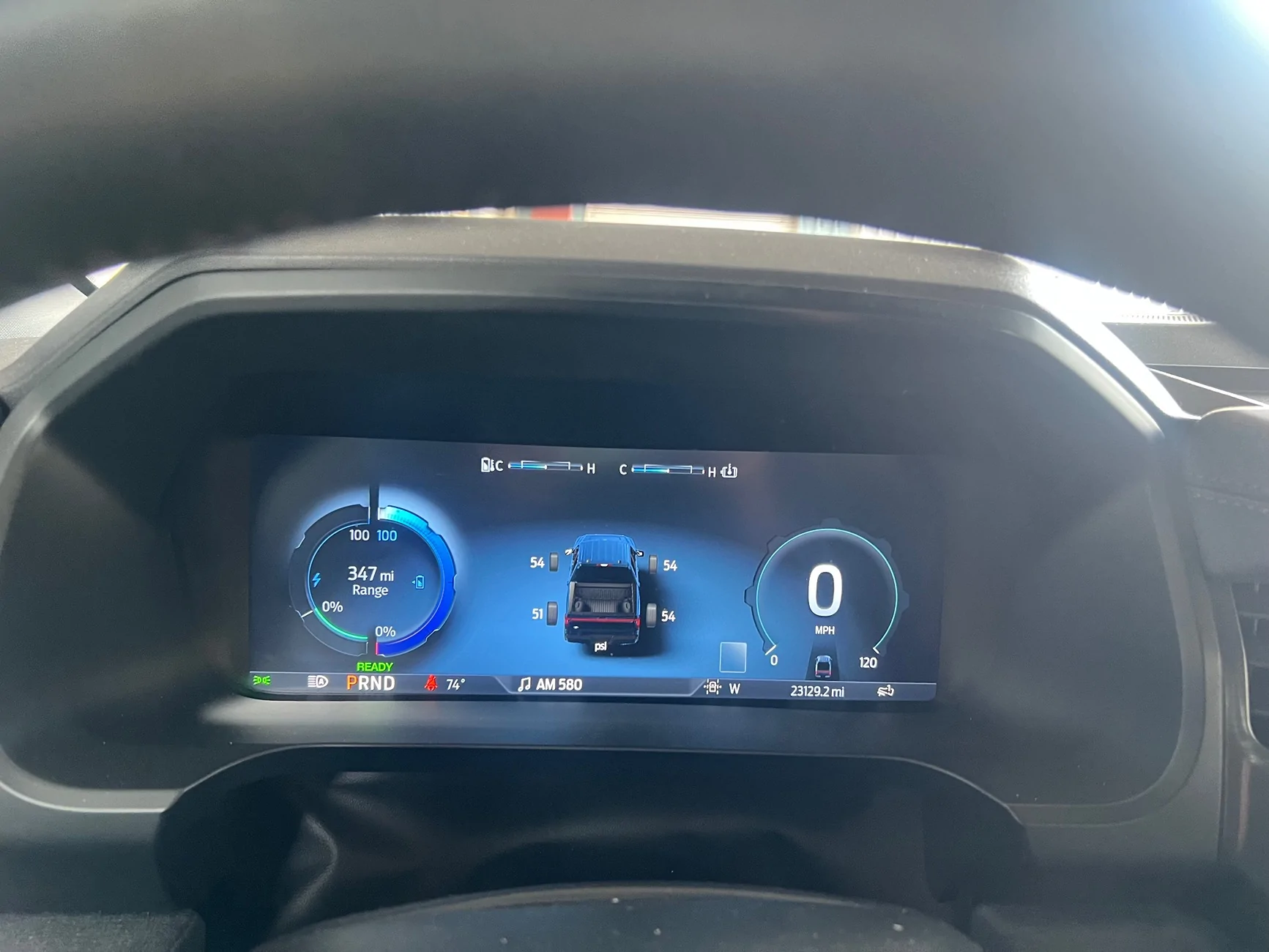
Here’s a screenshot of mine from Sunday morning when I charged it to 100% for the first time in a while just for the hell of it.

Ford F-150 Lightning Range not close to as advertised IMG_8197


Driven about 80% local, 20% hwy.
When on the highway I’m 75-85mph, and when local it’s fairly conservative because local police have no crime to deal with around here and are looking for something to do.

The steering wheel and seat heaters are always on, but the HVAC isn’t doing much this time of year in FL, it’s gorgeous outside!

The front always has a few hundred pounds of tools in it so the rake is more drastic than normal and looks kind of stupid to be honest, but perhaps that factors into hwy range.
 
Last edited:

TaxmanHog

Moderator
Moderator
First Name
Noel
Joined
Jan 19, 2022
Threads
216
Messages
15,834
Reaction score
17,764
Location
SE. Mass.
Vehicles
2022 Lightning Lariat-ER & 2024 HD Road Glide CVO-ST
Occupation
Retired
The steering wheel and seat heaters are always on, but the HVAC isn’t doing much this time of year in FL, it’s gorgeous outside!
Yup, figured you were in the WARM BELT, I'll post my 100% snap shot Sunday evening I expect a less optimistic GOM value for a New England Winter day.
 
Last edited:

Sponsored

DNap4

Member
First Name
Dave
Joined
Dec 14, 2025
Threads
4
Messages
14
Reaction score
9
Location
Virginia
Vehicles
22’ F-150 Lightning XLT SR
I was a little concerned when I got my Lightning a 3 weeks ago, but this forum helped to manage my expectations.

My last trip was 220miles roundtrip with outdoor temps around 55 degrees F.
- The first 110 mile segment I averaged 2.1 mi/kWh driving around 65mph.
- The second 110 mile segment I averaged 2.5 mi/kWh driving around 70mph. I drafted an 18-wheeler for about 50 miles and got about 2.7-2.8 mi/kWh during that span.

I have a short 6mi commute daily for work. I average between 2.4-3.1 mi/kWh each day with lower numbers when it’s < 40 degrees outside and higher when it’s over 40 degrees and I set departure times.

I’m very happy with my Lightning. I think most users just need to know expectations and how to maximize efficiency.
 

rdr854

Well-known member
Joined
Oct 19, 2021
Threads
13
Messages
1,319
Reaction score
907
Location
Northern Virginia
Vehicles
22 Ford F150 Lightning Lariat ER 23 Outback, 25 Volvo EX90 Twin Motor Plus
How are you getting 2.5kwhs I’ve never seen that and I have 30,000 miles on my truck it’s more like 2.1 for me in summer
I’m at 2.7 miles per kilowatt hour after 24,100 miles. I don’t drive it like I stole it and I use the heated seats and steering wheel in the winter. In the Summer, the AC is set to 80 degrees
 

RickLightning

Well-known member
Joined
Jan 17, 2022
Threads
106
Messages
6,642
Reaction score
9,068
Location
SE MI
Vehicles
'22 Lightning ER Lariat,'22 Mach-E Premium 4X
I’m at 2.7 miles per kilowatt hour after 24,100 miles. I don’t drive it like I stole it and I use the heated seats and steering wheel in the winter. In the Summer, the AC is set to 80 degrees
And don't drive on highway at speed limit...
 

B177y

Well-known member
First Name
Bill
Joined
Jul 16, 2024
Threads
12
Messages
622
Reaction score
795
Location
Olympic Peninsula, WA
Vehicles
2024 Pro SSV ER Max Tow
Here’s a screenshot of mine from Sunday morning when I charged it to 100% for the first time in a while just for the hell of it.

IMG_8197.webp


Driven about 80% local, 20% hwy.
When on the highway I’m 75-85mph, and when local it’s fairly conservative because local police have no crime to deal with around here and are looking for something to do.

The steering wheel and seat heaters are always on, but the HVAC isn’t doing much this time of year in FL, it’s gorgeous outside!

The front always has a few hundred pounds of tools in it so the rake is more drastic than normal and looks kind of stupid to be honest, but perhaps that factors into hwy range.
54 psi in your tires! 😳


Top